
Opening your dashboard
Class 12 Physics Chapter 24 Matter Waves: Competency-Based Questions (CBQ)
41 questions on Chapter 24, each worked through on its own page with the AI tutor. Class 12 Physics, ICSE 2026-27.
41 questions
1–4 marks · Mixed difficulty
- 13 marks
Question 1
Competency: Application
In 1961 Claus Jönsson carried out the first double-slit experiment with electrons. In a similar set-up, electrons accelerated from rest through pass through two slits, and , cut in a thin metal foil with their centres apart, and land on a fluorescent screen beyond the slits, as shown. Ignore the small effect of relativity. (Hypothetical data.) Take , and ; for an electron accelerated from rest through volts you may use .
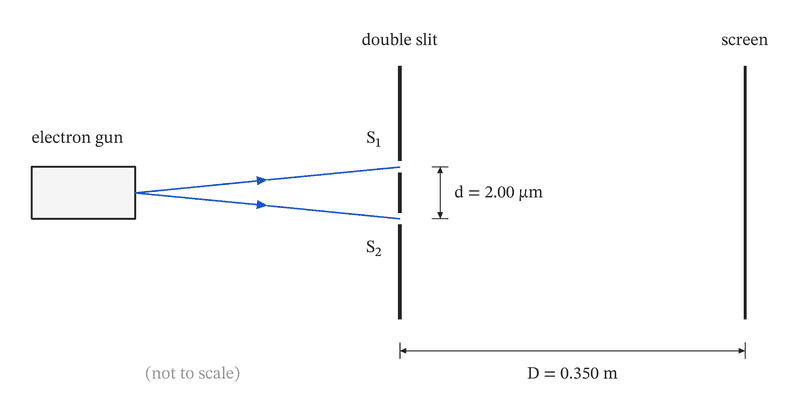
(a) Find the de Broglie wavelength of the electrons.
(b) The fringe width is , just as for light. Find the fringe width on the screen.
(c) To be seen clearly on a photograph, neighbouring bright fringes must be at least apart. By about what factor must electron lenses magnify the pattern?
- 21 mark
Question 2
Competency: Analysis & Evaluation
At a research reactor, a student notes four observations made with neutrons. Which observation shows the wave nature of neutrons?
- 31 mark
Question 3
Competency: Analysis & Evaluation
Electrons are sent one at a time through two slits, and , and over a long time their single flashes on a screen build up interference fringes. A small which-slit detector is then placed beside the slits, as shown. It records, for every electron, which slit the electron went through, and the experiment is repeated.
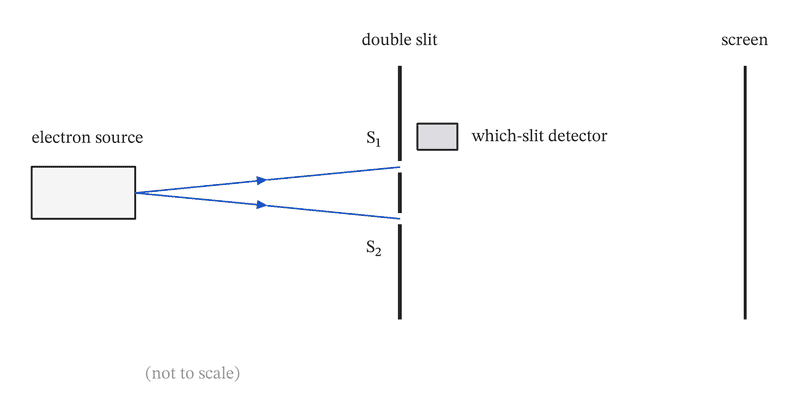
Assertion (A): With the which-slit detector working, the flashes build up a pattern with no interference fringes.
Reason (R): The de Broglie wavelength of an electron depends on its momentum.
- 43 marks
Question 4
Competency: Application
In 1933 Kapitza and Dirac predicted that a standing wave of light could diffract a beam of electrons, and in 2001 a team at the University of Nebraska–Lincoln observed it. In a set-up of this kind, a green laser beam of wavelength is reflected straight back on itself by a mirror. This forms a standing light wave whose bright planes lie half a wavelength of the light apart, and these bright planes act on electrons like the slits of a grating. A beam of electrons, accelerated from rest through , crosses the standing wave at right angles and reaches a detector screen beyond it, as shown. (Hypothetical data.) Take , and ; for an electron accelerated from rest through volts you may use .
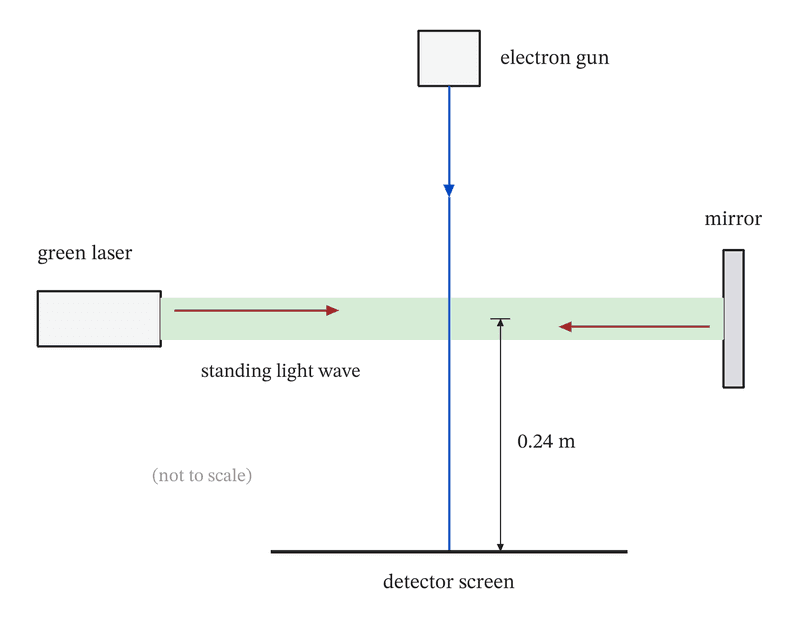
(a) Find the spacing of the bright planes and the de Broglie wavelength of the electrons.
(b) For a grating of spacing , the first-order beam leaves at an angle to the straight-through beam, where . Find , and how far apart the straight-through and first-order beams are on the screen.
(c) In the usual double-slit experiment, light is diffracted by slits in a solid sheet. Explain how this experiment turns the roles of light and matter round.
- 51 mark
Question 5
Competency: Application
In 2010 the Japanese spacecraft IKAROS became the first craft to be driven through interplanetary space by a solar sail. A light, flat sail of area faces the Sun near the Earth, where sunlight brings of energy to each square metre held face-on. Each photon of energy carries momentum , and the sail reflects all the light straight back. Take . (Hypothetical data.)
The force of the sunlight on the sail is about
- 64 marks
Question 6
Competency: Analysis & Evaluation
In 1991 Olivier Carnal and Jürgen Mlynek sent helium atoms through a double slit, one of the first interference experiments with whole atoms. In a set-up of this kind, helium atoms (mass ) pass through two slits whose centres are apart and reach a detector plane beyond them, as shown. A small detector moves across this plane and counts the atoms arriving at each place. Bright fringes lie at distances () from the central bright fringe. (Hypothetical data.) Take .
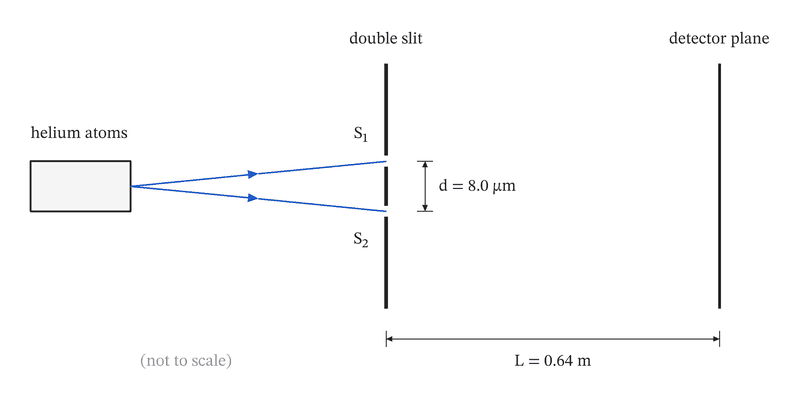
(a) Most of the atoms move at . Find their de Broglie wavelength.
(b) Find the fringe width for these atoms.
(c) In fact the atoms' speeds range from to . Find where the fifth bright fringe () lies for the slowest and for the fastest atoms, and use your results to explain why only the first few fringes on each side of the centre are clearly seen.
- 73 marks
Question 7
Competency: Analysis & Evaluation
In 2019 physicists in Vienna observed matter-wave interference with molecules of mass above , each built from about 2000 atoms. Consider such molecules of mass moving at . An older experiment used molecules (mass ) moving at . (Hypothetical data.) Take , and .
(a) Find the mass of one heavy molecule in kilograms, and its de Broglie wavelength.
(b) For a given grating, the diffraction angles depend only on the wavelength. At what speed would the heavy molecules have to move to have the same de Broglie wavelength as the molecules?
(c) At that speed, how long would a heavy molecule take to cross an interferometer long, and how far would it fall under gravity in that time? Comment on whether slowing the molecules down is a practical way to give them a longer wavelength.
- 81 mark
Question 8
Competency: Analysis & Evaluation
In a molecule-interference experiment, large molecules such as give clear interference fringes when the apparatus is kept at a very low pressure. When a small amount of gas is let into the apparatus, the fringes fade, although the molecules still reach the detector.
Assertion (A): Collisions with the gas molecules spoil the interference of the large molecules' matter waves.
Reason (R): Each large molecule is much larger than its own de Broglie wavelength.
- 91 mark
Question 9
Competency: Application
In an atom-interferometer gravimeter, a cloud of rubidium atoms (mass each) is laser-cooled until the atoms are almost at rest, and is then released to fall freely. Ignore the atoms' tiny starting speed. Take and . (Hypothetical data.)
After the atoms have fallen for , their de Broglie wavelength is about
- 104 marks
Question 10
Competency: Analysis & Evaluation
Ultracold neutrons move so slowly, below about , that they are reflected by the walls of a container at any angle of incidence. They can then be stored in a closed "bottle" for many minutes, and such stored neutrons are used to measure how long a free neutron lives. A wall of a certain material acts on a slow neutron like a smooth step of potential energy high (): the neutron is turned back if the part of its kinetic energy linked to its motion towards the wall is less than this. (Hypothetical data.) Take , and .
(a) Find the de Broglie wavelength of an ultracold neutron moving at , and compare it with the spacing of atoms in the wall, about .
(b) Find the kinetic energy of this neutron in neV.
(c) Find the greatest speed a neutron can have and still be turned back by this wall when it moves straight at it. Explain why, for such slow neutrons, the wall behaves like one smooth surface rather than a set of separate atoms.
- 111 mark
Question 11
Competency: Analysis & Evaluation
In a school fine-beam tube, electrons accelerated through move in a circle in a uniform magnetic field, leaving a glowing track in the low-pressure gas, as shown. Ignore the very small energy the electrons lose to the gas.
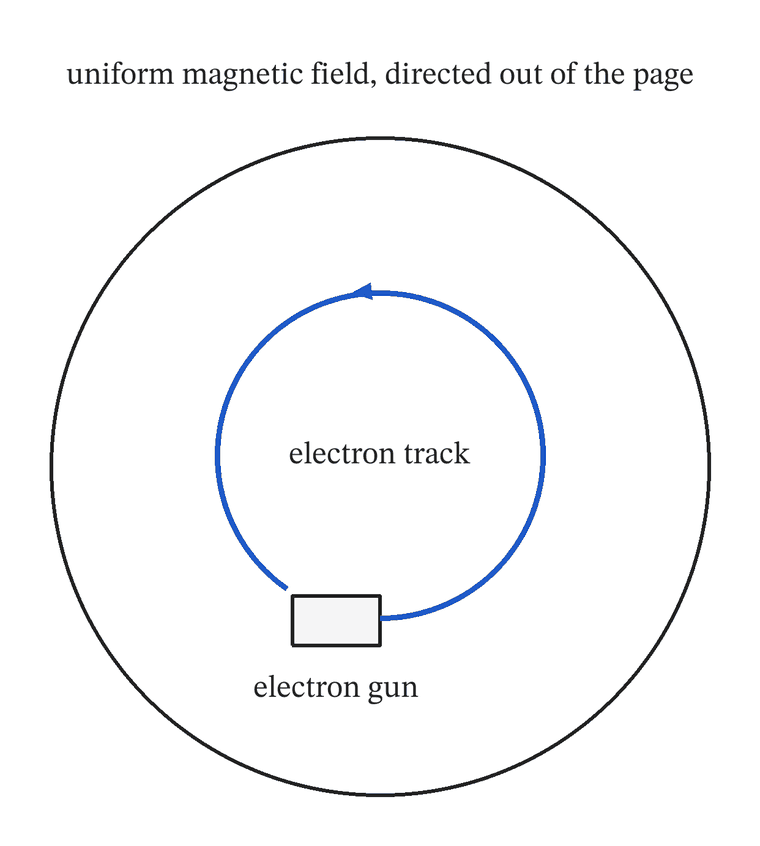
As an electron moves round the circle, its de Broglie wavelength
- 123 marks
Question 12
Competency: Application
A transmission electron microscope accelerates electrons through . At this voltage the electrons move at about , and when relativity is allowed for, their de Broglie wavelength is (). Because its magnetic lenses have aberrations, the microscope uses only electrons that travel within a narrow cone of half-angle () about the axis, as shown. For any microscope, the smallest separation of two points that can just be seen as separate is , where is the refractive index of the medium between the object and the objective; for electrons in a vacuum , and for so small an angle . (Hypothetical data.)

(a) An optical microscope uses green light of wavelength with an oil-immersion objective for which . Find its smallest resolvable separation.
(b) Find the smallest resolvable separation for the electron microscope, and about how many times finer it is than for the optical microscope.
(c) In silicon viewed along a certain direction, the atoms form pairs of columns ("dumbbells") only apart. Can this electron microscope show the two columns of a pair as separate? Could it if aberration-corrected lenses let it use ?
- 131 mark
Question 13
Competency: Analysis & Evaluation
An electron microscope forms an enlarged image of a thin specimen using a beam of fast electrons travelling in a vacuum.
Assertion (A): The electron beam is focused by glass lenses, in the same way as light in an optical microscope.
Reason (R): Electrons are charged, so a magnetic field can bend their paths.
- 141 mark
Question 14
Competency: Analysis & Evaluation
A scanning electron microscope accelerates its electrons from rest through . For an electron accelerated from rest through volts, ; at , relativity changes this by less than .
Assertion (A): The de Broglie wavelength of these electrons, about , is much smaller than the size of an atom (most atoms are about to across).
Reason (R): An electron's de Broglie wavelength becomes longer as the electron is accelerated to a higher speed.
- 153 marks
Question 15
Competency: Application
While very thin crystal layers are grown one atomic layer at a time, the surface is watched by reflection high-energy electron diffraction (RHEED). A beam of electrons, accelerated from rest through , meets the crystal surface at a grazing angle of only , and the diffracted electrons make a pattern on a fluorescent screen, as shown. Ignore relativity. (Hypothetical data.) Take , and ; for an electron accelerated from rest through volts you may use .
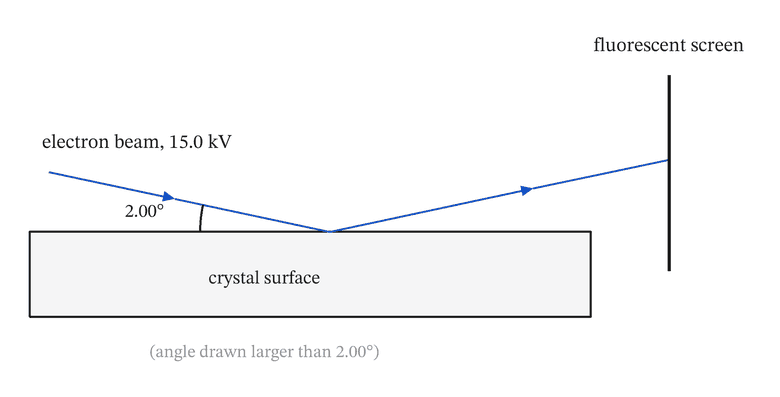
(a) Find the de Broglie wavelength and the momentum of the electrons.
(b) Find the component of the momentum perpendicular to the surface. The motion perpendicular to the surface behaves like a wave of wavelength . Find this wavelength and compare it with the spacing of the atomic layers, about .
(c) Find, in eV, the part of the kinetic energy linked to the motion perpendicular to the surface, . Use it to explain why RHEED, like low-energy electron diffraction (which uses electrons of about to ), gives information mainly about the top layers of atoms.
- 164 marks
Question 16
Competency: Analysis & Evaluation
When Davisson and Germer analysed their 1927 results, some of their diffraction peaks did not appear at exactly the accelerating voltages that the simple theory predicted. In 1928 Hans Bethe explained why: inside a metal an electron is attracted by the positive ions, so as it enters the metal it gains extra kinetic energy , where , the inner potential, is about to for most metals. Electrons accelerated from rest through meet the surface of a metal with at to the normal, as shown. On crossing the surface, the component of an electron's momentum parallel to the surface does not change. (Hypothetical data.) Take , and ; for an electron accelerated from rest through volts you may use . Inside the metal, use in place of .
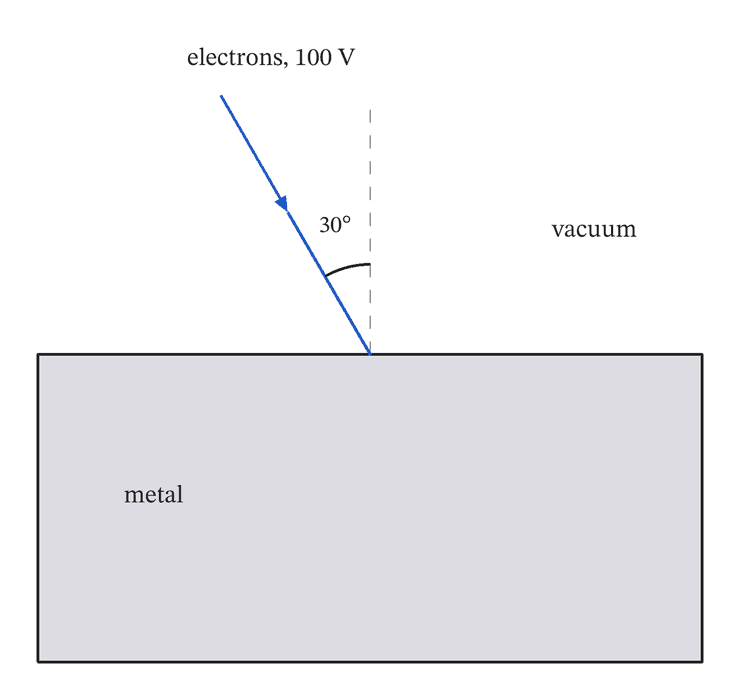
(a) Find the de Broglie wavelength of the electrons in the vacuum and inside the metal.
(b) Find the angle that the electrons' direction inside the metal makes with the normal. Does the electron wave bend towards or away from the normal?
(c) A certain strong diffracted beam needs the electrons' wavelength inside the metal to be . At what accelerating voltage does the simple theory, which ignores , predict this beam, and at what voltage does it really appear?
- 173 marks
Question 17
Competency: Application
Neutrons coming out of a research reactor have a wide range of speeds. To pick out neutrons of one wavelength, the beam is reflected from a large crystal of graphite whose reflecting planes are apart. The crystal is turned so that the beam meets these planes at a glancing angle , as shown, and Bragg's law, (), decides which neutrons are reflected towards the sample. (Hypothetical data.) Take , and .
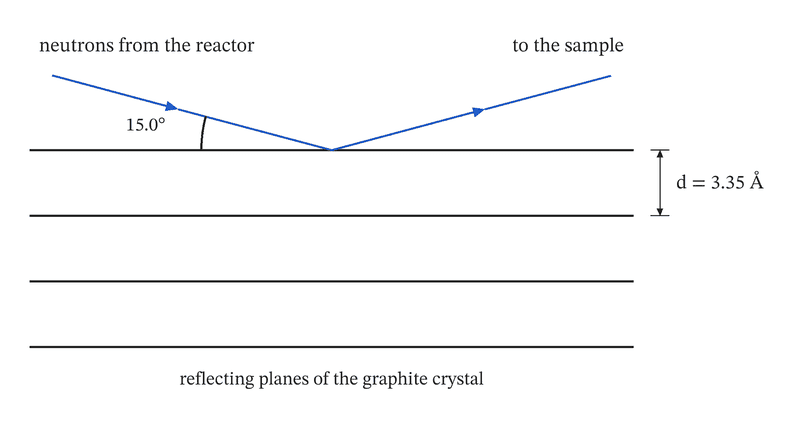
(a) Find the wavelength of the neutrons reflected in the first order.
(b) Find the speed of these neutrons, and their kinetic energy in meV ().
(c) At the same setting, the crystal also reflects some neutrons in the second order. Find their wavelength and kinetic energy, and explain why a filter that removes these faster neutrons is often placed in the reflected beam.
- 181 mark
Question 18
Competency: Analysis & Evaluation
A chemist wants to find exactly where the hydrogen atoms sit in the crystals of a new compound.
Assertion (A): Neutron diffraction can locate the hydrogen atoms far more reliably than X-ray diffraction can.
Reason (R): Neutrons are scattered mainly by the electrons of an atom, and a hydrogen atom has only one electron.
- 191 mark
Question 19
Competency: Analysis & Evaluation
An engineer wants to measure how the spacing of the planes of atoms (about ) has changed deep inside a thick steel weld, without cutting the weld open. Which beam is the best choice?
- 203 marks
Question 20
Competency: Analysis & Evaluation
In low-energy electron diffraction (LEED), a beam of slow electrons falls normally on a clean crystal surface. Electrons diffracted back by the rows of surface atoms travel out to a curved fluorescent screen and make bright spots, as shown. For rows of atoms a distance apart, the -th order beam leaves at an angle to the incident beam given by . With electrons accelerated from rest through , the first-order spots of the clean surface appear at . After a little oxygen is let into the vacuum chamber and sticks to the surface, extra spots appear at . (Hypothetical data.) Take , and ; for an electron accelerated from rest through volts you may use .
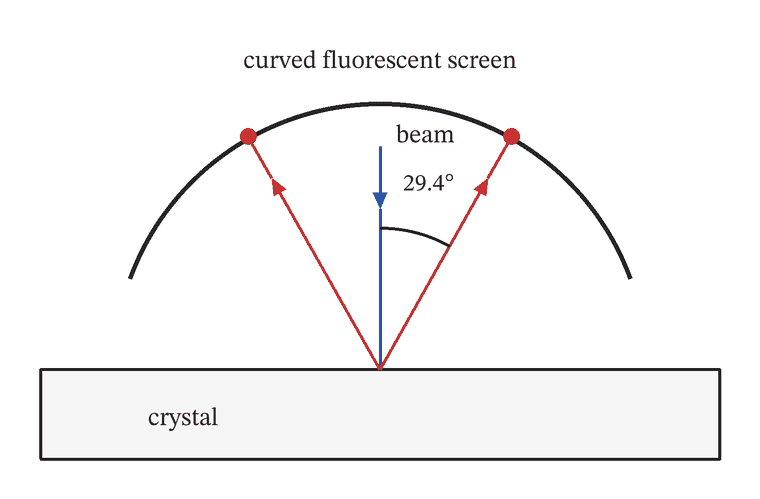
(a) Find the de Broglie wavelength of the electrons.
(b) Find the spacing of the rows of surface atoms on the clean surface.
(c) Treating the extra spots as first-order spots, find the row spacing they correspond to. What does this tell you about how the oxygen atoms have arranged themselves on the surface?
- 211 mark
Question 21
Competency: Analysis & Evaluation
In 1925 the vacuum tube in Davisson and Germer's experiment broke while their nickel target was hot, and air oxidised the nickel. To clean the target, they heated it strongly for a long time.
Assertion (A): After this heating, the pattern of scattered electrons changed: strong beams appeared in a few particular directions.
Reason (R): The heating made the nickel recrystallise into a few large crystals, so the electron beam met a regular array of atoms.
- 221 mark
Question 22
Competency: Analysis & Evaluation
In Davisson and Germer's 1927 experiment, a beam of electrons accelerated through fell normally on the face of a nickel crystal, and the strongest scattered beam left at to the direction straight back along the incident beam, as shown.
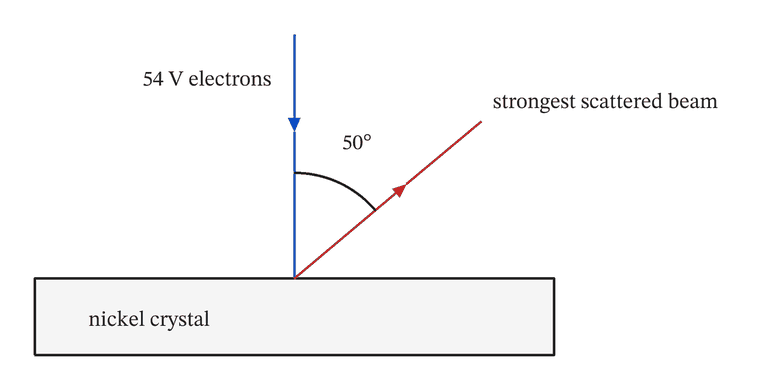
Assertion (A): The strong beam at is made of electrons reflected from the crystal face in the way that light is reflected by a plane mirror.
Reason (R): The electrons fell normally on the face of the crystal.
- 231 mark
Question 23
Competency: Analysis & Evaluation
In 1927, the same year as Davisson and Germer's experiment, G. P. Thomson showed electron diffraction in a different way: he sent a beam of electrons through a very thin metal film and photographed the rings formed beyond it. His electrons were accelerated through thousands of volts, while Davisson and Germer used electrons accelerated through only tens to hundreds of volts, which bounced back from the surface of a crystal. Why did Thomson need such fast electrons?
- 241 mark
Question 24
Competency: Analysis & Evaluation
In a school electron-diffraction tube, electrons pass through a thin film of graphite and make bright rings on the fluorescent screen at the end of the tube.
Assertion (A): When a magnet is held near the tube between the film and the screen, the whole ring pattern moves across the screen.
Reason (R): The rings are formed by charged particles, and a magnetic field exerts a force on moving charges.
- 251 mark
Question 25
Competency: Application
At a spallation neutron source, short pulses of neutrons with a wide range of speeds are produced. Neutrons from one pulse travel from the source to a powder sample and on to a detector that receives neutrons scattered through , as shown; the total flight path, source to sample to detector, is . A Bragg peak is recorded after the pulse. Assume the neutrons' speed does not change at the sample, and use Bragg's law in the first order, . Take and . (Hypothetical data.)
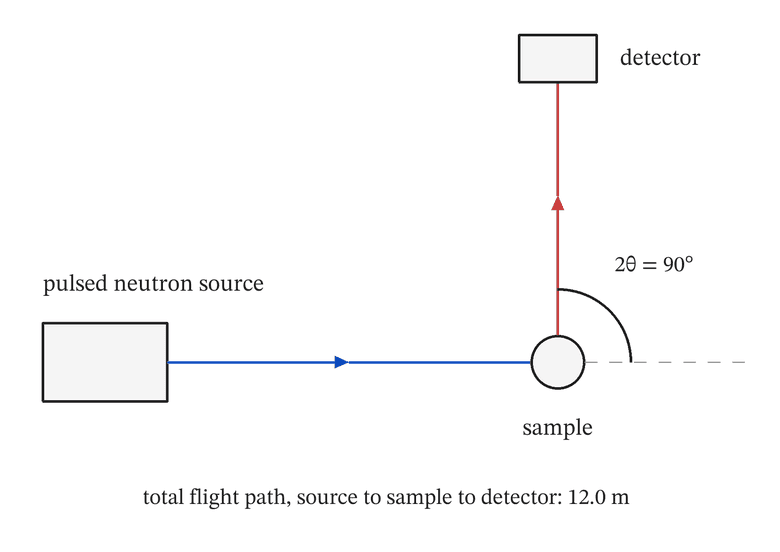
The spacing of the planes of atoms that give this peak is about
- 264 marks
Question 26
A neutron set free in a nuclear reactor has a de Broglie wavelength of . It is slowed down by collisions with carbon-12 nuclei, each about 12 times as heavy as a neutron. In a head-on elastic collision with a carbon nucleus at rest, the neutron bounces straight back with of its speed before the collision. Assume that every collision is head-on. (Hypothetical data.) Take and .
(i) Find the speed of the neutron when it is set free.
(ii) Find its de Broglie wavelength after one collision.
(iii) Find the least number of collisions after which its de Broglie wavelength is at least .
- 274 marks
Question 27
A beam of electrons falls normally on the surface of a crystal whose surface rows of atoms are apart, and a strong diffracted beam is found at from the direction straight back along the incident beam, as shown. Ignore any change in the electrons' speed inside the crystal. (Hypothetical data.)

Take , and ; for an electron accelerated from rest through volts you may use .
(a) Treating the surface rows as a grating, with the first maximum at , find .
(b) The same beam can be described as a Bragg reflection from planes of atoms that pass through the surface atoms. Show that these planes make an angle with the surface and are apart, and find and the glancing angle .
(c) Show that Bragg's law, (first order), gives the same wavelength.
(d) Find the accelerating voltage.
- 283 marks
Question 28
Show that the de Broglie wavelength for a particle of mass moving with the rms speed of a Maxwellian distribution at temperature is where is the Boltzmann's constant.
- 293 marks
Question 29
What is the de Broglie wavelength of 0.04 eV neutron? Given mass of neutron kg.
- 303 marks
Question 30
An electron and photon have the same de Broglie wavelength of m. Which of the two has greater kinetic energy?
- 313 marks
Question 31
What is the potential difference required in electron microscope to give electrons of wavelength 0.5 Å?
- 323 marks
Question 32
Starting with de Broglie formula, derive , only for a particle of zero rest mass.
- 333 marks
Question 33
Compare the de Broglie wavelength of an electron of kinetic energy 1 eV and neutron of kinetic energy 1 eV.
- 343 marks
Question 34
The kinetic energy of an electron in a hydrogen like atom is 3.4 eV. Calculate its de Broglie wavelength.
- 354 marks
Question 35
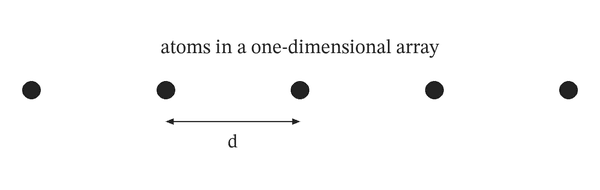
Assume that the de Broglie wave associated with an electron can form a standing wave between the atoms arranged in a one-dimensional array with nodes at each of the atomic sites. It is found that one such standing wave is formed if the distance between the atoms of array is 2 Å. A similar standing wave is again formed if is increased to 2.5 Å but not for any intermediate value of . Find the energy of the electrons in electron-volt and the least value of for which the standing wave of the type described above can form.
- 363 marks
Question 36
An X-ray tube operates at 10 kV. Find the ratio of X-ray wavelength to that of the de Broglie wavelength.
- 373 marks
Question 37
In a diode valve, the anode has a potential of 450 V relative to the cathode. Determine the wavelength associated with the electron as it reaches the anode.
- 383 marks
Question 38
X-rays of wavelength 1 Å fall on a metal plate, calculate the wavelength associated with the photoelectrons emitted. Neglect the work function of the metal.
- 393 marks
Question 39
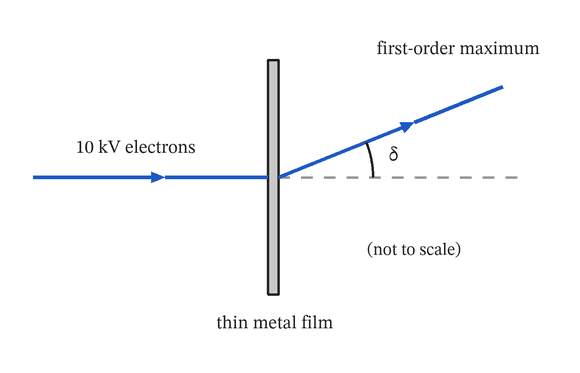
10 kV electrons are passed through a thin film of a metal for which the atomic spacing is m. What is the angle of deviation of the first order diffraction maximum?
- 403 marks
Question 40
The de Broglie wavelength of a moving electron is 0.8 Å. What voltage applied between two grids will bring it to rest?
- 413 marks
Question 41
A neutron is an uncharged particle of mass kg. Calculate the de Broglie wavelength of the neutron moving with a velocity such that kinetic energy is 0.04 eV.