
Competency: Analysis & Evaluation
In low-energy electron diffraction (LEED), a beam of slow electrons falls normally on a clean crystal surface. Electrons diffracted back by the rows of surface atoms travel out to a curved fluorescent screen and make bright spots, as shown. For rows of atoms a distance apart, the -th order beam leaves at an angle to the incident beam given by . With electrons accelerated from rest through , the first-order spots of the clean surface appear at . After a little oxygen is let into the vacuum chamber and sticks to the surface, extra spots appear at . (Hypothetical data.) Take , and ; for an electron accelerated from rest through volts you may use .
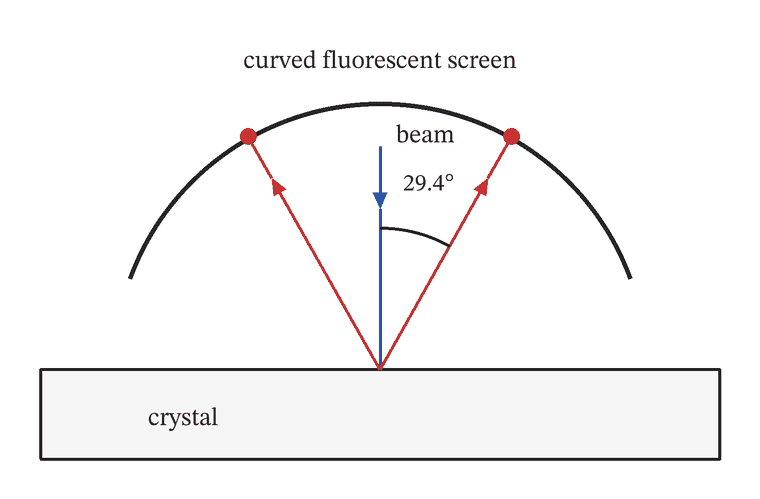
(a) Find the de Broglie wavelength of the electrons.
(b) Find the spacing of the rows of surface atoms on the clean surface.
(c) Treating the extra spots as first-order spots, find the row spacing they correspond to. What does this tell you about how the oxygen atoms have arranged themselves on the surface?