
Question 13 marksMedium
Competency: Application
In 1961 Claus Jönsson carried out the first double-slit experiment with electrons. In a similar set-up, electrons accelerated from rest through pass through two slits, and , cut in a thin metal foil with their centres apart, and land on a fluorescent screen beyond the slits, as shown. Ignore the small effect of relativity. (Hypothetical data.) Take , and ; for an electron accelerated from rest through volts you may use .
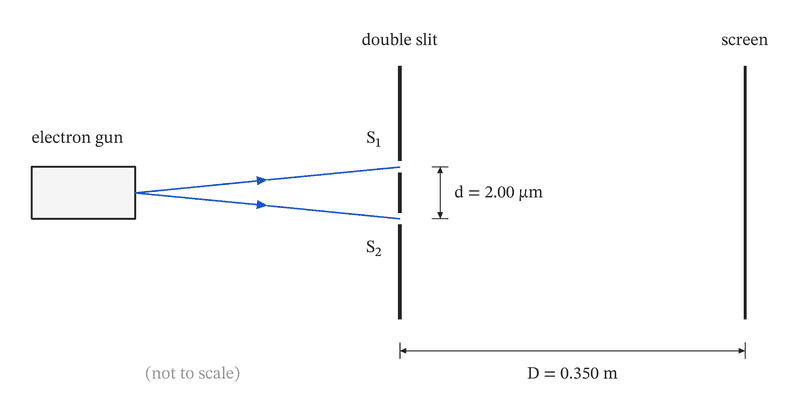
(a) Find the de Broglie wavelength of the electrons.
(b) The fringe width is , just as for light. Find the fringe width on the screen.
(c) To be seen clearly on a photograph, neighbouring bright fringes must be at least apart. By about what factor must electron lenses magnify the pattern?