
Competency: Application
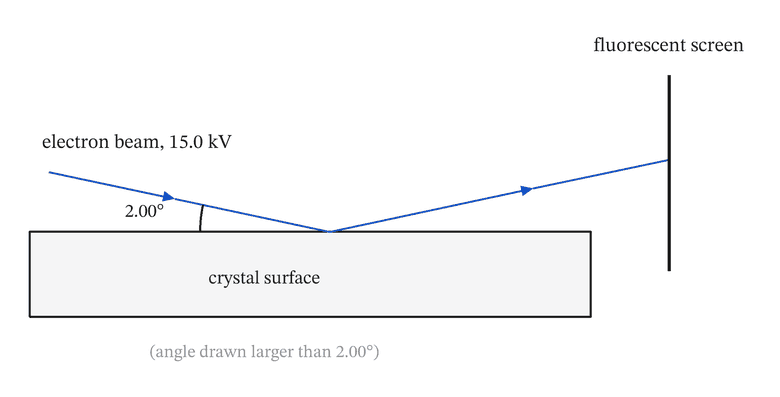
While very thin crystal layers are grown one atomic layer at a time, the surface is watched by reflection high-energy electron diffraction (RHEED). A beam of electrons, accelerated from rest through , meets the crystal surface at a grazing angle of only , and the diffracted electrons make a pattern on a fluorescent screen, as shown. Ignore relativity. (Hypothetical data.) Take , and ; for an electron accelerated from rest through volts you may use .
(a) Find the de Broglie wavelength and the momentum of the electrons.
(b) Find the component of the momentum perpendicular to the surface. The motion perpendicular to the surface behaves like a wave of wavelength . Find this wavelength and compare it with the spacing of the atomic layers, about .
(c) Find, in eV, the part of the kinetic energy linked to the motion perpendicular to the surface, . Use it to explain why RHEED, like low-energy electron diffraction (which uses electrons of about to ), gives information mainly about the top layers of atoms.