
Competency: Analysis & Evaluation
When Davisson and Germer analysed their 1927 results, some of their diffraction peaks did not appear at exactly the accelerating voltages that the simple theory predicted. In 1928 Hans Bethe explained why: inside a metal an electron is attracted by the positive ions, so as it enters the metal it gains extra kinetic energy , where , the inner potential, is about to for most metals. Electrons accelerated from rest through meet the surface of a metal with at to the normal, as shown. On crossing the surface, the component of an electron's momentum parallel to the surface does not change. (Hypothetical data.) Take , and ; for an electron accelerated from rest through volts you may use . Inside the metal, use in place of .
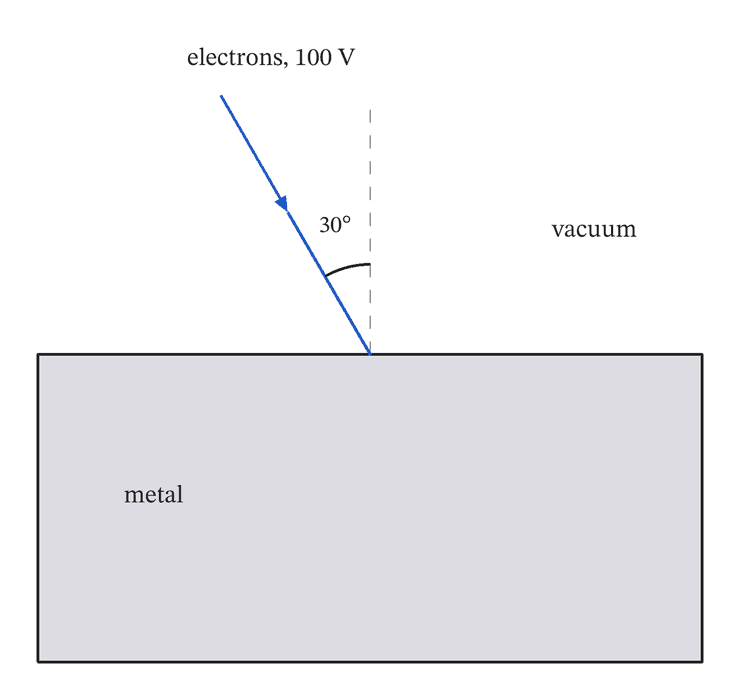
(a) Find the de Broglie wavelength of the electrons in the vacuum and inside the metal.
(b) Find the angle that the electrons' direction inside the metal makes with the normal. Does the electron wave bend towards or away from the normal?
(c) A certain strong diffracted beam needs the electrons' wavelength inside the metal to be . At what accelerating voltage does the simple theory, which ignores , predict this beam, and at what voltage does it really appear?