
Competency: Application
Neutrons coming out of a research reactor have a wide range of speeds. To pick out neutrons of one wavelength, the beam is reflected from a large crystal of graphite whose reflecting planes are apart. The crystal is turned so that the beam meets these planes at a glancing angle , as shown, and Bragg's law, (), decides which neutrons are reflected towards the sample. (Hypothetical data.) Take , and .
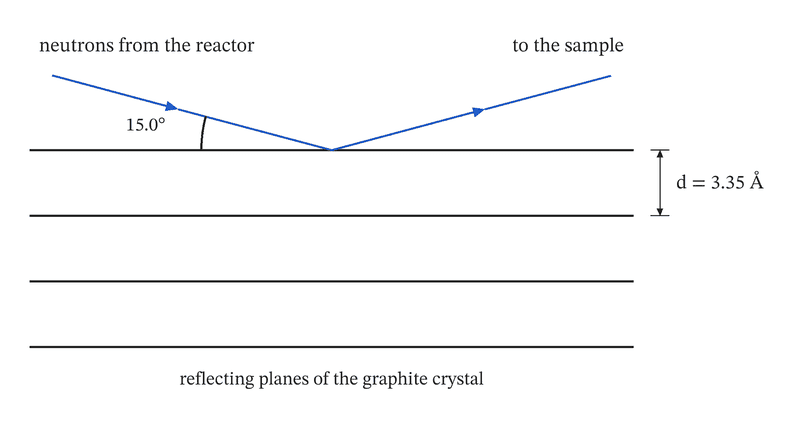
(a) Find the wavelength of the neutrons reflected in the first order.
(b) Find the speed of these neutrons, and their kinetic energy in meV ().
(c) At the same setting, the crystal also reflects some neutrons in the second order. Find their wavelength and kinetic energy, and explain why a filter that removes these faster neutrons is often placed in the reflected beam.