
Question 31 markMCQMedium
Competency: Analysis & Evaluation
Electrons are sent one at a time through two slits, and , and over a long time their single flashes on a screen build up interference fringes. A small which-slit detector is then placed beside the slits, as shown. It records, for every electron, which slit the electron went through, and the experiment is repeated.
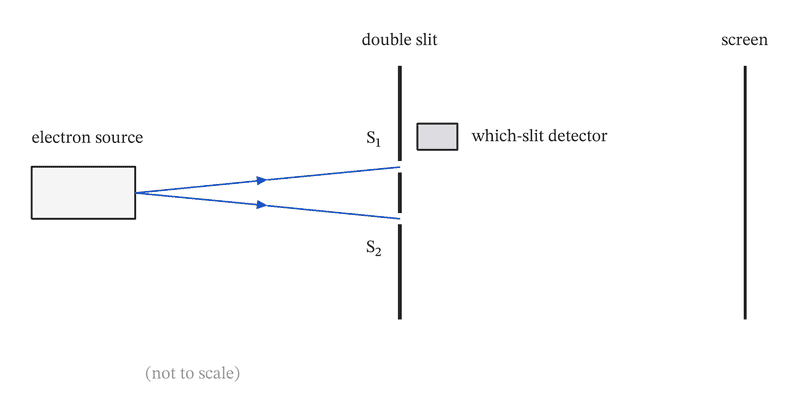
Assertion (A): With the which-slit detector working, the flashes build up a pattern with no interference fringes.
Reason (R): The de Broglie wavelength of an electron depends on its momentum.