
Competency: Application
In 1933 Kapitza and Dirac predicted that a standing wave of light could diffract a beam of electrons, and in 2001 a team at the University of Nebraska–Lincoln observed it. In a set-up of this kind, a green laser beam of wavelength is reflected straight back on itself by a mirror. This forms a standing light wave whose bright planes lie half a wavelength of the light apart, and these bright planes act on electrons like the slits of a grating. A beam of electrons, accelerated from rest through , crosses the standing wave at right angles and reaches a detector screen beyond it, as shown. (Hypothetical data.) Take , and ; for an electron accelerated from rest through volts you may use .
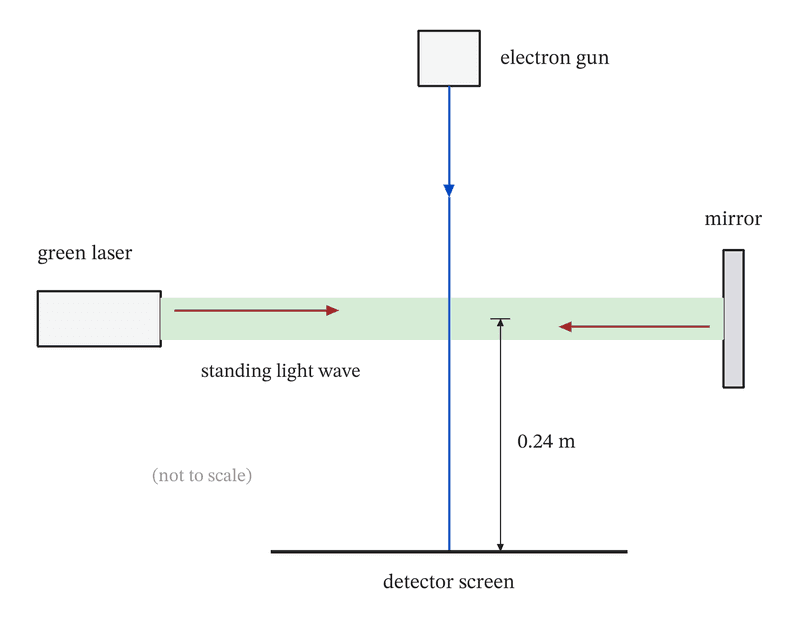
(a) Find the spacing of the bright planes and the de Broglie wavelength of the electrons.
(b) For a grating of spacing , the first-order beam leaves at an angle to the straight-through beam, where . Find , and how far apart the straight-through and first-order beams are on the screen.
(c) In the usual double-slit experiment, light is diffracted by slits in a solid sheet. Explain how this experiment turns the roles of light and matter round.