
Competency: Analysis & Evaluation
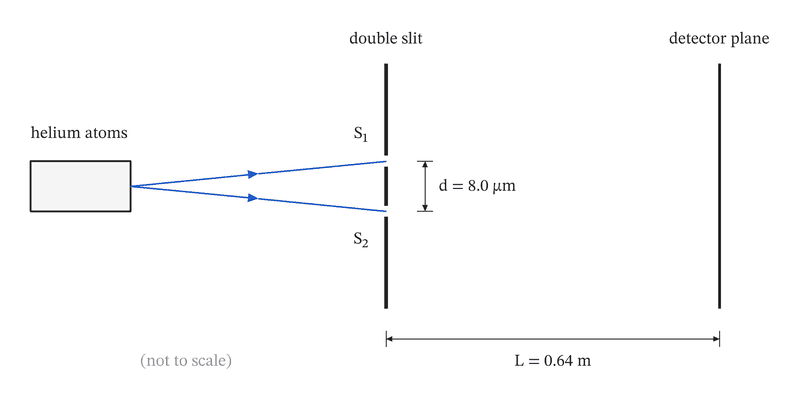
In 1991 Olivier Carnal and Jürgen Mlynek sent helium atoms through a double slit, one of the first interference experiments with whole atoms. In a set-up of this kind, helium atoms (mass ) pass through two slits whose centres are apart and reach a detector plane beyond them, as shown. A small detector moves across this plane and counts the atoms arriving at each place. Bright fringes lie at distances () from the central bright fringe. (Hypothetical data.) Take .
(a) Most of the atoms move at . Find their de Broglie wavelength.
(b) Find the fringe width for these atoms.
(c) In fact the atoms' speeds range from to . Find where the fifth bright fringe () lies for the slowest and for the fastest atoms, and use your results to explain why only the first few fringes on each side of the centre are clearly seen.