
Opening your dashboard
Class 9 Maths Chapter 26: Co-ordinate Geometry Solutions
128 textbook questions with step-by-step answers, free to read, for ICSE 2026-27.
Get talked through Ch 26, not just shown the answer
Reading a finished solution is not the same as being able to do it. The AI tutor takes one question at a time and works it with you, in your own words, until you can.
- Ask it out loud, in your own words
- It gives you the next step, not the answer
- Stuck on part (ii)? Start there
128 questions with solutions
1–3 marks · Mixed difficulty
The first 21 solutions are on this page. This chapter is a long one, so the rest open on their own page to keep this one quick to load.
- 11 mark
Question 1
In equation ; ordinate is :
Solve with AIAnswer
- Correct
(A) 0
(B) 2
(C) −5
(D) 1
Answer: (A) 0
Concept: A point is named by an ordered pair . The first number, , is its abscissa (-co-ordinate) and the second, , is its ordinate (-co-ordinate).
Step 1 — Solve the equation.
The equation contains only , so solving it fixes the abscissa.
Step 2 — Read the ordinate.
The equation has no -term at all (the coefficient of is 0), so it gives no value to the ordinate. Taken as one point, the equation is read as the point on the -axis with this abscissa, , whose ordinate is 0.
Note: Strictly, the equation describes a whole vertical line, , whose points can have any ordinate. The printed key, 0, reads the equation as the single point where this line meets the -axis; we keep that key.
Watch out: The ordinate is a co-ordinate (a value of ), not a number copied from the equation such as a coefficient or the constant.
Why the other options are wrong:
- (B) 2: 2 is the coefficient of , not a co-ordinate.
- (C) −5: is the constant term of the equation, not a co-ordinate.
- (D) 1: Nothing in the equation gives 1 as a value of .
Therefore, the ordinate is 0, option (A).
- 21 mark
Question 2
In equation , the independent variable is :
Solve with AIAnswer
(A)
- Correct
(B)
(C)
(D)
Answer: (B)
Concept: When an equation is written with one variable alone on one side (the subject), the variable on the other side can be given any value we choose: it is the independent variable. The subject is then worked out from it, so it is the dependent variable.
Step 1 — Find the subject.
In , stands alone on the left, so is the subject.
Step 2 — See which value is chosen first.
We may choose any value for ; then is worked out. For example, choosing gives:
So is chosen freely (independent) and depends on it (dependent).
Watch out: The subject of the equation is the DEPENDENT variable, not the independent one.
Why the other options are wrong:
- (A): is the dependent variable: its value depends on the value chosen for .
- (C): is an expression (a term of the equation), not a variable.
- (D): is the whole right-hand side, an expression, not a variable.
Therefore, the independent variable is , option (B).
- 31 mark
Question 3
If , the values of and are :
Solve with AIAnswer
(A)
(B)
- Correct
(C)
(D)
Answer: (C)
Concept: Two ordered pairs are equal only when their first components are equal and their second components are equal: and are equal exactly when equals and equals .
Step 1 — Equate the first components.
Equal ordered pairs have equal first components, so we solve for .
Step 2 — Equate the second components.
Their second components are equal too, so we solve for .
Watch out: Solve for ; do not just add or double the numbers.
Why the other options are wrong:
- (A): If is 4, the first component becomes 7, not 3.
- (B): If is 8, the first component becomes 15, not 3.
- (D): If is 1, the first component becomes 1, not 3.
Therefore, is 2 and is 5, option (C).
- 41 mark
Question 4
(5, −7) belongs to :
Solve with AIAnswer
(A) 1st quadrant
(B) 2nd quadrant
(C) 3rd quadrant
- Correct
(D) 4th quadrant
Answer: (D) 4th quadrant
Concept: The axes divide the plane into four quadrants. Signs of : first quadrant , second , third , fourth . A point on an axis is not in any quadrant.
Step 1 — Look at the signs.
In the abscissa 5 is positive and the ordinate is negative.
Step 2 — Match the quadrant.
The sign pattern belongs to the fourth quadrant: to the right of the -axis and below the -axis.
Watch out: The quadrants are numbered anticlockwise, starting from the top right.
Why the other options are wrong:
- (A) 1st quadrant: The first quadrant needs a positive ordinate, but is negative.
- (B) 2nd quadrant: The second quadrant needs a negative abscissa and a positive ordinate; here both signs are the other way.
- (C) 3rd quadrant: The third quadrant needs a negative abscissa, but 5 is positive.
Therefore, lies in the 4th quadrant, option (D).
- 51 mark
Question 5
Abscissa of a point is the solution of equation and its ordinate is the solution of equation . The point is :
Solve with AIAnswer
- Correct
(A) (3, 2)
(B) (−3, 2)
(C) (3, −2)
(D) (−3, −4)
Answer: (A) (3, 2)
Concept: A point is named by an ordered pair . The first number, , is its abscissa (-co-ordinate) and the second, , is its ordinate (-co-ordinate).
Step 1 — Find the abscissa.
The abscissa is the solution of the first equation.
Step 2 — Find the ordinate.
The ordinate is the solution of the second equation.
Step 3 — Write the point.
The abscissa comes first, so the point is .
Watch out: In , take the 8 across first; then is 6, so is positive.
Why the other options are wrong:
- (B) (−3, 2): An abscissa of makes equal to , not 7.
- (C) (3, −2): An ordinate of makes equal to 14, not 2.
- (D) (−3, −4): Both co-ordinates fail: an abscissa of makes equal to , and an ordinate of makes equal to 20.
Therefore, the point is , option (A).
- 63 marks
Question 6
For each equation given below; name the dependent and independent variables.
Solve with AIWritten solution
Solution:
Concept: When an equation is written with one variable alone on one side (the subject), the variable on the other side can be given any value we choose: it is the independent variable. The subject is then worked out from it, so it is the dependent variable.
Step 1 — Find the subject.
In , the variable stands alone on one side, so is the subject.
Step 2 — Choose a value and work out the other.
We may give any value; then is worked out from it. For example, taking gives:
Watch out: The variable that stands alone is the DEPENDENT one, because its value is calculated from the other.
Therefore, the independent variable is and the dependent variable is .
- 73 marks
Question 7
For each equation given below; name the dependent and independent variables.
Solve with AIWritten solution
Solution:
Concept: When an equation is written with one variable alone on one side (the subject), the variable on the other side can be given any value we choose: it is the independent variable. The subject is then worked out from it, so it is the dependent variable.
Step 1 — Find the subject.
In , the variable stands alone on one side, so is the subject.
Step 2 — Choose a value and work out the other.
We may give any value; then is worked out from it. For example, taking gives:
Watch out: The variable that stands alone is the DEPENDENT one, because its value is calculated from the other.
Therefore, the independent variable is and the dependent variable is .
- 83 marks
Question 8
For each equation given below; name the dependent and independent variables.
Solve with AIWritten solution
Solution:
Concept: When an equation is written with one variable alone on one side (the subject), the variable on the other side can be given any value we choose: it is the independent variable. The subject is then worked out from it, so it is the dependent variable.
Step 1 — Find the subject.
In , the variable stands alone on one side, so is the subject.
Step 2 — Choose a value and work out the other.
We may give any value; then is worked out from it. For example, taking gives:
Watch out: The variable that stands alone is the DEPENDENT one, because its value is calculated from the other.
Therefore, the independent variable is and the dependent variable is .
- 93 marks
Question 9
For each equation given below; name the dependent and independent variables.
Solve with AIWritten solution
Solution:
Concept: When an equation is written with one variable alone on one side (the subject), the variable on the other side can be given any value we choose: it is the independent variable. The subject is then worked out from it, so it is the dependent variable.
Step 1 — Find the subject.
In , the variable stands alone on one side, so is the subject.
Step 2 — Choose a value and work out the other.
We may give any value; then is worked out from it. For example, taking gives:
Watch out: The variable that stands alone is the DEPENDENT one, because its value is calculated from the other.
Therefore, the independent variable is and the dependent variable is .
- 103 marks
Question 10
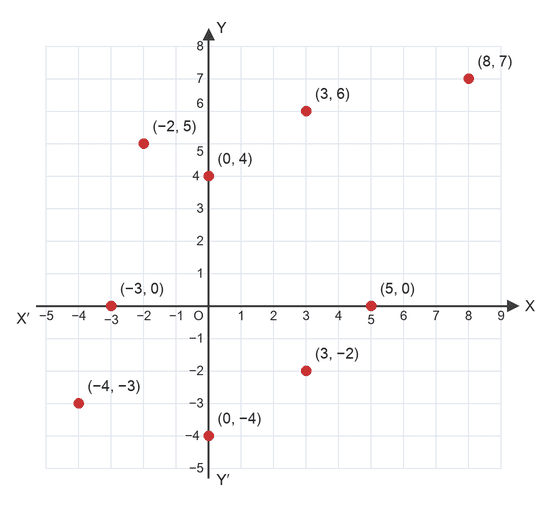
Plot the following points on the same graph paper :
(i) (8, 7) (ii) (3, 6) (iii) (0, 4) (iv) (0, − 4) (v) (3, − 2)
(vi) (− 2, 5) (vii) (− 3, 0) (viii) (5, 0) (ix) (− 4, − 3)
Solve with AIWritten solution
Solution:
Concept: To plot , start at the origin O, move units along the -axis (right if is positive, left if negative), then units parallel to the -axis (up if is positive, down if negative).
Step 1 — Draw the axes.
We draw the -axis and the -axis on graph paper, crossing at the origin O, and mark one small square as one unit on each axis, from to 9 across and from to 8 up.
Step 2 — Decide where each point goes.
The signs of the co-ordinates tell us where each point lies before we plot it.
- and : both co-ordinates positive, so they are in the first quadrant.
- : negative abscissa, positive ordinate, so it is in the second quadrant.
- : both negative, so it is in the third quadrant.
- : positive abscissa, negative ordinate, so it is in the fourth quadrant.
- and : abscissa 0, so they lie on the -axis.
- and : ordinate 0, so they lie on the -axis.
Step 3 — Plot the points.
For each point we move along the -axis by the abscissa, then up or down by the ordinate, and mark a dot. For example, for we go 4 units left of O and then 3 units down.
Watch out: In the first number is always the -co-ordinate. Move units along the -axis first, then units parallel to the -axis; swapping them plots a different point.
Therefore, the nine points are plotted as shown in the graph above.
- 113 marks
Question 11
Find the values of and if :
Solve with AIWritten solution
Solution:
Concept: Two ordered pairs are equal only when their first components are equal and their second components are equal: and are equal exactly when equals and equals .
Given: .
Step 1 — Equate the first components.
Equal ordered pairs have equal first components.
Step 2 — Equate the second components.
Their second components are equal too.
Watch out: Match first with first and second with second; never equate with the second 4.
Therefore, is 5 and is 1.
- 123 marks
Question 12
Find the values of and if :
Solve with AIWritten solution
Solution:
Concept: Two ordered pairs are equal only when their first components are equal and their second components are equal: and are equal exactly when equals and equals .
Given: .
Step 1 — Equate the first components.
Equal ordered pairs have equal first components.
Step 2 — Equate the second components.
Their second components are equal too.
Watch out: is , not ; adding 7 to moves towards zero.
Therefore, is (that is, ) and is .
- 133 marks
Question 13
Find the values of and if :
Solve with AIWritten solution
Solution:
Concept: Two ordered pairs are equal only when their first components are equal and their second components are equal: and are equal exactly when equals and equals .
Given: .
Step 1 — Write the two equations.
Equating the components gives two simultaneous equations.
and
Step 2 — Make y the subject of the second equation.
We take across, so that can be put into the first equation.
Step 3 — Substitute in the first equation.
We replace by in and solve for .
Step 4 — Find y.
Putting in the equation of Step 2 gives:
Step 5 — Check.
With and both 2, is (4) and is (), as required.
Watch out: is : the minus sign multiplies both terms in the bracket.
Therefore, is 2 and is 2.
- 143 marks
Question 14
Use the graph given below, to find the co-ordinates of the point (s) satisfying the given conditions :
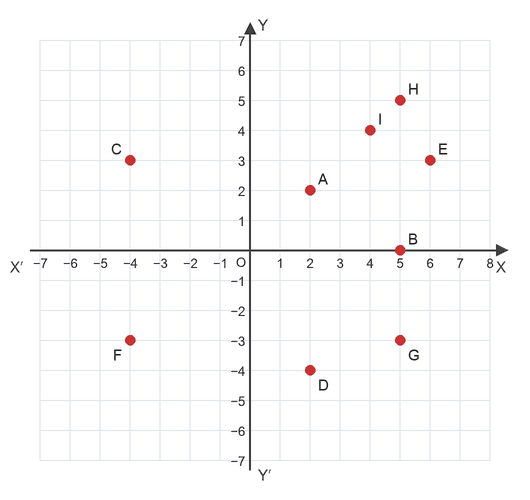
(i) the abscissa is 2.
(ii) the ordinate is 0.
(iii) the ordinate is 3.
(iv) the ordinate is − 4.
(v) the abscissa is 5.
(vi) the abscissa is equal to the ordinate.
(vii) the ordinate is half of the abscissa.
Solve with AIWritten solution
Solution:
Concept: A point is named by an ordered pair . The first number, , is its abscissa (-co-ordinate) and the second, , is its ordinate (-co-ordinate).
Step 1 — Read every point.
From the graph, each point's co-ordinates are read by dropping to the -axis (abscissa) and across to the -axis (ordinate):
, , , , , , , , .
Step 2 — Pick the points for each condition.
We check every point against each condition in turn.
- (i) Abscissa 2: and .
- (ii) Ordinate 0: .
- (iii) Ordinate 3: and .
- (iv) Ordinate : .
- (v) Abscissa 5: , and .
- (vi) Abscissa equal to ordinate: , and .
- (vii) Ordinate half of the abscissa: (3 is half of 6).
Watch out: The abscissa is read on the horizontal axis and the ordinate on the vertical axis; do not swap them.
Note: The printed answer to (i) lists only A(2, 2), but D(2, ) on the same graph also has abscissa 2, so both are given here.
Therefore, (i) A and D; (ii) B; (iii) C and E; (iv) D; (v) B, G and H; (vi) A, H and I; (vii) E.
- 153 marks
Question 15
State, true or false :
The ordinate of a point is its x-co-ordinate.
Solve with AIWritten solution
Solution:
Concept: A point is named by an ordered pair . The first number, , is its abscissa (-co-ordinate) and the second, , is its ordinate (-co-ordinate).
Step 1 — Recall the names.
The abscissa is the -co-ordinate and the ordinate is the -co-ordinate.
Step 2 — Test the statement.
The statement calls the ordinate the -co-ordinate. For example, in the ordinate is 7, the second number, which is the -co-ordinate.
Watch out: The word 'abscissa' goes with (across) and 'ordinate' with (up).
Therefore, the statement is false.
- 163 marks
Question 16
State, true or false :
The origin is in the first quadrant.
Solve with AIWritten solution
Solution:
Concept: The axes divide the plane into four quadrants. Signs of : first quadrant , second , third , fourth . A point on an axis is not in any quadrant.
Step 1 — Locate the origin.
The origin is where the two axes cross, so it lies on both axes.
Step 2 — Test the statement.
A quadrant contains only points off the axes, with both co-ordinates non-zero. The origin has both co-ordinates 0, so it is in no quadrant.
Watch out: The four quadrants do not include the axes, and so not the origin either.
Therefore, the statement is false.
- 173 marks
Question 17
State, true or false :
The y-axis is the vertical number line.
Solve with AIWritten solution
Solution:
Concept: The Cartesian plane is formed by two perpendicular number lines: the horizontal -axis and the vertical -axis.
Step 1 — Recall the axes.
On graph paper the -axis is the horizontal number line and the -axis is the vertical number line; they cross at right angles at O.
Step 2 — Test the statement.
The statement says the -axis is the vertical number line, which matches.
Watch out: Do not mix up the axes: is across, is up.
Therefore, the statement is true.
- 183 marks
Question 18
State, true or false :
Every point is located in one of the four quadrants.
Solve with AIWritten solution
Solution:
Concept: The axes divide the plane into four quadrants. Signs of : first quadrant , second , third , fourth . A point on an axis is not in any quadrant.
Step 1 — Find a counter-example.
The point lies on the -axis and lies on the -axis.
Step 2 — Test the statement.
Points on the axes are not in any quadrant, so not every point lies in one of the four quadrants.
Watch out: One counter-example is enough to show that an 'every point' statement is false.
Therefore, the statement is false.
- 193 marks
Question 19
State, true or false :
If the ordinate of a point is equal to its abscissa; the point lies either in the first quadrant or in the second quadrant.
Solve with AIWritten solution
Solution:
Concept: The axes divide the plane into four quadrants. Signs of : first quadrant , second , third , fourth . A point on an axis is not in any quadrant.
Step 1 — Use the condition.
If the ordinate equals the abscissa, both co-ordinates are the same number, so they have the same sign.
Step 2 — Find the quadrants.
Both positive, such as , is the first quadrant; both negative, such as , is the third quadrant. The second quadrant needs signs , which are different, so such a point can never be there. (Both zero gives the origin.)
Watch out: Equal co-ordinates have equal signs, so the quadrants are the first and the THIRD, not the second.
Therefore, the statement is false.
- 203 marks
Question 20
State, true or false :
The origin (0, 0) lies on the x-axis.
Solve with AIWritten solution
Solution:
Concept: A point is named by an ordered pair . The first number, , is its abscissa (-co-ordinate) and the second, , is its ordinate (-co-ordinate).
Step 1 — Recall the x-axis.
Every point on the -axis has ordinate 0, and every point with ordinate 0 is on the -axis.
Step 2 — Test the statement.
The origin has ordinate 0, so it lies on the -axis (and also on the -axis).
Watch out: The origin lies on BOTH axes, so it is correct to say it lies on the -axis.
Therefore, the statement is true.
- 213 marks
Question 21
State, true or false :
The point (a, b) lies on the y-axis if b = 0.
Solve with AIWritten solution
Solution:
Concept: A point is named by an ordered pair . The first number, , is its abscissa (-co-ordinate) and the second, , is its ordinate (-co-ordinate).
Step 1 — Recall the y-axis.
A point lies on the -axis when its abscissa (its first co-ordinate) is 0.
Step 2 — Test the statement.
For , the condition is , not . If is 0, the point is on the -axis instead, for example .
Watch out: On the -axis it is (the first number) that is 0.
Therefore, the statement is false.
- 223 marks
Question 22
In each of the following, find the co-ordinates of the point whose abscissa is the solution of the first equation and ordinate is the solution of the second equation :
; .
- 233 marks
Question 23
In each of the following, find the co-ordinates of the point whose abscissa is the solution of the first equation and ordinate is the solution of the second equation :
; .
- 243 marks
Question 24
In each of the following, find the co-ordinates of the point whose abscissa is the solution of the first equation and ordinate is the solution of the second equation :
; .
- 253 marks
Question 25
In each of the following, the co-ordinates of the three vertices of a rectangle ABCD are given. By plotting the given points; find, in each case, the co-ordinates of the fourth vertex :
A (2, 0), B (8, 0) and C (8, 4).
- 263 marks
Question 26
In each of the following, the co-ordinates of the three vertices of a rectangle ABCD are given. By plotting the given points; find, in each case, the co-ordinates of the fourth vertex :
A (4, 2), B (−2, 2) and D (4, −2).
- 273 marks
Question 27
In each of the following, the co-ordinates of the three vertices of a rectangle ABCD are given. By plotting the given points; find, in each case, the co-ordinates of the fourth vertex :
A (− 4, − 6), C (6, 0) and D (− 4, 0)
- 283 marks
Question 28
In each of the following, the co-ordinates of the three vertices of a rectangle ABCD are given. By plotting the given points; find, in each case, the co-ordinates of the fourth vertex :
B (10, 4), C (0, 4) and D (0, − 2).
- 293 marks
Question 29
A (− 2, 2), B (8, 2) and C (4, − 4) are the vertices of a parallelogram ABCD. By plotting the given points on a graph paper; find the co-ordinates of the fourth vertex D.
Also, from the same graph, state the co-ordinates of the mid-points of the sides AB and CD.
- 303 marks
Question 30
A (− 2, 4), C (4, 10) and D (− 2, 10) are the vertices of a square ABCD. Use the graphical method to find the co-ordinates of the fourth vertex B. Also, find :
(i) the co-ordinates of the mid-point of BC;
(ii) the co-ordinates of the mid-point of CD and
(iii) the co-ordinates of the point of intersection of the diagonals of the square ABCD.
- 311 mark
Question 31
Line is :
- 321 mark
Question 32
A line is parallel to -axis and at a distance of 5 units on the positive side of the -axis. The equation of the line is :
- 331 mark
Question 33
is the equation of a line. If then the value of will be :
- 341 mark
Question 34
For equation , the value of for is :
- 351 mark
Question 35
Lines and intersect each other at point P. The co-ordinates of point P are :
- 363 marks
Question 36
Draw the graph for each linear equation given below :
- 373 marks
Question 37
Draw the graph for each linear equation given below :
- 383 marks
Question 38
Draw the graph for each linear equation given below :
- 393 marks
Question 39
Draw the graph for each linear equation given below :
- 403 marks
Question 40
Draw the graph for each linear equation given below :
- 413 marks
Question 41
Draw the graph for each linear equation given below :
- 423 marks
Question 42
Draw the graph for each linear equation given below :
- 433 marks
Question 43
Draw the graph for each linear equation given below :
- 443 marks
Question 44
Draw the graph for each linear equation given below :
- 453 marks
Question 45
Draw the graph for each linear equation given below :
- 463 marks
Question 46
Draw the graph for each linear equation given below :
- 473 marks
Question 47
Draw the graph for each linear equation given below :
- 483 marks
Question 48
Draw the graph for each linear equation given below :
- 493 marks
Question 49
Draw the graph for each linear equation given below :
- 503 marks
Question 50
Draw the graph for each linear equation given below :
- 513 marks
Question 51
Draw the graph for each linear equation given below :
- 523 marks
Question 52
Draw the graph for each linear equation given below :
- 533 marks
Question 53
Draw the graph for each linear equation given below :
- 543 marks
Question 54
Draw the graph for each linear equation given below :
- 553 marks
Question 55
Draw the graph for each linear equation given below :
- 563 marks
Question 56
Draw the graph for each linear equation given below :
- 573 marks
Question 57
Draw the graph for each linear equation given below :
- 583 marks
Question 58
Draw the graph for each linear equation given below :
- 593 marks
Question 59
Draw the graph for each linear equation given below :
- 603 marks
Question 60
Draw the graph for each linear equation given below :
- 613 marks
Question 61
Draw the graph for each linear equation given below :
- 623 marks
Question 62
Draw the graph for each linear equation given below :
- 633 marks
Question 63
Draw the graph for each linear equation given below :
- 643 marks
Question 64
Draw the graph for each linear equation given below :
- 653 marks
Question 65
Draw the graph for each equation given below :
In each case, find the co-ordinates of the points where the graph (line) drawn meets the co-ordinate axes.
- 663 marks
Question 66
Draw the graph for each equation given below :
In each case, find the co-ordinates of the points where the graph (line) drawn meets the co-ordinate axes.
- 673 marks
Question 67
Draw the graph for each equation given below :
In each case, find the co-ordinates of the points where the graph (line) drawn meets the co-ordinate axes.
- 683 marks
Question 68
Draw the graph for each equation given below :
In each case, find the co-ordinates of the points where the graph (line) drawn meets the co-ordinate axes.
- 693 marks
Question 69
For each linear equation, given below, draw the graph and then use the graph drawn (in each case) to find the area of a triangle enclosed by the graph and the co-ordinate axes :
- 703 marks
Question 70
For each linear equation, given below, draw the graph and then use the graph drawn (in each case) to find the area of a triangle enclosed by the graph and the co-ordinate axes :
.
- 713 marks
Question 71
For each pair of linear equations given below, draw graphs and then state, whether the lines drawn are parallel or perpendicular to each other.
- 723 marks
Question 72
For each pair of linear equations given below, draw graphs and then state, whether the lines drawn are parallel or perpendicular to each other.
- 733 marks
Question 73
For each pair of linear equations given below, draw graphs and then state, whether the lines drawn are parallel or perpendicular to each other.
- 743 marks
Question 74
For each pair of linear equations given below, draw graphs and then state, whether the lines drawn are parallel or perpendicular to each other.
- 753 marks
Question 75
On the same graph paper, plot the graph of , and from to 3.
- 763 marks
Question 76
On the same graph paper, plot the graphs of , and from to . Are the graphs (lines) drawn parallel to each other ?
- 773 marks
Question 77
The graph of meets the -axis at point P and the -axis at point Q. Use the graphical method to find the co-ordinates of points P and Q.
- 781 mark
Question 78
The inclination of a point is 60°. The slope of the line is :
- 791 mark
Question 79
For the equation ; slope is :
- 801 mark
Question 80
For the equation , the -intercept is :
- 811 mark
Question 81
If the slope of a line is −2 and its -intercept is −7, the equation of the line is:
- 821 mark
Question 82
For the equation ; the values of slope () and -intercepts () are :
- 833 marks
Question 83
In each of the following, find the inclination of line AB :
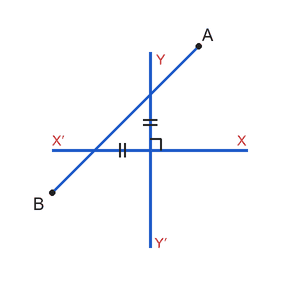
- 843 marks
Question 84
In each of the following, find the inclination of line AB :
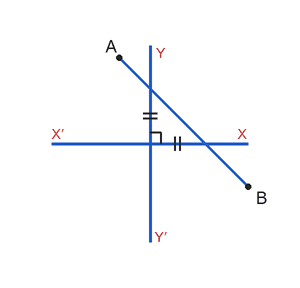
- 853 marks
Question 85
In each of the following, find the inclination of line AB :
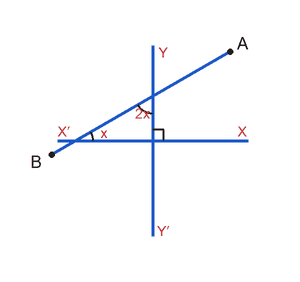
- 863 marks
Question 86
Write the inclination of a line which is :
parallel to x-axis.
- 873 marks
Question 87
Write the inclination of a line which is :
perpendicular to x-axis.
- 883 marks
Question 88
Write the inclination of a line which is :
parallel to y-axis.
- 893 marks
Question 89
Write the inclination of a line which is :
perpendicular to y-axis.
- 903 marks
Question 90
Write the slope of the line whose inclination is:
0°
- 913 marks
Question 91
Write the slope of the line whose inclination is:
30°
- 923 marks
Question 92
Write the slope of the line whose inclination is:
45°
- 933 marks
Question 93
Write the slope of the line whose inclination is:
60°
- 943 marks
Question 94
Find the inclination of the line whose slope is:
- 953 marks
Question 95
Find the inclination of the line whose slope is:
- 963 marks
Question 96
Find the inclination of the line whose slope is:
- 973 marks
Question 97
Find the inclination of the line whose slope is:
- 983 marks
Question 98
Write the slope of the line which is :
parallel to x-axis.
- 993 marks
Question 99
Write the slope of the line which is :
perpendicular to x-axis.
- 1003 marks
Question 100
Write the slope of the line which is :
parallel to y-axis.
- 1013 marks
Question 101
Write the slope of the line which is :
perpendicular to y-axis.
- 1023 marks
Question 102
For each of the equations given below, find the slope and the -intercept :
- 1033 marks
Question 103
For each of the equations given below, find the slope and the -intercept :
- 1043 marks
Question 104
For each of the equations given below, find the slope and the -intercept :
- 1053 marks
Question 105
For each of the equations given below, find the slope and the -intercept :
- 1063 marks
Question 106
For each of the equations given below, find the slope and the -intercept :
- 1073 marks
Question 107
For each of the equations given below, find the slope and the -intercept :
- 1083 marks
Question 108
For each of the equations given below, find the slope and the -intercept :
- 1093 marks
Question 109
Find the equation of the line, whose :
slope = 2 and -intercept = 3
- 1103 marks
Question 110
Find the equation of the line, whose :
slope = 5 and -intercept = - 8
- 1113 marks
Question 111
Find the equation of the line, whose :
slope = - 4 and -intercept = 2
- 1123 marks
Question 112
Find the equation of the line, whose :
slope = - 3 and -intercept = - 1
- 1133 marks
Question 113
Find the equation of the line, whose :
slope = 0 and -intercept = -5
- 1143 marks
Question 114
Find the equation of the line, whose :
slope = 0 and -intercept = 0
- 1153 marks
Question 115
Draw the line on a graph paper. From the graph paper, read the -intercept of the line.
- 1163 marks
Question 116
Draw the line on a graph paper. From the graph paper, read the -intercept of the line.
- 1173 marks
Question 117
By plotting the following points on the same graph paper, check whether they are collinear or not :
(3, 5), (1, 1) and (0, −1)
- 1183 marks
Question 118
By plotting the following points on the same graph paper, check whether they are collinear or not :
(− 2, −1), (− 1, − 4) and (− 4, 1)
- 1193 marks
Question 119
Plot the point A (5, − 7). From point A, draw AM perpendicular to x-axis and AN perpendicular to y-axis. Write the co-ordinates of points M and N.
- 1203 marks
Question 120
In square ABCD; A = (3, 4), B = (− 2, 4) and C = (−2, −1). By plotting these points on a graph paper, find the co-ordinates of vertex D. Also, find the area of the square.
- 1213 marks
Question 121
In rectangle OABC; point O is the origin, OA = 10 units along x-axis and AB = 8 units.
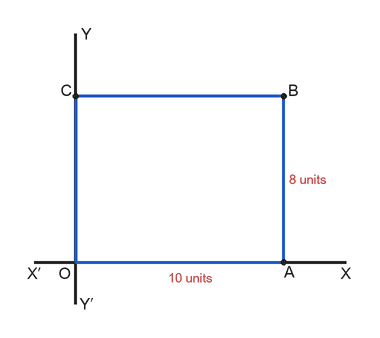
Find the co-ordinates of vertices A, B and C.
- 1223 marks
Question 122
Draw the graph of equation . From the graph, find :
(i) , the value of , when
(ii) , the value of , when .
- 1233 marks
Question 123
Draw the graph of equation .
Use the graph drawn to find :
(i) , the value of , when
(ii) , the value of , when .
- 1243 marks
Question 124
Draw the graph of equation . Use the graph drawn to find :
(i) , the value of , when
(ii) , the value of , when .
- 1253 marks
Question 125
Use the graphical method to show that the straight lines given by the equations , and pass through the same point.
- 1263 marks
Question 126
Draw the graph of line . Use the graph paper drawn to find the inclination and the -intercept of the line.
- 1273 marks
Question 127
Draw the graph of line .
- 1283 marks
Question 128
Draw the graph of line . Use this graph to find :
(i) , the value of when .
(ii) , the value of , when .
What Class 9 Maths Ch 26 covers
The sections of the chapter, in the order the book takes them. Every question above comes from one of these.
- 01Dependent and Independent Variables
- 02Ordered Pair
- 03Cartesian Plane
- 04Co-ordinates of Points
- 05Quadrants and Sign Convention
- 06Graphs of x = 0, y = 0, x = a, y = a
More ways to study this chapter
The same chapter asked three other ways. Practise it, revise it, and see what the board has set on Ch 26 before.
Class 9 Maths Ch 26 questions students ask
How many questions are there in Class 9 Maths Ch 26?
128 questions. Every one is solved step by step on this page.
Are these Class 9 Maths solutions free?
Yes. Every question and its full working is free to read, with no account needed.
Can I download the Class 9 Maths Ch 26 solutions as a PDF?
There is no PDF to download. Every solution is on this page instead, which means it is searchable, always the current syllabus, and readable on a phone. Use your browser's print option if you want it on paper.