Solution:
Concept: In a square, all sides are equal, opposite sides are parallel, adjacent sides are perpendicular and the diagonals bisect each other. A mid-point is half-way between the two ends in both co-ordinates.
Step 1 — Plot the given points.
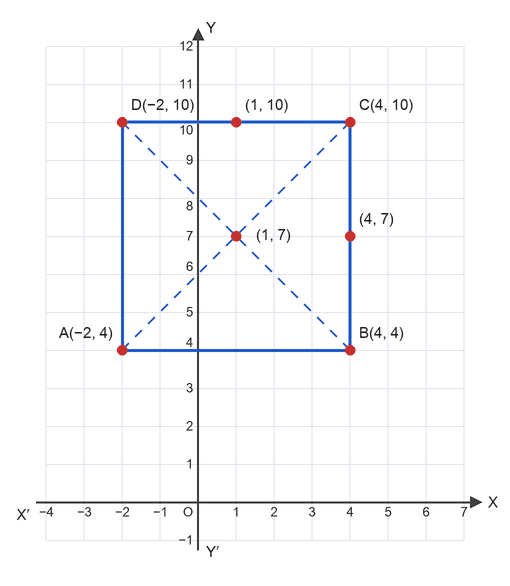
We plot A(−2,4), C(4,10) and D(−2,10) on graph paper.
Step 2 — Find B.
AD is vertical (abscissa −2) and DC is horizontal (ordinate 10). Their lengths are:
AD=10−4=6
DC=4−(−2)=4+2=6
So B is directly below C (abscissa 4) and level with A (ordinate 4): B is (4,4). Then AB and BC are also 6 units long, so ABCD is a square.
Step 3 — Mid-point of BC.
B(4,4) and C(4,10) have abscissa 4, so BC is vertical. Its mid-point has abscissa 4 and the ordinate half-way between 4 and 10:
y=24+10=214=7
Step 4 — Mid-point of CD.
C(4,10) and D(−2,10) have ordinate 10, so CD is horizontal. Its mid-point has ordinate 10 and the abscissa half-way between 4 and −2:
x=24+(−2)=22=1
Step 5 — Point where the diagonals meet.
The diagonals of a square bisect each other, so they meet at the mid-point of AC: half-way across from −2 to 4 and half-way up from 4 to 10.
x=2−2+4=1
y=24+10=7
Watch out: The mid-point of a horizontal side keeps the common ordinate; only the abscissa is averaged.
Therefore, B is (4,4); (i) the mid-point of BC is (4,7); (ii) the mid-point of CD is (1,10); (iii) the diagonals meet at (1,7).
