Solution:
Concept: In a parallelogram, opposite sides are parallel and equal. On graph paper, a horizontal side joins two points with the same ordinate, and its mid-point is half-way between their abscissas.
Step 1 — Plot the given points.
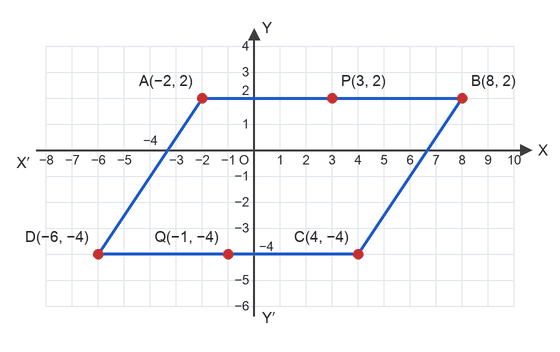
We plot A(−2,2), B(8,2) and C(4,−4) on graph paper.
Step 2 — Find the length of AB.
A and B have the same ordinate, 2, so AB is horizontal and its length is the difference of the abscissas.
AB=8−(−2)=8+2=10
Step 3 — Find D.
In a parallelogram ABCD, DC is parallel and equal to AB. So DC is horizontal through C, and D is 10 units to the left of C (going from D to C is the same move as going from A to B). The abscissa of D is:
xD=4−10=−6
and its ordinate is the same as C's, −4. So D is (−6,−4).
Step 4 — Find the mid-points.
AB is horizontal, so its mid-point has the same ordinate, 2, and the abscissa half-way between −2 and 8:
x=2−2+8=26=3
CD is horizontal with ordinate −4, and the abscissa half-way between −6 and 4 is:
x=2−6+4=2−2=−1
The graph shows these mid-points as P on AB and Q on CD.
Watch out: D must be placed so that ABCD goes round the figure in order: DC (not CD reversed) has the same direction as AB.
Therefore, D is (−6,−4); the mid-point of AB is (3,2) and the mid-point of CD is (−1,−4).
