
Question 273 marksEasy
In each of the following, the co-ordinates of the three vertices of a rectangle ABCD are given. By plotting the given points; find, in each case, the co-ordinates of the fourth vertex :
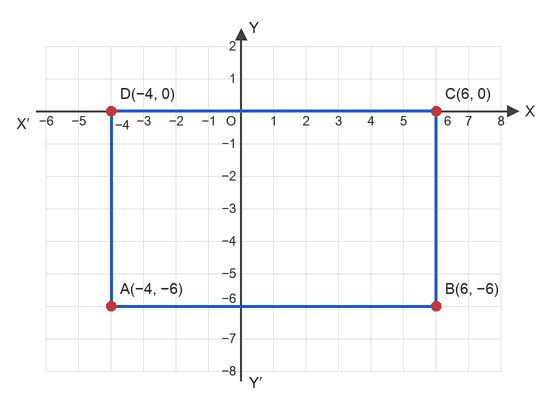
A (− 4, − 6), C (6, 0) and D (− 4, 0)
Confirming your payment
Sign up now and get 250 free tokens.
Co-ordinate Geometry · Question 27 of 128
In each of the following, the co-ordinates of the three vertices of a rectangle ABCD are given. By plotting the given points; find, in each case, the co-ordinates of the fourth vertex :
A (− 4, − 6), C (6, 0) and D (− 4, 0)
Solution:
Concept: In a rectangle, opposite sides are parallel and equal, and adjacent sides are perpendicular. On graph paper, a horizontal side joins two points with the same ordinate and a vertical side joins two points with the same abscissa.
Step 1 — Plot the given points.
We plot , and on graph paper.
Step 2 — Use the sides we know.
AD is vertical (abscissa ) and DC is horizontal (ordinate 0; it lies on the -axis). So AB is horizontal through A, which needs ordinate , and BC is vertical through C, which needs abscissa 6. Hence B is .
Step 3 — Check the sides.
With this fourth vertex, both horizontal sides have the same length, the difference of the abscissas:
and both vertical sides have the same length, the difference of the ordinates:
So the opposite sides are equal, and the figure is a rectangle.
Watch out: In the first number is always the -co-ordinate. Move units along the -axis first, then units parallel to the -axis; swapping them plots a different point.
Therefore, the fourth vertex is .