
Question 703 marksMedium
For each linear equation, given below, draw the graph and then use the graph drawn (in each case) to find the area of a triangle enclosed by the graph and the co-ordinate axes :
.
Confirming your payment
Sign up now and get 250 free tokens.
Co-ordinate Geometry · Question 70 of 128
For each linear equation, given below, draw the graph and then use the graph drawn (in each case) to find the area of a triangle enclosed by the graph and the co-ordinate axes :
.
Solution:
Concept: An equation of the form , where and are not both zero, is a linear equation in and . All its solutions lie on one straight line, called its graph. Two points fix a straight line, so we find at least two points and plot a third as a check.
Every point on the -axis has ordinate 0, and every point on the -axis has abscissa 0. So a line meets the -axis where is 0, and the -axis where is 0.
The area of a triangle is .
Step 1 — Simplify the equation.
We open the brackets and collect the terms, so the equation is in its simplest form.
Step 2 — Find where the line meets the axes.
Every point on the -axis has ordinate 0 and every point on the -axis has abscissa 0, so these give the two corners of the triangle on the axes. Putting in the simplified equation gives:
Putting in it gives:
Step 3 — Plot the points and join them.
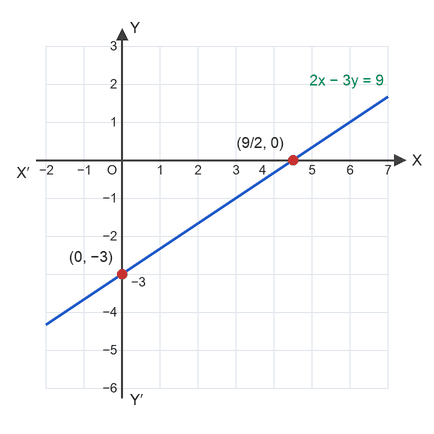
We plot the points and on graph paper (one small square for one unit on each axis) and join them with a ruler, extending the line beyond them. The line and the two axes enclose a right-angled triangle with its right angle at the origin O.
Step 4 — Find the area.
The two sides along the axes are perpendicular, so one is the base and the other the height. The base is units and the height is 3 units (lengths are positive even when a co-ordinate is negative).
Watch out: The height is the length 3, not the co-ordinate ; an area is never negative.
Therefore, the area of the triangle is sq. units (that is, 6.75 sq. units).