
Question 773 marksEasy
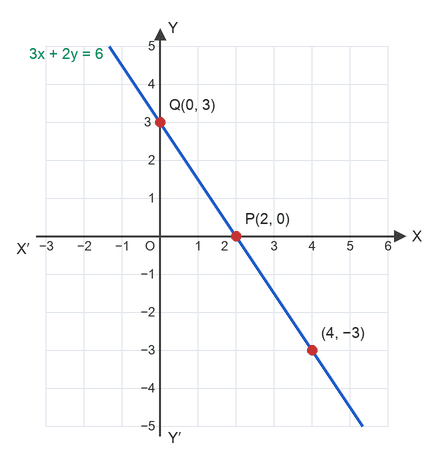
The graph of meets the -axis at point P and the -axis at point Q. Use the graphical method to find the co-ordinates of points P and Q.
Confirming your payment
Sign up now and get 250 free tokens.
Co-ordinate Geometry · Question 77 of 128
The graph of meets the -axis at point P and the -axis at point Q. Use the graphical method to find the co-ordinates of points P and Q.
Solution:
Concept: An equation of the form , where and are not both zero, is a linear equation in and . All its solutions lie on one straight line, called its graph. Two points fix a straight line, so we find at least two points and plot a third as a check.
Every point on the -axis has ordinate 0, and every point on the -axis has abscissa 0. So a line meets the -axis where is 0, and the -axis where is 0.
Step 1 — Make y the subject.
We rearrange the equation to get alone on one side, so that each chosen value of gives its directly.
Step 2 — Make a table of values.
We choose , 2 and 4 (even numbers, so that halving gives whole numbers) and work out the matching values of .
Putting in the equation gives:
Putting in the equation gives:
Putting in the equation gives:
Table of values:
Step 3 — Plot the points and join them.
We plot the points , and on graph paper (one small square for one unit on each axis) and join them with a ruler, extending the line beyond them. The points all lie on one straight line, which is a check on the working.
Step 4 — Read P and Q.
On the graph the line crosses the -axis at the point where ; there , so P is . It crosses the -axis where ; there , so Q is . Both points satisfy the equation:
Watch out: A point on the -axis has ordinate 0, so P is , not .
Therefore, and .