Solution:
Concept: A point is named by an ordered pair (x,y). The first number, x, is its abscissa (x-co-ordinate) and the second, y, is its ordinate (y-co-ordinate).
Step 1 — Read every point.
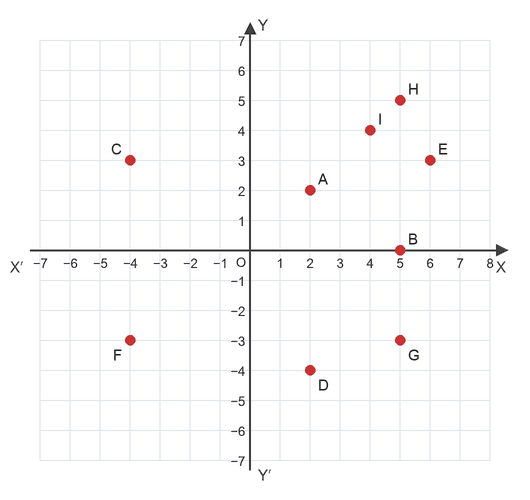
From the graph, each point's co-ordinates are read by dropping to the x-axis (abscissa) and across to the y-axis (ordinate):
A(2,2), B(5,0), C(−4,3), D(2,−4), E(6,3), F(−4,−3), G(5,−3), H(5,5), I(4,4).
Step 2 — Pick the points for each condition.
We check every point against each condition in turn.
- (i) Abscissa 2: A(2,2) and D(2,−4).
- (ii) Ordinate 0: B(5,0).
- (iii) Ordinate 3: C(−4,3) and E(6,3).
- (iv) Ordinate −4: D(2,−4).
- (v) Abscissa 5: B(5,0), G(5,−3) and H(5,5).
- (vi) Abscissa equal to ordinate: A(2,2), H(5,5) and I(4,4).
- (vii) Ordinate half of the abscissa: E(6,3) (3 is half of 6).
Watch out: The abscissa is read on the horizontal axis and the ordinate on the vertical axis; do not swap them.
Note: The printed answer to (i) lists only A(2, 2), but D(2, −4) on the same graph also has abscissa 2, so both are given here.
Therefore, (i) A and D; (ii) B; (iii) C and E; (iv) D; (v) B, G and H; (vi) A, H and I; (vii) E.