
Opening your dashboard
Class 9 Maths Chapter 26 Co-ordinate Geometry: Competency-Based Questions (CBQ)
40 questions on Chapter 26, each worked through on its own page with the AI tutor. Class 9 Maths, ICSE 2026-27.
40 questions
1–5 marks · Mixed difficulty
- 11 mark
Question 1
Competency: Understanding
A cinema hall prints every ticket as an ordered pair (row number, seat number).
Riya's ticket reads and Sara's ticket reads . Which statement is correct?
- 21 mark
Question 2
Competency: Application
A drone is launched from a tower at the origin . The positive -axis points east and the positive -axis points north.
The drone flies 3 km west, then 2 km south, and then 5 km east. In which quadrant is the drone now?
- 31 mark
Question 3
Competency: Application & Analysis
On a district map, 1 unit stands for 1 km. A straight canal runs along the line . A village is at the point .
What is the shortest distance from the village to the canal?
- 41 mark
Question 4
Competency: Application
An escalator in a mall is drawn on a co-ordinate plane with the level floor along the -axis. The escalator rises at an angle of with the positive direction of the -axis.
The slope of the line along the escalator is
- 51 mark
Question 5
Competency: Analysis
A straight line is drawn on graph paper as shown. The two marked points are on the line.

Which equation does the line represent?
- 61 mark
Question 6
Competency: Analysis & Evaluation
Assertion (A): The line does not pass through the fourth quadrant.
Reason (R): For every point in the fourth quadrant, the abscissa is positive and the ordinate is negative.
- 72 marks
Question 7
Competency: Application
A water tank holds 600 litres. When the outlet is opened, 40 litres flow out every minute. The volume (in litres) left after minutes is given by
(a) In this equation, name the dependent variable and the independent variable.
(b) Rewrite the equation so that becomes the dependent variable. Use it to find the time after which 200 litres are left.
- 82 marks
Question 8
Competency: Evaluation
Arjun says, "Take any point in the second quadrant. If I interchange its abscissa and its ordinate, the new point is in the fourth quadrant."
Is Arjun's statement always true, sometimes true or never true? Justify your answer.
- 92 marks
Question 9
Competency: Application
A sapling is 10 cm tall when it is planted. It then grows 2 cm every week. Its expected height (in cm) after weeks is .
(a) Make a table of values of for , and .
(b) In the garden record, the entry for week 4 is the point . Does this point lie on the graph of ? What does your answer tell you about the sapling?
- 102 marks
Question 10
Competency: Application
A straight road starts from a crossing at the origin . The positive -axis points east and the positive -axis points north. The road has an inclination of .
(a) Write the slope of the road and its equation.
(b) A car on this road is 2 km east of . How far north of is it? (Take )
- 113 marks
Question 11
Competency: Analysis & Evaluation
Two candles are lit at the same time. The height (in cm) of each candle after hours of burning is given below.
Candle A:
Candle B:
(a) Find the slope and the -intercept of each line. Say what each of them tells you about the candle.
(b) Which candle is taller at the start? Which is taller after 6 hours? A power cut is expected to last 9 hours. Which candle should be chosen? Give reasons.
- 123 marks
Question 12
Competency: Creativity
A gardener marks a rectangular vegetable bed on a co-ordinate grid, where 1 unit stands for 1 m. The bed must satisfy all three conditions.
- Each side lies along a line parallel to the -axis or the -axis.
- The area of the bed is 24 m².
- The origin , where a tap stands, lies inside the bed and not on its boundary.
Design one such bed. Write the equations of the four lines along its sides and the co-ordinates of its four corners.
- 133 marks
Question 13
Competency: Analysis
A robot cleaner moves on a floor marked as a co-ordinate plane. It starts at a point . It moves 4 units to the right, then 6 units down, and then 7 units to the left. It stops at the point .
(a) Find the co-ordinates of . In which quadrant did the robot start?
(b) How many times did the robot cross a co-ordinate axis on its way? Give the point of each crossing.
- 145 marks
Question 14
Competency: Analysis & Evaluation
Case study — The dripping tap
A bucket stands under a dripping tap. It already has some water in it. The graph shows the depth of water (in cm) in the bucket hours after Ravi starts watching it.
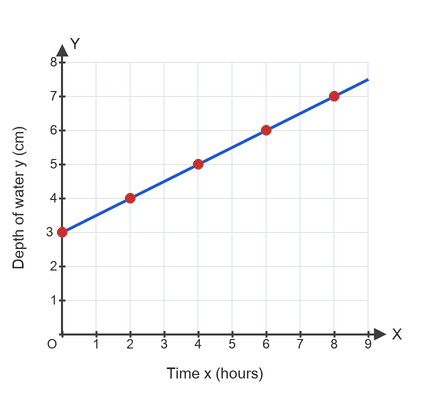
(a) Read from the graph the -intercept of the line and the depth of water after 4 hours. What does the -intercept tell you here?
(b) Take the equation of the line as . Use your readings from part (a) to find and write the equation. What does the slope tell you here?
(c) The bucket is 12 cm deep. Ravi says, "The water rises 1 cm in 2 hours, so the bucket will be full 24 hours after I started watching." Is Ravi right? Justify your answer.
- 155 marks
Question 15
Competency: Application & Analysis
Case study — Three roads on a town plan
A town planner draws three straight roads on a co-ordinate grid. On the grid, 1 unit stands for 100 m.
Road 1:
Road 2:
Road 3:
(a) Find the slope and the -intercept of Road 1 and of Road 2.
(b) Will Road 1 and Road 2 ever meet? Give a reason from your answer to part (a).
(c) Describe the position of Road 3 with respect to the axes. Find the points where Road 3 crosses Road 1 and Road 2. Hence find, in metres, the length of Road 3 between these two crossings.
- 161 mark
Question 16
Competency: Analysis
Kabir studies the straight line with the equation , taking all values of .
Apart from the origin, through which quadrants does the line pass?
- 171 mark
Question 17
Competency: Analysis
A courier notes each delivery as an ordered pair (lane number, house number). One morning the log is
How many different houses did the courier deliver to?
- 181 mark
Question 18
Competency: Application
A square playground is drawn on a grid, where 1 unit stands for 1 m. Its sides are parallel to the axes, its centre is at the origin , and one corner is at .
What is the area of the playground?
- 191 mark
Question 19
Competency: Application & Analysis
On a town plan, 1 unit stands for 10 m. A rectangular park is fenced along the lines , , and .
A guard walks once all the way round the fence. How far does the guard walk?
- 201 mark
Question 20
Competency: Analysis & Evaluation
Assertion (A) : The line has slope .
Reason (R) : In the equation , the number multiplying is the slope of the line.
- 211 mark
Question 21
Competency: Application
A weather app shows a room temperature of F. The relation between the temperature in degrees Fahrenheit and the temperature in degrees Celsius is
What is the temperature in degrees Celsius?
- 221 mark
Question 22
Competency: Understanding & Analysis
Assertion (A) : The points and lie in different quadrants.
Reason (R) : The signs of the abscissa and the ordinate are for and for .
- 231 mark
Question 23
Competency: Application
A straight pipe is laid on a plan along a line that makes an angle of with the positive direction of the -axis. The pipe cuts the -axis at the point .
At which point does the pipe cut the -axis?
- 241 mark
Question 24
Competency: Analysis
The grid shows four villages P, Q, R and S on a map. The positive -axis points east and the positive -axis points north.
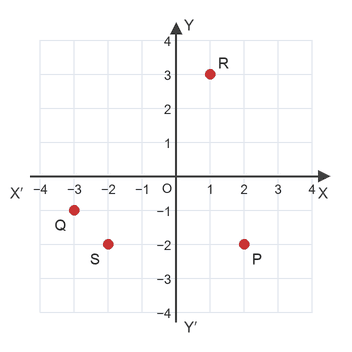
Which village has an abscissa and an ordinate that are equal in size but opposite in sign?
- 251 mark
Question 25
Competency: Understanding
On a map, a straight road joins the point to the point and is extended in both directions.
Which of the following points does not lie on this road?
- 262 marks
Question 26
Competency: Analysis
A straight rope is stretched on a grid from the point to the point .
(a) Name the quadrants through which the rope passes, and write the point where it crosses the -axis.
(b) Find the length of the rope, if 1 unit stands for 1 m.
- 272 marks
Question 27
Competency: Understanding
A harbour is taken as the origin, with east as the positive -direction and north as the positive -direction. Two boats are each 5 km east of the harbour.
(a) Why is this information not enough to fix the position of each boat?
(b) One boat is also 3 km north of the harbour and the other is 4 km south. Write the position of each boat as an ordered pair.
- 282 marks
Question 28
Competency: Evaluation
Asha and Bala each choose two points on the line .
Asha chooses and . Bala chooses and .
Check the choices by substitution. Whose points are all correct? Correct any wrong point.
- 292 marks
Question 29
Competency: Application
A straight cable on a plan, with 1 unit equal to 1 m, is fixed at the point and passes through the point .
(a) Find the slope of the cable.
(b) Write the equation of the line along the cable, and find the ordinate of the point of the cable whose abscissa is .
- 302 marks
Question 30
Competency: Evaluation
Tanvi says, "If the inclination of a line is doubled, its slope is also doubled."
Test her claim with the inclinations and . Is the claim correct?
- 312 marks
Question 31
Competency: Creativity
Write a short real-life situation that fits the equation
Say what and stand for, which one is the independent variable, and what the numbers and mean in your situation.
- 323 marks
Question 32
Competency: Analysis
A triangular flower bed is fenced along the three lines , and drawn on a grid. 1 unit stands for 1 m.
(a) Find the co-ordinates of the three corners of the bed.
(b) Find the area of the bed.
(c) A water tap is fixed at the origin . Is the tap inside the bed, on its boundary or outside it? Give a reason.
- 333 marks
Question 33
Competency: Analysis & Evaluation
(Hypothetical data.) In a science lesson, weights are hung from a spring. The table gives the load (in newtons) and the length (in cm) of the spring.
Load (N) 0 1 2 3 4 5 Length (cm) 10 12 14 16 18 23 (a) Find which of the readings lie on the line .
(b) For the line , find the slope and the -intercept, and say what each means for the spring.
(c) Which reading does not fit? Give a possible reason.
- 343 marks
Question 34
Competency: Application
A tailor has 30 m of cloth. A shirt needs 2.5 m and a pair of trousers needs 1.5 m. If he makes shirts and pairs of trousers and uses all the cloth, then
(a) Rewrite the equation so that is the dependent variable.
(b) How many pairs of trousers can he make along with 6 shirts?
(c) List every plan with whole numbers of shirts and trousers that uses all the cloth, including plans with no shirts or no trousers.
- 353 marks
Question 35
Competency: Analysis
A straight rope AB is stretched on a grid, where 1 unit stands for 1 m. The end A is on the -axis and the end B is on the -axis.
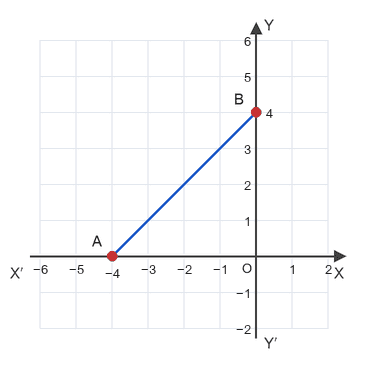
(a) Write the co-ordinates of A and B. Using the right triangle , find the inclination and the slope of the rope, and write its equation.
(b) Find the point on the rope whose ordinate is equal to the negative of its abscissa.
- 363 marks
Question 36
Competency: Application & Evaluation
Meera draws a map of a village, taking the school gate as the origin . The positive -axis points east and the positive -axis points north. One unit stands for 100 m. On her map the library is at , the park is at and the temple is at .
Her friend Karan makes a second map in which the library is the origin and the axes point in the same directions.
(a) Write the co-ordinates of the school gate, the park and the temple on Karan's map.
(b) Name the quadrant of each of the park and the temple on each of the two maps.
(c) Meera says, "The quadrant of a place never depends on where the origin is placed." Is she right? Give an example from the maps.
- 375 marks
Question 37
Competency: Analysis & Evaluation
Case study: (Hypothetical data.) Two gyms in Pune charge a joining fee and a monthly fee. The table shows the total amount (in ₹) a member has paid after months.
Months 0 1 2 3 4 5 6 Gym A: (₹) 1000 1800 2600 3400 4200 5000 5800 Gym B: (₹) 400 1400 2400 3400 4400 5400 6400 (a) For each gym, find the joining fee and the monthly fee from the table, and write the equation connecting and .
(b) Which gym is cheaper for 2 months and which is cheaper for 6 months? After how many months have the two gyms cost the same?
(c) Rohan wants to join for 8 months. Use the equations to find which gym is cheaper for him and by how much.
- 385 marks
Question 38
Competency: Application & Analysis
Case study: On a plan of a farm, 1 unit stands for 100 m, the -axis points east and the -axis points north. Two straight water pipes, and , are drawn as shown. Four points on the pipes are marked on grid points.
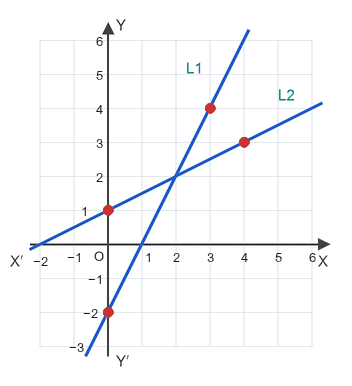
(a) Read the -intercept of each pipe from the figure. Using the two marked points on each pipe, find its slope, and write its equation in the form .
(b) Which pipe has the greater inclination? Does the point lie on ? Does it lie on ?
(c) Sanjay reads the point where the two pipes cross as . Check this with the two equations, and say what the point means on the farm.
- 394 marks
Question 39
Competency: Creativity
Case study: Your class is planning a treasure hunt on a school-ground grid. The origin is the flag post, the -axis points east and the -axis points north. One unit stands for 1 m.
(a) Choose four hiding spots, one in each of the four quadrants, and write the co-ordinates of each.
(b) Write two clues for your hunt. The first clue must give the equation of a line parallel to an axis on which one of your spots lies. The second clue must give an equation on which a different spot lies.
(c) Show by substitution that each spot satisfies its clue. Then show that one of your other spots does not satisfy the second clue, so that the clue picks out the right spot.
- 404 marks
Question 40
Competency: Application & Analysis
Case study: (Hypothetical data.) A skate park has three straight ramps. Each ramp rises from the ground to the top of a block. The table gives the horizontal distance (run) and the height (rise) of each ramp, in metres.
Ramp Run Rise R1 R2 R3 (a) For each ramp, find the slope and the inclination.
(b) In the beginners' area, only ramps whose inclination is at most are allowed. Which ramps may be used there?
(c) A new ramp R4 has the same inclination as R1, but its lower end rests on a low platform 0.5 m above the ground. Take the point on the ground just below this lower end as the origin, with the -axis along the ground and the -axis vertical. Write the equation of the line along R4, and find its height above the ground at a horizontal distance of 1.2 m.