
Opening your dashboard
Class 8 Physics Chapter 5: Light Energy Solutions
94 textbook questions with step-by-step answers, free to read, for ICSE 2026-27.
Get talked through Ch 5, not just shown the answer
Reading a finished solution is not the same as being able to do it. The AI tutor takes one question at a time and works it with you, in your own words, until you can.
- Ask it out loud, in your own words
- It gives you the next step, not the answer
- Stuck on part (ii)? Start there
94 questions with solutions
1–4 marks · Mixed difficulty
- 11 mark
Question 1
The speed of light in air or vacuum is :
Solve with AIAnswer
- Correct
(A) m s
(B) m s
(C) 332 m s
(D) m s
Answer: (A) m s
Concept: A medium in which light travels more slowly is called optically denser; one in which it travels faster is optically rarer. Light travels at about m s in air (or vacuum), m s in water and m s in glass.
Step 1 — Recall the fastest speed.
Light travels fastest in vacuum. Air is so thin that light moves through it at almost the same speed.
Step 2 — Match with the options.
Only option (A) gives this value; the other numbers belong to water, glass and sound.
Watch out: The speed of light in vacuum is the greatest speed of all; in any material it is less.
Why the other options are wrong:
- (B) m s: m s is the speed of light in water, which is optically denser than air.
- (C) 332 m s: 332 m s is roughly the speed of sound in air, about a million times slower than light.
- (D) m s: m s is the speed of light in glass.
Therefore, the speed of light in air or vacuum is m s, option (A).
- 21 mark
Question 2
A ray of light moving from an optically rarer to a denser medium :
Solve with AIAnswer
(A) bends away from the normal
- Correct
(B) bends towards the normal
(C) remains undeviated
(D) none of the above.
Answer: (B) bends towards the normal
Concept: Going from a rarer to a denser medium, a ray bends towards the normal (angle of refraction r less than angle of incidence i). Going from a denser to a rarer medium, it bends away from the normal (r more than i). A ray falling along the normal passes straight through.
Step 1 — Note the change of speed.
On entering an optically denser medium, light slows down.
Step 2 — Apply the rule of bending.
A ray that slows down at the boundary bends towards the normal, so its angle of refraction is smaller than its angle of incidence. For example, a ray going from air into glass at 40° is refracted at only about 25°.
Watch out: Towards the normal for rarer → denser, away from it for denser → rarer; do not mix them up.
Why the other options are wrong:
- (A) bends away from the normal: A ray bends away from the normal only when it goes from a denser to a rarer medium.
- (C) remains undeviated: Only a ray falling along the normal goes straight on; an oblique ray changes direction.
- (D) none of the above: Option (B) is correct, so 'none of the above' cannot be.
Therefore, a ray going from a rarer to a denser medium bends towards the normal, option (B).
- 31 mark
Question 3
The angle between the normal and refracted ray is called :
Solve with AIAnswer
(A) angle of deviation
(B) angle of incidence
- Correct
(C) angle of refraction
(D) angle of emergence.
Answer: (C) angle of refraction
Concept: At the point of incidence, the normal is the line drawn at right angles to the surface separating the two media. The angle of incidence i is between the incident ray and the normal; the angle of refraction r is between the refracted ray and the normal.
Step 1 — Name the two lines.
The angle asked for is between the normal and the refracted ray.
Step 2 — Recall the name.
The angle between the refracted ray and the normal is called the angle of refraction, written r.
Watch out: Every one of these angles is measured from the normal, not from the surface.
Why the other options are wrong:
- (A) angle of deviation: The angle of deviation is between the direction of the incident ray (produced forward) and the direction of the ray that finally comes out.
- (B) angle of incidence: The angle of incidence is between the incident ray and the normal.
- (D) angle of emergence: The angle of emergence is between the emergent ray and the normal at the face where light leaves.
Therefore, the angle between the normal and the refracted ray is the angle of refraction, option (C).
- 41 mark
Question 4
The property of splitting of white light into its seven constituent colours is known as :
Solve with AIAnswer
(A) rectilinear propagation
(B) refraction
(C) reflection
- Correct
(D) dispersion.
Answer: (D) dispersion
Concept: White light is a mixture of seven colours. In glass each colour travels at a slightly different speed, so a prism bends (deviates) each colour by a different amount: violet the most, red the least. The splitting of white light into its colours is called dispersion, and the band of colours is a spectrum (VIBGYOR).
Step 1 — Identify the effect.
The question describes white light splitting into its seven colours.
Step 2 — Name it.
This splitting is called dispersion of light; a prism shows it clearly.
Watch out: Dispersion happens because of refraction, but the name of the splitting itself is dispersion.
Why the other options are wrong:
- (A) rectilinear propagation: Rectilinear propagation means that light travels in straight lines; it does not split light.
- (B) refraction: Refraction is the bending of light at a boundary. Each colour is refracted by a different amount, but the name for the splitting into colours is dispersion.
- (C) reflection: Reflection is the bouncing back of light from a surface; it does not separate the colours.
Therefore, the splitting of white light into its seven colours is called dispersion, option (D).
- 51 mark
Question 5
The seven colours in the spectrum of sunlight in order, are represented as :
Solve with AIAnswer
- Correct
(A) VIBGYOR
(B) VIGYBOR
(C) BIVGYOR
(D) RYOBIVG
Answer: (A) VIBGYOR
Concept: White light is a mixture of seven colours. In glass each colour travels at a slightly different speed, so a prism bends (deviates) each colour by a different amount: violet the most, red the least. The splitting of white light into its colours is called dispersion, and the band of colours is a spectrum (VIBGYOR).
Step 1 — Start from the base side of the prism.
Violet is bent the most, so it is nearest the base; red is bent the least, so it is farthest from the base.
Step 2 — Write the colours in order.
Violet, Indigo, Blue, Green, Yellow, Orange, Red. The first letters spell VIBGYOR.
Watch out: Read VIBGYOR from violet (most bent) to red (least bent); in reverse it is ROYGBIV, never a jumbled order.
Why the other options are wrong:
- (B) VIGYBOR: VIGYBOR puts blue between yellow and orange; blue really lies between indigo and green.
- (C) BIVGYOR: BIVGYOR starts with blue; the spectrum starts with violet (or, read the other way, with red).
- (D) RYOBIVG: RYOBIVG puts yellow before orange and blue before indigo, which is not the order of the spectrum.
Therefore, the seven colours in order are VIBGYOR, option (A).
- 61 mark
Question 6
A ray of light passing through the centre of curvature of a spherical mirror, after reflection :
Solve with AIAnswer
(A) passes through the focus
(B) passes through the pole
(C) becomes parallel to the principal axis
- Correct
(D) retraces its own path.
Answer: (D) retraces its own path
Concept: A spherical mirror obeys the laws of reflection at every point, the normal at any point being the line joining that point to the centre of curvature C.
Step 1 — Find the normal.
The line from C to any point of the mirror is a radius, so it is the normal at that point.
Step 2 — Find the angle of incidence.
A ray passing through C travels along this radius, so it falls along the normal and its angle of incidence is 0°.
Step 3 — Apply the law of reflection.
The angle of reflection equals the angle of incidence, so it is also 0°: the ray goes back along the same line.
Watch out: A ray through F becomes parallel to the axis; a ray through C comes straight back.
Why the other options are wrong:
- (A) passes through the focus: It is a ray parallel to the principal axis that passes through the focus after reflection.
- (B) passes through the pole: The ray returns along its own path through C, not through the pole.
- (C) becomes parallel to the principal axis: It is a ray through the focus that becomes parallel to the principal axis.
Therefore, a ray through the centre of curvature retraces its own path, option (D).
- 71 mark
Question 7
If the radius of curvature of a concave mirror is 20 cm, its focal length is :
Solve with AIAnswer
- Correct
(A) 10 cm
(B) 20 cm
(C) 40 cm
(D) 80 cm.
Answer: (A) 10 cm
Concept: The focus F lies midway between the pole P and the centre of curvature C, so the focal length is half the radius of curvature: , or . This holds for both concave and convex mirrors.
Step 1 — Write the relation.
The focal length is half the radius of curvature.
Step 2 — Put in R = 20 cm.
Dividing the radius of curvature by 2 gives the focal length.
Watch out: The focal length is half of R, not double it.
Why the other options are wrong:
- (B) 20 cm: 20 cm is the radius of curvature itself, not the focal length.
- (C) 40 cm: 40 cm is twice the radius of curvature; the focal length is half of it.
- (D) 80 cm: 80 cm is four times the radius of curvature; the focal length is half of it.
Therefore, the focal length of the mirror is 10 cm, option (A).
- 81 mark
Question 8
The image formed by a convex mirror is :
Solve with AIAnswer
- Correct
(A) erect and diminished
(B) erect and enlarged
(C) inverted and diminished
(D) inverted and enlarged.
Answer: (A) erect and diminished
Concept: A convex mirror diverges light, so for every position of the object it forms a virtual, erect and diminished image behind the mirror, between its pole P and focus F.
Step 1 — Recall what a convex mirror does.
A convex mirror spreads out (diverges) the light falling on it, so the reflected rays never actually meet.
Step 2 — Describe the image.
The reflected rays only seem to come from a point behind the mirror, so the image is virtual and erect, and it is always smaller than the object (diminished).
Watch out: A convex mirror never forms an inverted or an enlarged image.
Why the other options are wrong:
- (B) erect and enlarged: An erect, enlarged image is formed by a concave mirror when the object is between its pole and focus.
- (C) inverted and diminished: An inverted image is a real image; a convex mirror never forms a real image.
- (D) inverted and enlarged: An inverted, enlarged image is real and comes from a concave mirror with the object between F and C.
Therefore, the image formed by a convex mirror is erect and diminished, option (A).
- 91 mark
Question 9
The image formed by a concave mirror is of the same size as the object, if the object is placed :
Solve with AIAnswer
(A) at the focus
(B) between the pole and the focus
(C) between the focus and the centre of curvature
- Correct
(D) at the centre of curvature.
Answer: (D) at the centre of curvature
Concept: A concave mirror forms a real, inverted image when the object is beyond its focus F, and a virtual, erect, enlarged image behind the mirror when the object is between its pole P and focus F.
Step 1 — Use the ray through C.
With the object at C, a ray from its top passing through C is reflected back along itself, and a ray parallel to the axis is reflected through F.
Step 2 — Find where the rays meet.
These rays meet directly below C, at the same distance from the axis as the top of the object. So the image is at C, inverted, and of the same size as the object.
Watch out: Same size only at C; between F and C the image is enlarged, beyond C it is diminished.
Why the other options are wrong:
- (A) at the focus: With the object at the focus, the reflected rays are parallel, so the image is at infinity and highly enlarged.
- (B) between the pole and the focus: Between the pole and the focus the image is virtual, erect and enlarged.
- (C) between the focus and the centre of curvature: Between F and C the image is formed beyond C and is real, inverted and enlarged.
Therefore, the image is of the same size when the object is at the centre of curvature, option (D).
- 101 mark
Question 10
A convex mirror is used :
Solve with AIAnswer
(A) as a shaving mirror
(B) as a head mirror by a dentist
- Correct
(C) as a rear view mirror by a driver
(D) as a reflector in torch.
Answer: (C) as a rear view mirror by a driver
Concept: A convex mirror diverges light, so for every position of the object it forms a virtual, erect and diminished image behind the mirror, between its pole P and focus F.
Step 1 — Think about what a driver needs.
A driver needs an upright image of the traffic behind, and needs to see a wide area in a small mirror.
Step 2 — Match the mirror.
A convex mirror always gives an erect, diminished image and has a wide field of view, so it is used as a rear view mirror.
Watch out: Shaving mirrors, a dentist's mirror and torch reflectors are all concave.
Why the other options are wrong:
- (A) as a shaving mirror: A shaving mirror is concave: with the face held close it gives an erect, enlarged image.
- (B) as a head mirror by a dentist: A dentist's mirror is concave: it gives an enlarged view of a tooth and can focus light on it.
- (D) as a reflector in torch: A torch reflector is concave: with the bulb at its focus it sends out a parallel beam.
Therefore, a convex mirror is used as a rear view mirror by a driver, option (C).
- 111 mark
Question 11
Assertion (A) : If a white light is passed through a prism, it splits into different colours.
Reason (R) : White light is a mixture of colours.
Solve with AIAnswer
(A) Both A and R are true and R is the correct explanation of A
- Correct
(B) Both A and R are true and R is not the correct explanation of A
(C) Assertion is true but reason is false
(D) Assertion is false but reason is true
Answer: (B) Both true, R does not explain A
Concept: In an Assertion–Reason item, first judge the Assertion (A) true or false, then the Reason (R), and only if both are true ask whether R explains why A happens. White light is a mixture of seven colours. In glass each colour travels at a slightly different speed, so a prism bends (deviates) each colour by a different amount: violet the most, red the least. The splitting of white light into its colours is called dispersion, and the band of colours is a spectrum (VIBGYOR).
Step 1 — Judge the Assertion.
A narrow beam of white light passing through a prism comes out as a band of seven colours. So A is true.
Step 2 — Judge the Reason.
White light is indeed made up of seven colours. So R is true.
Step 3 — Decide whether R explains A.
R tells us the colours are already present in white light, but it does not say why the prism separates them. They separate because each colour travels at a different speed in glass and is bent by a different amount (violet most, red least). A mixture of colours passing through a parallel glass slab is not split into a spectrum, so being a mixture alone is not the explanation.
Watch out: A true Reason that is only part of the cause does not count as 'the correct explanation'.
Note: the printed key is code (2), and it is kept. Some answer keys give code (1), reading R as the explanation because it says where the colours come from; but R does not say why the prism separates them.
Why the other options are wrong:
- (A) Both true, R explains A: R is true but incomplete: the splitting happens because the colours are bent by different amounts.
- (C) A true, R false: R is true: white light really is a mixture of seven colours.
- (D) A false, R true: A is true: a prism does split white light into a spectrum.
Therefore, both A and R are true, but R is not the correct explanation of A, option (B).
- 121 mark
Question 12
Assertion (A) : The bottom of a pond appears shallower than its actual depth.
Reason (R) : Light rays from the bottom of the pond bend towards the normal as they pass from water to air.
Solve with AIAnswer
(A) Both A and R are true and R is the correct explanation of A
(B) Both A and R are true and R is not the correct explanation of A
- Correct
(C) Assertion is true but reason is false
(D) Assertion is false but reason is true
Answer: (C) A true, R false
Concept: In an Assertion–Reason item, first judge the Assertion (A) true or false, then the Reason (R), and only if both are true ask whether R explains why A happens. Rays from an object under water bend away from the normal as they leave the water, so they seem to come from a point above the object. For water, the apparent depth is the real depth divided by the refractive index of water, 4/3, so it is about three-quarters of the real depth.
Step 1 — Judge the Assertion.
Seen from above, the bottom of a pond looks raised, so the pond looks shallower than it is. A is true.
Step 2 — Judge the Reason.
Water is optically denser than air. A ray going from a denser medium (water) into a rarer one (air) bends away from the normal, not towards it. So R is false.

Step 3 — Choose the code.
A is true and R is false, which is code (C).
Watch out: Water to air is denser to rarer: away from the normal.
Note: the printed key is code (4) (A false, R true). That is clearly wrong by the chapter's own rule (water to air bends away from the normal) and its own statement that a pond looks shallower, so the answer is code (3).
Why the other options are wrong:
- (A) Both true, R explains A: R is false, so it cannot explain A.
- (B) Both true, R does not explain A: R is false, so 'both true' cannot be right.
- (D) A false, R true: A is true: a pond does look shallower than it really is.
Therefore, the Assertion is true but the Reason is false, option (C).
- 131 mark
Question 13
Assertion (A) : A concave mirror can form both real and virtual images.
Reason (R) : The type of image formed by a concave mirror depends on the position of the object relative to the mirror's focal point.
Solve with AIAnswer
- Correct
(A) Both A and R are true and R is the correct explanation of A
(B) Both A and R are true and R is not the correct explanation of A
(C) Assertion is true but reason is false
(D) Assertion is false but reason is true
Answer: (A) Both true, R explains A
Concept: In an Assertion–Reason item, first judge the Assertion (A) true or false, then the Reason (R), and only if both are true ask whether R explains why A happens. A concave mirror forms a real, inverted image when the object is beyond its focus F, and a virtual, erect, enlarged image behind the mirror when the object is between its pole P and focus F.
Step 1 — Judge the Assertion.
A concave mirror forms a real image for an object beyond F and a virtual image for an object between P and F. A is true.
Step 2 — Judge the Reason.
Which kind of image is formed depends on where the object is placed with respect to the focus. R is true.
Step 3 — Decide whether R explains A.
Yes. Beyond F the reflected rays really meet (real image); nearer than F they spread out and only seem to meet behind the mirror (virtual image). So the change of object position relative to F is exactly why both kinds of image occur.
Why the other options are wrong:
- (B) Both true, R does not explain A: R gives the very reason why both kinds of image are possible, so it does explain A.
- (C) A true, R false: R is true: the type of image changes as the object crosses the focus.
- (D) A false, R true: A is true: a concave mirror can form both real and virtual images.
Therefore, both A and R are true and R is the correct explanation of A, option (A).
- 141 mark
Question 14
Assertion (A) : Convex mirrors are used as a vigilance mirror.
Reason (R) : Convex mirrors form magnified images.
Solve with AIAnswer
(A) Both A and R are true and R is the correct explanation of A
(B) Both A and R are true and R is not the correct explanation of A
- Correct
(C) Assertion is true but reason is false
(D) Assertion is false but reason is true
Answer: (C) A true, R false
Concept: In an Assertion–Reason item, first judge the Assertion (A) true or false, then the Reason (R), and only if both are true ask whether R explains why A happens. A convex mirror diverges light, so for every position of the object it forms a virtual, erect and diminished image behind the mirror, between its pole P and focus F.
Step 1 — Judge the Assertion.
Big shops and stores use convex mirrors as vigilance (security) mirrors to watch a large area. A is true.
Step 2 — Judge the Reason.
A convex mirror always forms a diminished image, never a magnified one. R is false.
Step 3 — Choose the code.
It is the small, erect image of a wide area (wide field of view) that makes a convex mirror useful for watching a shop. A is true and R is false: code (C).
Watch out: A convex mirror gives a wider view precisely because its images are small.
Note: the printed key is code (4) (A false, R true). That is clearly wrong: the chapter itself lists vigilance mirrors as a use of convex mirrors, and it says their images are diminished. So the answer is code (3).
Why the other options are wrong:
- (A) Both true, R explains A: R is false, so it cannot explain A.
- (B) Both true, R does not explain A: R is false, so 'both true' cannot be right.
- (D) A false, R true: A is true: convex mirrors are used as vigilance mirrors.
Therefore, the Assertion is true but the Reason is false, option (C).
- 151 mark
Question 15
Fill in the blank :
Water is optically ........ than air.
Solve with AIWritten solution
Solution:
Concept: A medium in which light travels more slowly is called optically denser; one in which it travels faster is optically rarer. Light travels at about m s in air (or vacuum), m s in water and m s in glass.
Step 1 — Compare the speeds.
Light travels at m s in water and at m s in air, so it is slower in water.
Step 2 — Apply the rule.
The medium in which light is slower is optically denser.
Therefore, water is optically denser than air.
- 161 mark
Question 16
Fill in the blank :
Air is optically ........ than glass.
Solve with AIWritten solution
Solution:
Concept: A medium in which light travels more slowly is called optically denser; one in which it travels faster is optically rarer. Light travels at about m s in air (or vacuum), m s in water and m s in glass.
Step 1 — Compare the speeds.
Light travels at m s in air and at m s in glass, so it is faster in air.
Step 2 — Apply the rule.
The medium in which light is faster is optically rarer.
Therefore, air is optically rarer than glass.
- 171 mark
Question 17
Fill in the blank :
When a ray of light travels from water to air, it bends ........ the normal.
Solve with AIWritten solution
Solution:
Concept: Going from a rarer to a denser medium, a ray bends towards the normal (angle of refraction r less than angle of incidence i). Going from a denser to a rarer medium, it bends away from the normal (r more than i). A ray falling along the normal passes straight through.
Step 1 — Decide denser or rarer.
Water is optically denser than air, so the ray goes from a denser to a rarer medium.
Step 2 — Apply the rule.
On entering the rarer medium the ray speeds up and bends away from the normal, so the angle of refraction is larger than the angle of incidence.
Therefore, a ray going from water to air bends away from the normal.
- 181 mark
Question 18
Fill in the blank :
When a ray of light travels from air to glass, it bends ........ the normal.
Solve with AIWritten solution
Solution:
Concept: Going from a rarer to a denser medium, a ray bends towards the normal (angle of refraction r less than angle of incidence i). Going from a denser to a rarer medium, it bends away from the normal (r more than i). A ray falling along the normal passes straight through.
Step 1 — Decide denser or rarer.
Glass is optically denser than air, so the ray goes from a rarer to a denser medium.
Step 2 — Apply the rule.
On entering glass the ray slows down and bends towards the normal, so the angle of refraction is smaller than the angle of incidence.
Therefore, a ray going from air to glass bends towards the normal.
- 191 mark
Question 19
Fill in the blank :
Refractive index of water is 4/3, so the apparent depth is ........ of the real depth.
Solve with AIWritten solution
Solution:
Concept: Rays from an object under water bend away from the normal as they leave the water, so they seem to come from a point above the object. For water, the apparent depth is the real depth divided by the refractive index of water, 4/3, so it is about three-quarters of the real depth.
Step 1 — Write the relation.
The refractive index of water is the real depth divided by the apparent depth.
Step 2 — Make the apparent depth the subject.
Divide the real depth by the refractive index .
Step 3 — Check with numbers.
A pond 4 m deep therefore looks only 3 m deep.
Watch out: Divide by , do not multiply; the apparent depth is the smaller one.
Therefore, the apparent depth is three-fourths (3/4) of the real depth.
- 201 mark
Question 20
Fill in the blank :
The splitting of white light into its constituent colours is called ........
Solve with AIWritten solution
Solution:
Concept: White light is a mixture of seven colours. In glass each colour travels at a slightly different speed, so a prism bends (deviates) each colour by a different amount: violet the most, red the least. The splitting of white light into its colours is called dispersion, and the band of colours is a spectrum (VIBGYOR).
Step 1 — Identify the effect.
The blank asks for the name of the splitting of white light into its colours.
Step 2 — Name it.
This is dispersion, seen when white light passes through a prism.
Therefore, the splitting of white light into its constituent colours is called dispersion.
- 211 mark
Question 21
Fill in the blank :
A ........ mirror is obtained on silvering the outer surface of a part of a hollow glass sphere.
Solve with AIWritten solution
Solution:
Concept: A spherical mirror is a part of a hollow glass sphere with one surface silvered. If the outer surface is silvered, light is reflected from the hollow inner surface: a concave mirror. If the inner surface is silvered, light is reflected from the bulging outer surface: a convex mirror.
Step 1 — Find the reflecting surface.
When the outer surface of the piece of a hollow sphere is silvered, light cannot pass through it, so reflection takes place from the inner, hollow (caved-in) surface.
Step 2 — Name the mirror.
A mirror that reflects from its hollow side is a concave mirror.
Watch out: The silvered side is the back of the mirror; the mirror is named after the side that reflects.
Therefore, a concave mirror is obtained on silvering the outer surface.
- 221 mark
Question 22
Fill in the blank :
Radius of curvature of a spherical mirror is ........ its focal length.
Solve with AIWritten solution
Solution:
Concept: The focus F lies midway between the pole P and the centre of curvature C, so the focal length is half the radius of curvature: , or . This holds for both concave and convex mirrors.
Step 1 — Write the relation.
The focal length is half the radius of curvature.
Step 2 — Turn it round.
Multiplying both sides by 2 gives the radius of curvature.
Therefore, the radius of curvature of a spherical mirror is two times (double) its focal length.
- 231 mark
Question 23
Fill in the blank :
The angle of incidence for a ray of light passing through the centre of curvature of a spherical mirror is ........
Solve with AIWritten solution
Solution:
Concept: A spherical mirror obeys the laws of reflection at every point, the normal at any point being the line joining that point to the centre of curvature C.
Step 1 — Find the normal.
The line from C to the point where the ray meets the mirror is a radius, so it is the normal there.
Step 2 — Measure the angle.
A ray through C travels along this normal, so the angle between the ray and the normal is zero. It is reflected straight back along its own path.
Therefore, the angle of incidence for such a ray is 0°.
- 241 mark
Question 24
Fill in the blank :
A ........ mirror always forms a virtual image.
Solve with AIWritten solution
Solution:
Concept: A convex mirror diverges light, so for every position of the object it forms a virtual, erect and diminished image behind the mirror, between its pole P and focus F.
Step 1 — Compare the two spherical mirrors.
A concave mirror forms a virtual image only for an object between P and F, and real images otherwise. A convex mirror spreads the light out, so its reflected rays never meet.
Step 2 — Fill the blank.
So the spherical mirror that always forms a virtual image is the convex mirror. (A plane mirror also forms only virtual images, but it is not a curved mirror.)
Therefore, a convex mirror always forms a virtual image.
- 251 mark
Question 25
Fill in the blank :
A concave mirror forms a virtual image for an object placed ........
Solve with AIWritten solution
Solution:
Concept: A concave mirror forms a real, inverted image when the object is beyond its focus F, and a virtual, erect, enlarged image behind the mirror when the object is between its pole P and focus F.
Step 1 — Look at the reflected rays.
For an object nearer to the mirror than its focus, the reflected rays spread out and never meet in front of the mirror.
Step 2 — Locate the image.
Produced backwards, they meet behind the mirror, giving a virtual, erect, enlarged image.
Therefore, a concave mirror forms a virtual image for an object placed between its pole and focus.
- 261 mark
Question 26
Write true or false :
Water is optically denser than glass.
Solve with AIWritten solution
Solution:
Concept: A medium in which light travels more slowly is called optically denser; one in which it travels faster is optically rarer. Light travels at about m s in air (or vacuum), m s in water and m s in glass.
Step 1 — Compare the speeds.
Light travels at m s in water but only m s in glass, so light is slower in glass.
Step 2 — Decide.
The medium in which light is slower is the denser one, so glass is denser than water.
Therefore, the statement is false. Correct statement: glass is optically denser than water.
- 271 mark
Question 27
Write true or false :
A ray of light when passes from glass to air, bends towards the normal.
Solve with AIWritten solution
Solution:
Concept: Going from a rarer to a denser medium, a ray bends towards the normal (angle of refraction r less than angle of incidence i). Going from a denser to a rarer medium, it bends away from the normal (r more than i). A ray falling along the normal passes straight through.
Step 1 — Decide denser or rarer.
Glass is denser than air, so glass to air is denser to rarer.
Step 2 — Apply the rule.
From a denser to a rarer medium a ray bends away from the normal.
Therefore, the statement is false. Correct statement: a ray of light passing from glass to air bends away from the normal.
- 281 mark
Question 28
Write true or false :
The speed of light is more in glass than in water.
Solve with AIWritten solution
Solution:
Concept: A medium in which light travels more slowly is called optically denser; one in which it travels faster is optically rarer. Light travels at about m s in air (or vacuum), m s in water and m s in glass.
Step 1 — Compare the speeds.
In glass light travels at m s, and in water at m s.
Step 2 — Decide.
is less than , so light is slower in glass.
Therefore, the statement is false. Correct statement: the speed of light is less in glass than in water.
- 291 mark
Question 29
Write true or false :
The depth of a pond when seen from above appears to be less.
Solve with AIWritten solution
Solution:
Concept: Rays from an object under water bend away from the normal as they leave the water, so they seem to come from a point above the object. For water, the apparent depth is the real depth divided by the refractive index of water, 4/3, so it is about three-quarters of the real depth.
Step 1 — Follow a ray from the bottom.
A ray from the bottom bends away from the normal as it leaves the water.
Step 2 — Find where it seems to come from.
To the eye the ray seems to come from a point above the real bottom, so the bottom looks raised and the pond looks shallower (about three-quarters of its real depth).
Therefore, the statement is true.
- 301 mark
Question 30
Write true or false :
Light travels at a lower speed in water than in air.
Solve with AIWritten solution
Solution:
Concept: A medium in which light travels more slowly is called optically denser; one in which it travels faster is optically rarer. Light travels at about m s in air (or vacuum), m s in water and m s in glass.
Step 1 — Compare the speeds.
In water light travels at m s; in air at m s.
Step 2 — Decide.
The speed in water is the lower one, because water is optically denser than air.
Therefore, the statement is true.
- 311 mark
Question 31
Write true or false :
Light travels in the same straight line path while passing through different media.
Solve with AIWritten solution
Solution:
Concept: Refraction is the change in direction of light when it passes obliquely from one transparent medium into another, because light travels at different speeds in the two media.
Step 1 — Within one medium.
Inside a single uniform medium, light does travel in a straight line.
Step 2 — At the boundary.
When light passes obliquely from one medium into another, it changes direction (refraction), so it does not keep the same straight-line path.
Therefore, the statement is false. Correct statement: light changes its direction when it passes obliquely from one medium into another.
- 321 mark
Question 32
Write true or false :
The angle formed between the normal and the refracted ray is known as the angle of incidence.
Solve with AIWritten solution
Solution:
Concept: At the point of incidence, the normal is the line drawn at right angles to the surface separating the two media. The angle of incidence i is between the incident ray and the normal; the angle of refraction r is between the refracted ray and the normal.
Step 1 — Look at the two lines named.
The statement talks about the normal and the refracted ray.
Step 2 — Name the angle.
That angle is the angle of refraction; the angle of incidence uses the incident ray.
Therefore, the statement is false. Correct statement: the angle between the normal and the refracted ray is the angle of refraction.
- 331 mark
Question 33
Write true or false :
At the point of incidence, a line drawn at right angles to the surface, separating the two media, is called the normal.
Solve with AIWritten solution
Solution:
Concept: At the point of incidence, the normal is the line drawn at right angles to the surface separating the two media. The angle of incidence i is between the incident ray and the normal; the angle of refraction r is between the refracted ray and the normal.
Step 1 — Recall the definition.
The normal is the line at right angles (perpendicular) to the surface separating the two media, drawn at the point of incidence.
Step 2 — Compare.
The statement gives exactly this definition.
Therefore, the statement is true.
- 341 mark
Question 34
Write true or false :
Image is formed by a mirror due to refraction of light.
Solve with AIWritten solution
Solution:
Concept: A spherical mirror is a part of a hollow glass sphere with one surface silvered. If the outer surface is silvered, light is reflected from the hollow inner surface: a concave mirror. If the inner surface is silvered, light is reflected from the bulging outer surface: a convex mirror.
Step 1 — What a mirror does.
A mirror sends light back into the same medium; the light does not pass into another medium.
Step 2 — Name the process.
Bouncing back of light is reflection; refraction needs light to pass from one medium into another.
Therefore, the statement is false. Correct statement: an image is formed by a mirror due to reflection of light.
- 351 mark
Question 35
Write true or false :
Rays of light incident parallel to the principal axis pass through the focus after reflection from a concave mirror.
Solve with AIWritten solution
Solution:
Concept: Rays whose paths after reflection are known: (1) a ray parallel to the principal axis passes through F (concave) or seems to come from F (convex); (2) a ray through (or towards) C falls normally and comes back along its own path; (3) a ray through (or towards) F comes out parallel to the principal axis.
Step 1 — Recall the definition of the focus.
The focus of a concave mirror is the point on the principal axis where rays parallel to the axis meet after reflection.
Step 2 — Compare.
The statement describes exactly this.
Therefore, the statement is true.
- 361 mark
Question 36
Write true or false :
A convex mirror is used as a shaving mirror.
Solve with AIWritten solution
Solution:
Concept: A convex mirror diverges light, so for every position of the object it forms a virtual, erect and diminished image behind the mirror, between its pole P and focus F.
Step 1 — What a shaving mirror needs.
A shaving mirror must show an erect, enlarged image of the face held close to it.
Step 2 — Which mirror does this.
A concave mirror does, when the face is between its pole and focus. A convex mirror always gives a diminished image.
Therefore, the statement is false. Correct statement: a concave mirror is used as a shaving mirror.
- 371 mark
Question 37
Write true or false :
The focal length of a convex mirror is equal to its radius of curvature.
Solve with AIWritten solution
Solution:
Concept: The focus F lies midway between the pole P and the centre of curvature C, so the focal length is half the radius of curvature: , or . This holds for both concave and convex mirrors.
Step 1 — Write the relation.
For every spherical mirror, convex or concave, the focal length is half the radius of curvature.
Step 2 — Compare.
So f is half of R, not equal to it.
Therefore, the statement is false. Correct statement: the focal length of a convex mirror is half its radius of curvature.
- 381 mark
Question 38
Write true or false :
A concave mirror converges the light rays, but a convex mirror diverges them.
Solve with AIWritten solution
Solution:
Concept: Rays whose paths after reflection are known: (1) a ray parallel to the principal axis passes through F (concave) or seems to come from F (convex); (2) a ray through (or towards) C falls normally and comes back along its own path; (3) a ray through (or towards) F comes out parallel to the principal axis.
Step 1 — Concave mirror.
Parallel rays meet at the focus after reflection, so a concave mirror converges light.
Step 2 — Convex mirror.
Parallel rays spread out after reflection, as if coming from the focus behind it, so a convex mirror diverges light.
Therefore, the statement is true.
- 391 mark
Question 39
Write true or false :
A virtual image formed by a spherical mirror is always erect and situated behind the mirror.
Solve with AIWritten solution
Solution:
Concept: A real image is formed where reflected rays actually meet; it can be taken on a screen and is inverted. A virtual image is formed where the rays only appear to meet (when produced backwards); it cannot be taken on a screen and is erect.
Step 1 — Where the rays meet.
For a virtual image the reflected rays meet only when produced backwards, and that happens behind the mirror.
Step 2 — Check both mirrors.
The virtual image of a concave mirror (object between P and F) and of a convex mirror are both erect and behind the mirror.
Therefore, the statement is true.
- 401 mark
Question 40
Match with the correct option from Column B :
Column A : White light
Column B : (i) convex mirror, (ii) concave mirror, (iii) refraction, (iv) spectrum, (v) ray of light from glass to air
Solve with AIWritten solution
Solution:
Concept: White light is a mixture of seven colours. In glass each colour travels at a slightly different speed, so a prism bends (deviates) each colour by a different amount: violet the most, red the least. The splitting of white light into its colours is called dispersion, and the band of colours is a spectrum (VIBGYOR).
Step 1 — What happens to white light.
White light passed through a prism splits into seven colours.
Step 2 — Match.
The coloured band obtained on a screen is called a spectrum, item (iv).
Therefore, white light matches (iv) spectrum.
- 411 mark
Question 41
Match with the correct option from Column B :
Column A : Refraction
Column B : (i) convex mirror, (ii) concave mirror, (iii) refraction, (iv) spectrum, (v) ray of light from glass to air
Solve with AIWritten solution
Solution:
Concept: Refraction is the change in direction of light when it passes obliquely from one transparent medium into another, because light travels at different speeds in the two media.
Step 1 — What refraction is.
Refraction is the change in direction of light as it passes from one medium into another.
Step 2 — Match.
A ray of light going from glass into air bends away from the normal, which is an example of refraction, item (v).
Therefore, refraction matches (v) ray of light from glass to air.
- 421 mark
Question 42
Match with the correct option from Column B :
Column A : Virtual images
Column B : (i) convex mirror, (ii) concave mirror, (iii) refraction, (iv) spectrum, (v) ray of light from glass to air
Solve with AIWritten solution
Solution:
Concept: A convex mirror diverges light, so for every position of the object it forms a virtual, erect and diminished image behind the mirror, between its pole P and focus F.
Step 1 — Which mirror gives only virtual images.
A convex mirror forms a virtual image for every position of the object.
Step 2 — Match.
So virtual images go with item (i). (A concave mirror forms virtual images only for a very near object, and it is paired with real images.)
Therefore, virtual images match (i) convex mirror.
- 431 mark
Question 43
Match with the correct option from Column B :
Column A : Real images
Column B : (i) convex mirror, (ii) concave mirror, (iii) refraction, (iv) spectrum, (v) ray of light from glass to air
Solve with AIWritten solution
Solution:
Concept: A real image is formed where reflected rays actually meet; it can be taken on a screen and is inverted. A virtual image is formed where the rays only appear to meet (when produced backwards); it cannot be taken on a screen and is erect.
Step 1 — Which mirror can give a real image.
Only a concave mirror makes reflected rays actually meet, when the object is beyond its focus.
Step 2 — Match.
A convex mirror never forms a real image, so real images go with item (ii).
Therefore, real images match (ii) concave mirror.
- 441 mark
Question 44
Match with the correct option from Column B :
Column A : Prism
Column B : (i) convex mirror, (ii) concave mirror, (iii) refraction, (iv) spectrum, (v) ray of light from glass to air
Solve with AIWritten solution
Solution:
Concept: A prism is a transparent medium bounded by five plane surfaces, with a triangular cross-section. Its two refracting faces are inclined to each other, so a ray is refracted twice and comes out bent towards the base.
Step 1 — What happens in a prism.
Light entering and leaving a prism changes direction at both faces.
Step 2 — Match.
This bending is refraction, item (iii).
Therefore, the prism matches (iii) refraction.
- 453 marks
Question 45
State the speed of light in (a) air, (b) water, and (c) glass.
Solve with AIWritten solution
Solution:
Concept: A medium in which light travels more slowly is called optically denser; one in which it travels faster is optically rarer. Light travels at about m s in air (or vacuum), m s in water and m s in glass.
Step 1 — Air.
Air is very thin, so light travels through it at almost its speed in vacuum.
Step 2 — Water.
Water is optically denser than air, so light is slower in it.
Step 3 — Glass.
Glass is optically denser still, so light is slowest in it.
Step 4 — Put them side by side.
The table compares the three speeds.
Medium Speed of light (a) Air (or vacuum) m s (b) Water m s (c) Glass m s Therefore, the speed of light is (a) m s in air, (b) m s in water and (c) m s in glass.
- 462 marks
Question 46
How does the speed of light determine the optical density of a medium ?
Solve with AIWritten solution
Solution:
Concept: A medium in which light travels more slowly is called optically denser; one in which it travels faster is optically rarer. Light travels at about m s in air (or vacuum), m s in water and m s in glass.
Step 1 — State the rule.
The optical density of a medium is judged by the speed of light in it. If light slows down on entering a medium, that medium is optically denser; if it speeds up, the medium is optically rarer.
Step 2 — Apply it to three media.
Light is slowest in glass ( m s), faster in water ( m s) and fastest in air ( m s). So glass is optically denser than water, and water is optically denser than air.
Step 3 — Note the limit.
No medium lets light travel faster than in vacuum, so vacuum (and almost equally air) is the rarest medium.
Watch out: Optical density is about the speed of light, not about mass per volume; a less dense material can be optically denser (kerosene floats on water, yet light is slower in kerosene).
Therefore, the lower the speed of light in a medium, the optically denser that medium is.
- 472 marks
Question 47
Which is optically denser : water or air ? Give reason.
Solve with AIWritten solution
Solution:
Concept: A medium in which light travels more slowly is called optically denser; one in which it travels faster is optically rarer. Light travels at about m s in air (or vacuum), m s in water and m s in glass.
Step 1 — Compare the speeds.
Light travels at m s in water and at m s in air.
Step 2 — Apply the rule.
Light is slower in water, and the medium in which light is slower is optically denser.
Therefore, water is optically denser than air, because light travels more slowly in water.
- 482 marks
Question 48
Out of air and glass, which is optically rarer ? Give reason.
Solve with AIWritten solution
Solution:
Concept: A medium in which light travels more slowly is called optically denser; one in which it travels faster is optically rarer. Light travels at about m s in air (or vacuum), m s in water and m s in glass.
Step 1 — Compare the speeds.
Light travels at m s in air and at m s in glass.
Step 2 — Apply the rule.
Light is faster in air, and the medium in which light is faster is optically rarer.
Therefore, air is optically rarer than glass, because light travels faster in air.
- 492 marks
Question 49
What do you understand by refraction of light ?
Solve with AIWritten solution
Solution:
Concept: Refraction is the change in direction of light when it passes obliquely from one transparent medium into another, because light travels at different speeds in the two media.
Step 1 — Give the definition.
The change in the direction of the path of light when it passes from one transparent medium into another is called refraction of light.
Step 2 — Describe what happens.
Light travels in a straight line within one medium. When a ray falls obliquely on the surface of a second medium, it goes on in a new direction:
- from a rarer to a denser medium (air to glass) it bends towards the normal;
- from a denser to a rarer medium (glass to air) it bends away from the normal;
- a ray falling normally (along the normal) passes straight through without bending.
Step 3 — Give the cause.
Refraction happens because light travels at different speeds in different media.
Therefore, refraction is the bending of light as it passes obliquely from one transparent medium into another.
- 503 marks
Question 50
Define the following terms :
Incident ray, Refracted ray, Angle of incidence, Angle of refraction.
Solve with AIWritten solution
Solution:
Concept: At the point of incidence, the normal is the line drawn at right angles to the surface separating the two media. The angle of incidence i is between the incident ray and the normal; the angle of refraction r is between the refracted ray and the normal.
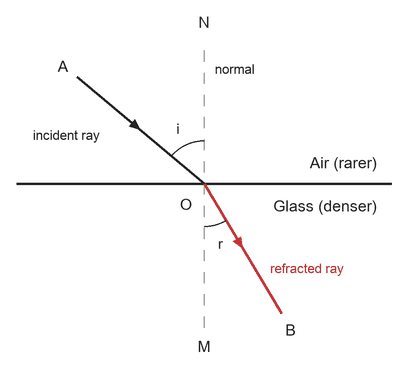
Step 1 — Look at the figure.
AO is the ray in air, O is the point of incidence, NOM is the normal and OB is the ray in glass.
Step 2 — Incident ray.
The ray of light that falls on the surface separating the two media is the incident ray (AO).
Step 3 — Refracted ray.
The ray that travels in the second medium in the changed direction is the refracted ray (OB).
Step 4 — Angle of incidence.
The angle between the incident ray and the normal at the point of incidence is the angle of incidence i (∠AON).
Step 5 — Angle of refraction.
The angle between the refracted ray and the normal is the angle of refraction r (∠BOM).
Watch out: Both angles are measured from the normal, never from the surface.
Therefore, AO is the incident ray, OB the refracted ray, i = ∠AON the angle of incidence and r = ∠BOM the angle of refraction.
- 512 marks
Question 51
A ray of light falls normally on a glass slab. What is the angle of incidence ?
Solve with AIWritten solution
Solution:
Concept: At the point of incidence, the normal is the line drawn at right angles to the surface separating the two media. The angle of incidence i is between the incident ray and the normal; the angle of refraction r is between the refracted ray and the normal.
Step 1 — Understand 'falls normally'.
A ray falling normally on the slab travels along the normal itself.
Step 2 — Measure the angle.
The angle of incidence is the angle between the incident ray and the normal. Here the two are the same line, so the angle is zero.
Step 3 — What happens next.
Such a ray goes into the glass without bending, so the angle of refraction is also 0°.

Watch out: The word 'normally' means at right angles to the surface, so the angle with the surface is 90° but the angle of incidence is 0°.
Therefore, the angle of incidence is 0°.
- 522 marks
Question 52
A ray of light travels from a rarer medium to a denser medium. How will it bend ?
Solve with AIWritten solution
Solution:
Concept: Going from a rarer to a denser medium, a ray bends towards the normal (angle of refraction r less than angle of incidence i). Going from a denser to a rarer medium, it bends away from the normal (r more than i). A ray falling along the normal passes straight through.
Step 1 — Note the change of speed.
Going from a rarer into a denser medium, light slows down.
Step 2 — State the bending.
So it bends towards the normal, and the angle of refraction is less than the angle of incidence.
Step 3 — Example.
A ray going obliquely from air into water at 45° is refracted at only about 32°.

Therefore, a ray going from a rarer to a denser medium bends towards the normal.
- 532 marks
Question 53
A ray of light travels from a denser medium to a rarer medium. How will it bend ?
Solve with AIWritten solution
Solution:
Concept: Going from a rarer to a denser medium, a ray bends towards the normal (angle of refraction r less than angle of incidence i). Going from a denser to a rarer medium, it bends away from the normal (r more than i). A ray falling along the normal passes straight through.
Step 1 — Note the change of speed.
Going from a denser into a rarer medium, light speeds up.
Step 2 — State the bending.
So it bends away from the normal, and the angle of refraction is more than the angle of incidence.
Step 3 — Example.
A ray going from water into air at 30° comes out at about 42°.
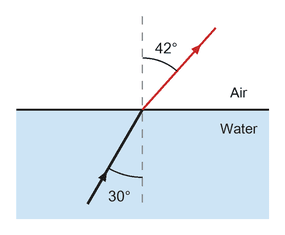
Therefore, a ray going from a denser to a rarer medium bends away from the normal.
- 542 marks
Question 54
What do you mean by the term dispersion ?
Solve with AIWritten solution
Solution:
Concept: White light is a mixture of seven colours. In glass each colour travels at a slightly different speed, so a prism bends (deviates) each colour by a different amount: violet the most, red the least. The splitting of white light into its colours is called dispersion, and the band of colours is a spectrum (VIBGYOR).
Step 1 — Give the definition.
The splitting of white light into its constituent colours is called dispersion of light.
Step 2 — Describe it.
When a narrow beam of white light passes through a glass prism, it comes out as seven colours: violet, indigo, blue, green, yellow, orange and red.
Step 3 — Give the cause.
Each colour travels at a slightly different speed in glass, so each is bent by a different amount: violet the most and red the least. The prism does not make the colours; it only separates those already present in white light.
Therefore, dispersion is the splitting of white light into its seven constituent colours.
- 553 marks
Question 55
What do you understand by the term spectrum ? Name the various colours present in the spectrum of sunlight.
Solve with AIWritten solution
Solution:
Concept: White light is a mixture of seven colours. In glass each colour travels at a slightly different speed, so a prism bends (deviates) each colour by a different amount: violet the most, red the least. The splitting of white light into its colours is called dispersion, and the band of colours is a spectrum (VIBGYOR).
Step 1 — Define spectrum.
The coloured band obtained on a screen when white light (sunlight) is passed through a prism is called a spectrum.
Step 2 — Name the colours.
Starting from the side of the base of the prism (violet is bent the most), the colours are:
Violet, Indigo, Blue, Green, Yellow, Orange, Red
Step 3 — Remember the order.
The first letters spell VIBGYOR.
Therefore, a spectrum is the band of seven colours, VIBGYOR, obtained by the dispersion of white light.
- 562 marks
Question 56
State the two laws of reflection of light.
Solve with AIWritten solution
Solution:
Concept: A spherical mirror obeys the laws of reflection at every point, the normal at any point being the line joining that point to the centre of curvature C.
Step 1 — First law.
The angle of incidence is equal to the angle of reflection.
Step 2 — Second law.
The incident ray, the reflected ray and the normal at the point of incidence all lie in the same plane.
Step 3 — Apply them to curved mirrors.
Both laws hold for plane and spherical mirrors alike; for a spherical mirror the normal is the line joining the point to the centre of curvature.
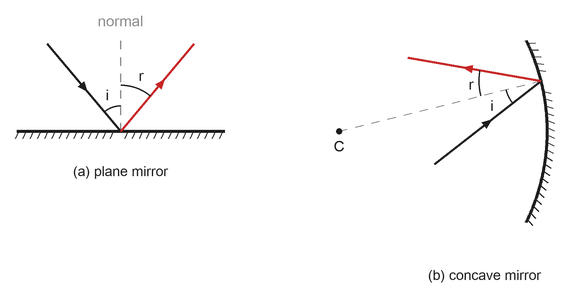
Therefore, (1) ∠i = ∠r, and (2) the incident ray, the reflected ray and the normal lie in one plane.
- 572 marks
Question 57
What is a spherical mirror ?
Solve with AIWritten solution
Solution:
Concept: A spherical mirror is a part of a hollow glass sphere with one surface silvered. If the outer surface is silvered, light is reflected from the hollow inner surface: a concave mirror. If the inner surface is silvered, light is reflected from the bulging outer surface: a convex mirror.
Step 1 — Define it.
A spherical mirror is a part of a hollow glass sphere, one surface of which is silvered. Reflection takes place from the other surface, the reflecting surface.
Step 2 — Name the two kinds.
There are two kinds:
- concave mirror: outer surface silvered, so it reflects from the hollow (inner) surface;
- convex mirror: inner surface silvered, so it reflects from the bulging (outer) surface.
Therefore, a spherical mirror is a mirror whose reflecting surface is a part of a sphere.
- 583 marks
Question 58
How is a spherical mirror used to converge a beam of light at a point ? Name the type of mirror used.
Solve with AIWritten solution
Solution:
Concept: Rays whose paths after reflection are known: (1) a ray parallel to the principal axis passes through F (concave) or seems to come from F (convex); (2) a ray through (or towards) C falls normally and comes back along its own path; (3) a ray through (or towards) F comes out parallel to the principal axis.
Step 1 — Choose the mirror.
To bring light together at a point we need a converging mirror, which is a concave mirror.
Step 2 — Arrange the beam.
Let a beam of light parallel to the principal axis fall on the reflecting surface of the concave mirror.
Step 3 — See where it goes.
After reflection all the rays meet (converge) at one point on the principal axis, the focus F, as in figure (a).
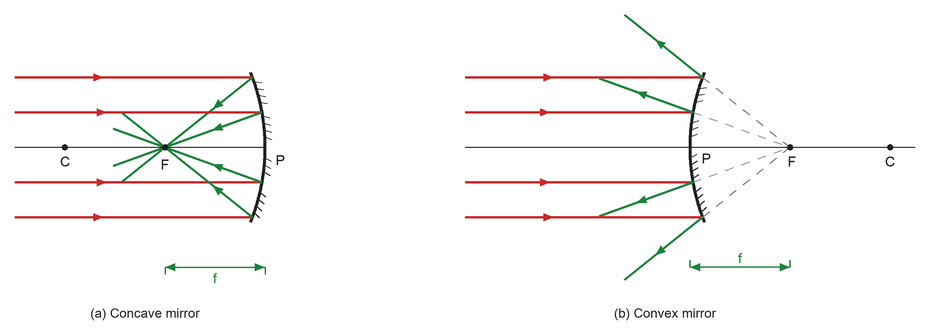
Step 4 — Uses.
A doctor's head mirror and a solar cooker use this property.
Therefore, a concave mirror converges a parallel beam of light to its focus.
- 593 marks
Question 59
How is a spherical mirror used to diverge a beam of light from a point ? Name the type of mirror used.
Solve with AIWritten solution
Solution:
Concept: Rays whose paths after reflection are known: (1) a ray parallel to the principal axis passes through F (concave) or seems to come from F (convex); (2) a ray through (or towards) C falls normally and comes back along its own path; (3) a ray through (or towards) F comes out parallel to the principal axis.
Step 1 — Choose the mirror.
To spread light out as if from a point we need a diverging mirror, which is a convex mirror.
Step 2 — Arrange the beam.
Let a beam of light parallel to the principal axis fall on the convex mirror.
Step 3 — See where it goes.
After reflection the rays spread out (diverge). Produced backwards, they seem to come from a point F behind the mirror, its focus, as in figure (b).
Step 4 — Use.
A convex mirror behind a street lamp spreads its light over a large area.
Therefore, a convex mirror diverges a beam of light as if it came from its focus.
- 603 marks
Question 60
State the direction of incident ray which after reflection from a spherical mirror gets reflected along its own path. Give a reason.
Solve with AIWritten solution
Solution:
Concept: A spherical mirror obeys the laws of reflection at every point, the normal at any point being the line joining that point to the centre of curvature C.
Step 1 — State the direction.
The incident ray must pass through the centre of curvature C (concave mirror) or be directed towards C (convex mirror). Ray 2 in each part of the figure is such a ray.

Step 2 — Give the reason.
The line joining C to any point of the mirror is the normal at that point, so such a ray falls along the normal. Its angle of incidence is 0°, so by the law of reflection its angle of reflection is also 0°.
Step 3 — Conclude.
A ray reflected at 0° to the normal goes straight back along its own path.
Therefore, a ray through (or towards) the centre of curvature is reflected back along its own path, because it falls normally on the mirror.
- 612 marks
Question 61
How is the focal length of a spherical mirror related to its radius of curvature ?
Solve with AIWritten solution
Solution:
Concept: The focus F lies midway between the pole P and the centre of curvature C, so the focal length is half the radius of curvature: , or . This holds for both concave and convex mirrors.
Step 1 — State the relation.
The focus lies midway between the pole and the centre of curvature, so the focal length is half the radius of curvature.
Step 2 — Example.
A mirror whose radius of curvature is 30 cm has a focal length of half of it.
Therefore, the focal length of a spherical mirror is half its radius of curvature: .
- 623 marks
Question 62
Name the mirror which always forms an erect and virtual image. What is the size of the image as compared to that of the object ?
Solve with AIWritten solution
Solution:
Concept: A convex mirror diverges light, so for every position of the object it forms a virtual, erect and diminished image behind the mirror, between its pole P and focus F.
Step 1 — Name the mirror.
A convex mirror spreads out the light, so its reflected rays never meet; it always forms an erect, virtual image, whatever the position of the object.
Step 2 — Compare the size.
The image is always smaller than the object (diminished). It lies behind the mirror, between the pole and the focus.
Therefore, a convex mirror always forms an erect, virtual image, and the image is diminished.
- 633 marks
Question 63
Name the mirror which forms an erect, virtual and enlarged image of an object. What is the position of object relative to the mirror ?
Solve with AIWritten solution
Solution:
Concept: A concave mirror forms a real, inverted image when the object is beyond its focus F, and a virtual, erect, enlarged image behind the mirror when the object is between its pole P and focus F.
Step 1 — Name the mirror.
Only a concave mirror can form an enlarged virtual image.
Step 2 — Place the object.
The object must be placed between the pole P and the focus F of the mirror.
Step 3 — Why it works.
The reflected rays then diverge and appear to meet behind the mirror, giving an erect, virtual, enlarged image. This is how a concave mirror is used as a shaving mirror.
Therefore, a concave mirror with the object between its pole and focus forms an erect, virtual, enlarged image.
- 643 marks
Question 64
What is a real image ? Name the mirror which can be used to obtain the real image of an object. What should be the position of the object relative to the mirror ?
Solve with AIWritten solution
Solution:
Concept: A real image is formed where reflected rays actually meet; it can be taken on a screen and is inverted. A virtual image is formed where the rays only appear to meet (when produced backwards); it cannot be taken on a screen and is erect.
Step 1 — Define a real image.
If the reflected rays actually meet at a point, the image formed there is a real image. It can be obtained on a screen and it is always inverted.
Step 2 — Name the mirror.
A concave mirror is used; a convex mirror never forms a real image.
Step 3 — Place the object.
The object must be beyond the focus F of the concave mirror: between F and C, at C, or beyond C.
Watch out: With the object exactly at F the reflected rays are parallel, so the image is at infinity.
Therefore, a real image is formed where reflected rays actually meet; a concave mirror gives one when the object is beyond its focus.
- 652 marks
Question 65
State two uses of a concave mirror.
Solve with AIWritten solution
Solution:
Concept: A concave mirror converges light, and it gives an erect, enlarged image of an object held close to it.
Step 1 — Use as a shaving mirror.
With the face between its pole and focus, a concave mirror gives an erect, enlarged image of the face.
Step 2 — Use as a reflector.
In torches, searchlights and vehicle headlights, a bulb at the focus of a concave mirror gives a strong parallel beam.
Step 3 — Other uses.
Doctors' and dentists' mirrors (to light up and enlarge a small area) and solar cookers (to concentrate sunlight) also use concave mirrors.
Therefore, two uses of a concave mirror are as a shaving mirror and as a reflector in torches and headlights.
- 662 marks
Question 66
State two uses of a convex mirror.
Solve with AIWritten solution
Solution:
Concept: A convex mirror always gives a small, erect image and has a wide field of view; it also spreads light out.
Step 1 — Use as a rear view mirror.
In vehicles it gives an erect, diminished image of the traffic behind over a wide field of view.
Step 2 — Use as a street-lamp reflector.
It spreads the light of the lamp over a large area of the street.
Step 3 — Another use.
As a vigilance (security) mirror in big shops, it shows a large area of the shop.
Therefore, two uses of a convex mirror are as a rear view mirror in vehicles and as a reflector in street lamps.
- 673 marks
Question 67
Name the kind of mirror used to obtain
(a) a real and enlarged image,
(b) a virtual and enlarged image,
(c) a real and diminished image, and
(d) a virtual and diminished image.
Solve with AIWritten solution
Solution:
Concept: A concave mirror forms a real, inverted image when the object is beyond its focus F, and a virtual, erect, enlarged image behind the mirror when the object is between its pole P and focus F. A convex mirror diverges light, so for every position of the object it forms a virtual, erect and diminished image behind the mirror, between its pole P and focus F.
Step 1 — Real and enlarged.
Only a concave mirror forms real images; the image is enlarged when the object is between F and C (or at F, image at infinity).
Step 2 — Virtual and enlarged.
A concave mirror, with the object between the pole and F.
Step 3 — Real and diminished.
A concave mirror, with the object beyond C.
Step 4 — Virtual and diminished.
A convex mirror, for any position of the object.
Watch out: Only the virtual, diminished image comes from a convex mirror; the other three come from a concave mirror.
Therefore, (a) concave, (b) concave, (c) concave and (d) convex mirror.
- 684 marks
Question 68
Describe an experiment to show that a light ray bends when it passes from one transparent medium into another transparent medium.
Solve with AIWritten solution
Solution:
Concept: Refraction is the change in direction of light when it passes obliquely from one transparent medium into another, because light travels at different speeds in the two media.
Step 1 — Apparatus.
An empty opaque vessel (a bowl or a mug), a coin and a jug of water.
Step 2 — Set it up.
Place the coin at the bottom of the vessel. Look at it from one side and move your head back slowly until the coin just disappears behind the rim. Keep your eye there.
Step 3 — Pour the water.
Ask a friend to pour water gently into the vessel without moving the coin.
Step 4 — Observe.
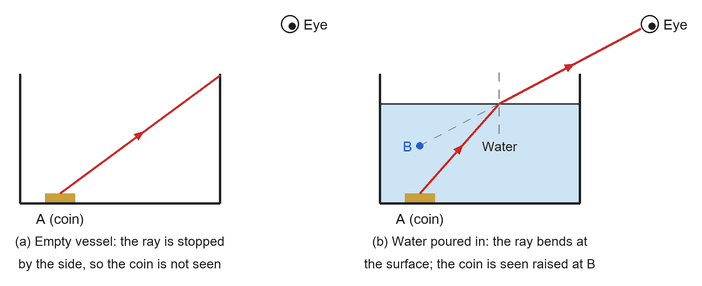
When there is enough water, the coin comes into view again, and it seems raised from its real position A to a position B.
Step 5 — Explain.
In the empty vessel, light from the coin travels in a straight line and is stopped by the side of the vessel, so it cannot reach the eye (figure a). With water in the vessel, the ray from the coin reaches the surface and passes from water (denser) into air (rarer). There it bends away from the normal, passes over the rim and enters the eye (figure b). The eye sees the coin along the ray that enters it, so the coin appears at B.
Step 6 — Another quick check.
A pencil dipped obliquely in a beaker of water looks bent at the surface for the same reason.
Watch out: The coin itself does not move; only the path of the light changes at the water surface.
Therefore, a ray of light bends when it passes obliquely from one transparent medium (water) into another (air): this is refraction.
- 693 marks
Question 69
Draw a ray diagram to show that the depth of a vessel containing water when seen from above, appears to be less than its real depth.
Solve with AIWritten solution
Solution:
Concept: Rays from an object under water bend away from the normal as they leave the water, so they seem to come from a point above the object. For water, the apparent depth is the real depth divided by the refractive index of water, 4/3, so it is about three-quarters of the real depth.
Step 1 — Draw the vessel and the object.
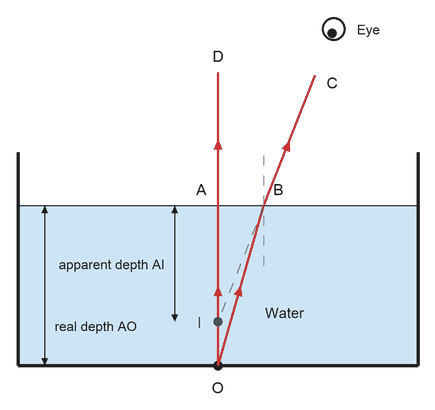
Let O be a point at the bottom of the vessel, so the real depth of the water is AO, where A is on the surface vertically above O.
Step 2 — Draw the normal ray.
The ray OA meets the surface normally, so it goes into air without bending, along AD.
Step 3 — Draw an oblique ray.
The ray OB meets the surface obliquely. Going from water (denser) into air (rarer) it bends away from the normal at B and travels along BC to the eye.
Step 4 — Locate the image.
Produced backwards, the rays AD and BC meet at I. To the eye the light seems to come from I, so I is the image of O.
Step 5 — Compare the depths.
I lies above O, so the apparent depth AI is less than the real depth AO. For water seen from nearly straight above, AI is about three-quarters of AO.
Watch out: The dashed line BI only shows where the light seems to come from; no light travels along it.
Therefore, the vessel appears shallower: the apparent depth AI is less than the real depth AO.
- 704 marks
Question 70
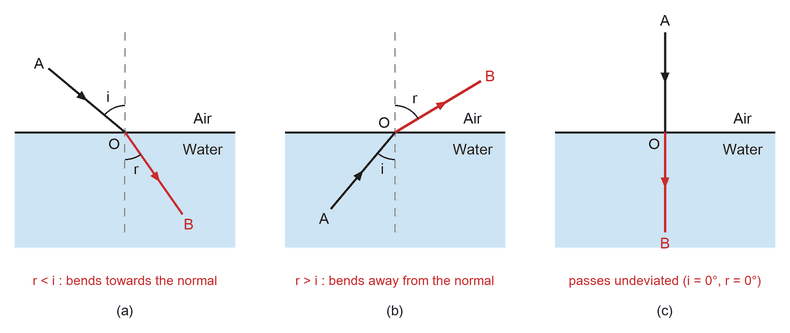
The diagram given below in Fig. 5.38 shows a ray of light AO falling on a surface separating two media. Draw the refracted ray in each, case.
 Solve with AI
Written solution
Solution:
Concept: Going from a rarer to a denser medium, a ray bends towards the normal (angle of refraction r less than angle of incidence i). Going from a denser to a rarer medium, it bends away from the normal (r more than i). A ray falling along the normal passes straight through.
Step 1 — Read each case.
In each part, AO is the incident ray, O the point of incidence and the dashed line the normal at O.
Step 2 — Case (a): air to water.
The ray goes from air (rarer) into water (denser), so the refracted ray OB bends towards the normal: r is less than i. In the figure, i = 50° gives r ≈ 35°.
Step 3 — Case (b): water to air.
The ray goes from water (denser) into air (rarer), so OB bends away from the normal: r is more than i. In the figure, i = 40° gives r ≈ 59°.
Step 4 — Case (c): along the normal.
The ray meets the surface normally (i = 0°), so it goes straight on into the water without bending (r = 0°).
Watch out: Draw the angles from the normal, and make r clearly smaller in (a) and clearly larger in (b).
Therefore, the refracted ray bends towards the normal in (a), away from the normal in (b), and passes undeviated in (c).
- 713 marks
Question 71
Draw a diagram showing the refraction of a light ray from water to glass. Label on it the incident ray, the angle of incidence (), and the angle of refraction ().
Solve with AIWritten solution
Solution:
Concept: A medium in which light travels more slowly is called optically denser; one in which it travels faster is optically rarer. Light travels at about m s in air (or vacuum), m s in water and m s in glass. Going from a rarer to a denser medium, a ray bends towards the normal (angle of refraction r less than angle of incidence i). Going from a denser to a rarer medium, it bends away from the normal (r more than i). A ray falling along the normal passes straight through.
Step 1 — Decide denser or rarer.
Light is slower in glass ( m s) than in water ( m s), so glass is the denser medium. The ray therefore bends towards the normal.
Step 2 — Draw and label.
AO is the incident ray in water and OB the refracted ray in glass; NOM is the normal at the point of incidence O.

Step 3 — Mark the angles.
The angle of incidence i is ∠AON, between the incident ray and the normal. The angle of refraction r is ∠BOM, between the refracted ray and the normal; r is less than i.
Step 4 — Size of the bending.
Water and glass differ less in optical density than air and glass, so the bending is small: for i = 50° the angle of refraction is about 43° (from air it would be about 31°).
Therefore, from water to glass the ray bends towards the normal: the angle of refraction r (∠BOM) is less than the angle of incidence i (∠AON).
- 723 marks
Question 72
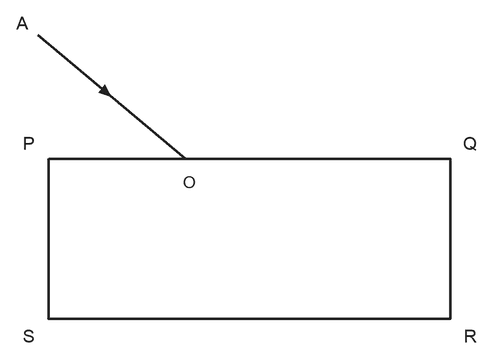
The diagram in Fig. 5.39 shows a ray of light AO falling on a rectangular glass slab PQRS. Complete the diagram till the ray of light emerges out of the slab. Label on the diagram the incident ray, the refracted ray and the emergent ray.
 Solve with AI
Written solution
Solution:
Concept: Going from a rarer to a denser medium, a ray bends towards the normal (angle of refraction r less than angle of incidence i). Going from a denser to a rarer medium, it bends away from the normal (r more than i). A ray falling along the normal passes straight through.
Step 1 — First face PQ.
At O the ray passes from air into glass (rarer to denser), so it bends towards the normal: r is less than i.

Step 2 — Inside the slab.
The refracted ray travels in a straight line through the glass until it meets the opposite face SR.
Step 3 — Second face SR.
There it passes from glass into air (denser to rarer), so it bends away from the normal and comes out as the emergent ray.
Step 4 — Compare the directions.
Because the faces PQ and SR are parallel, the angle of emergence e equals the angle of incidence i. So the emergent ray is parallel to the incident ray AO, only shifted sideways.
Watch out: The emergent ray is parallel to the incident ray but not on the same line.
Therefore, AO is the incident ray, the ray inside the slab is the refracted ray, and the ray leaving face SR is the emergent ray, parallel to AO.
- 734 marks
Question 73
What is a prism ? Draw a ray diagram to show the refraction of a light ray through a prism.
Solve with AIWritten solution
Solution:
Concept: A prism is a transparent medium bounded by five plane surfaces, with a triangular cross-section. Its two refracting faces are inclined to each other, so a ray is refracted twice and comes out bent towards the base.
Step 1 — Define a prism.
A prism is a transparent medium bounded by five plane surfaces with a triangular cross-section. Two of its surfaces are identical, parallel triangles; the other three are rectangles inclined to each other. In a diagram it is drawn as a triangle such as ABC.
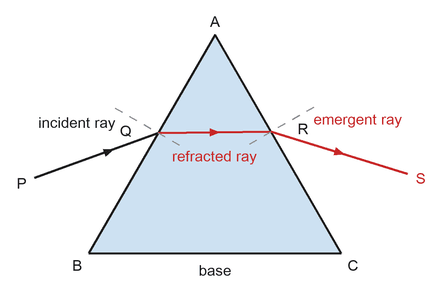
Step 2 — At the first face.
A ray PQ of one colour falls obliquely on face AB. Going from air into glass, it bends towards the normal and travels along QR inside the prism (the refracted ray).
Step 3 — At the second face.
At face AC it goes from glass into air, so it bends away from the normal and comes out along RS (the emergent ray).
Step 4 — Overall effect.
The two faces are inclined, not parallel, so the emergent ray is not parallel to the incident ray: the ray is bent towards the base BC.
Watch out: Unlike a glass slab, a prism turns the ray; the emergent ray is not parallel to the incident ray.
Therefore, a ray passing through a prism is refracted at both faces and bends towards the base.
- 743 marks
Question 74
A ray of white light falls on a prism. Draw a ray diagram to show that the prism disperses the white light.
Solve with AIWritten solution
Solution:
Concept: White light is a mixture of seven colours. In glass each colour travels at a slightly different speed, so a prism bends (deviates) each colour by a different amount: violet the most, red the least. The splitting of white light into its colours is called dispersion, and the band of colours is a spectrum (VIBGYOR).
Step 1 — Draw the arrangement.
A narrow beam of white light falls on face AB of a glass prism ABC, and a white screen is placed beyond the face AC.
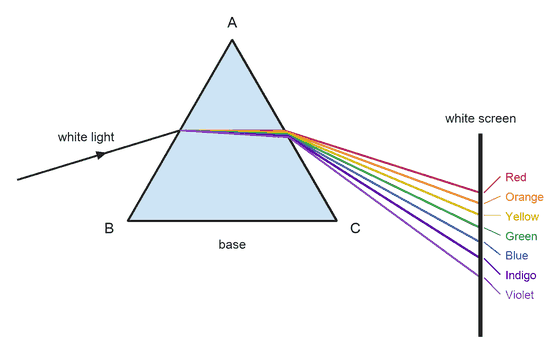
Step 2 — Show the separation.
Inside the prism each colour travels at a different speed, so each is bent by a different amount: violet the most, red the least. The colours separate at the first face and spread further at the second.
Step 3 — Label the spectrum.
On the screen a band of colours, the spectrum, is formed. From the side of the base the colours are violet, indigo, blue, green, yellow, orange and red (VIBGYOR).
Watch out: Violet is nearest the base and red farthest; do not draw them the other way round.
Therefore, the prism disperses white light into a spectrum of seven colours, with violet deviated the most and red the least.
- 753 marks
Question 75
In Fig. 5.40, AO is the ray of white light falling on a prism PQR. Complete the diagram till the light emerges out from the prism and falls on the screen.
 Solve with AI
Written solution
Solution:
Concept: White light is a mixture of seven colours. In glass each colour travels at a slightly different speed, so a prism bends (deviates) each colour by a different amount: violet the most, red the least. The splitting of white light into its colours is called dispersion, and the band of colours is a spectrum (VIBGYOR).
Step 1 — At face PQ.
At O the white light enters the glass and bends towards the normal. The colours bend by different amounts, so they begin to separate inside the prism.
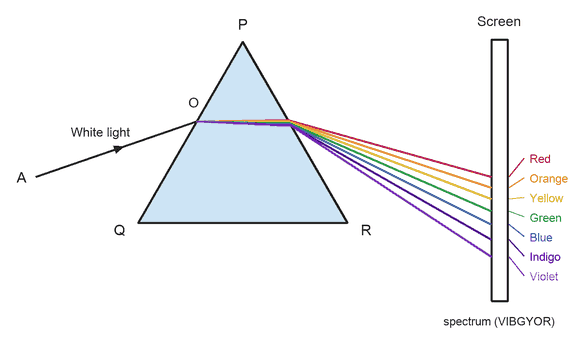
Step 2 — At face PR.
Each colour bends away from the normal as it comes out into air, and the colours spread further apart. All of them are bent towards the base QR.
Step 3 — On the screen.
A spectrum of seven colours is formed: red (deviated least) at the top and violet (deviated most) at the bottom, nearer the side of the base.
Therefore, the light emerges as a spectrum with red at the top and violet at the bottom (VIBGYOR from the bottom).
- 764 marks
Question 76
State the two kinds of spherical mirrors and distinguish them with the aid of proper diagrams.
Solve with AIWritten solution
Solution:
Concept: A spherical mirror is a part of a hollow glass sphere with one surface silvered. If the outer surface is silvered, light is reflected from the hollow inner surface: a concave mirror. If the inner surface is silvered, light is reflected from the bulging outer surface: a convex mirror.
Step 1 — Name the two kinds.
The two kinds of spherical mirrors are the concave mirror and the convex mirror.
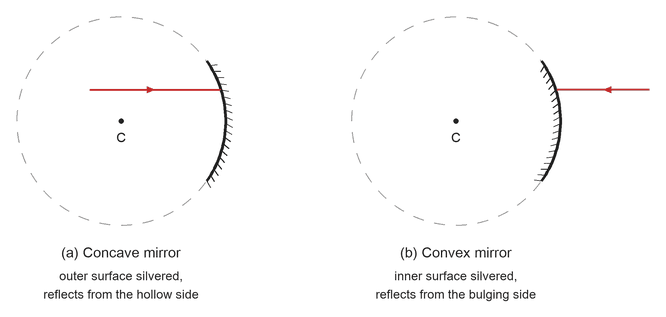
Step 2 — Show what each does to a parallel beam.
A concave mirror converges a parallel beam to its focus; a convex mirror spreads it out as if it came from its focus behind the mirror.
Step 3 — Distinguish them.
The table lists the differences.
Concave mirror Convex mirror Made by silvering the outer surface of a part of a hollow sphere. Made by silvering the inner surface of a part of a hollow sphere. Reflects from the hollow (caved-in) surface. Reflects from the bulging (outer) surface. Converges a parallel beam to its focus. Diverges a parallel beam. Focus in front of the mirror, real. Focus behind the mirror, virtual. Forms real or virtual images, depending on the object's position. Always forms virtual, erect, diminished images. Therefore, the two kinds are the concave mirror (reflects from the hollow side, converges light) and the convex mirror (reflects from the bulging side, diverges light).
- 774 marks
Question 77
Explain the following terms :
Pole, Centre of curvature, Radius of curvature, Principal axis.
Show them on separate diagrams for each of the concave and convex mirrors.
Solve with AIWritten solution
Solution:
Concept: A spherical mirror is a part of a hollow glass sphere with one surface silvered. If the outer surface is silvered, light is reflected from the hollow inner surface: a concave mirror. If the inner surface is silvered, light is reflected from the bulging outer surface: a convex mirror.
Step 1 — Pole (P).
The geometric centre of the reflecting surface of the mirror is its pole. It is the mid-point of the aperture AB.
Step 2 — Centre of curvature (C).
The centre of the sphere of which the mirror is a part is its centre of curvature. It is in front of a concave mirror and behind a convex mirror.
Step 3 — Radius of curvature (R).
The radius of that sphere is the radius of curvature: the distance of C from any point of the mirror, for example PC or CA.
Step 4 — Principal axis.
The straight line through the pole and the centre of curvature is the principal axis.

Step 5 — A useful fact.
The line from C to any point of the mirror, such as CA, is a radius, so it is the normal to the mirror at that point.
Watch out: C is in front of a concave mirror but behind a convex mirror.
Therefore, P is the centre of the mirror's surface, C the centre of its sphere, R = PC the radius of that sphere, and the principal axis the line through P and C.
- 784 marks
Question 78
What do you understand by the focus and focal length of a spherical mirror ? Show them on separate diagrams for each of a concave mirror and a convex mirror.
Solve with AIWritten solution
Solution:
Concept: The focus F lies midway between the pole P and the centre of curvature C, so the focal length is half the radius of curvature: , or . This holds for both concave and convex mirrors.
Step 1 — Focus of a concave mirror.
The point on the principal axis where rays incident parallel to the axis meet after reflection. It is in front of the mirror, so it is a real focus.
Step 2 — Focus of a convex mirror.
The point on the principal axis from which rays incident parallel to the axis appear to come after reflection (they meet only when produced backwards). It is behind the mirror, so it is a virtual focus.
Step 3 — Focal length.
The distance of the focus from the pole is the focal length, f = PF. It is half the radius of curvature.
Step 4 — Read the diagrams.
In both diagrams F lies midway between the pole P and the centre of curvature C.
Therefore, the focus is where parallel rays meet (concave) or seem to come from (convex) after reflection, and the focal length is PF = R/2.
- 794 marks
Question 79
Draw suitable diagrams to illustrate how a beam of light incident parallel to the principal axis is reflected by :
(a) a concave mirror, and (b) a convex mirror.
Solve with AIWritten solution
Solution:
Concept: A spherical mirror obeys the laws of reflection at every point, the normal at any point being the line joining that point to the centre of curvature C.
Step 1 — Draw the beam.
Draw several rays parallel to the principal axis falling on each mirror.
Step 2 — (a) Concave mirror.
Each ray is reflected so that all of them converge and meet at the focus F in front of the mirror; beyond F they spread out again.
Step 3 — (b) Convex mirror.
The reflected rays diverge. Produced backwards (dashed lines), they appear to come from the focus F behind the mirror.
Step 4 — Why.
At every point the angle of incidence equals the angle of reflection, the normal being the line joining that point to C.
Therefore, a concave mirror converges a parallel beam to F, and a convex mirror diverges it as if from F behind the mirror.
- 804 marks
Question 80
The diagrams (Fig. 5.41) given below show two parallel rays 1 and 2 incident on (a) a concave mirror, (b) a convex mirror. Draw the reflected rays and mark the focus by the symbol F.
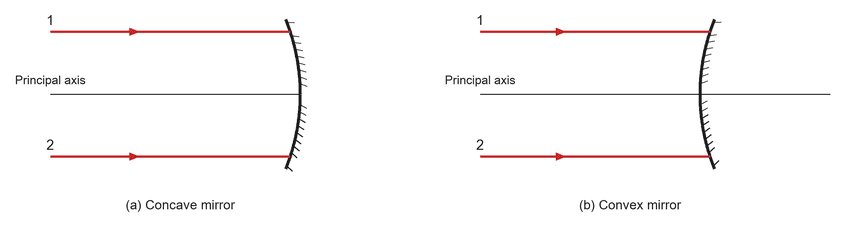 Solve with AI
Written solution
Solution:
Concept: Rays whose paths after reflection are known: (1) a ray parallel to the principal axis passes through F (concave) or seems to come from F (convex); (2) a ray through (or towards) C falls normally and comes back along its own path; (3) a ray through (or towards) F comes out parallel to the principal axis.
Step 1 — Use the rule for parallel rays.
Rays 1 and 2 are parallel to the principal axis, so after reflection they pass through the focus (concave) or appear to come from it (convex).
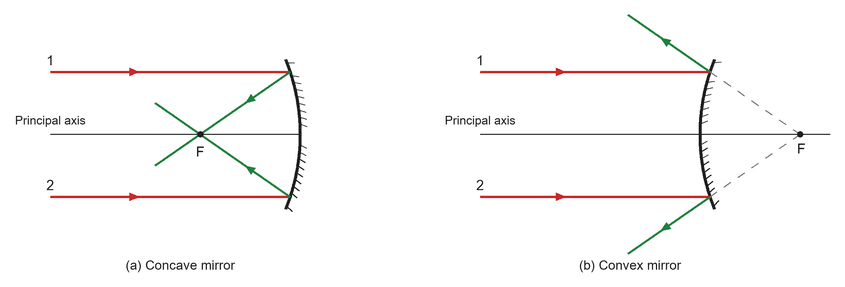
Step 2 — (a) Concave mirror.
Both reflected rays cross the principal axis at the same point in front of the mirror. That point is marked F.
Step 3 — (b) Convex mirror.
The reflected rays spread out. Produced backwards (dashed), they meet on the principal axis behind the mirror; that point is marked F.
Watch out: For the convex mirror, F is found from the dashed backward extensions, behind the mirror.
Therefore, F is where the reflected rays meet (concave) or where their backward extensions meet (convex).
- 814 marks
Question 81
Complete the following diagrams in Fig. 5.42 by drawing the reflected rays for the incident rays 1 and 2 if F is the focus and C is the centre of curvature.
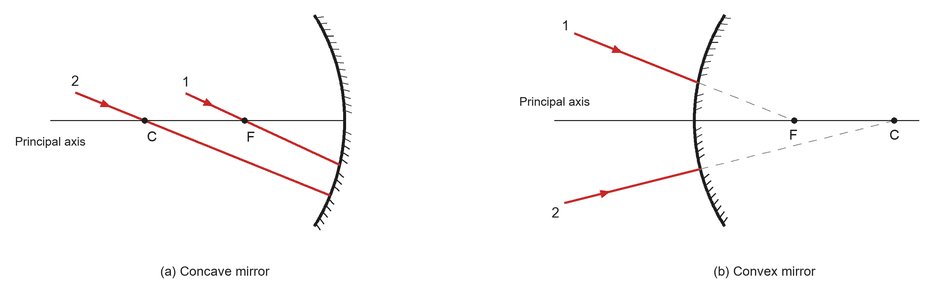 Solve with AI
Written solution
Solution:
Concept: Rays whose paths after reflection are known: (1) a ray parallel to the principal axis passes through F (concave) or seems to come from F (convex); (2) a ray through (or towards) C falls normally and comes back along its own path; (3) a ray through (or towards) F comes out parallel to the principal axis.
Step 1 — Identify the rays.
In each mirror, one ray goes through (or towards) F and the other through (or towards) C.
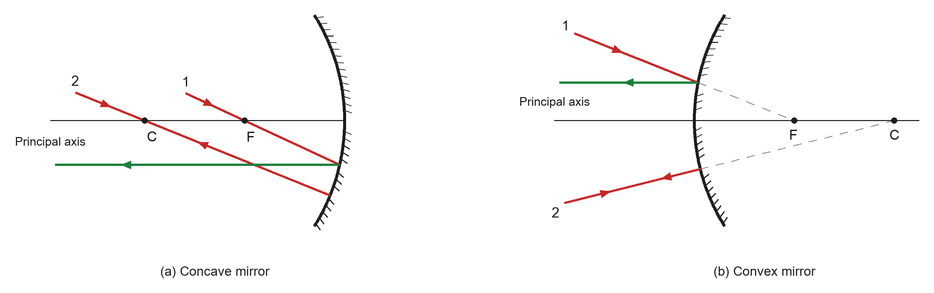
Step 2 — (a) Concave mirror.
Ray 2 passes through C, so it meets the mirror normally and is reflected back along its own path. Ray 1 passes through F, so after reflection it travels parallel to the principal axis.
Step 3 — (b) Convex mirror.
Ray 1 is directed towards F behind the mirror, so after reflection it travels parallel to the principal axis. Ray 2 is directed towards C, so it meets the mirror normally and is reflected back along its own path.
Therefore, the ray through (or towards) C retraces its path, and the ray through (or towards) F comes out parallel to the principal axis.
- 824 marks
Question 82
Which are the two convenient rays that are chosen to construct the image formed by a spherical mirror for a given object? Explain with the help of suitable ray diagrams.
Solve with AIWritten solution
Solution:
Concept: Rays whose paths after reflection are known: (1) a ray parallel to the principal axis passes through F (concave) or seems to come from F (convex); (2) a ray through (or towards) C falls normally and comes back along its own path; (3) a ray through (or towards) F comes out parallel to the principal axis.
Step 1 — First convenient ray.
A ray parallel to the principal axis is reflected through the focus (concave mirror) or as if it came from the focus (convex mirror).
Step 2 — Second convenient ray.
A ray through the centre of curvature (concave mirror), or directed towards it (convex mirror), meets the mirror along the normal, so its angles of incidence and reflection are both 0° and it comes back along its own path.
Step 3 — Locate the image.
Draw both rays from the top A of the object. The point where the reflected rays meet (or appear to meet) is the image A′ of A.
Step 4 — A third choice.
A ray through (or towards) the focus is reflected parallel to the principal axis; any two of the three rays are enough.
Watch out: Draw both rays from the same point A, or they will not give the image of A.
Therefore, the two convenient rays are the ray parallel to the principal axis and the ray through (or towards) the centre of curvature.
- 834 marks
Question 83
Draw a ray diagram to show the formation of the image of an object placed beyond the centre of curvature of a concave mirror. State the position, size and nature of the image.
Solve with AIWritten solution
Solution:
Concept: A concave mirror forms a real, inverted image when the object is beyond its focus F, and a virtual, erect, enlarged image behind the mirror when the object is between its pole P and focus F.
Step 1 — Draw two rays from A.
From the top A of the object AB, a ray parallel to the principal axis is reflected through F, and a ray through C is reflected back along itself.
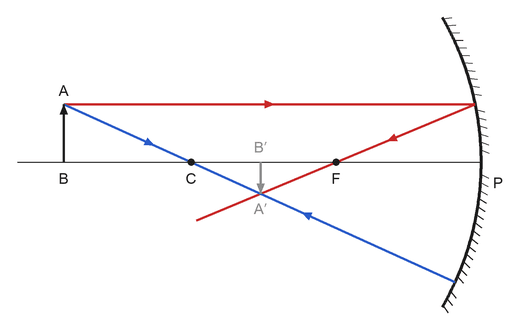
Step 2 — Locate the image.
The reflected rays meet at A′, between F and C; the foot B′ is on the principal axis directly above A′.
Step 3 — Describe the image.
Position: between F and C. Size: smaller than the object (diminished). Nature: real and inverted.
Therefore, the image is formed between F and C, and it is diminished, real and inverted.
- 844 marks
Question 84
Draw a ray diagram to show the formation of the image of an object placed at the centre of curvature of a concave mirror. State the position, size and nature of the image.
Solve with AIWritten solution
Solution:
Concept: A concave mirror forms a real, inverted image when the object is beyond its focus F, and a virtual, erect, enlarged image behind the mirror when the object is between its pole P and focus F.
Step 1 — Draw two rays from A.
From the top A of the object AB placed at C, a ray parallel to the principal axis is reflected through F, and a ray through F is reflected parallel to the principal axis.
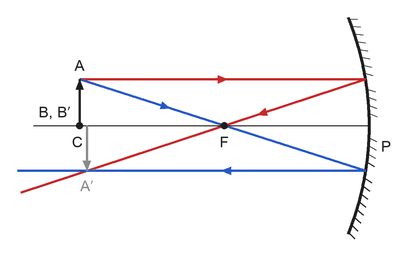
Step 2 — Locate the image.
The two reflected rays meet at A′ directly below C, as far below the axis as A is above it, so the image A′B′ is formed at C.
Step 3 — Describe the image.
Position: at C. Size: same as the object. Nature: real and inverted.
Therefore, the image is formed at the centre of curvature C, and it is of the same size, real and inverted.
- 854 marks
Question 85
Draw a ray diagram to show the formation of image of an object placed between the focus and centre of curvature of a concave mirror. State the position, size and nature of the image.
Solve with AIWritten solution
Solution:
Concept: A concave mirror forms a real, inverted image when the object is beyond its focus F, and a virtual, erect, enlarged image behind the mirror when the object is between its pole P and focus F.
Step 1 — Draw two rays from A.
From the top A of the object AB, a ray parallel to the principal axis is reflected through F, and a ray through F is reflected parallel to the principal axis.
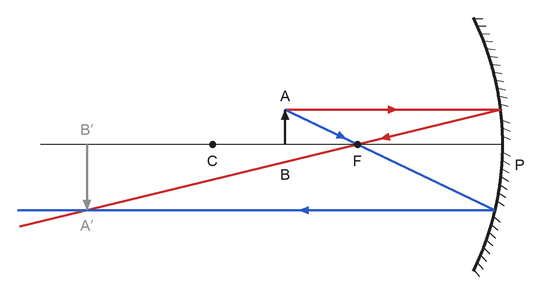
Step 2 — Locate the image.
The two reflected rays meet at A′, beyond C, giving the image A′B′.
Step 3 — Describe the image.
Position: beyond C. Size: larger than the object (enlarged). Nature: real and inverted.
Therefore, the image is formed beyond C, and it is enlarged, real and inverted.
- 864 marks
Question 86
Draw a ray diagram to show the formation of image of an object placed between the pole and focus of a concave mirror. State the position, size and nature of the image.
Solve with AIWritten solution
Solution:
Concept: A concave mirror forms a real, inverted image when the object is beyond its focus F, and a virtual, erect, enlarged image behind the mirror when the object is between its pole P and focus F.
Step 1 — Draw two rays from A.
From the top A of the object AB, a ray parallel to the principal axis is reflected through F. A second ray, travelling along the line from C through A, meets the mirror normally and is reflected back along itself.

Step 2 — Locate the image.
The reflected rays spread out and do not meet in front of the mirror. Produced backwards (dashed lines), they meet at A′ behind the mirror, giving the image A′B′.
Step 3 — Describe the image.
Position: behind the mirror. Size: larger than the object (enlarged). Nature: virtual and erect.
Step 4 — Use.
This is why a concave mirror held close to the face works as a shaving mirror.
Therefore, the image is formed behind the mirror, and it is enlarged, virtual and erect.
- 874 marks
Question 87
Draw a ray diagram to show the formation of the image of an object placed on the principal axis of a convex mirror. State the position, size and nature of the image. What happens to the image as the object is moved away from the mirror ?
Solve with AIWritten solution
Solution:
Concept: A convex mirror diverges light, so for every position of the object it forms a virtual, erect and diminished image behind the mirror, between its pole P and focus F.
Step 1 — Draw two rays from A.
From the top A of the object AB, a ray parallel to the principal axis is reflected so that it seems to come from F. A ray directed towards C is reflected back along itself.

Step 2 — Locate the image.
The reflected rays diverge. Produced backwards (dashed lines), they appear to meet at A′ behind the mirror, giving the image A′B′.
Step 3 — Describe the image.
Position: behind the mirror, between P and F. Size: smaller than the object (diminished). Nature: virtual and erect.
Step 4 — Move the object away.
As the object moves away from the mirror, the image moves from P towards F and becomes smaller, but it stays virtual, erect, diminished and between P and F. For a very distant object the image is a tiny point near F.
Watch out: The image of a convex mirror never goes beyond F, however far the object is.
Therefore, the image is between P and F behind the mirror, diminished, virtual and erect; as the object moves away it shifts towards F and becomes smaller.
- 884 marks
Question 88
Draw separate diagrams for the formation of virtual image of an object by
(a) a concave mirror and
(b) a convex mirror.
State the difference of the two images.
Solve with AIWritten solution
Solution:
Concept: A concave mirror forms a real, inverted image when the object is beyond its focus F, and a virtual, erect, enlarged image behind the mirror when the object is between its pole P and focus F. A convex mirror diverges light, so for every position of the object it forms a virtual, erect and diminished image behind the mirror, between its pole P and focus F.
Step 1 — (a) Concave mirror.
The object AB must be placed between the pole P and the focus F; the reflected rays appear to meet behind the mirror.
Step 2 — (b) Convex mirror.
The object AB may be anywhere in front of the mirror; again the reflected rays appear to meet behind the mirror.
Step 3 — State the difference.
The table compares the two virtual images.
Virtual image by a concave mirror Virtual image by a convex mirror Enlarged (bigger than the object) Diminished (smaller than the object) Only when the object is between P and F For every position of the object Farther behind the mirror than the object is in front Behind the mirror, between P and F Therefore, both images are virtual and erect, but the concave mirror's image is enlarged while the convex mirror's image is diminished.
- 893 marks
Question 89
How can a concave mirror be used to obtain a virtual image of an object ? Draw a diagram to illustrate your answer.
Solve with AIWritten solution
Solution:
Concept: A concave mirror forms a real, inverted image when the object is beyond its focus F, and a virtual, erect, enlarged image behind the mirror when the object is between its pole P and focus F.
Step 1 — Place the object.
Put the object between the pole P and the focus F of the concave mirror, that is, very close to the mirror.
Step 2 — Follow the rays.
The reflected rays spread out; produced backwards they meet behind the mirror, so a virtual, erect and enlarged image is formed there.
Step 3 — Check.
The image cannot be caught on a screen. This is the enlarged face we see in a shaving mirror.
Therefore, a concave mirror gives a virtual image when the object is between its pole and focus.
- 904 marks
Question 90
A driver uses a convex mirror as a rear view mirror. Explain the reason with the help of a ray diagram.
Solve with AIWritten solution
Solution:
Concept: A convex mirror diverges light, so for every position of the object it forms a virtual, erect and diminished image behind the mirror, between its pole P and focus F.
Step 1 — Erect image.
A convex mirror always forms an erect image, so the driver sees the traffic behind the right way up.
Step 2 — Diminished image.
Its image is always diminished, so a large area behind the vehicle fits into a small mirror.
Step 3 — Wider field of view.
Because it diverges the rays, a convex mirror sends light into the driver's eye from a much wider region than a plane mirror of the same size.
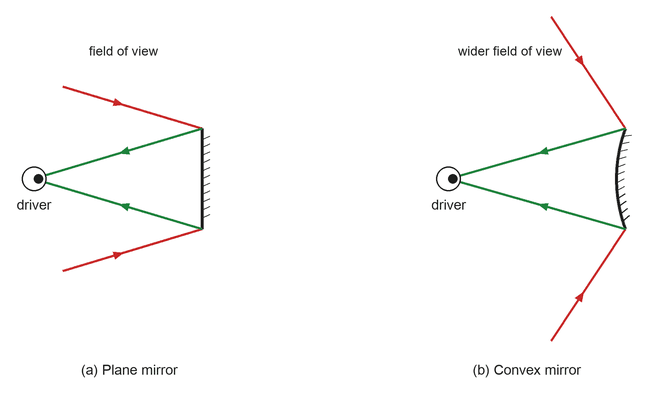
Step 4 — Read the diagram.
The rays reaching the eye from the edges of the convex mirror come from directions much farther apart than those from the plane mirror, so the driver sees a wider area behind.
Watch out: A convex mirror makes vehicles look smaller, and so farther away than they really are; drivers allow for this.
Therefore, a driver uses a convex mirror because it gives an erect, diminished image with a much wider field of view.
- 913 marks
Question 91
Explain the following :
(a) A coin placed at the bottom of a vessel appears to be raised when water is poured in the vessel.
(b) A straight stick partly dipped in water obliquely, appears to be bent at the surface of water.
(c) The sun is seen before the sunrise and after the sunset.
Solve with AIWritten solution
Solution:
Concept: Refraction is the change in direction of light when it passes obliquely from one transparent medium into another, because light travels at different speeds in the two media. Going from a rarer to a denser medium, a ray bends towards the normal (angle of refraction r less than angle of incidence i). Going from a denser to a rarer medium, it bends away from the normal (r more than i). A ray falling along the normal passes straight through.
Step 1 — (a) Coin appears raised.
Light from the coin travels through water and, at the surface, passes from water (denser) into air (rarer). There it bends away from the normal before entering the eye. The eye sees the coin along the ray that enters it, so the coin seems to be at a point above its real position.
Step 2 — (b) Stick appears bent.
Rays from the immersed part of the stick, such as from its end C, bend away from the normal as they come out of the water. To the eye they seem to come from points such as C′, above their real positions. So the immersed part BC appears raised to BC′, while the part above water is seen where it is: the stick looks bent at the surface.

Step 3 — (c) Sun seen before sunrise and after sunset.
The air near the earth is denser than the air higher up. When the sun is just below the horizon, its light passes from rarer into denser layers and bends towards the normal at each layer, so it follows a curved path and reaches the observer. The sun therefore appears above the horizon while it is really just below it. So it is seen about 2 minutes before it actually rises and stays visible about 2 minutes after it has actually set.
Watch out: In (c) the light bends towards the normal (rarer to denser), unlike (a) and (b) where it goes from water to air.
Note: some books give 3 to 4 minutes; the bending of sunlight at the horizon (about half a degree) gives about 2 minutes, a little longer far from the equator.
Therefore, all three are effects of refraction: (a) the coin looks raised, (b) the stick looks bent, and (c) the sun is seen about 2 minutes early and 2 minutes late.
- 923 marks
Question 92
What is a mirage ? Give a reason for its formation.
Solve with AIWritten solution
Solution:
Concept: A mirage is caused by refraction of light through layers of air at different temperatures: hot air is optically rarer than cooler air.
Step 1 — What a mirage is.
In a desert (or on a hot road), an inverted image of a tree is sometimes seen below it, giving the false impression of a pool of water. This is a mirage.
Step 2 — Layers of air.
During the day the sand gets very hot and heats the air just above it. So the layers near the ground are hotter and optically rarer than the layers above them.
Step 3 — Bending of the ray.
Light from the top of the tree travelling downwards passes from denser into rarer layers, so at each layer it bends away from the normal, and the angle of refraction keeps increasing.
Step 4 — Turning upwards.
Close to the ground the ray bends so much that it turns upwards (the book calls this reflection at the hot layer). Now going from rarer into denser layers, it bends towards the normal.
Step 5 — What the eye sees.
The ray reaches the eye travelling upwards, so it seems to come from a point below the ground. The observer sees an inverted image of the tree, as if reflected in a pool of water.
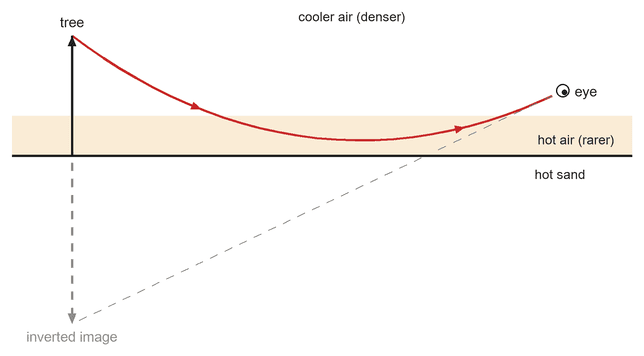
Watch out: There is no water at all; the 'pool' is an image of the sky and the tree formed by refraction.
Therefore, a mirage is a false image of water formed by refraction of light through hot, rarer layers of air near the ground.
- 932 marks
Question 93
You are given a disc divided into seven sectors with colours violet, indigo, blue, green, yellow, orange and red in them. What would be its colour when it is rotated rapidly ?
Solve with AIWritten solution
Solution:
Concept: White light is a mixture of seven colours. In glass each colour travels at a slightly different speed, so a prism bends (deviates) each colour by a different amount: violet the most, red the least. The splitting of white light into its colours is called dispersion, and the band of colours is a spectrum (VIBGYOR).
Step 1 — Spin the disc.
When the disc spins fast, each sector's colour reaches the eye one after another, many times a second.
Step 2 — Mixing in the eye.
The eye keeps an impression of each colour for about one-sixteenth of a second (persistence of vision), so the impressions of all seven colours overlap and mix.
Step 3 — Result.
Violet, indigo, blue, green, yellow, orange and red are the colours of white light, so mixed together they give the effect of white. (With real paints the disc looks whitish-grey.)
Therefore, the disc appears white (whitish) when it is rotated rapidly, showing that white light is a mixture of seven colours.
- 943 marks
Question 94
State the kind of mirror used
(a) by a dentist, and
(b) as a street light reflector.
Solve with AIWritten solution
Solution:
Concept: A concave mirror converges light and enlarges a near object; a convex mirror spreads light out.
Step 1 — (a) A dentist's mirror.
A dentist uses a concave mirror. It converges light on to a small area of the teeth to light it up, and when held close to a tooth it gives an erect, enlarged image of it.
Step 2 — (b) A street-light reflector.
A convex mirror is used. It diverges the light from the lamp, so the light spreads over a large area of the street.
Therefore, (a) a dentist uses a concave mirror, and (b) a street light uses a convex mirror as its reflector.
What Class 8 Physics Ch 5 covers
The sections of the chapter, in the order the book takes them. Every question above comes from one of these.
- 01Refraction of Light
- 02Laws of Refraction (Snell's Law)
- 03Effects of Refraction
- 04Refraction of Light Through a Rectangular Glass Block
- 05Refraction of Light Through a Prism
- 06Dispersion of White Light
- 07Spherical Mirrors
More ways to study this chapter
The same chapter asked three other ways. Practise it, revise it, and see what the board has set on Ch 5 before.
Class 8 Physics Ch 5 questions students ask
How many questions are there in Class 8 Physics Ch 5?
94 questions. Every one is solved step by step on this page.
Are these Class 8 Physics solutions free?
Yes. Every question and its full working is free to read, with no account needed.
Can I download the Class 8 Physics Ch 5 solutions as a PDF?
There is no PDF to download. Every solution is on this page instead, which means it is searchable, always the current syllabus, and readable on a phone. Use your browser's print option if you want it on paper.