
Question 804 marksEasy
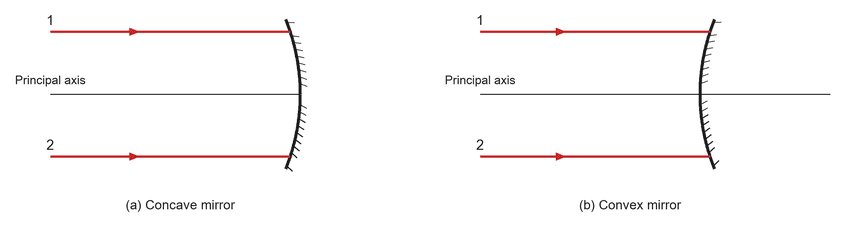
The diagrams (Fig. 5.41) given below show two parallel rays 1 and 2 incident on (a) a concave mirror, (b) a convex mirror. Draw the reflected rays and mark the focus by the symbol F.
Confirming your payment
Sign up now and get 250 free tokens.
Light Energy · Question 80 of 94
The diagrams (Fig. 5.41) given below show two parallel rays 1 and 2 incident on (a) a concave mirror, (b) a convex mirror. Draw the reflected rays and mark the focus by the symbol F.
Solution:
Concept: Rays whose paths after reflection are known: (1) a ray parallel to the principal axis passes through F (concave) or seems to come from F (convex); (2) a ray through (or towards) C falls normally and comes back along its own path; (3) a ray through (or towards) F comes out parallel to the principal axis.
Step 1 — Use the rule for parallel rays.
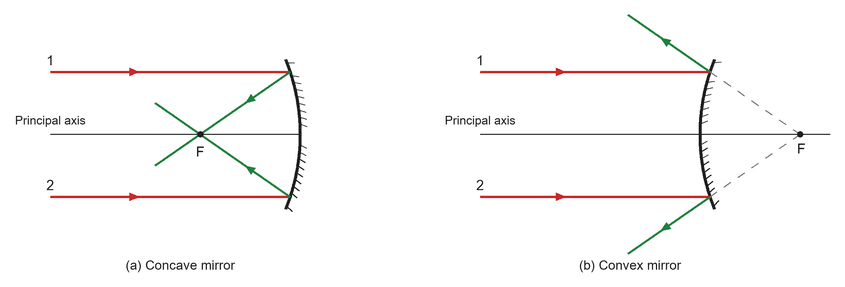
Rays 1 and 2 are parallel to the principal axis, so after reflection they pass through the focus (concave) or appear to come from it (convex).
Step 2 — (a) Concave mirror.
Both reflected rays cross the principal axis at the same point in front of the mirror. That point is marked F.
Step 3 — (b) Convex mirror.
The reflected rays spread out. Produced backwards (dashed), they meet on the principal axis behind the mirror; that point is marked F.
Watch out: For the convex mirror, F is found from the dashed backward extensions, behind the mirror.
Therefore, F is where the reflected rays meet (concave) or where their backward extensions meet (convex).