
Question 734 marksEasy
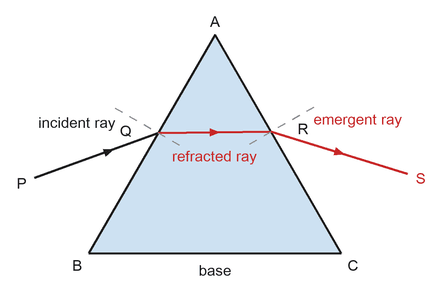
What is a prism ? Draw a ray diagram to show the refraction of a light ray through a prism.
Confirming your payment
Sign up now and get 250 free tokens.
Light Energy · Question 73 of 94
What is a prism ? Draw a ray diagram to show the refraction of a light ray through a prism.
Solution:
Concept: A prism is a transparent medium bounded by five plane surfaces, with a triangular cross-section. Its two refracting faces are inclined to each other, so a ray is refracted twice and comes out bent towards the base.
Step 1 — Define a prism.
A prism is a transparent medium bounded by five plane surfaces with a triangular cross-section. Two of its surfaces are identical, parallel triangles; the other three are rectangles inclined to each other. In a diagram it is drawn as a triangle such as ABC.
Step 2 — At the first face.
A ray PQ of one colour falls obliquely on face AB. Going from air into glass, it bends towards the normal and travels along QR inside the prism (the refracted ray).
Step 3 — At the second face.
At face AC it goes from glass into air, so it bends away from the normal and comes out along RS (the emergent ray).
Step 4 — Overall effect.
The two faces are inclined, not parallel, so the emergent ray is not parallel to the incident ray: the ray is bent towards the base BC.
Watch out: Unlike a glass slab, a prism turns the ray; the emergent ray is not parallel to the incident ray.
Therefore, a ray passing through a prism is refracted at both faces and bends towards the base.