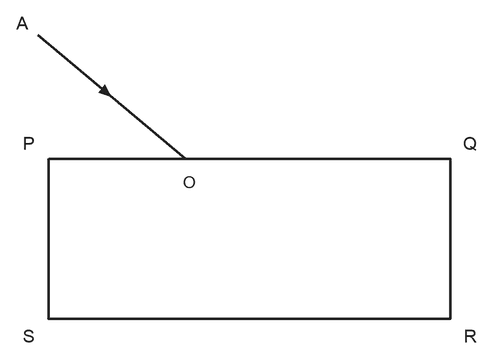
Solution:
Concept: Going from a rarer to a denser medium, a ray bends towards the normal (angle of refraction r less than angle of incidence i). Going from a denser to a rarer medium, it bends away from the normal (r more than i). A ray falling along the normal passes straight through.
Step 1 — First face PQ.
At O the ray passes from air into glass (rarer to denser), so it bends towards the normal: r is less than i.

Step 2 — Inside the slab.
The refracted ray travels in a straight line through the glass until it meets the opposite face SR.
Step 3 — Second face SR.
There it passes from glass into air (denser to rarer), so it bends away from the normal and comes out as the emergent ray.
Step 4 — Compare the directions.
Because the faces PQ and SR are parallel, the angle of emergence e equals the angle of incidence i. So the emergent ray is parallel to the incident ray AO, only shifted sideways.
Watch out: The emergent ray is parallel to the incident ray but not on the same line.
Therefore, AO is the incident ray, the ray inside the slab is the refracted ray, and the ray leaving face SR is the emergent ray, parallel to AO.