
Question 693 marksEasy
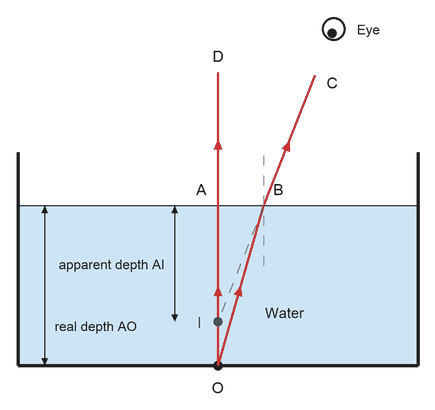
Draw a ray diagram to show that the depth of a vessel containing water when seen from above, appears to be less than its real depth.
Confirming your payment
Sign up now and get 250 free tokens.
Light Energy · Question 69 of 94
Draw a ray diagram to show that the depth of a vessel containing water when seen from above, appears to be less than its real depth.
Solution:
Concept: Rays from an object under water bend away from the normal as they leave the water, so they seem to come from a point above the object. For water, the apparent depth is the real depth divided by the refractive index of water, 4/3, so it is about three-quarters of the real depth.
Step 1 — Draw the vessel and the object.
Let O be a point at the bottom of the vessel, so the real depth of the water is AO, where A is on the surface vertically above O.
Step 2 — Draw the normal ray.
The ray OA meets the surface normally, so it goes into air without bending, along AD.
Step 3 — Draw an oblique ray.
The ray OB meets the surface obliquely. Going from water (denser) into air (rarer) it bends away from the normal at B and travels along BC to the eye.
Step 4 — Locate the image.
Produced backwards, the rays AD and BC meet at I. To the eye the light seems to come from I, so I is the image of O.
Step 5 — Compare the depths.
I lies above O, so the apparent depth AI is less than the real depth AO. For water seen from nearly straight above, AI is about three-quarters of AO.
Watch out: The dashed line BI only shows where the light seems to come from; no light travels along it.
Therefore, the vessel appears shallower: the apparent depth AI is less than the real depth AO.