
Question 704 marksEasy
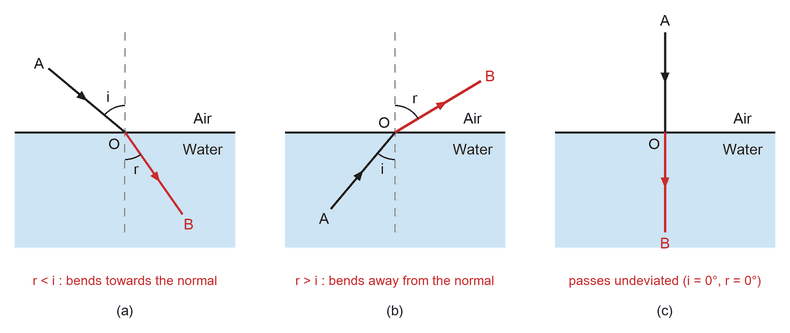
The diagram given below in Fig. 5.38 shows a ray of light AO falling on a surface separating two media. Draw the refracted ray in each, case.

Confirming your payment
Sign up now and get 250 free tokens.
Light Energy · Question 70 of 94
The diagram given below in Fig. 5.38 shows a ray of light AO falling on a surface separating two media. Draw the refracted ray in each, case.
Solution:
Concept: Going from a rarer to a denser medium, a ray bends towards the normal (angle of refraction r less than angle of incidence i). Going from a denser to a rarer medium, it bends away from the normal (r more than i). A ray falling along the normal passes straight through.
Step 1 — Read each case.
In each part, AO is the incident ray, O the point of incidence and the dashed line the normal at O.
Step 2 — Case (a): air to water.
The ray goes from air (rarer) into water (denser), so the refracted ray OB bends towards the normal: r is less than i. In the figure, i = 50° gives r ≈ 35°.
Step 3 — Case (b): water to air.
The ray goes from water (denser) into air (rarer), so OB bends away from the normal: r is more than i. In the figure, i = 40° gives r ≈ 59°.
Step 4 — Case (c): along the normal.
The ray meets the surface normally (i = 0°), so it goes straight on into the water without bending (r = 0°).
Watch out: Draw the angles from the normal, and make r clearly smaller in (a) and clearly larger in (b).
Therefore, the refracted ray bends towards the normal in (a), away from the normal in (b), and passes undeviated in (c).