
Opening your dashboard
Class 8 Physics Chapter 5 Light Energy: Practice Questions
44 questions on Chapter 5, each worked through on its own page with the AI tutor. Class 8 Physics, ICSE 2026-27.
44 questions
1–5 marks · Mixed difficulty
- 11 mark
Question 1
Bloom's level: Remember
A mirage in a desert and seeing the sun a few minutes before it actually rises are both caused by :
- 21 mark
Question 2
Bloom's level: Understand
The speed of light is m s in glass and m s in water. A ray of light passes obliquely from glass into water. It :
- 31 mark
Question 3
Bloom's level: Apply
The refractive index of diamond is 2.4. The speed of light in air is m s. The speed of light in diamond is :
- 41 mark
Question 4
Bloom's level: Apply
A pond is 2 m deep. The refractive index of water is . When seen from directly above, the pond appears to be about :
- 51 mark
Question 5
Bloom's level: Understand
A ray of light falls obliquely on one face of a rectangular glass block and comes out from the opposite face. The emergent ray is :
- 61 mark
Question 6
Bloom's level: Understand
A ray of light of a single colour falls on one face of a glass prism with its base at the bottom. After passing through the prism, the ray :
- 71 mark
Question 7
Bloom's level: Understand
When white light passes through a prism, violet light is bent the most. This is because, in glass :
- 81 mark
Question 8
Bloom's level: Apply
A concave mirror held facing the sun forms a sharp, tiny image of the sun on a sheet of paper 12 cm from the mirror. The radius of curvature of the mirror is :
- 91 mark
Question 9
Bloom's level: Analyse
An object is placed 25 cm in front of a concave mirror of focal length 10 cm. The image formed is :
- 101 mark
Question 10
Bloom's level: Understand
Read the Assertion (A) and the Reason (R) and choose the correct option.
Assertion (A): A convex mirror is used as a rear-view mirror in vehicles.
Reason (R): A convex mirror always forms an erect, diminished image and has a wider field of view than a plane mirror.
- 111 mark
Question 11
Bloom's level: Understand
Read the Assertion (A) and the Reason (R) and choose the correct option.
Assertion (A): A concave mirror is used as a shaving mirror.
Reason (R): A concave mirror always forms a magnified image, wherever the object is placed.
- 121 mark
Question 12
Bloom's level: Remember
Read the Assertion (A) and the Reason (R) and choose the correct option.
Assertion (A): A ray of light that falls normally (along the normal) on a glass surface passes into the glass without bending.
Reason (R): Glass is optically denser than air.
- 132 marks
Question 13
Bloom's level: Remember
Name the phenomenon of light (reflection, refraction or dispersion) responsible for each of the following.
(a) A rainbow after rain
(b) A pencil looks bent when dipped obliquely in water
(c) Seeing your face in a steel spoon
(d) A swimming pool looks shallower than it is
- 142 marks
Question 14
Bloom's level: Remember
In the figure, a ray of light passes from air into glass.
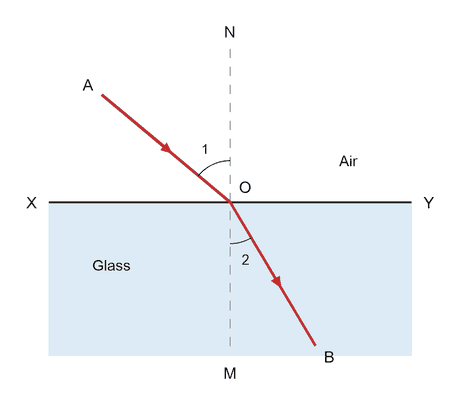
Name (a) AO, (b) OB, (c) NOM, (d) angle 1 and angle 2.
- 152 marks
Question 15
Bloom's level: Apply
The speed of light in a liquid is m s and in air m s. Find the refractive index of the liquid. Is the liquid optically denser or rarer than water (refractive index ) ? Give a reason.
- 162 marks
Question 16
Bloom's level: Understand
We see the sun a few minutes before it actually rises above the horizon and a few minutes after it has actually set. Explain why.
- 172 marks
Question 17
Bloom's level: Analyse
A ray of light falls on the face PQ of a rectangular glass block at an angle of incidence of 50° and comes out from the opposite face RS.
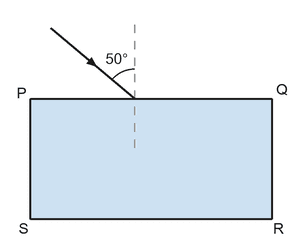
(a) Is the angle of refraction at PQ more or less than 50° ? Why ?
(b) At what angle with the normal does the ray come out of RS ? Explain.
(c) If the ray falls normally on PQ, what is the lateral displacement ?
- 182 marks
Question 18
Bloom's level: Analyse
Compare the path of a ray of light of a single colour through a rectangular glass block with that through a glass prism. State one similarity and one difference, and give the reason for the difference.
- 192 marks
Question 19
Bloom's level: Apply
A concave mirror is cut from a hollow glass sphere of radius 40 cm. Find its radius of curvature and focal length. How far from the pole are its centre of curvature C and its focus F ?
- 202 marks
Question 20
Bloom's level: Apply
A candle is placed 30 cm in front of a concave mirror of focal length 15 cm. Where is the image formed, and what are its nature and size ? Can it be obtained on a screen ?
- 212 marks
Question 21
Bloom's level: Evaluate
A shopkeeper fixes a large convex mirror in a corner of his shop and says, "This mirror makes everything look bigger, so I can see thieves clearly." Evaluate his statement.
- 222 marks
Question 22
Bloom's level: Apply
Where should the bulb be placed in front of a concave mirror (a) in a torch, to get a parallel beam of light; (b) in a flood light, to get a wide, spreading beam ? Give a reason for each.
- 234 marks
Question 23
Bloom's level: Analyse
A student moves a lit candle along the principal axis of a concave mirror and looks for its image on a screen. Her observations are :
Distance of candle from mirror Observation 50 cm small, inverted image on the screen 30 cm inverted image of the same size as the candle, at 30 cm 20 cm large, inverted image on the screen, far from the mirror 10 cm no image on the screen at any position; a large, erect image is seen in the mirror (a) Find the radius of curvature and the focal length of the mirror. Give a reason.
(b) Between which two points was the candle in the 50 cm and the 20 cm readings ?
(c) Explain the observation at 10 cm.
(d) Predict what she will see if she places the candle exactly 15 cm from the mirror.
- 244 marks
Question 24
Bloom's level: Apply
Case study: Ravi, who cannot swim, looks into a clear swimming pool and says, "It is hardly a metre and a half deep - I can stand in it." The lifeguard tells him the pool is actually 2.4 m deep. (Refractive index of water = .)
(a) Why does the pool look shallower than it is ?
(b) Calculate how deep the pool appears when seen from above.
(c) A fisherman on the bank wants to spear a fish he sees in the water. Should he aim at the fish he sees, above it or below it ? Explain.
- 254 marks
Question 25
Bloom's level: Analyse
Case study: After an evening shower, Meena stands with the sun behind her and sees a rainbow in the eastern sky. Her brother says, "The rain has painted colours on the sky."
(a) Name the phenomenon that produces the rainbow and say what the raindrops act like.
(b) Is her brother right ? Where do the colours come from ?
(c) Why do the colours separate at all ? Which colour is bent the most and which the least ? Explain in terms of the speed of light in water.
- 264 marks
Question 26
Bloom's level: Apply
Case study: A village school builds a solar cooker using a large concave mirror cut from a sphere of radius 1.2 m.
(a) Why is a concave mirror, and not a convex mirror, used ?
(b) At what distance from the mirror should the cooking pot be placed ? Show your working.
(c) Before fixing the pot stand, how can the students find this point in practice, using the sun and a sheet of paper ?
- 274 marks
Question 27
Bloom's level: Evaluate
Check these revision notes on refraction and dispersion. Say whether each is correct, and correct the wrong ones.
-
Light travels fastest in glass.
-
A ray going from water into air bends away from the normal.
-
The refractive index of a medium can be less than 1.
-
A prism produces the seven colours of the spectrum.
-
Starting from the base of the prism, the colours of the spectrum are violet, indigo, blue, green, yellow, orange, red.
-
The emergent ray from a rectangular glass block is parallel to the incident ray.
-
- 285 marks
Question 28
Bloom's level: Create
Plan an experiment, using a rectangular glass block, a drawing board, white paper, drawing pins, a few office pins, a protractor and a ruler, to show that the ray coming out of the block is parallel to the ray going in. Include :
(a) the steps you will follow to trace the path of the ray,
(b) the measurements you will take and an observation table,
(c) how your result will show that the emergent ray is parallel to the incident ray,
(d) two precautions.
- 294 marks
Question 29
Bloom's level: Create
A school club wants to project an enlarged, sharp picture of a small, brightly lit slide on to a screen using a concave mirror of focal length 10 cm.
(a) Plan where the slide should be placed relative to F and C, and choose a suitable distance.
(b) Where will the screen have to be placed ? Draw a labelled ray diagram for your arrangement.
(c) The picture on the screen comes out upside down. Suggest how to get an upright picture.
- 303 marks
Question 30
Bloom's level: Evaluate
Three students make claims about spherical mirrors. Judge each claim, with a reason.
(a) Asha : "A convex mirror can never form a real image."
(b) Bina : "A concave mirror gives a magnified image only when the object is between its pole and focus."
(c) Charu : "A real image formed by a mirror is always inverted and can be taken on a screen."
- 311 mark
Question 31
When a ray of light passes obliquely from glass into air :
- 321 mark
Question 32
A girl looks into a mirror and finds that her image is erect and smaller than her face, whether she stands near the mirror or far from it. The mirror is :
- 331 mark
Question 33
The focus of a concave shaving mirror is 12.5 cm from its pole. How far from the pole is the centre of curvature of the mirror ?
- 341 mark
Question 34
Fill in the blank :
The incident ray, the refracted ray and the normal at the point of incidence all lie in the same .............. .
- 351 mark
Question 35
Write true or false :
When white light is dispersed by a glass prism, red light is deviated the most and violet light is deviated the least.
- 362 marks
Question 36
A glass slab 9 cm thick is placed over an ink dot made on a sheet of paper. The refractive index of glass is 1.5. The dot is viewed from vertically above through the slab.
(a) At what depth below the upper surface of the slab does the dot appear to be ?
(b) By how much does the dot appear to be raised ?
- 372 marks
Question 37
A ray of light of a single colour passes from air through a glass prism which stands on its base.
(a) How does the ray bend at each of the two faces of the prism through which it passes ?
(b) Why is the emergent ray not parallel to the incident ray, as it is in the case of a rectangular glass block ?
- 384 marks
Question 38
(a) Draw a labelled diagram to show the path of a ray of light which falls obliquely on one face of a rectangular glass block and comes out from the opposite face. Mark on it the angle of incidence , the angle of refraction , the angle of emergence and the lateral displacement.
(b) How is the angle of emergence related to the angle of incidence ? What does this tell us about the direction of the emergent ray ?
(c) What is meant by lateral displacement ?
- 395 marks
Question 39
A concave mirror has a radius of curvature of 40 cm. An object AB is placed on its principal axis at a distance of 12 cm from the pole P.
(a) Find the focal length of the mirror.
(b) Between which two points on the principal axis does the object lie ?
(c) Draw a ray diagram (not to scale) to show the formation of the image.
(d) State the position, the nature and the size of the image. Name one use of a concave mirror in which the object is kept in this position.
- 404 marks
Question 40
A narrow beam of white light from the sun falls on one face of a glass prism, and the light coming out of the prism is received on a white screen.
(a) What is seen on the screen ? Name the phenomenon that takes place.
(b) Write the colours seen on the screen in order, starting from the colour that is deviated the least.
(c) State the cause of this phenomenon.
- 411 mark
Question 41
In which of the following is the speed of light the maximum ?
- 421 mark
Question 42
Give a reason for the following :
Dispersion of white light occurs when it passes through a prism.
- 431 mark
Question 43
When white light is dispersed by a prism, the colour of light which is deviated (bent) the least is :
- 442 marks
Question 44
State the laws of refraction of light.