
Opening your dashboard
Class 8 Physics Chapter 5 Light Energy: Competency-Based Questions (CBQ)
40 questions on Chapter 5, each worked through on its own page with the AI tutor. Class 8 Physics, ICSE 2026-27.
40 questions
1–5 marks · Mixed difficulty
- 11 mark
Question 1
Competency: Analysis
The figure shows the path of a ray of light as it passes from a transparent medium X into another transparent medium Y. The angles that the ray makes with the normal are marked.

Which conclusion can be drawn from the figure ?
- 21 mark
Question 2
Competency: Application & Analysis
The speed of light in air is . The table gives the speed of light in four transparent materials.
Material Speed of light () P 2.25 Q 2.00 R 2.40 S 1.25 A ray of light from air falls on a flat surface of each material at the same angle of incidence. In which material is the ray bent the most from its path, and what is the refractive index of that material ?
- 31 mark
Question 3
Competency: Application
Arjun can stand safely in water that is up to 1.6 m deep. He looks straight down into a clear swimming pool and judges that the floor of the pool is about 1.5 m below the surface of the water. The refractive index of water is .
What is the real depth of the pool, and should he step in ?
- 41 mark
Question 4
Competency: Analysis
A shopkeeper tests three mirrors X, Y and Z of the same size. She holds a bottle in front of each mirror, first close to it and then far from it, and notes the image she sees in the mirror.
Mirror Bottle 5 cm from the mirror Bottle 2 m from the mirror X erect, larger than the bottle inverted, smaller than the bottle Y erect, smaller than the bottle erect, smaller than the bottle Z erect, same size as the bottle erect, same size as the bottle She wants to fix one mirror high up in a corner so that she can watch as much of the shop as possible. Which mirror should she choose, and what kind of mirror is it ?
- 51 mark
Question 5
Competency: Understanding
Assertion (A): When white light passes through a glass prism, violet light is bent the most and red light is bent the least.
Reason (R): In air, light of all colours travels at the same speed.
- 61 mark
Question 6
Competency: Understanding
Assertion (A): A convex mirror held facing the sun can be used to char a piece of paper kept at its focus.
Reason (R): Rays of light parallel to the principal axis of a convex mirror, after reflection, appear to come from its focus, which lies behind the mirror.
- 72 marks
Question 7
Competency: Analysis & Evaluation
Riya traces the path of a ray of light through a rectangular glass block lying on a sheet of paper. The ray enters one long face and leaves through the opposite, parallel face. She records :
Angle measured with the normal Reading Angle of incidence at the first face 40° Angle of refraction in the glass 25° Angle that the emergent ray makes with the normal 46° (a) Which one of her readings must be a mistake ? What should its value be, and why ?
(b) With the correct value, the emergent ray still does not lie along the line of the incident ray. Name this shift and state how Riya can measure it on her tracing.
- 82 marks
Question 8
Competency: Understanding & Application
In a science exhibition, a narrow beam of red laser light passes through a glass prism that stands on its base, and then makes a spot on a wall.
(a) Compared with the spot made when the prism is taken away, is the spot now higher or lower on the wall ? What happens to the spot if the prism is turned upside down, so that its base is at the top ? Give the reason.
(b) A visitor expects to see a band of seven colours on the wall. Will he see it ? Give a reason.
- 92 marks
Question 9
Competency: Application & Evaluation
A company makes a clear gel for which the refractive index (with respect to air) is 1.2. The speed of light in air is .
(a) Calculate the speed of light in the gel.
(b) An advertisement says that the company's next gel will have a refractive index of 0.8. Use a calculation to judge whether this claim can be true.
- 102 marks
Question 10
Competency: Application
Meera buys a concave make-up mirror whose radius of curvature is 60 cm. When she looks into it from 1 m away, she sees a small, upside-down image of her face.
(a) Find the focal length of the mirror.
(b) Explain why her image is upside down, and state how far from the mirror her face should be for the mirror to work as a make-up mirror.
- 114 marks
Question 11
Competency: Application & Analysis
Case study: To plan a small projector for a class project, Kabir draws a ray diagram to scale on squared paper. AB is a lighted object standing on the principal axis of a concave mirror, and A'B' is its image. P is the pole of the mirror, F its focus and C its centre of curvature.
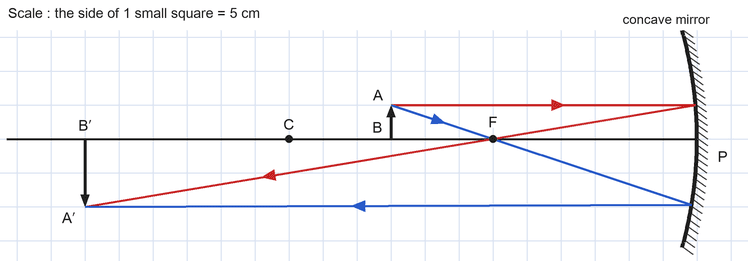
(a) Use the scale to find the focal length and the radius of curvature of the mirror, in cm.
(b) Read from the diagram the distance of the object and of the image from the pole, and the height of each. How many times as tall as the object is the image ? Is the image real or virtual ? Give a reason from the diagram.
(c) Kabir wants the picture on the screen to be of the same size as the object. How far from the pole should he place the object, and where must the screen be ? If, instead, he moves the object to 20 cm from the pole, why does he get no picture on the screen at all ?
- 124 marks
Question 12
Competency: Analysis
Case study: Three identical tall glass jars contain three different clear liquids, each to a depth of 24 cm. A coin lies at the bottom of each jar. Looking from straight above, a student measures how far below the surface the coin appears to be.
Jar Real depth of liquid (cm) Apparent depth of coin (cm) P 24 18 Q 24 16 R 24 15 The speed of light in air is .
(a) Why does the coin in every jar appear to be nearer to the surface than it really is ?
(b) Calculate the refractive index of each liquid. One of the liquids is water. Which jar contains it ?
(c) In which liquid does light travel the slowest ? Calculate the speed of light in that liquid.
- 133 marks
Question 13
Competency: Analysis & Evaluation
Case study: Zoya lets a narrow beam of sunlight pass through a slit in a dark room. Without a prism, the beam makes a white spot on the opposite wall, 60 cm above the floor. She then places a glass prism, standing on its base, in the path of the beam. A band of colours appears on the wall, and she marks the height of some of the colours above the floor.
Colour Height above the floor (cm) Red 42 Yellow 40 Green 38 Violet 35 (a) By how many centimetres has the red light been shifted on the wall ? And the violet light ? Which of the two is bent more by the prism ?
(b) Explain why the different colours of sunlight are bent by different amounts in the prism.
(c) Zoya's brother says, "The glass of the prism adds the colours to the light." Judge this statement, and describe one simple activity whose result goes against it.
- 143 marks
Question 14
Competency: Application & Analysis
Case study: Dev builds a torch using a small bulb and a concave reflector. He can slide the bulb along the principal axis of the reflector. In a dark room he notes what the reflected light does for three positions of the bulb.
Distance of bulb from the pole of the reflector Reflected light 1 cm spreads out widely; only a faint patch on the far wall 2 cm a narrow beam of the same width all along; a bright spot on the far wall 4 cm closes in to a point 4 cm from the reflector, then spreads out (a) What is the focal length of the reflector ? Give the reason for your answer.
(b) Find the radius of curvature of the reflector, and use it to explain the observation made with the bulb at 4 cm.
(c) Dev's friend suggests using a flat (plane) mirror behind the bulb in place of the concave reflector, to save money. Would the torch still throw a bright spot on a far wall ? Give a reason.
- 154 marks
Question 15
Competency: Creation
A school laboratory has three mirrors of the same size in identical frames, with no labels: one plane, one concave and one convex. Their surfaces must not be touched. You are given a metre ruler, a sheet of white paper and a sunny window.
(a) Plan a way to find out which mirror is which, only by looking at the image of your own face in each. State what you expect to see in each mirror.
(b) Plan a method to find the approximate focal length of the concave mirror. Include two precautions.
(c) Draw up a table for your readings and show how the focal length and the radius of curvature will be worked out from it.
- 161 mark
Question 16
Competency: Analysis
Four students P, Q, R and S send a ray of light across the boundary between two transparent media and measure the angles that the rays make with the normal. Their records are in the table. (Hypothetical data.)
Student Ray goes from to Angle of incidence Angle of refraction P air water Q glass air R water glass S air glass The speed of light is in air, in water and in glass. Which record cannot be correct?
- 171 mark
Question 17
Competency: Application
A narrow ray of light travels in water and falls on a boundary with glass at to the normal. The speed of light is in water and in glass. Take .
Which option gives the refractive index of glass with respect to water, and the angle of refraction with the way the ray bends?
- 181 mark
Question 18
Competency: Understanding & Analysis
In a dark room, a narrow beam of sunlight passes through a glass prism and makes a band of seven colours on a white screen. Then Meera places a thick rectangular glass block, instead of the prism, in the path of the same narrow beam, with the beam falling obliquely on one of its large faces. She sees a single patch of light on the screen, shifted a little to one side, which looks almost white.
Which statement explains why the block does not give a band of seven colours?
- 191 mark
Question 19
Competency: Analysis
A ray of light PQ falls on the face AB of a glass prism ABC and travels inside the prism along QR, as shown in the figure. Four students draw the path of the ray after it leaves the prism at R as the lines 1, 2, 3 and 4.
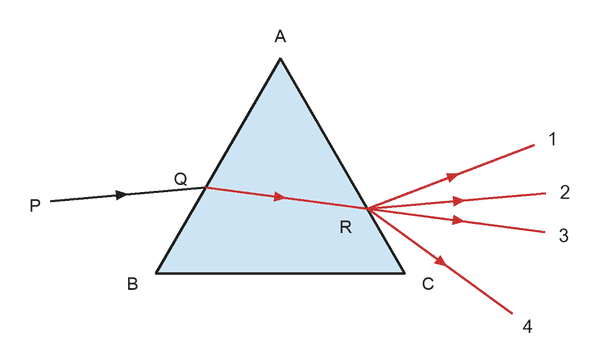
Which line shows the correct path of the emergent ray?
- 201 mark
Question 20
Competency: Analysis
Two rays parallel to the principal axis fall on a concave mirror whose pole is P. After reflection the two rays meet at the point X on the principal axis, as shown. The points W, X, Y and Z lie on the principal axis, and the scale below the axis is in cm, measured from P.
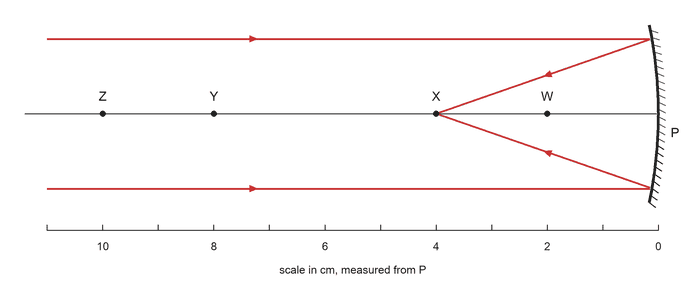
Which of the marked points is the centre of curvature of the mirror?
- 211 mark
Question 21
Competency: Application & Analysis
Kavya holds a concave mirror towards the sun and moves a card until she gets a sharp, tiny bright spot on it, 15 cm from the mirror. She now wants a real, inverted and enlarged image of a lighted candle on a screen. She can place the candle, one at a time, at 10 cm, 15 cm, 22 cm or 36 cm from the mirror.
At which distance should she place the candle?
- 221 mark
Question 22
Competency: Understanding
Assertion (A): Light takes longer to pass through a glass window pane than through a layer of air of the same thickness.
Reason (R): Light travels faster in glass than in air.
- 231 mark
Question 23
Competency: Understanding & Analysis
Assertion (A): When a narrow beam of white light passes through a glass prism standing on its base, light of every colour comes out bent towards the base of the prism.
Reason (R): Glass bends violet light more than red light.
- 241 mark
Question 24
Competency: Evaluation
A science club makes a chart of mirrors used for different jobs. Each row of the chart gives the job, the kind of mirror, and a reason. One row has a mistake.
Row Job Mirror Reason given P Fixed at a sharp bend of a hill road to show approaching vehicles convex It gives a wide field of view and an erect, smaller image Q Held close to a tooth by a dentist concave The tooth is between the pole and the focus, so the image is erect and enlarged R Rear-view mirror of a motorcycle convex It always forms an erect, diminished image S Collecting sunlight at one point in a solar cooker convex It brings the parallel rays of the sun together at its focus Which option correctly names the row with the mistake and the reason?
- 251 mark
Question 25
Competency: Understanding & Application
Seema looks at a lamp post outside through a thick, flat glass window pane. When she looks straight at the post, along the normal to the pane, it is in its true position. When she looks at it from the side, through the pane at a slant, the post seems to be shifted a little to one side.
Which statement explains what she sees?
- 262 marks
Question 26
Competency: Analysis
A fish swimming under the surface of a calm pond looks up at a bird sitting on a branch beside the pond. The bird is not directly above the fish.
(a) Does the fish see the bird higher or lower than the bird's real position?
(b) Explain your answer by following the bending of a ray of light from the bird as it enters the water.
- 272 marks
Question 27
Competency: Application
Arjun traces the path of a ray of light that passes from air into a rectangular glass block lying on a sheet of paper. For an angle of incidence of he measures the angle of refraction as . Before he measures again, he wants to predict the angle of refraction for an angle of incidence of . Use , , and . (Hypothetical data.)
(a) Use his first reading to find the refractive index of the glass with respect to air.
(b) Use the second law of refraction to predict the angle of refraction for an angle of incidence of .
- 282 marks
Question 28
Competency: Analysis & Evaluation
In a dark room, Neha sends a narrow beam of light of a single colour (from a lamp with a green filter) through a glass prism P1 standing on its base. She then places a second, identical prism P2 just beyond P1, upside down (base at the top), so that the face of P2 next to P1 is parallel to the face of P1 from which the beam comes out. The beam passes through P1 and then P2.
(a) In which direction is the beam bent in P1, and in which direction in P2? Give a reason.
(b) How does the direction of the beam that comes out of P2 compare with the direction of the beam falling on P1? Name the glass object whose effect the pair of prisms copies.
- 292 marks
Question 29
Competency: Application & Analysis
A concave mirror has a radius of curvature of 36 cm. In a dark room, Divya places a lighted candle exactly at the focus of the mirror and holds a white wall 2 m in front of the mirror.
(a) Find the distance of the candle from the mirror.
(b) Divya expects a sharp image of the flame on the wall. Will she get one? Give a reason.
- 302 marks
Question 30
Competency: Analysis
A student places a candle 6 cm tall in front of a convex mirror of radius of curvature 40 cm, at four different distances, and measures the image each time. (Hypothetical data.)
Distance of candle from the mirror (cm) Distance of image from the mirror (cm) Height of image (cm) 100 16.7 1.0 60 15.0 1.5 40 13.3 2.0 20 10.0 3.0 (a) Describe how the position and the size of the image change as the candle is brought nearer the mirror.
(b) Can she ever get an image taller than the candle? Give a reason from the table and from the nature of the image.
- 312 marks
Question 31
Competency: Application
A shiny steel ball of diameter 6 cm lies in the sun. The outside surface of the ball acts as a convex mirror.
(a) Find the radius of curvature and the focal length of this mirror.
(b) Where does the image of the sun appear, and can it be caught on a card? Give a reason.
- 323 marks
Question 32
Competency: Analysis & Application
A teacher measures the speed of light of three colours in a block of glass. The speed of light in air is for every colour. (Hypothetical data.)
Colour Speed in the glass () Red 2.00 Green 1.96 Violet 1.92 (a) Find the refractive index of the glass for each of the three colours.
(b) Which colour will a prism made of this glass bend the most, and which the least? Write the three colours in the order in which they will fall on a screen, starting from the side of the base of the prism.
(c) Explain, using the speeds, why the colours get separated.
- 333 marks
Question 33
Competency: Evaluation
A teacher shows refraction with a toy cart. A pair of wheels joined by an axle rolls from a smooth tile floor on to a rough carpet strip, which it meets at an angle. The cart slows down on the carpet. The teacher says, "The cart turns towards the normal to the edge of the carpet, just as a ray of light turns towards the normal when it enters glass."
(a) The cart meets the edge of the carpet at an angle, so that its left wheel reaches the carpet first. What happens to the speed of the left wheel while the right wheel is still on the tile?
(b) Explain why this makes the cart turn towards the normal.
(c) Give one way in which the cart does not behave like light.
- 343 marks
Question 34
Competency: Application & Analysis
In a dark room, Rahul has a concave mirror whose radius of curvature is 32 cm, a lighted candle and a white screen. He places the candle on the principal axis, first 50 cm from the mirror (position A) and later 24 cm from the mirror (position B). Each time he moves the screen to catch a sharp image of the flame. (Hypothetical data.)
(a) Find the focal length of the mirror. Where does the candle lie in each position, compared with the focus F and the centre of curvature C?
(b) For each position, state between which distances from the mirror (in cm) the image is formed, and describe the image.
(c) Rahul wants to keep the screen at one place and get a sharp image for both positions of the candle. Can he? For which position must the screen be farther from the mirror?
- 353 marks
Question 35
Competency: Analysis
Light in air falls at on the surface of three clear liquids P, Q and R in turn. The angles of refraction are measured. Take and the speed of light in air as . (Hypothetical data.)
Liquid Angle of refraction P 0.651 Q 0.578 R 0.500 (a) Find the refractive index of each liquid with respect to air.
(b) One of the liquids is water. Which one is it, and what is the speed of light in it?
(c) In which liquid is the speed of light the least? Give a reason from the table.
- 363 marks
Question 36
Competency: Evaluation
An advertisement for a concave make-up mirror makes three claims. Judge each claim as true or false, and give a reason.
(a) "Our mirror magnifies your face from any distance."
(b) "Because it magnifies, it is also the best mirror to use as the rear-view mirror of a car."
(c) "Do not leave it facing a sunny window, because it can focus sunlight on a point and start a fire."
- 374 marks
Question 37
Competency: Analysis
Case study: In the school laboratory, Mohan traces the path of a ray of light through rectangular glass blocks of the same glass, lying on a sheet of paper. In each trial he marks the incident ray and the emergent ray with pins, takes the block away, and measures the lateral displacement, which is the perpendicular distance between the incident ray and the emergent ray. His results are in the table. (Hypothetical data.)
Trial Thickness of block (cm) Angle of incidence Lateral displacement (cm) 1 4 0.49 2 4 1.12 3 4 2.05 4 2 0.56 5 6 1.68 (a) Use trials 1, 2 and 3 to say how the lateral displacement changes with the angle of incidence. What would it be if the ray fell along the normal? Give a reason.
(b) Use trials 2, 4 and 5 to find the displacement for each centimetre of thickness. What do you conclude? Predict the displacement for a 5 cm block at .
(c) A student says, "A thin window pane, 3 mm thick, does not shift a ray at all." Use your result from part (b) to judge this statement for a ray falling at .
- 385 marks
Question 38
Competency: Analysis & Evaluation
Case study: On a hot summer afternoon, Ishaan is cycling along a straight road. Far ahead, the road looks wet and he sees an upside-down image of a tree beside it, although the road is dry. His teacher measures the temperature of the air at different heights above the road. The figure shows the air near the road as five layers, with the differences in their refractive index exaggerated. A ray of light goes from a point T on the tree to Ishaan's eye E, and the dashed line shows where he sees the image T'. (Hypothetical data.)
Height above the road (cm) 150 100 50 10 2 Temperature of the air (C) 33 35 39 47 58 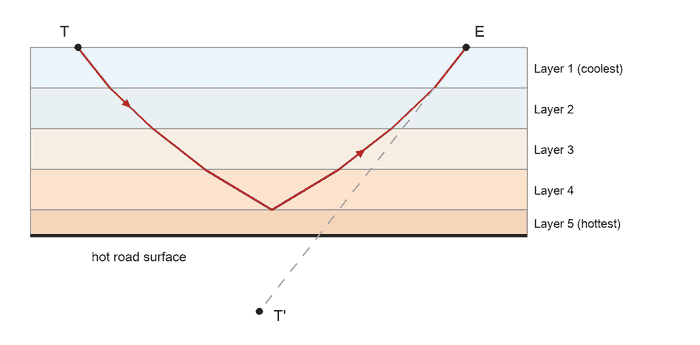
(a) From the table, where is the air hottest? Is it optically rarer or denser than the air above it? Give a reason.
(b) Describe how the ray from T bends as it goes down through layers 1 to 4, and what happens to it near layer 5.
(c) Explain why Ishaan sees the image below the road, upside down, and takes it for water.
- 394 marks
Question 39
Competency: Creation
Case study: Zara's class has to find the refractive index of water. Her teacher reminds them that, seen from straight above, a coin at the bottom of a vessel of water appears to be nearer to the surface than it really is, and that the refractive index is the real depth divided by the apparent depth. The laboratory has a tall transparent glass tank, water, a coin, a metre scale, a pin fixed in a cork and a clamp stand that can hold the pin just outside the tank, beside its glass wall, at any height. (Hypothetical data.)
(a) Plan how Zara can measure the real depth and the apparent depth of the coin. How can she tell when the tip of the pin is at the same level as the image of the coin?
(b) Draw up a table for three readings with different depths of water, and show how the refractive index is worked out from it.
(c) State two precautions. What value should she get? What would you conclude if she got 1.6?
- 405 marks
Question 40
Competency: Evaluation & Analysis
Case study: At a blind turn in a narrow hill lane, the local council wants to fix a mirror so that drivers can see the vehicles coming from round the bend. Two mirrors of the same size are tested, one after the other, from the same spot. Six cars stand in a row on the road beyond the bend, the nearest one 10 m from the mirror. Five drivers each estimate the distance of the nearest car from what they see in the mirror. (Hypothetical data.)
Mirror Number of cars seen Average estimate of the distance of the nearest car (m) Plane mirror 2 10 Convex mirror 5 17 (a) Which mirror shows more cars? Explain why, using the way a convex mirror reflects light.
(b) Why do the drivers think the nearest car is farther away than it really is when they use the convex mirror? Why can this be dangerous?
(c) Which mirror would you recommend for the bend? Give a reason, and one piece of advice for drivers who use it.