
Opening your dashboard
Class 7 Maths Chapter 19: Symmetry Solutions
79 textbook questions with step-by-step answers, free to read, for ICSE 2026-27.
Get talked through Ch 19, not just shown the answer
Reading a finished solution is not the same as being able to do it. The AI tutor takes one question at a time and works it with you, in your own words, until you can.
- Ask it out loud, in your own words
- It gives you the next step, not the answer
- Stuck on part (ii)? Start there
79 questions with solutions
1–3 marks · Mixed difficulty
- 13 marks
Question 1
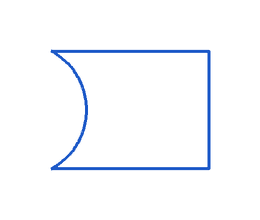
For each figure, given below, draw the line(s) of symmetry, if possible :
(i)
 Solve with AI
Written solution
Solution:
Concept: A line of symmetry (axis of symmetry) divides a figure into two parts that fit exactly on each other when the figure is folded along that line, so each part is the mirror image of the other.
Step 1 — Look at the figure.
The figure is a rectangle whose left side is replaced by an arc curving inwards. The arc is centred on the middle of the left side, so it bulges in equally above and below that middle.
Step 2 — Test the folds.
If we fold along the horizontal line through the middle of the left and right sides, the top side falls on the bottom side and the upper half of the arc falls on the lower half. A vertical fold does not work, because the left side is curved and the right side is straight.

Watch out: Two parts of equal size are not enough; they must fall exactly on each other when folded along the line, as mirror images.
Therefore, the figure has exactly one line of symmetry: the horizontal line through the middle of its left and right sides.
- 23 marks
Question 2
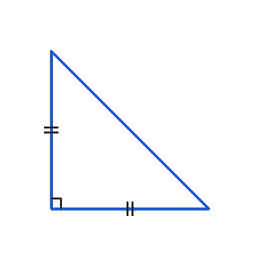
For each figure, given below, draw the line(s) of symmetry, if possible :
(ii)
 Solve with AI
Written solution
Solution:
Concept: A line of symmetry (axis of symmetry) divides a figure into two parts that fit exactly on each other when the figure is folded along that line, so each part is the mirror image of the other.
Step 1 — Look at the figure.
The triangle has a right angle, and the two arms of the right angle are marked equal (the double ticks). So it is an isosceles right-angled triangle, and its two acute angles are each 45°.
Step 2 — Find the fold.
When we fold along the bisector of the right angle, the two equal arms fall on each other and the third side (the hypotenuse) folds onto itself at its mid-point. So this bisector is a line of symmetry.
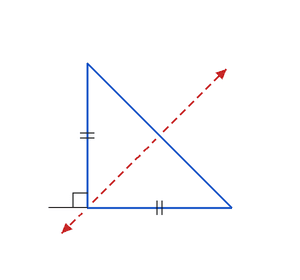
Step 3 — Check other lines.
No other fold works: the hypotenuse is longer than the arms, so no fold can put it on an arm.
Therefore, the triangle has exactly one line of symmetry, the bisector of its right angle.
- 33 marks
Question 3
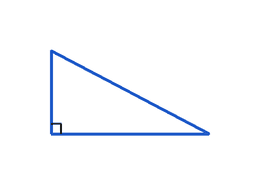
For each figure, given below, draw the line(s) of symmetry, if possible :
(iii)
 Solve with AI
Written solution
Solution:
Concept: A line of symmetry (axis of symmetry) divides a figure into two parts that fit exactly on each other when the figure is folded along that line, so each part is the mirror image of the other.
Step 1 — Look at the figure.
The triangle has a right angle, but its two arms are of different lengths. So all three sides are different: it is a scalene right-angled triangle.
Step 2 — Test the folds.
A line of symmetry of a triangle would have to fold one side onto another equal side. Here no two sides are equal, so no fold makes one part fall exactly on the other.
Watch out: A right angle alone does not give a line of symmetry; the two arms of the right angle must also be equal.
Therefore, a line of symmetry is not possible for this figure.
- 43 marks
Question 4
For each figure, given below, draw the line(s) of symmetry, if possible :
(iv)
 Solve with AI
Written solution
Solution:
Concept: A line of symmetry (axis of symmetry) divides a figure into two parts that fit exactly on each other when the figure is folded along that line, so each part is the mirror image of the other.
Step 1 — Look at the figure.
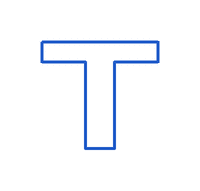
The figure is a T shape: a top bar with an upright stem standing in the middle of it.
Step 2 — Find the fold.
The stem is exactly in the middle of the bar, so folding along the vertical line through the middle of the stem puts the left half of the bar on the right half and the two sides of the stem on each other.

Step 3 — Check other lines.
A horizontal fold does not work, because the bar is at the top only.
Therefore, the T shape has exactly one line of symmetry, the vertical line through the middle of its stem.
- 53 marks
Question 5
For each figure, given below, draw the line(s) of symmetry, if possible :
(v)
 Solve with AI
Written solution
Solution:
Concept: A line of symmetry (axis of symmetry) divides a figure into two parts that fit exactly on each other when the figure is folded along that line, so each part is the mirror image of the other.
Step 1 — Look at the figure.
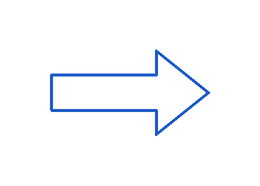
The figure is an arrow pointing to the right: a straight shaft with a triangular head.
Step 2 — Find the fold.
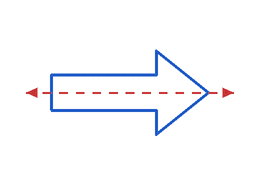
The shaft and the head spread out equally above and below the middle of the arrow, so folding along the horizontal line through its middle puts the upper half exactly on the lower half.
Step 3 — Check other lines.
A vertical fold does not work, because the head is only at the right end.
Therefore, the arrow has exactly one line of symmetry, the horizontal line along its middle.
- 63 marks
Question 6
For each figure, given below, draw the line(s) of symmetry, if possible :
(vi)
 Solve with AI
Written solution
Solution:
Concept: A line of symmetry (axis of symmetry) divides a figure into two parts that fit exactly on each other when the figure is folded along that line, so each part is the mirror image of the other.
Step 1 — Look at the figure.
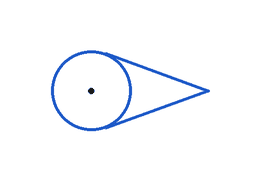
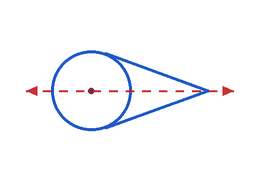
The figure is a circle (centre marked) with two tangents drawn from one point outside it; the two tangents meet at that point, giving a cone (ice-cream) shape.
Step 2 — Find the fold.
Two tangents drawn from one outside point are equal and are placed alike on the two sides of the line joining that point to the centre. So folding along the line through the centre and the meeting point puts one tangent exactly on the other, and the circle onto itself.
Step 3 — Check other lines.
Any other line through the centre would fold the circle onto itself but would send the pointed part to some other place, so it is not a line of symmetry.
Therefore, the figure has exactly one line of symmetry, the line through the centre of the circle and the point where the tangents meet.
- 73 marks
Question 7
For each figure, given below, draw the line(s) of symmetry, if possible :
(vii)
 Solve with AI
Written solution
Solution:
Concept: A line of symmetry (axis of symmetry) divides a figure into two parts that fit exactly on each other when the figure is folded along that line, so each part is the mirror image of the other.
Step 1 — Look at the figure.
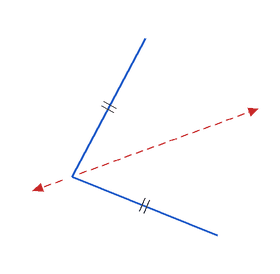
The figure is an angle whose two arms are marked equal (double ticks).
Step 2 — Find the fold.
Folding along the bisector of the angle puts one arm exactly on the other, because the two arms make equal angles with the bisector and have the same length.
Watch out: The line of symmetry bisects the angle; it does not join the free ends of the arms.
Therefore, the figure has exactly one line of symmetry, the bisector of the angle.
- 83 marks
Question 8
For each figure, given below, draw the line(s) of symmetry, if possible :
(viii)
 Solve with AI
Written solution
Solution:
Concept: A line of symmetry (axis of symmetry) divides a figure into two parts that fit exactly on each other when the figure is folded along that line, so each part is the mirror image of the other.
Step 1 — Look at the figure.
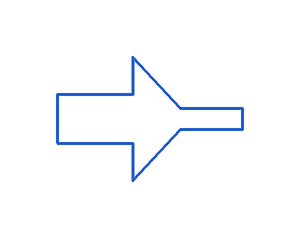
The figure is a broad arrow: a wide tail on the left, a pointed head in the middle and a narrow strip on the right.
Step 2 — Find the fold.
Every part (tail, head and strip) is placed evenly above and below the middle horizontal line, so folding along that line puts the upper half on the lower half.

Step 3 — Check other lines.
A vertical fold does not work, because the left and right ends are different.
Therefore, the figure has exactly one line of symmetry, the horizontal line through its middle.
- 93 marks
Question 9
Write capital letters A to Z of English alphabet and in each case, if possible, draw the largest number of lines of symmetry.
Solve with AIWritten solution
Solution:
Concept: A line of symmetry (axis of symmetry) divides a figure into two parts that fit exactly on each other when the figure is folded along that line, so each part is the mirror image of the other.
Step 1 — Test a vertical line.
A vertical line works when the left half of the letter is the mirror image of the right half. This is true for A, M, T, U, V, W and Y, and also for H, I, O and X.
Step 2 — Test a horizontal line.
A horizontal line works when the top half is the mirror image of the bottom half. This is true for B, C, D, E and K, and also for H, I, O and X.
Step 3 — Draw and sort the letters.
We draw each letter with its lines of symmetry dotted. H, I, O and X have both lines, so they have two; the other ten letters have none.
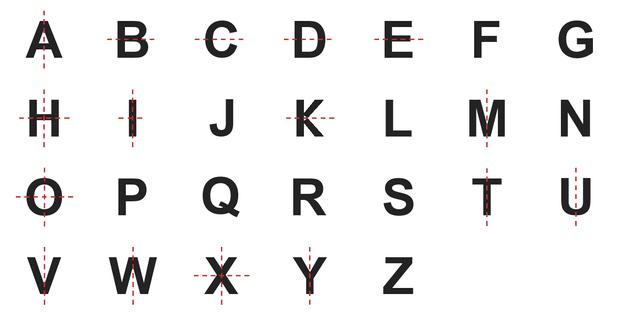
Lines of symmetry Letters One (vertical) A, M, T, U, V, W, Y One (horizontal) B, C, D, E, K Two (vertical and horizontal) H, I, O, X None F, G, J, L, N, P, Q, R, S, Z Watch out: N, S and Z look the same after a half turn, but that is rotational symmetry, not a line of symmetry; they have no line.
Note: The answer depends a little on how the letters are written. It assumes plain capital letters, with O drawn as an oval and K drawn with both arms starting from the middle of its upright.
Therefore, A, M, T, U, V, W and Y have one vertical line; B, C, D, E and K have one horizontal line; H, I, O and X have two lines; F, G, J, L, N, P, Q, R, S and Z have none.
- 103 marks
Question 10
By drawing a free hand sketch of each of the following, draw in each case, the line(s) of symmetry, if any :
(i) a scalene triangle
Solve with AIWritten solution
Solution:
Concept: A line of symmetry (axis of symmetry) divides a figure into two parts that fit exactly on each other when the figure is folded along that line, so each part is the mirror image of the other.
Step 1 — Recall the shape.
A scalene triangle has all three sides of different lengths.
Step 2 — Test the folds.
A fold would have to put one side on another equal side. No two sides are equal, so no fold makes the two parts fit.
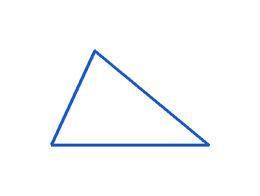
Therefore, a scalene triangle has no line of symmetry.
- 113 marks
Question 11
By drawing a free hand sketch of each of the following, draw in each case, the line(s) of symmetry, if any :
(ii) an isosceles right angled triangle
Solve with AIWritten solution
Solution:
Concept: A line of symmetry (axis of symmetry) divides a figure into two parts that fit exactly on each other when the figure is folded along that line, so each part is the mirror image of the other.
Step 1 — Recall the shape.
An isosceles right-angled triangle has a right angle whose two arms are equal.
Step 2 — Find the fold.
Folding along the bisector of the right angle puts the two equal arms on each other, and the third side folds onto itself at its mid-point.
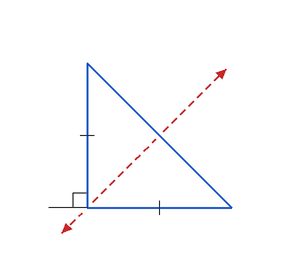
Therefore, an isosceles right-angled triangle has one line of symmetry, the bisector of its right angle.
- 123 marks
Question 12
By drawing a free hand sketch of each of the following, draw in each case, the line(s) of symmetry, if any :
(iii) a rhombus
Solve with AIWritten solution
Solution:
Concept: A line of symmetry (axis of symmetry) divides a figure into two parts that fit exactly on each other when the figure is folded along that line, so each part is the mirror image of the other.
Step 1 — Recall the shape.
A rhombus has all four sides equal, and each diagonal bisects the angles at its two ends.
Step 2 — Find the folds.
Folding along either diagonal puts two equal sides on the other two equal sides, so each diagonal is a line of symmetry.
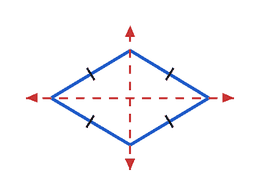
Step 3 — Check other lines.
The lines joining the mid-points of opposite sides do not work, because the angles of a rhombus are not all equal (unless it is a square).
Watch out: A rhombus is not a square; its lines of symmetry are the diagonals, not the lines through mid-points of sides.
Therefore, a rhombus has two lines of symmetry, its two diagonals.
- 133 marks
Question 13
By drawing a free hand sketch of each of the following, draw in each case, the line(s) of symmetry, if any :
(iv) a kite shaped figure
Solve with AIWritten solution
Solution:
Concept: A line of symmetry (axis of symmetry) divides a figure into two parts that fit exactly on each other when the figure is folded along that line, so each part is the mirror image of the other.
Step 1 — Recall the shape.
A kite has two pairs of equal sides, and the equal sides are next to each other.
Step 2 — Find the fold.
The diagonal through the two vertices where the equal sides meet (the long diagonal) divides the kite into two triangles that are mirror images, so it is a line of symmetry.
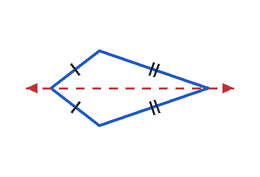
Step 3 — Check other lines.
The other diagonal does not work, because the two unequal pairs of sides lie on its two sides.
Therefore, a kite has one line of symmetry, the diagonal through the vertices where its equal sides meet.
- 143 marks
Question 14
By drawing a free hand sketch of each of the following, draw in each case, the line(s) of symmetry, if any :
(v) a rectangle
Solve with AIWritten solution
Solution:
Concept: A line of symmetry (axis of symmetry) divides a figure into two parts that fit exactly on each other when the figure is folded along that line, so each part is the mirror image of the other.
Step 1 — Recall the shape.
A rectangle has opposite sides equal and all four angles equal to 90°.
Step 2 — Find the folds.
Folding along the line joining the mid-points of the two longer sides puts the left half on the right half; folding along the line joining the mid-points of the two shorter sides puts the top half on the bottom half.
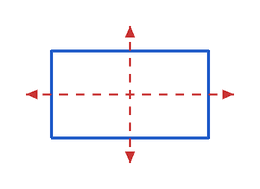
Step 3 — Check other lines.
A diagonal does not work, because the sides next to each other are unequal (unless the rectangle is a square).
Watch out: The diagonals of a rectangle are equal, but they are not lines of symmetry.
Therefore, a rectangle has two lines of symmetry, the lines joining the mid-points of its opposite sides.
- 153 marks
Question 15
By drawing a free hand sketch of each of the following, draw in each case, the line(s) of symmetry, if any :
(vi) a square
Solve with AIWritten solution
Solution:
Concept: A line of symmetry (axis of symmetry) divides a figure into two parts that fit exactly on each other when the figure is folded along that line, so each part is the mirror image of the other.
Step 1 — Recall the shape.
A square has all sides equal and all angles 90°, so it is both a rectangle and a rhombus.
Step 2 — Find the folds.
Like a rectangle, it folds along the two lines joining the mid-points of opposite sides; like a rhombus, it folds along its two diagonals.
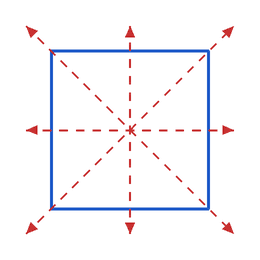
Therefore, a square has four lines of symmetry: its two diagonals and the two lines joining the mid-points of opposite sides.
- 163 marks
Question 16
By drawing a free hand sketch of each of the following, draw in each case, the line(s) of symmetry, if any :
(vii) an isosceles triangle.
Solve with AIWritten solution
Solution:
Concept: A line of symmetry (axis of symmetry) divides a figure into two parts that fit exactly on each other when the figure is folded along that line, so each part is the mirror image of the other.
Step 1 — Recall the shape.
An isosceles triangle has two equal sides, which meet at its vertex.
Step 2 — Find the fold.
The line from this vertex to the mid-point of the base bisects the vertex angle and is perpendicular to the base. Folding along it puts one equal side on the other.
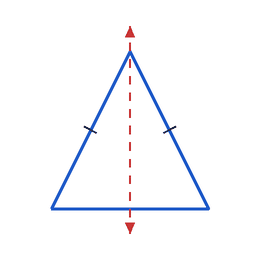
Therefore, an isosceles triangle has one line of symmetry, the bisector of its vertex angle (the perpendicular bisector of its base).
- 173 marks
Question 17
Draw a triangle with :
(i) no line of symmetry,
In each case, if possible, represent the line(s) of symmetry by dotted lines. Also, write the specific name of the triangle drawn.
Solve with AIWritten solution
Solution:
Concept: A line of symmetry (axis of symmetry) divides a figure into two parts that fit exactly on each other when the figure is folded along that line, so each part is the mirror image of the other. A line of symmetry of a triangle passes through a vertex and folds the two sides at that vertex onto each other, so those two sides must be equal.
Step 1 — Choose the triangle.
A triangle with no line of symmetry must have no two sides equal, so we draw a scalene triangle.
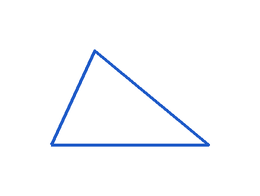
Step 2 — Check.
No two sides are equal, so no fold makes the parts fit; there is no line to draw.
Therefore, the triangle drawn is a scalene triangle.
- 183 marks
Question 18
Draw a triangle with :
(ii) only one line of symmetry,
In each case, if possible, represent the line(s) of symmetry by dotted lines. Also, write the specific name of the triangle drawn.
Solve with AIWritten solution
Solution:
Concept: A line of symmetry (axis of symmetry) divides a figure into two parts that fit exactly on each other when the figure is folded along that line, so each part is the mirror image of the other. A line of symmetry of a triangle passes through a vertex and folds the two sides at that vertex onto each other, so those two sides must be equal.
Step 1 — Choose the triangle.
A triangle with exactly two equal sides has one line of symmetry, so we draw an isosceles triangle.
Step 2 — Draw the line.
Its only line of symmetry is the bisector of the angle between the equal sides; we draw it dotted.
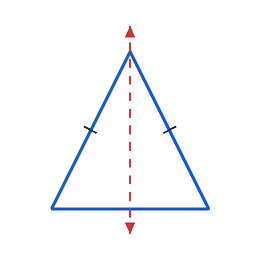
Therefore, the triangle drawn is an isosceles triangle, with its one line of symmetry dotted.
- 193 marks
Question 19
Draw a triangle with :
(iii) exactly two lines of symmetry,
In each case, if possible, represent the line(s) of symmetry by dotted lines. Also, write the specific name of the triangle drawn.
Solve with AIWritten solution
Solution:
Concept: A line of symmetry (axis of symmetry) divides a figure into two parts that fit exactly on each other when the figure is folded along that line, so each part is the mirror image of the other. A line of symmetry of a triangle passes through a vertex and folds the two sides at that vertex onto each other, so those two sides must be equal.
Step 1 — Count the equal sides needed.
Each line of symmetry makes the two sides at one vertex equal. Two lines of symmetry make two different pairs of sides equal, so all three sides are equal.
Step 2 — See what follows.
A triangle with all three sides equal is equilateral, and an equilateral triangle has a third line of symmetry as well (through its third vertex). So it has three lines, never exactly two.
Therefore, a triangle with exactly two lines of symmetry is not possible.
- 203 marks
Question 20
Draw a triangle with :
(iv) exactly three lines of symmetry,
In each case, if possible, represent the line(s) of symmetry by dotted lines. Also, write the specific name of the triangle drawn.
Solve with AIWritten solution
Solution:
Concept: A line of symmetry (axis of symmetry) divides a figure into two parts that fit exactly on each other when the figure is folded along that line, so each part is the mirror image of the other. A line of symmetry of a triangle passes through a vertex and folds the two sides at that vertex onto each other, so those two sides must be equal.
Step 1 — Choose the triangle.
Three lines of symmetry need all three pairs of sides equal, so we draw an equilateral triangle.
Step 2 — Draw the lines.
The line from each vertex to the mid-point of the opposite side is a line of symmetry; we draw all three dotted. They meet at one point inside the triangle.
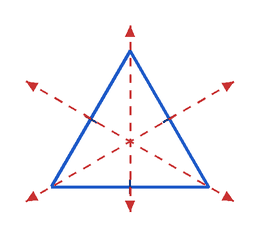
Therefore, the triangle drawn is an equilateral triangle, with its three lines of symmetry dotted.
- 213 marks
Question 21
Draw a triangle with :
(v) more than three lines of symmetry.
In each case, if possible, represent the line(s) of symmetry by dotted lines. Also, write the specific name of the triangle drawn.
Solve with AIWritten solution
Solution:
Concept: A line of symmetry (axis of symmetry) divides a figure into two parts that fit exactly on each other when the figure is folded along that line, so each part is the mirror image of the other. A line of symmetry of a triangle passes through a vertex and folds the two sides at that vertex onto each other, so those two sides must be equal.
Step 1 — Count the possible lines.
Every line of symmetry of a triangle passes through one of its three vertices, and each vertex can give at most one line (the bisector of its angle).
Step 2 — Conclude.
So a triangle has at most three lines of symmetry, which an equilateral triangle reaches. More than three is impossible.
Therefore, a triangle with more than three lines of symmetry is not possible; the most is three, for an equilateral triangle.
- 223 marks
Question 22
Draw a quadrilateral with :
(i) no line of symmetry.
In each case, if possible, represent the line(s) of symmetry by dotted lines. Also, write the specific name of the quadrilateral drawn.
Solve with AIWritten solution
Solution:
Concept: A line of symmetry (axis of symmetry) divides a figure into two parts that fit exactly on each other when the figure is folded along that line, so each part is the mirror image of the other.
Step 1 — Choose the quadrilateral.
We take four unequal sides and four unequal angles, so that no fold can put one part on another.
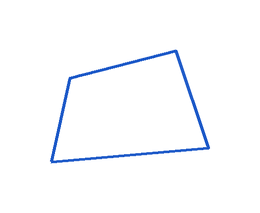
Step 2 — Check.
No two sides next to each other are equal and no two angles are equal, so there is no line of symmetry to draw.
Therefore, the figure drawn is a quadrilateral with all sides unequal (an irregular quadrilateral); a parallelogram that is not a rectangle or a rhombus also has no line of symmetry.
- 233 marks
Question 23
Draw a quadrilateral with :
(ii) only one line of symmetry.
In each case, if possible, represent the line(s) of symmetry by dotted lines. Also, write the specific name of the quadrilateral drawn.
Solve with AIWritten solution
Solution:
Concept: A line of symmetry (axis of symmetry) divides a figure into two parts that fit exactly on each other when the figure is folded along that line, so each part is the mirror image of the other.
Step 1 — Choose the quadrilateral.
A kite has two pairs of equal sides next to each other.
Step 2 — Draw the line.
Its one line of symmetry is the diagonal through the vertices where the equal sides meet; we draw it dotted.

Therefore, the quadrilateral drawn is a kite; an isosceles trapezium also has exactly one line of symmetry.
- 243 marks
Question 24
Draw a quadrilateral with :
(iii) exactly two lines of symmetry.
In each case, if possible, represent the line(s) of symmetry by dotted lines. Also, write the specific name of the quadrilateral drawn.
Solve with AIWritten solution
Solution:
Concept: A line of symmetry (axis of symmetry) divides a figure into two parts that fit exactly on each other when the figure is folded along that line, so each part is the mirror image of the other.
Step 1 — First example: a rectangle.
A rectangle has two lines of symmetry, the lines joining the mid-points of its opposite sides.
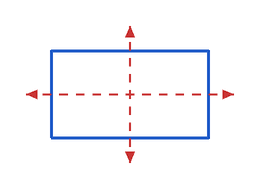
Step 2 — Second example: a rhombus.
A rhombus also has exactly two, its two diagonals.
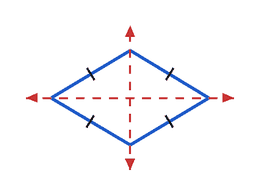
Therefore, the quadrilateral drawn is a rectangle or a rhombus (either one answers the question).
- 253 marks
Question 25
Draw a quadrilateral with :
(iv) exactly three lines of symmetry.
In each case, if possible, represent the line(s) of symmetry by dotted lines. Also, write the specific name of the quadrilateral drawn.
Solve with AIWritten solution
Solution:
Concept: A line of symmetry (axis of symmetry) divides a figure into two parts that fit exactly on each other when the figure is folded along that line, so each part is the mirror image of the other.
Step 1 — Use two of the lines.
When a figure has two lines of symmetry meeting at a point, folding along one and then the other turns the figure about that point. With three lines, equally spaced 60° apart, the figure would fit onto itself after a turn of 120°.
Step 2 — Apply it to four vertices.
Such a turn moves the vertices round in groups of three, but a quadrilateral has four vertices, which cannot be shared out in groups of three. So no quadrilateral has exactly three lines of symmetry; the possible numbers are 0, 1, 2 and 4.
Therefore, a quadrilateral with exactly three lines of symmetry is not possible.
- 263 marks
Question 26
Draw a quadrilateral with :
(v) exactly four lines of symmetry.
In each case, if possible, represent the line(s) of symmetry by dotted lines. Also, write the specific name of the quadrilateral drawn.
Solve with AIWritten solution
Solution:
Concept: A line of symmetry (axis of symmetry) divides a figure into two parts that fit exactly on each other when the figure is folded along that line, so each part is the mirror image of the other.
Step 1 — Choose the quadrilateral.
A square has all sides equal and all angles equal to 90°.
Step 2 — Draw the lines.
Its two diagonals and the two lines joining the mid-points of opposite sides are all lines of symmetry; we draw the four lines dotted.
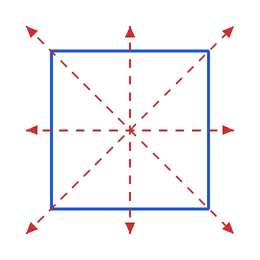
Therefore, the quadrilateral drawn is a square, with its four lines of symmetry dotted.
- 273 marks
Question 27
Draw a quadrilateral with :
(vi) more than four lines of symmetry.
In each case, if possible, represent the line(s) of symmetry by dotted lines. Also, write the specific name of the quadrilateral drawn.
Solve with AIWritten solution
Solution:
Concept: A line of symmetry (axis of symmetry) divides a figure into two parts that fit exactly on each other when the figure is folded along that line, so each part is the mirror image of the other.
Step 1 — Count the possible lines.
A polygon cannot have more lines of symmetry than it has sides; a regular polygon with n sides has exactly n.
Step 2 — Conclude.
A quadrilateral has four sides, so it has at most four lines of symmetry, which a square reaches.
Therefore, a quadrilateral with more than four lines of symmetry is not possible; a square, with four, has the most.
- 283 marks
Question 28
Construct an equilateral triangle with each side 6 cm. In the triangle drawn, draw all possible lines of symmetry.
Solve with AIWritten solution
Solution:
Concept: A line of symmetry (axis of symmetry) divides a figure into two parts that fit exactly on each other when the figure is folded along that line, so each part is the mirror image of the other. An equilateral triangle has three: the line from each vertex to the mid-point of the opposite side.
Step 1 — Draw the base.
We draw a line segment AB, 6 cm long.
Step 2 — Locate C.
With A as centre and radius 6 cm we draw an arc; with B as centre and the same radius we draw another arc cutting the first at C. Joining AC and BC gives triangle ABC with every side 6 cm.
Step 3 — Draw the lines of symmetry.
We join each vertex to the mid-point of the opposite side (found by bisecting that side) and draw these three lines dotted. Each one also bisects the angle at its vertex.
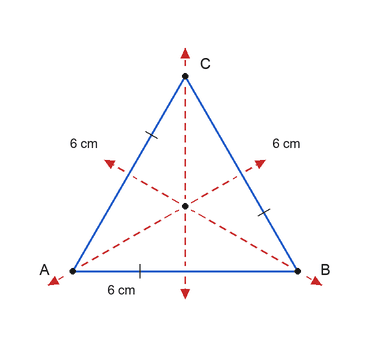
Watch out: Use the same radius (6 cm) for both arcs, so that all three sides are equal.
Therefore, the equilateral triangle has three lines of symmetry, and all three meet at one point inside the triangle.
- 293 marks
Question 29
Construct a triangle ABC in which AB = AC = 5 cm and BC = 5·6 cm. If possible, draw its line(s) of symmetry.
Solve with AIWritten solution
Solution:
Concept: A line of symmetry (axis of symmetry) divides a figure into two parts that fit exactly on each other when the figure is folded along that line, so each part is the mirror image of the other. An isosceles triangle has exactly one: the line through the vertex between the equal sides, perpendicular to the base.
Step 1 — Draw the base.
We draw BC, 5.6 cm long.
Step 2 — Locate A.
With B and C as centres and radius 5 cm we draw two arcs meeting at A, and join AB and AC.
Step 3 — Find the line of symmetry.
Since AB = AC, the triangle is isosceles. Its only line of symmetry is the perpendicular bisector of BC, which passes through A; we draw it dotted.
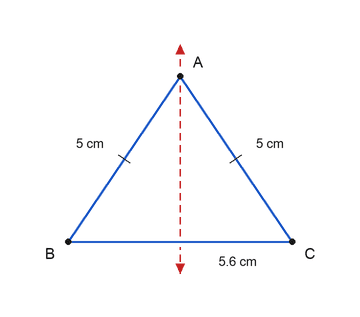
Therefore, triangle ABC is isosceles and has only one line of symmetry, the dotted line through A perpendicular to BC.
- 303 marks
Question 30
Construct a triangle PQR such that PQ = QR = 5·5 cm and angle PQR = 90°. If possible, draw its lines of symmetry.
Solve with AIWritten solution
Solution:
Concept: A line of symmetry (axis of symmetry) divides a figure into two parts that fit exactly on each other when the figure is folded along that line, so each part is the mirror image of the other.
Step 1 — Draw QR.
We draw QR, 5.5 cm long.
Step 2 — Construct the right angle at Q.
With Q as centre we draw an arc cutting QR; from that point we step off two equal arcs of the same radius (giving 60° and 120°), and from these two points draw equal arcs meeting at a point. Joining it to Q gives ∠RQP = 90°.
Step 3 — Locate P.
With Q as centre and radius 5.5 cm we cut this perpendicular at P, and join PR.
Step 4 — Draw the line of symmetry.
Since PQ = QR and ∠Q = 90°, triangle PQR is an isosceles right-angled triangle. Its only line of symmetry is the bisector of ∠PQR, which is also the perpendicular bisector of PR; we draw it dotted.
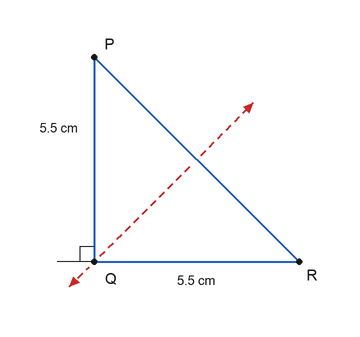
Watch out: The line of symmetry starts at Q, the vertex between the equal sides, not at P or R.
Therefore, triangle PQR has exactly one line of symmetry, the bisector of ∠PQR (also the perpendicular bisector of PR).
- 313 marks
Question 31
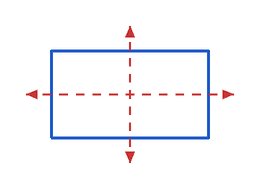
If possible, draw a rough sketch of a quadrilateral which has exactly two lines of symmetry.
Solve with AIWritten solution
Solution:
Concept: A line of symmetry (axis of symmetry) divides a figure into two parts that fit exactly on each other when the figure is folded along that line, so each part is the mirror image of the other.
Step 1 — First sketch: a rectangle.
A rectangle has exactly two lines of symmetry, the lines joining the mid-points of its opposite sides.
Step 2 — Second sketch: a rhombus.
A rhombus also has exactly two, its diagonals.
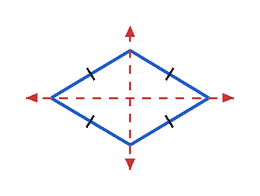
Therefore, the required figure is a rectangle (lines through the mid-points of opposite sides) or a rhombus (its diagonals).
- 323 marks
Question 32
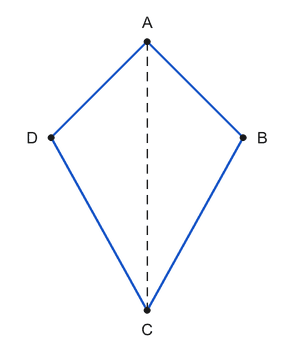
A quadrilateral ABCD is symmetric about its diagonal AC. Name the sides of this quadrilateral which are equal.
 Solve with AI
Written solution
Solution:
Concept: A line of symmetry (axis of symmetry) divides a figure into two parts that fit exactly on each other when the figure is folded along that line, so each part is the mirror image of the other.
Step 1 — See what the fold does.
Folding along the diagonal AC leaves A and C where they are, and B must fall on D (B and D are mirror images in AC).
Step 2 — Match the sides.
So side AB falls on AD, and side CB falls on CD. Sides that fall on each other are equal.

Watch out: AB and CD are not a matching pair; match each side to the side it falls on.
Therefore, AB = AD and CB = CD, so ABCD is a kite.
- 333 marks
Question 33
In each figure, given below, find the image of the point P in the line AB :
(i)
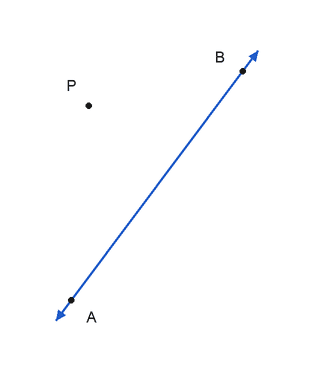 Solve with AI
Written solution
Solution:
Concept: The image of a point P in a line (the mirror line) is the point P′ on the other side of the line such that the line is the perpendicular bisector of PP′: PP′ meets the line at right angles, and P and P′ are at equal distances from it.
Step 1 — Draw the perpendicular.
From P we draw PO perpendicular to AB, meeting AB at O.
Step 2 — Mark the image.
We produce PO beyond O and cut off OP′ equal to OP. Then AB is the perpendicular bisector of PP′, so P′ is the image of P in AB.
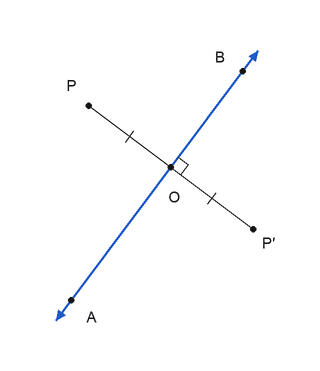
Watch out: The image is found along the perpendicular from P, not along a line parallel to AB.
Therefore, P′ is the required image of P in AB (PP′ ⊥ AB and PO = OP′).
- 343 marks
Question 34
In each figure, given below, find the image of the point P in the line AB :
(ii)
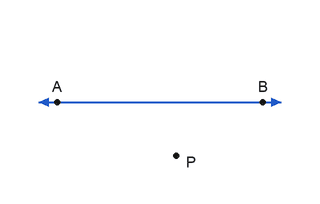 Solve with AI
Written solution
Solution:
Concept: The image of a point P in a line (the mirror line) is the point P′ on the other side of the line such that the line is the perpendicular bisector of PP′: PP′ meets the line at right angles, and P and P′ are at equal distances from it.
Step 1 — Draw the perpendicular.
From P we draw PO perpendicular to AB, meeting AB at O.
Step 2 — Mark the image.
We produce PO beyond O and cut off OP′ equal to OP. Then AB is the perpendicular bisector of PP′, so P′ is the image of P in AB. Here AB is horizontal and P is below it, so P′ is directly above P, at the same distance from AB.
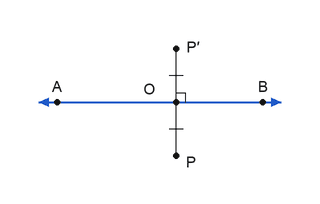
Watch out: The image is found along the perpendicular from P, not along a line parallel to AB.
Therefore, P′ is the required image of P in AB (PP′ ⊥ AB and PO = OP′).
- 353 marks
Question 35
In each figure, given below, find the image of the line segment AB in the line PQ :
(i)
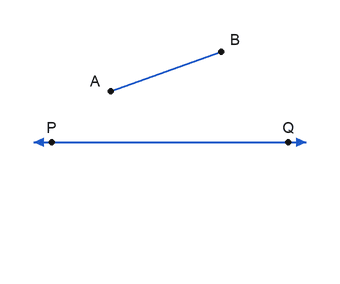 Solve with AI
Written solution
Solution:
Concept: The image of a point P in a line (the mirror line) is the point P′ on the other side of the line such that the line is the perpendicular bisector of PP′: PP′ meets the line at right angles, and P and P′ are at equal distances from it. The image of a segment is the segment joining the images of its end points.
Step 1 — Reflect A.
From A we draw a perpendicular to PQ and produce it to A′, so that A and A′ are at equal distances from PQ on opposite sides.
Step 2 — Reflect B.
In the same way we find B′, the image of B.
Step 3 — Join the images.
Joining A′B′ gives the image of the segment AB.
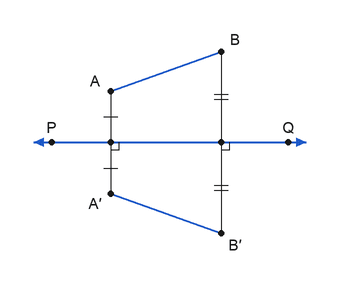
Therefore, A′B′ is the image of AB in PQ, and A′B′ = AB.
- 363 marks
Question 36
In each figure, given below, find the image of the line segment AB in the line PQ :
(ii)
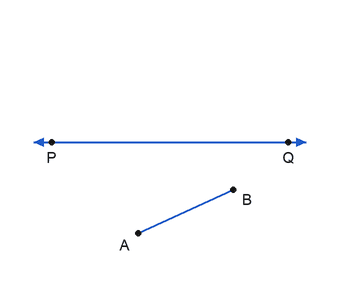 Solve with AI
Written solution
Solution:
Concept: The image of a point P in a line (the mirror line) is the point P′ on the other side of the line such that the line is the perpendicular bisector of PP′: PP′ meets the line at right angles, and P and P′ are at equal distances from it. The image of a segment is the segment joining the images of its end points.
Step 1 — Reflect A.
From A we draw a perpendicular to PQ and produce it to A′, so that A and A′ are at equal distances from PQ on opposite sides.
Step 2 — Reflect B.
In the same way we find B′, the image of B.
Step 3 — Join the images.
Joining A′B′ gives the image of the segment AB.

Therefore, A′B′ is the image of AB in PQ, and A′B′ = AB.
- 373 marks
Question 37
Complete the following table :
Point Reflection in x-axis Reflection in y-axis Reflection in origin (i) (8, 2) ………… ………… ………… (ii) (5, 6) ………… ………… ………… (iii) (4, −5) ………… ………… ………… (iv) (6, −2) ………… ………… ………… (v) (−3, 7) ………… ………… ………… (vi) (−4, 5) ………… ………… ………… (vii) (−2, −7) ………… ………… ………… (viii) (−6, −3) ………… ………… ………… (ix) (4, 0) ………… ………… ………… (x) (−7, 0) ………… ………… ………… (xi) (0, −6) ………… ………… ………… (xii) (0, 8) ………… ………… ………… (xiii) (0, 0) ………… ………… ………… Solve with AIWritten solution
Solution:
Concept: In the co-ordinate plane, a reflection in the x-axis changes only the sign of the y-co-ordinate, becomes ; a reflection in the y-axis changes only the sign of the x-co-ordinate, becomes ; a reflection in the origin changes both signs, becomes .
Step 1 — Write the three rules.
In the x-axis we change the sign of ; in the y-axis we change the sign of ; in the origin we change both signs. The sign of 0 does not change, since .
Step 2 — Apply them to an example.
For row (iii), the point is . Its image in the x-axis is , in the y-axis , and in the origin .
Step 3 — Complete the table.
Applying the same rules to every row gives the completed table.
Point Reflection in x-axis Reflection in y-axis Reflection in origin (i) (8, 2) (8, −2) (−8, 2) (−8, −2) (ii) (5, 6) (5, −6) (−5, 6) (−5, −6) (iii) (4, −5) (4, 5) (−4, −5) (−4, 5) (iv) (6, −2) (6, 2) (−6, −2) (−6, 2) (v) (−3, 7) (−3, −7) (3, 7) (3, −7) (vi) (−4, 5) (−4, −5) (4, 5) (4, −5) (vii) (−2, −7) (−2, 7) (2, −7) (2, 7) (viii) (−6, −3) (−6, 3) (6, −3) (6, 3) (ix) (4, 0) (4, 0) (−4, 0) (−4, 0) (x) (−7, 0) (−7, 0) (7, 0) (7, 0) (xi) (0, −6) (0, 6) (0, −6) (0, 6) (xii) (0, 8) (0, −8) (0, 8) (0, −8) (xiii) (0, 0) (0, 0) (0, 0) (0, 0) Watch out: In the x-axis it is the y-co-ordinate that changes sign (not x); a reflection never swaps the two co-ordinates.
Note: A point on the x-axis is its own image in the x-axis, a point on the y-axis is its own image in the y-axis, and the origin is its own image in all three.
Therefore, the table is completed as shown above.
- 383 marks
Question 38
A point P (7, 3) is reflected in x-axis to point P′. The point P′ is further reflected in y-axis to point P″. Find :
(i) the co-ordinates of P′
(ii) the co-ordinates of P″
(iii) the image of P (7, 3) in origin.
Solve with AIWritten solution
Solution:
Concept: In the co-ordinate plane, a reflection in the x-axis changes only the sign of the y-co-ordinate, becomes ; a reflection in the y-axis changes only the sign of the x-co-ordinate, becomes ; a reflection in the origin changes both signs, becomes .
Step 1 — Find P′.
In the x-axis, only the sign of the y-co-ordinate changes.
Step 2 — Find P″.
Now we reflect P′ in the y-axis, so only the sign of the x-co-ordinate changes.
Step 3 — Reflect P in the origin.
In the origin, both co-ordinates change sign.
Note: Reflecting in the x-axis and then in the y-axis gives the same point as reflecting in the origin.
Therefore, (i) P′ = (7, −3); (ii) P″ = (−7, −3); (iii) the image is (−7, −3).
- 393 marks
Question 39
A point A (–5, 4) is reflected in y-axis to point B. The point B is further reflected in origin to point C. Find :
(i) the co-ordinates of B
(ii) the co-ordinates of C
(iii) the image of A (–5, 4) in x-axis.
Solve with AIWritten solution
Solution:
Concept: In the co-ordinate plane, a reflection in the x-axis changes only the sign of the y-co-ordinate, becomes ; a reflection in the y-axis changes only the sign of the x-co-ordinate, becomes ; a reflection in the origin changes both signs, becomes .
Step 1 — Find B.
In the y-axis, only the sign of the x-co-ordinate changes.
Step 2 — Find C.
Now we reflect B in the origin, so both co-ordinates change sign.
Step 3 — Reflect A in the x-axis.
In the x-axis, only the sign of the y-co-ordinate changes.
Note: C is the same point as the image of A in the x-axis.
Therefore, (i) B = (5, 4); (ii) C = (−5, −4); (iii) the image is (−5, −4).
- 403 marks
Question 40
The point P (3, –8) is reflected in origin to point Q. The point Q is further reflected in x-axis to point R. Find :
(i) the co-ordinates of Q
(ii) the co-ordinates of R
(iii) the image of P (3, –8) in y-axis.
Solve with AIWritten solution
Solution:
Concept: In the co-ordinate plane, a reflection in the x-axis changes only the sign of the y-co-ordinate, becomes ; a reflection in the y-axis changes only the sign of the x-co-ordinate, becomes ; a reflection in the origin changes both signs, becomes .
Step 1 — Find Q.
In the origin, both co-ordinates change sign.
Step 2 — Find R.
Now we reflect Q in the x-axis, so only the sign of the y-co-ordinate changes.
Step 3 — Reflect P in the y-axis.
In the y-axis, only the sign of the x-co-ordinate changes.
Note: R is the same point as the image of P in the y-axis.
Therefore, (i) Q = (−3, 8); (ii) R = (−3, −8); (iii) the image is (−3, −8).
- 413 marks
Question 41
Each of the points A (3, 0), B (7, 0), C (–8, 0), D (–7, 0) and E (0, 0) is reflected in x-axis to points A′, B′, C′, D′ and E′ respectively. Write the co-ordinates of each of the image points A′, B′, C′, D′ and E′.
Solve with AIWritten solution
Solution:
Concept: In the co-ordinate plane, a reflection in the x-axis changes only the sign of the y-co-ordinate, becomes ; a reflection in the y-axis changes only the sign of the x-co-ordinate, becomes ; a reflection in the origin changes both signs, becomes .
Step 1 — Use the rule.
Every point has y = 0, so it lies on the x-axis itself. A point on the mirror is its own image.
Step 2 — Write the images.
Applying the rule to each point gives these images.
- A(3, 0) has image A′(3, 0)
- B(7, 0) has image B′(7, 0)
- C(−8, 0) has image C′(−8, 0)
- D(−7, 0) has image D′(−7, 0)
- E(0, 0) has image E′(0, 0)
Watch out: The origin (0, 0) is its own image in both axes and in the origin.
Therefore, A′ = (3, 0), B′ = (7, 0), C′ = (−8, 0), D′ = (−7, 0) and E′ = (0, 0).
- 423 marks
Question 42
Each of the points A (0, 4), B (0, 10), C (0, –4), D (0, –6) and E (0, 0) is reflected in y-axis to points A′, B′, C′, D′ and E′ respectively. Write the co-ordinates of each of the image points A′, B′, C′, D′ and E′.
Solve with AIWritten solution
Solution:
Concept: In the co-ordinate plane, a reflection in the x-axis changes only the sign of the y-co-ordinate, becomes ; a reflection in the y-axis changes only the sign of the x-co-ordinate, becomes ; a reflection in the origin changes both signs, becomes .
Step 1 — Use the rule.
Every point has x = 0, so it lies on the y-axis itself. A point on the mirror is its own image.
Step 2 — Write the images.
Applying the rule to each point gives these images.
- A(0, 4) has image A′(0, 4)
- B(0, 10) has image B′(0, 10)
- C(0, −4) has image C′(0, −4)
- D(0, −6) has image D′(0, −6)
- E(0, 0) has image E′(0, 0)
Watch out: The origin (0, 0) is its own image in both axes and in the origin.
Therefore, A′ = (0, 4), B′ = (0, 10), C′ = (0, −4), D′ = (0, −6) and E′ = (0, 0).
- 433 marks
Question 43
Each of the points A (0, 7), B (8, 0), C (0, –5), D (–7, 0) and E (0, 0) is reflected in origin to points A′, B′, C′, D′ and E′ respectively. Write the co-ordinates of each of the image points A′, B′, C′, D′ and E′.
Solve with AIWritten solution
Solution:
Concept: In the co-ordinate plane, a reflection in the x-axis changes only the sign of the y-co-ordinate, becomes ; a reflection in the y-axis changes only the sign of the x-co-ordinate, becomes ; a reflection in the origin changes both signs, becomes .
Step 1 — Use the rule.
Each point has one co-ordinate equal to 0, and the sign of 0 does not change. So only the non-zero co-ordinate changes its sign.
Step 2 — Write the images.
Applying the rule to each point gives these images.
- A(0, 7) has image A′(0, −7)
- B(8, 0) has image B′(−8, 0)
- C(0, −5) has image C′(0, 5)
- D(−7, 0) has image D′(7, 0)
- E(0, 0) has image E′(0, 0)
Watch out: Change the sign of the non-zero co-ordinate only; do not move the point to the other axis.
Therefore, A′ = (0, −7), B′ = (−8, 0), C′ = (0, 5), D′ = (7, 0) and E′ = (0, 0).
- 443 marks
Question 44
Mark points A (4, 5) and B (–5, 4) on a graph paper. Find A′, the image of A in x-axis and B′, the image of B in x-axis. Mark A′ and B′ also on the same graph paper. Join AB and A′ B′ and find if AB = A′ B′ ?
Solve with AIWritten solution
Solution:
Concept: In the co-ordinate plane, a reflection in the x-axis changes only the sign of the y-co-ordinate, becomes ; a reflection in the y-axis changes only the sign of the x-co-ordinate, becomes ; a reflection in the origin changes both signs, becomes . A reflection never changes lengths.
Step 1 — Find the images.
In the x-axis only the sign of the y-co-ordinate changes.
Step 2 — Plot and join.
We mark the four points on graph paper and join AB and A′B′.
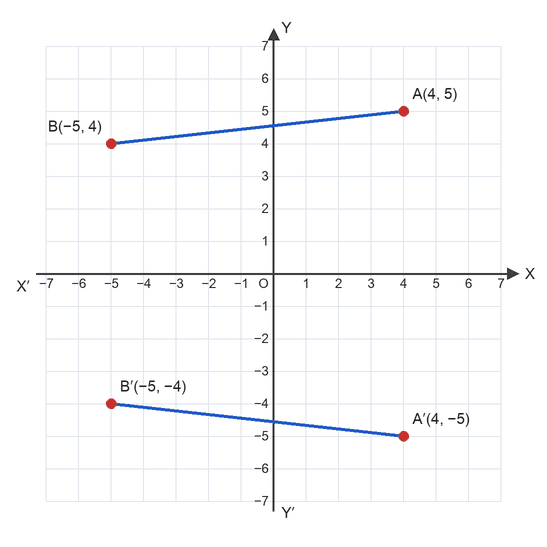
Step 3 — Find AB.
From B to A we move 9 units across and 1 unit up, so by Pythagoras' theorem we get the length below.
Step 4 — Find A′B′.
From B′ to A′ we move 9 units across and 1 unit down, so its length is the same.
Therefore, A′ = (4, −5), B′ = (−5, −4), and yes, AB = A′B′ (each is √82 units).
- 453 marks
Question 45
Mark points A (6, 4) and B (4, –6) on a graph paper. Find A′, the image of A in y-axis and B′, the image of B in y-axis. Mark A′ and B′ also on the same graph paper.
Solve with AIWritten solution
Solution:
Concept: In the co-ordinate plane, a reflection in the x-axis changes only the sign of the y-co-ordinate, becomes ; a reflection in the y-axis changes only the sign of the x-co-ordinate, becomes ; a reflection in the origin changes both signs, becomes .
Step 1 — Find the images.
In the y-axis only the sign of the x-co-ordinate changes.
Step 2 — Plot the points.
We mark A, B, A′ and B′ on the same graph paper.
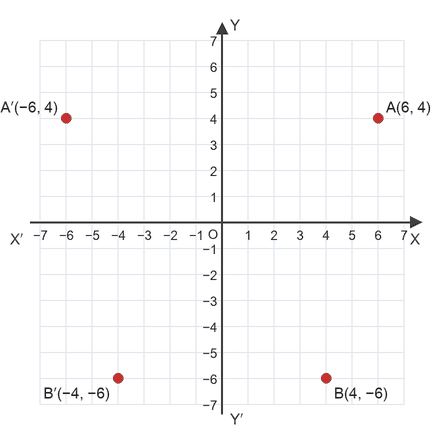
Watch out: A point and its image in the y-axis are at the same height (same y).
Therefore, A′ = (−6, 4) and B′ = (−4, −6).
- 463 marks
Question 46
Mark points A (–6, 5) and B (–4, –6) on a graph paper. Find A′, the image of A in origin and B′, the image of B in origin. Mark A′ and B′ also on the same graph paper. Join AB and A′ B′ and find if AB = A′ B′ ?
Solve with AIWritten solution
Solution:
Concept: In the co-ordinate plane, a reflection in the x-axis changes only the sign of the y-co-ordinate, becomes ; a reflection in the y-axis changes only the sign of the x-co-ordinate, becomes ; a reflection in the origin changes both signs, becomes . A reflection never changes lengths.
Step 1 — Find the images.
In the origin both co-ordinates change sign.
Step 2 — Plot and join.
We mark the four points on graph paper and join AB and A′B′.

Step 3 — Find AB.
From A to B we move 2 units across and 11 units down, so by Pythagoras' theorem we get the length below.
Step 4 — Find A′B′.
From A′ to B′ we move 2 units across and 11 units up, so its length is the same.
Therefore, A′ = (6, −5), B′ = (4, 6), and yes, AB = A′B′ (each is √125 units).
- 473 marks
Question 47
How many lines of symmetry does a rhombus have ?
Solve with AIWritten solution
Solution:
Concept: A line of symmetry (axis of symmetry) divides a figure into two parts that fit exactly on each other when the figure is folded along that line, so each part is the mirror image of the other.
Step 1 — Recall the shape.
A rhombus has all four sides equal, and each diagonal bisects the angles at its ends.
Step 2 — Count the lines.
Folding along either diagonal makes the two halves fit, so both diagonals are lines of symmetry. The lines joining mid-points of opposite sides do not work (unless the rhombus is a square).
Therefore, a rhombus has 2 lines of symmetry, its diagonals.
- 483 marks
Question 48
What is the order of rotational symmetry of a rhombus ?
Solve with AIWritten solution
Solution:
Concept: A figure has rotational symmetry when it fits onto itself after a turn of less than 360° about a fixed point (its centre). The order of rotational symmetry is the number of times it fits onto itself during one complete turn of 360°; a figure that fits only at 360° is said to have no rotational symmetry.
Step 1 — Find the centre.
The diagonals of a rhombus bisect each other; the point where they meet is the centre of turning.
Step 2 — Turn the rhombus.
A half turn (180°) about this point sends each vertex to the opposite vertex, so the rhombus fits onto itself at 180° and again at 360°. At 90° it does not fit, because its diagonals are unequal (unless it is a square).
Watch out: Count the fit at 360° as well; a half turn and a full turn give order 2.
Therefore, the order of rotational symmetry of a rhombus is 2.
- 493 marks
Question 49
Show that each of the following figures has two lines of symmetry and a rotational symmetry of order 2.
(i) H
 Solve with AI
Written solution
Solution:
Concept: A line of symmetry (axis of symmetry) divides a figure into two parts that fit exactly on each other when the figure is folded along that line, so each part is the mirror image of the other. A figure with two perpendicular lines of symmetry also fits onto itself after a half turn (180°) about the point where they meet.
Step 1 — Find the lines of symmetry.
The two lines of symmetry of H are the vertical line through the middle of the cross-bar and the horizontal line along the cross-bar.
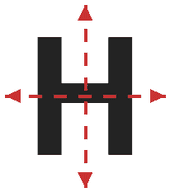
Step 2 — Turn the letter.
We turn H through 180° about the point where the two lines meet. The top part goes to the bottom and the left part to the right, and the letter looks exactly the same. So it fits onto itself at 180° and at 360°, which is twice in one complete turn.
Therefore, H has two lines of symmetry and rotational symmetry of order 2.
- 503 marks
Question 50
Show that each of the following figures has two lines of symmetry and a rotational symmetry of order 2.
(ii) I
 Solve with AI
Written solution
Solution:
Concept: A line of symmetry (axis of symmetry) divides a figure into two parts that fit exactly on each other when the figure is folded along that line, so each part is the mirror image of the other. A figure with two perpendicular lines of symmetry also fits onto itself after a half turn (180°) about the point where they meet.
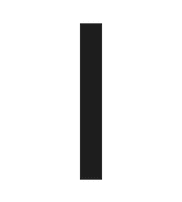
Step 1 — Find the lines of symmetry.
The two lines of symmetry of I are the vertical line along the upright and the horizontal line through its middle.

Step 2 — Turn the letter.
We turn I through 180° about the point where the two lines meet. The top part goes to the bottom and the left part to the right, and the letter looks exactly the same. So it fits onto itself at 180° and at 360°, which is twice in one complete turn.
Therefore, I has two lines of symmetry and rotational symmetry of order 2.
- 513 marks
Question 51
Show that each of the following figures has two lines of symmetry and a rotational symmetry of order 2.
(iii) O
 Solve with AI
Written solution
Solution:
Concept: A line of symmetry (axis of symmetry) divides a figure into two parts that fit exactly on each other when the figure is folded along that line, so each part is the mirror image of the other. A figure with two perpendicular lines of symmetry also fits onto itself after a half turn (180°) about the point where they meet.
Step 1 — Find the lines of symmetry.
The two lines of symmetry of O are the vertical and the horizontal lines through the centre of the oval.
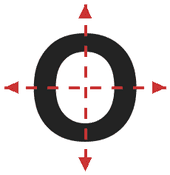
Step 2 — Turn the letter.
We turn O through 180° about the point where the two lines meet. The top part goes to the bottom and the left part to the right, and the letter looks exactly the same. So it fits onto itself at 180° and at 360°, which is twice in one complete turn.
Therefore, O has two lines of symmetry and rotational symmetry of order 2.
- 523 marks
Question 52
Show that each of the following figures has two lines of symmetry and a rotational symmetry of order 2.
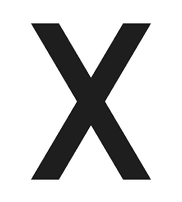
(iv) X
 Solve with AI
Written solution
Solution:
Concept: A line of symmetry (axis of symmetry) divides a figure into two parts that fit exactly on each other when the figure is folded along that line, so each part is the mirror image of the other. A figure with two perpendicular lines of symmetry also fits onto itself after a half turn (180°) about the point where they meet.
Step 1 — Find the lines of symmetry.
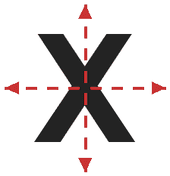
The two lines of symmetry of X are the vertical and the horizontal lines through the crossing point.
Step 2 — Turn the letter.
We turn X through 180° about the point where the two lines meet. The top part goes to the bottom and the left part to the right, and the letter looks exactly the same. So it fits onto itself at 180° and at 360°, which is twice in one complete turn.
Therefore, X has two lines of symmetry and rotational symmetry of order 2.
- 533 marks
Question 53
Name a figure that has a line of symmetry but does not have any rotational symmetry.
Solve with AIWritten solution
Solution:
Concept: A line of symmetry (axis of symmetry) divides a figure into two parts that fit exactly on each other when the figure is folded along that line, so each part is the mirror image of the other. A figure has rotational symmetry when it fits onto itself after a turn of less than 360° about a fixed point (its centre). The order of rotational symmetry is the number of times it fits onto itself during one complete turn of 360°; a figure that fits only at 360° is said to have no rotational symmetry.
Step 1 — Choose a figure.
A kite has one line of symmetry, the diagonal through the vertices where its equal sides meet.
Step 2 — Test turning.
Turning a kite through any angle less than 360° never brings it back to its starting position, because its two ends are different (one sharp, one blunt). So it has no rotational symmetry.
Therefore, a kite-shaped figure is one example; an isosceles triangle or the letter A would also do.
- 543 marks
Question 54
In each of the following figures, draw all possible lines of symmetry and also write the order of rotational symmetry :
(i)
 Solve with AI
Written solution
Solution:
Concept: A line of symmetry (axis of symmetry) divides a figure into two parts that fit exactly on each other when the figure is folded along that line, so each part is the mirror image of the other. A figure has rotational symmetry when it fits onto itself after a turn of less than 360° about a fixed point (its centre). The order of rotational symmetry is the number of times it fits onto itself during one complete turn of 360°; a figure that fits only at 360° is said to have no rotational symmetry.
Step 1 — Look at the figure.
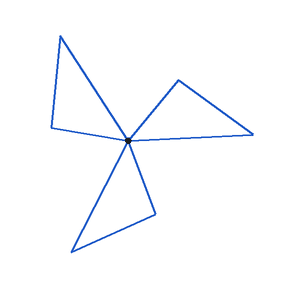
The figure is made of three equal triangles with a common vertex, turned 120° from one another like a pinwheel. Each triangle is lopsided, and all three lean the same way round the centre.
Step 2 — Test the folds.
Folding along any line through the centre sends the lean of each triangle the opposite way, so the parts do not fit: there is no line of symmetry.
Step 3 — Test turning.
Turning about the common vertex through 120° puts each triangle on the next one, so the figure fits onto itself after turns of 120°, 240° and 360°.
Watch out: A figure can have rotational symmetry without any line of symmetry, as this pinwheel shows.
Therefore, the figure has no line of symmetry, and its order of rotational symmetry is 3.
- 553 marks
Question 55
In each of the following figures, draw all possible lines of symmetry and also write the order of rotational symmetry :
(ii)
 Solve with AI
Written solution
Solution:
Concept: A line of symmetry (axis of symmetry) divides a figure into two parts that fit exactly on each other when the figure is folded along that line, so each part is the mirror image of the other. A figure has rotational symmetry when it fits onto itself after a turn of less than 360° about a fixed point (its centre). The order of rotational symmetry is the number of times it fits onto itself during one complete turn of 360°; a figure that fits only at 360° is said to have no rotational symmetry.
Step 1 — Name the figure.
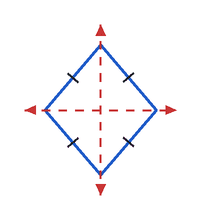
All four sides are marked equal and no right angles are marked, so the figure is a rhombus.
Step 2 — Draw the lines.
Its two diagonals are its lines of symmetry.
Step 3 — Test turning.
A half turn (180°) about the point where the diagonals meet fits it onto itself, and so does a full turn.
Therefore, the figure has 2 lines of symmetry, and its order of rotational symmetry is 2.
- 563 marks
Question 56
In each of the following figures, draw all possible lines of symmetry and also write the order of rotational symmetry :
(iii)
 Solve with AI
Written solution
Solution:
Concept: A line of symmetry (axis of symmetry) divides a figure into two parts that fit exactly on each other when the figure is folded along that line, so each part is the mirror image of the other. A figure has rotational symmetry when it fits onto itself after a turn of less than 360° about a fixed point (its centre). The order of rotational symmetry is the number of times it fits onto itself during one complete turn of 360°; a figure that fits only at 360° is said to have no rotational symmetry.
Step 1 — Look at the figure.
The figure is a long rectangle with equal V-shaped notches in the middle of its top and bottom sides.
Step 2 — Draw the lines.
Folding along the vertical line through the two notches, or along the horizontal centre line, makes the two halves fit, so both are lines of symmetry.

Step 3 — Test turning.
A half turn about the centre also fits the figure onto itself, so it fits at 180° and at 360°.
Therefore, the figure has 2 lines of symmetry, and its order of rotational symmetry is 2.
- 573 marks
Question 57
In each of the following figures, draw all possible lines of symmetry and also write the order of rotational symmetry :
(iv)
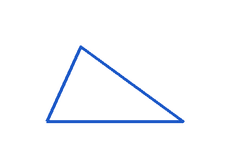 Solve with AI
Written solution
Solution:
Concept: A line of symmetry (axis of symmetry) divides a figure into two parts that fit exactly on each other when the figure is folded along that line, so each part is the mirror image of the other. A figure has rotational symmetry when it fits onto itself after a turn of less than 360° about a fixed point (its centre). The order of rotational symmetry is the number of times it fits onto itself during one complete turn of 360°; a figure that fits only at 360° is said to have no rotational symmetry.
Step 1 — Name the figure.
All three sides of the triangle are different, so it is a scalene triangle.
Step 2 — Test folds and turns.
No fold makes two parts fit, and the triangle fits onto itself only after a full turn of 360°.
Therefore, the triangle has no line of symmetry and no rotational symmetry (it fits only once, at 360°).
- 583 marks
Question 58
In each of the following figures, draw all possible lines of symmetry and also write the order of rotational symmetry :
(v)
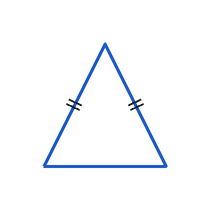 Solve with AI
Written solution
Solution:
Concept: A line of symmetry (axis of symmetry) divides a figure into two parts that fit exactly on each other when the figure is folded along that line, so each part is the mirror image of the other. A figure has rotational symmetry when it fits onto itself after a turn of less than 360° about a fixed point (its centre). The order of rotational symmetry is the number of times it fits onto itself during one complete turn of 360°; a figure that fits only at 360° is said to have no rotational symmetry.
Step 1 — Name the figure.
Two sides are marked equal, so the triangle is isosceles.
Step 2 — Draw the line.
Its one line of symmetry is the bisector of the angle between the equal sides.
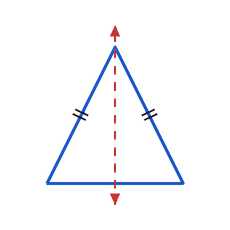
Step 3 — Test turning.
The triangle fits onto itself only after a full turn of 360°, so it has no rotational symmetry.
Therefore, the triangle has one line of symmetry and no rotational symmetry.
- 593 marks
Question 59
In each of the following figures, line of symmetry is given by dotted line. Complete each figure so that the completed figure is symmetric about the given dotted line.
(i)
 Solve with AI
Written solution
Solution:
Concept: To complete a figure about a given line of symmetry, reflect every corner of the given part in that line: draw a perpendicular from the corner to the line and mark a point at the same distance on the other side. Joining the image points in the same order gives the missing half.
Step 1 — Look at the given part.
The given part is half of a four-sided figure standing on the dotted line, with a right angle at its foot.
Step 2 — Reflect each corner.
From each corner we draw a perpendicular to the dotted line and mark a point at the same distance on the other side. Corners lying on the dotted line are their own images.
Step 3 — Join the image points.
Joining the image points in the same order gives the missing half, shown in light blue.
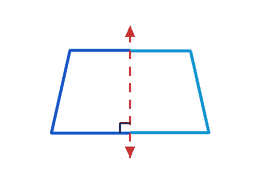
Watch out: Measure each distance along the perpendicular to the dotted line, not straight across the page.
Therefore, the completed figure is an isosceles trapezium.
- 603 marks
Question 60
In each of the following figures, line of symmetry is given by dotted line. Complete each figure so that the completed figure is symmetric about the given dotted line.
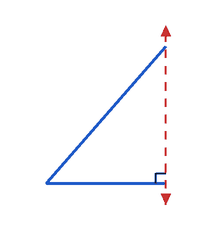
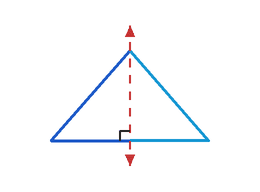
(ii)
 Solve with AI
Written solution
Solution:
Concept: To complete a figure about a given line of symmetry, reflect every corner of the given part in that line: draw a perpendicular from the corner to the line and mark a point at the same distance on the other side. Joining the image points in the same order gives the missing half.
Step 1 — Look at the given part.
The given part is a right-angled triangle with one side along the dotted line.
Step 2 — Reflect each corner.
From each corner we draw a perpendicular to the dotted line and mark a point at the same distance on the other side. Corners lying on the dotted line are their own images.
Step 3 — Join the image points.
Joining the image points in the same order gives the missing half, shown in light blue.
Watch out: Measure each distance along the perpendicular to the dotted line, not straight across the page.
Therefore, the completed figure is an isosceles triangle.
- 613 marks
Question 61
In each of the following figures, line of symmetry is given by dotted line. Complete each figure so that the completed figure is symmetric about the given dotted line.
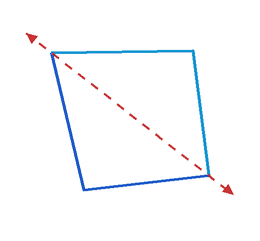
(iii)
 Solve with AI
Written solution
Solution:
Concept: To complete a figure about a given line of symmetry, reflect every corner of the given part in that line: draw a perpendicular from the corner to the line and mark a point at the same distance on the other side. Joining the image points in the same order gives the missing half.
Step 1 — Look at the given part.
The given part is a triangle with two of its vertices on the slanting dotted line.
Step 2 — Reflect each corner.
From each corner we draw a perpendicular to the dotted line and mark a point at the same distance on the other side. Corners lying on the dotted line are their own images.
Step 3 — Join the image points.
Joining the image points in the same order gives the missing half, shown in light blue.
Watch out: Measure each distance along the perpendicular to the dotted line, not straight across the page.
Therefore, the completed figure is a kite-shaped quadrilateral, with the dotted line as its diagonal.
- 623 marks
Question 62
In each of the following figures, line of symmetry is given by dotted line. Complete each figure so that the completed figure is symmetric about the given dotted line.
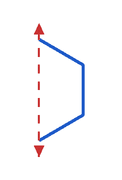
(iv)
 Solve with AI
Written solution
Solution:
Concept: To complete a figure about a given line of symmetry, reflect every corner of the given part in that line: draw a perpendicular from the corner to the line and mark a point at the same distance on the other side. Joining the image points in the same order gives the missing half.
Step 1 — Look at the given part.
The given part is the right half of a hexagon, with its top and bottom vertices on the dotted line.
Step 2 — Reflect each corner.
From each corner we draw a perpendicular to the dotted line and mark a point at the same distance on the other side. Corners lying on the dotted line are their own images.
Step 3 — Join the image points.
Joining the image points in the same order gives the missing half, shown in light blue.
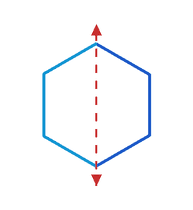
Watch out: Measure each distance along the perpendicular to the dotted line, not straight across the page.
Therefore, the completed figure is a regular hexagon.
- 633 marks
Question 63
In each of the following figures, line of symmetry is given by dotted line. Complete each figure so that the completed figure is symmetric about the given dotted line.
(v)
 Solve with AI
Written solution
Solution:
Concept: To complete a figure about a given line of symmetry, reflect every corner of the given part in that line: draw a perpendicular from the corner to the line and mark a point at the same distance on the other side. Joining the image points in the same order gives the missing half.
Step 1 — Look at the given part.
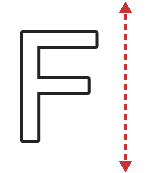
The given part is the letter F, with the dotted line to its right.
Step 2 — Reflect each corner.
From each corner we draw a perpendicular to the dotted line and mark a point at the same distance on the other side. Corners lying on the dotted line are their own images.
Step 3 — Join the image points.
Joining the image points in the same order gives the missing half, shown in light blue.
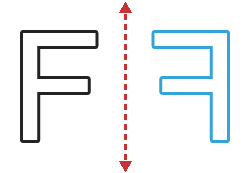
Watch out: Measure each distance along the perpendicular to the dotted line, not straight across the page.
Therefore, the completed figure is F together with its mirror image on the other side of the dotted line.
- 643 marks
Question 64
In each of the following figures, line of symmetry is given by dotted line. Complete each figure so that the completed figure is symmetric about the given dotted line.
(vi)
 Solve with AI
Written solution
Solution:
Concept: To complete a figure about a given line of symmetry, reflect every corner of the given part in that line: draw a perpendicular from the corner to the line and mark a point at the same distance on the other side. Joining the image points in the same order gives the missing half.
Step 1 — Look at the given part.
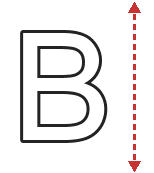
The given part is the letter B, with the dotted line to its right.
Step 2 — Reflect each corner.
From each corner we draw a perpendicular to the dotted line and mark a point at the same distance on the other side. Corners lying on the dotted line are their own images.
Step 3 — Join the image points.
Joining the image points in the same order gives the missing half, shown in light blue.
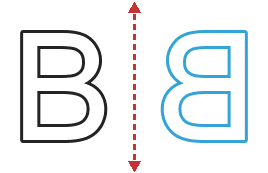
Watch out: Measure each distance along the perpendicular to the dotted line, not straight across the page.
Therefore, the completed figure is B together with its mirror image on the other side of the dotted line.
- 653 marks
Question 65
In each of the following figures, line of symmetry is given by dotted line. Complete each figure so that the completed figure is symmetric about the given dotted line.
(vii)
 Solve with AI
Written solution
Solution:
Concept: To complete a figure about a given line of symmetry, reflect every corner of the given part in that line: draw a perpendicular from the corner to the line and mark a point at the same distance on the other side. Joining the image points in the same order gives the missing half.
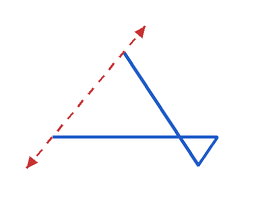
Step 1 — Look at the given part.
The given part is made of a slanting segment and a horizontal segment that cross, forming a small triangle, next to the slanting dotted line.
Step 2 — Reflect each corner.
From each corner we draw a perpendicular to the dotted line and mark a point at the same distance on the other side. Corners lying on the dotted line are their own images.
Step 3 — Join the image points.
Joining the image points in the same order gives the missing half, shown in light blue.

Watch out: Measure each distance along the perpendicular to the dotted line, not straight across the page.
Therefore, the completed figure is the given figure together with its mirror image in the slanting dotted line.
- 661 mark
Question 66
The number of lines of symmetry of a regular polygon with n sides is :
Solve with AIAnswer
(A) n – 3
(B) n – 1
- Correct
(C) n
(D) n + 3
Answer: (C) n
Concept: A regular polygon has all sides equal and all angles equal. A line of symmetry (axis of symmetry) divides a figure into two parts that fit exactly on each other when the figure is folded along that line, so each part is the mirror image of the other.
Step 1 — Look at examples.
An equilateral triangle has 3 lines of symmetry, a square 4, a regular pentagon 5 and a regular hexagon 6.
Step 2 — Spot the pattern.
In each case the number of lines equals the number of sides: one line through each vertex (or the mid-point of each side) and the centre, counted once per line.
Why the other options are wrong:
- (A) n – 3: n − 3 is the number of diagonals that can be drawn from one vertex, not the number of lines of symmetry; for a square it would give 1.
- (B) n – 1: n − 1 would give a square only 3 lines, but a square has 4.
- (D) n + 3: n + 3 would give a square 7 lines; a regular polygon has exactly as many lines as sides, never more.
Therefore, a regular polygon with n sides has n lines of symmetry, option (C).
- 671 mark
Question 67
The number of lines of symmetry in the given figure, is :
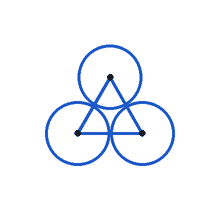
[Given : Circles have equal radii]
Solve with AIAnswer
(A) 6
- Correct
(B) 3
(C) 0
(D) 4
Answer: (B) 3
Concept: A line of symmetry (axis of symmetry) divides a figure into two parts that fit exactly on each other when the figure is folded along that line, so each part is the mirror image of the other.
Step 1 — Look at the centres.
The three equal circles touch one another, so the distance between any two centres is twice the radius. The three centres therefore form an equilateral triangle.
Step 2 — Count the lines.
A line of symmetry must send the three circles onto the three circles, so it must be a line of symmetry of this equilateral triangle. Each of its 3 lines passes through one centre and the point where the other two circles touch.
Why the other options are wrong:
- (A) 6: 6 is twice the true number; a line through two centres is not a line of symmetry, because the third circle lies on one side of it only.
- (C) 0: 0 is wrong, since folding along the line through one centre and the opposite touching point makes the figure fit.
- (D) 4: 4 is the number of lines of a square; turning this figure through 90° does not fit it onto itself, so it cannot have the four lines of a square.
Therefore, the figure has 3 lines of symmetry, option (B).
- 681 mark
Question 68
The number of lines of symmetry, which the given figure has :
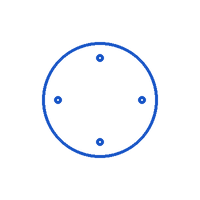 Solve with AI
Answer
(A) 2
- Correct
(B) 4
(C) 6
(D) 8
Answer: (B) 4
Concept: A line of symmetry (axis of symmetry) divides a figure into two parts that fit exactly on each other when the figure is folded along that line, so each part is the mirror image of the other.
Step 1 — Look at the small circles.
The four equal small circles sit at the top, bottom, left and right of the big circle, at equal distances from its centre. So they are at the corners of a square centred at the centre of the big circle.
Step 2 — Count the lines.
A line of symmetry must send the small circles onto the small circles, so the figure has the 4 lines of that square: the vertical line, the horizontal line and the two slanting lines midway between them.
Why the other options are wrong:
- (A) 2: 2 counts only the vertical and horizontal lines and misses the two slanting lines midway between the small circles.
- (C) 6: 6 is too many; a line of symmetry must be one of the four lines of the square formed by the small circles.
- (D) 8: 8 counts each line twice (once for each end); the figure has 4 lines.
Therefore, the figure has 4 lines of symmetry, option (B).
- 691 mark
Question 69
The maximum lines of symmetry, which a quadrilateral can have :
Solve with AIAnswer
(A) 0
(B) 1
(C) 2
- Correct
(D) 4
Answer: (D) 4
Concept: A line of symmetry (axis of symmetry) divides a figure into two parts that fit exactly on each other when the figure is folded along that line, so each part is the mirror image of the other.
Step 1 — Use the rule.
A polygon can have at most as many lines of symmetry as it has sides.
Step 2 — Apply it.
A quadrilateral has 4 sides, so at most 4 lines; a square reaches this maximum.
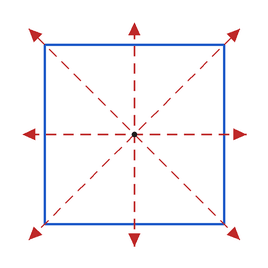
Why the other options are wrong:
- (A) 0: 0 is the least number (a general quadrilateral), not the most.
- (B) 1: 1 is the number for a kite or an isosceles trapezium, not the most.
- (C) 2: 2 is the number for a rectangle or a rhombus; a square has more.
Therefore, the maximum number of lines of symmetry of a quadrilateral is 4, option (D).
- 701 mark
Question 70
A triangle has three lines of symmetry, the triangle is :
Solve with AIAnswer
(A) scalene
(B) right-angled
- Correct
(C) equiangular
(D) isosceles
Answer: (C) equiangular
Concept: A line of symmetry (axis of symmetry) divides a figure into two parts that fit exactly on each other when the figure is folded along that line, so each part is the mirror image of the other.
Step 1 — Count the equal sides needed.
Each line of symmetry of a triangle makes the two sides at one vertex equal. Three lines make all three sides equal.
Step 2 — Name the triangle.
A triangle with all sides equal also has all angles equal (each 60°), so it is equilateral, which is the same as equiangular.

Why the other options are wrong:
- (A) scalene: a scalene triangle has no two sides equal, so it has no line of symmetry.
- (B) right-angled: a right-angled triangle has at most one line of symmetry (when its arms are equal).
- (D) isosceles: an isosceles triangle in general has only one line of symmetry; only the special case with all three sides equal has three, and that case is named exactly by (C).
Therefore, the triangle is equiangular, option (C).
- 711 mark
Question 71
The point (5, 3) is reflected in y-axis to point (–a, b); then :
Solve with AIAnswer
- Correct
(A) a = 5 and b = 3
(B) a = –5 and b = 3
(C) a = 5 and b = –3
(D) a = –5 and b = –3
Answer: (A) a = 5 and b = 3
Concept: In the co-ordinate plane, a reflection in the x-axis changes only the sign of the y-co-ordinate, becomes ; a reflection in the y-axis changes only the sign of the x-co-ordinate, becomes ; a reflection in the origin changes both signs, becomes .
Step 1 — Reflect the point.
In the y-axis only the sign of the x-co-ordinate changes.
Step 2 — Compare with (−a, b).
The image is written as (−a, b). Matching the co-ordinates gives the two equations below.
Watch out: The image is (−a, b), so a is the size of the x-co-ordinate, without its minus sign.
Why the other options are wrong:
- (B): a = −5 and b = 3 make (−a, b) = (5, 3), which is the point itself, not its image.
- (C): a = 5 and b = −3 make (−a, b) = (−5, −3), which is the image in the origin.
- (D): a = −5 and b = −3 make (−a, b) = (5, −3), which is the image in the x-axis.
Therefore, a = 5 and b = 3, option (A).
- 721 mark
Question 72
The point (6, –8) is first reflected in x-axis followed by reflection in origin. The co-ordinates of final image are :
Solve with AIAnswer
(A) (6, –8)
(B) (–6, 8)
- Correct
(C) (–6, –8)
(D) (6, 8)
Answer: (C) (–6, –8)
Concept: In the co-ordinate plane, a reflection in the x-axis changes only the sign of the y-co-ordinate, becomes ; a reflection in the y-axis changes only the sign of the x-co-ordinate, becomes ; a reflection in the origin changes both signs, becomes .
Step 1 — Reflect in the x-axis.
Only the sign of y changes.
Step 2 — Reflect in the origin.
Now both signs change.
Watch out: Apply the two reflections one after the other, in the order given.
Why the other options are wrong:
- (A) (6, –8): (6, −8) is the starting point itself.
- (B) (–6, 8): (−6, 8) is the image of (6, −8) in the origin alone, without the first reflection.
- (D) (6, 8): (6, 8) is the image after the first reflection only.
Therefore, the final image is (−6, −8), option (C).
- 731 mark
Question 73
The point (0, 13) is first reflected in origin followed by reflection in y-axis. The co-ordinates of final image are :
Solve with AIAnswer
(A) (0, 13)
(B) (13, 0)
- Correct
(C) (0, –13)
(D) (–13, 0)
Answer: (C) (0, –13)
Concept: In the co-ordinate plane, a reflection in the x-axis changes only the sign of the y-co-ordinate, becomes ; a reflection in the y-axis changes only the sign of the x-co-ordinate, becomes ; a reflection in the origin changes both signs, becomes .
Step 1 — Reflect in the origin.
Both signs change; the sign of 0 stays the same.
Step 2 — Reflect in the y-axis.
Only the sign of x changes, and x is 0, so the point does not move: it lies on the y-axis.
Why the other options are wrong:
- (A) (0, 13): (0, 13) is the starting point; it would also be the image in the y-axis alone, but the origin step is missed.
- (B) (13, 0): (13, 0) swaps the two co-ordinates (a quarter turn), which no reflection in an axis or the origin does.
- (D) (–13, 0): (−13, 0) also swaps the co-ordinates (a quarter turn the other way), which no reflection here does.
Therefore, the final image is (0, −13), option (C).
- 741 mark
Question 74
Which of the following quadrilaterals has rotational symmetry of order 4 ?
Solve with AIAnswer
(A) Parallelogram
(B) Trapezium
(C) Rectangle
- Correct
(D) Square
Answer: (D) Square
Concept: A figure has rotational symmetry when it fits onto itself after a turn of less than 360° about a fixed point (its centre). The order of rotational symmetry is the number of times it fits onto itself during one complete turn of 360°; a figure that fits only at 360° is said to have no rotational symmetry.
Step 1 — Recall order 4.
Order 4 means the figure fits onto itself after every quarter turn: at 90°, 180°, 270° and 360°.
Step 2 — Test the shapes.
Only a square, with all sides and all angles equal, fits after a quarter turn about its centre.
Why the other options are wrong:
- (A) Parallelogram: a parallelogram fits only after a half turn, so its order is 2.
- (B) Trapezium: a trapezium (one pair of parallel sides) fits only after a full turn, so it has no rotational symmetry.
- (C) Rectangle: a rectangle fits after a half turn but not a quarter turn, so its order is 2.
Therefore, the square has rotational symmetry of order 4, option (D).
- 751 mark
Question 75
Which of the following quadrilaterals has four lines of symmetry and rotational symmetry of order 4 ?
Solve with AIAnswer
(A) Parallelogram
(B) Trapezium
(C) Rectangle
- Correct
(D) Square
Answer: (D) Square
Concept: A line of symmetry (axis of symmetry) divides a figure into two parts that fit exactly on each other when the figure is folded along that line, so each part is the mirror image of the other. A figure has rotational symmetry when it fits onto itself after a turn of less than 360° about a fixed point (its centre). The order of rotational symmetry is the number of times it fits onto itself during one complete turn of 360°; a figure that fits only at 360° is said to have no rotational symmetry.
Step 1 — Check the square.
A square has 4 lines of symmetry (two diagonals and two lines through mid-points of opposite sides) and fits onto itself at 90°, 180°, 270° and 360°, so its order is 4.
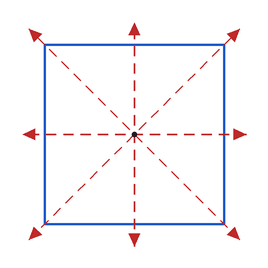
Step 2 — Check the others.
None of the other shapes has both properties.
Why the other options are wrong:
- (A) Parallelogram: a general parallelogram has no line of symmetry and rotational symmetry of order 2.
- (B) Trapezium: a trapezium has at most one line of symmetry (an isosceles trapezium) and no rotational symmetry.
- (C) Rectangle: a rectangle has only two lines of symmetry and rotational symmetry of order 2.
Therefore, the square has four lines of symmetry and rotational symmetry of order 4, option (D).
- 761 mark
Question 76
Statement 1 : A circle has a point symmetry and infinite many lines symmetry.
Statement 2 : A hexagon has 6 lines symmetry (lines joining the mid-points of opposite sides and the diagonals passing through the centre).
Which of the following options is correct?
Solve with AIAnswer
- Correct
(A) Both the statements are true.
(B) Both the statements are false.
(C) Statement 1 is true, and statement 2 is false.
(D) Statement 1 is false, and statement 2 is true.
Answer: (A) Both the statements are true.
Concept: We judge each statement separately, true or false, and then choose the option that matches both verdicts.
Step 1 — Judge statement 1.
A circle looks the same after a half turn about its centre, so it has point symmetry; and every diameter is a line of symmetry, so it has infinitely many. Statement 1 is true.
Step 2 — Judge statement 2.
For a regular hexagon, the 3 lines joining the mid-points of opposite sides and the 3 diagonals through the centre give 6 lines of symmetry. Statement 2 is true, taking the hexagon to be regular as its description in brackets shows.

Note: A hexagon that is not regular can have fewer lines of symmetry; the statement is true for the regular hexagon it describes.
Why the other options are wrong:
- (B): both statements are true, not false.
- (C): statement 2 is true for the regular hexagon it describes.
- (D): statement 1 is true: a circle has point symmetry and infinitely many lines of symmetry.
Therefore, both statements are true, option (A).
- 771 mark
Question 77
The following questions are Assertion-Reason based questions. Choose your answer based on the codes given below :
(1) A is true, R is false.
(2) A is false, R is true.
(3) Both A and R are true.
(4) Both A and R are false.
Assertion (A) : Square is a quadrilateral having four lines of symmetry.
Reason (R) : A geometrical figure is said to be symmetrical about a line, if the line divides the geometrical figure into two congruent halves.
Solve with AIAnswer
- Correct
(A) (1)
(B) (2)
(C) (3)
(D) (4)
Answer: (A) (1)
Concept: In an Assertion–Reason item we judge the Assertion (A) and the Reason (R) separately, true or false, and then choose the code that matches both verdicts. A line of symmetry (axis of symmetry) divides a figure into two parts that fit exactly on each other when the figure is folded along that line, so each part is the mirror image of the other.
Step 1 — Judge the Assertion.
A square has four lines of symmetry: its two diagonals and the two lines joining the mid-points of opposite sides. So A is true.
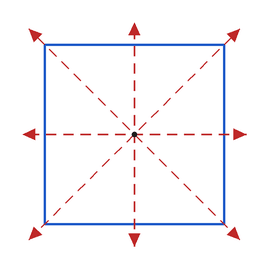
Step 2 — Judge the Reason.
R says that dividing a figure into two congruent halves is enough. That is not so: a diagonal of a parallelogram divides it into two congruent triangles, but they do not fall on each other when the parallelogram is folded along the diagonal. The halves must be mirror images. So R is false.
Watch out: Two parts of equal size are not enough; they must fall exactly on each other when folded along the line, as mirror images.
Why the other options are wrong:
- (B): code (2) calls A false, but a square does have four lines of symmetry.
- (C): code (3) calls R true, but congruent halves alone do not make a line of symmetry.
- (D): code (4) calls A false as well as R.
Therefore, A is true and R is false, code (1), option (A).
- 781 mark
Question 78
The following questions are Assertion-Reason based questions. Choose your answer based on the codes given below :
(1) A is true, R is false.
(2) A is false, R is true.
(3) Both A and R are true.
(4) Both A and R are false.
Assertion (A) : Equilateral triangle has rotational symmetry of order 3.
Reason (R) : If a figure is given one complete rotation and during rotation the number of times the figure fits onto itself is called the order of the rotational symmetry.
Solve with AIAnswer
(A) (1)
(B) (2)
- Correct
(C) (3)
(D) (4)
Answer: (C) (3)
Concept: In an Assertion–Reason item we judge the Assertion (A) and the Reason (R) separately, true or false, and then choose the code that matches both verdicts. A figure has rotational symmetry when it fits onto itself after a turn of less than 360° about a fixed point (its centre). The order of rotational symmetry is the number of times it fits onto itself during one complete turn of 360°; a figure that fits only at 360° is said to have no rotational symmetry.
Step 1 — Judge the Assertion.
An equilateral triangle fits onto itself after turns of 120°, 240° and 360° about its centre: that is 3 times in one complete turn. So A is true.
Step 2 — Judge the Reason.
R states the meaning of the order of rotational symmetry: the number of times a figure fits onto itself during one complete turn. So R is true.
Why the other options are wrong:
- (A): code (1) calls R false, but R is the correct meaning of the order.
- (B): code (2) calls A false, but the order of an equilateral triangle is 3.
- (D): code (4) calls both false, but both are true.
Therefore, both A and R are true, code (3), option (C).
- 791 mark
Question 79
The following questions are Assertion-Reason based questions. Choose your answer based on the codes given below :
(1) A is true, R is false.
(2) A is false, R is true.
(3) Both A and R are true.
(4) Both A and R are false.
Assertion (A) : A square has 4 lines symmetry and rotational symmetry of order 4.
Reason (R) : A parallelogram has a line symmetry.
Solve with AIAnswer
- Correct
(A) (1)
(B) (2)
(C) (3)
(D) (4)
Answer: (A) (1)
Concept: In an Assertion–Reason item we judge the Assertion (A) and the Reason (R) separately, true or false, and then choose the code that matches both verdicts. A line of symmetry (axis of symmetry) divides a figure into two parts that fit exactly on each other when the figure is folded along that line, so each part is the mirror image of the other.
Step 1 — Judge the Assertion.
A square has 4 lines of symmetry and fits onto itself at 90°, 180°, 270° and 360°, so A is true.
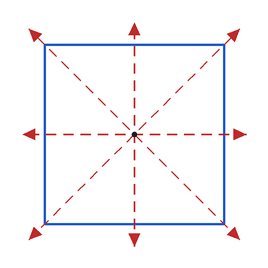
Step 2 — Judge the Reason.
A general parallelogram (not a rectangle or a rhombus) has no line of symmetry: folding along a diagonal or along a line through the mid-points of opposite sides does not make the halves fit. So R is false.
Why the other options are wrong:
- (B): code (2) calls A false, but a square has 4 lines and order 4.
- (C): code (3) calls R true, but a parallelogram has no line of symmetry.
- (D): code (4) calls A false, but A is true.
Therefore, A is true and R is false, code (1), option (A).
What Class 7 Maths Ch 19 covers
The sections of the chapter, in the order the book takes them. Every question above comes from one of these.
- 01Lines of Symmetry of Given Geometrical Figures
- 02Reflection
- 03Reflection in X-Axis
- 04Reflection in Y-Axis
- 05Reflection in Origin
- 06Rotation
More ways to study this chapter
The same chapter asked three other ways. Practise it, revise it, and see what the board has set on Ch 19 before.
Class 7 Maths Ch 19 questions students ask
How many questions are there in Class 7 Maths Ch 19?
79 questions. Every one is solved step by step on this page.
Are these Class 7 Maths solutions free?
Yes. Every question and its full working is free to read, with no account needed.
Can I download the Class 7 Maths Ch 19 solutions as a PDF?
There is no PDF to download. Every solution is on this page instead, which means it is searchable, always the current syllabus, and readable on a phone. Use your browser's print option if you want it on paper.