
Question 93 marksEasy
Write capital letters A to Z of English alphabet and in each case, if possible, draw the largest number of lines of symmetry.
Confirming your payment
Sign up now and get 250 free tokens.
Symmetry · Question 9 of 79
Write capital letters A to Z of English alphabet and in each case, if possible, draw the largest number of lines of symmetry.
Solution:
Concept: A line of symmetry (axis of symmetry) divides a figure into two parts that fit exactly on each other when the figure is folded along that line, so each part is the mirror image of the other.
Step 1 — Test a vertical line.
A vertical line works when the left half of the letter is the mirror image of the right half. This is true for A, M, T, U, V, W and Y, and also for H, I, O and X.
Step 2 — Test a horizontal line.
A horizontal line works when the top half is the mirror image of the bottom half. This is true for B, C, D, E and K, and also for H, I, O and X.
Step 3 — Draw and sort the letters.
We draw each letter with its lines of symmetry dotted. H, I, O and X have both lines, so they have two; the other ten letters have none.
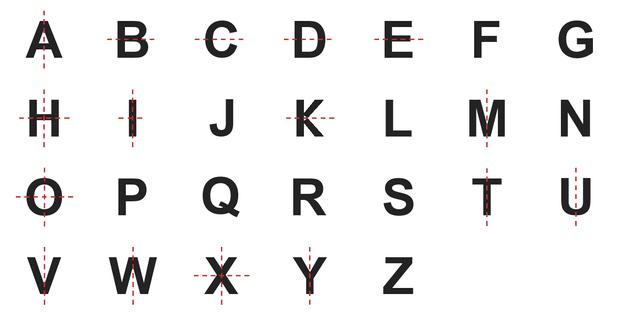
| Lines of symmetry | Letters |
|---|---|
| One (vertical) | A, M, T, U, V, W, Y |
| One (horizontal) | B, C, D, E, K |
| Two (vertical and horizontal) | H, I, O, X |
| None | F, G, J, L, N, P, Q, R, S, Z |
Watch out: N, S and Z look the same after a half turn, but that is rotational symmetry, not a line of symmetry; they have no line.
Note: The answer depends a little on how the letters are written. It assumes plain capital letters, with O drawn as an oval and K drawn with both arms starting from the middle of its upright.
Therefore, A, M, T, U, V, W and Y have one vertical line; B, C, D, E and K have one horizontal line; H, I, O and X have two lines; F, G, J, L, N, P, Q, R, S and Z have none.