
Question 293 marksMedium
Construct a triangle ABC in which AB = AC = 5 cm and BC = 5·6 cm. If possible, draw its line(s) of symmetry.
Confirming your payment
Sign up now and get 250 free tokens.
Symmetry · Question 29 of 79
Construct a triangle ABC in which AB = AC = 5 cm and BC = 5·6 cm. If possible, draw its line(s) of symmetry.
Solution:
Concept: A line of symmetry (axis of symmetry) divides a figure into two parts that fit exactly on each other when the figure is folded along that line, so each part is the mirror image of the other. An isosceles triangle has exactly one: the line through the vertex between the equal sides, perpendicular to the base.
Step 1 — Draw the base.
We draw BC, 5.6 cm long.
Step 2 — Locate A.
With B and C as centres and radius 5 cm we draw two arcs meeting at A, and join AB and AC.
Step 3 — Find the line of symmetry.
Since AB = AC, the triangle is isosceles. Its only line of symmetry is the perpendicular bisector of BC, which passes through A; we draw it dotted.
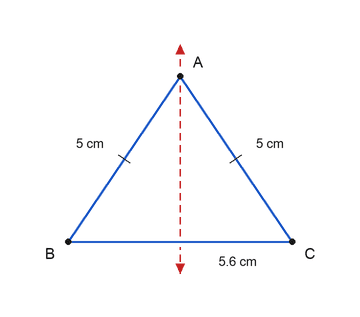
Therefore, triangle ABC is isosceles and has only one line of symmetry, the dotted line through A perpendicular to BC.