
Question 283 marksMedium
Construct an equilateral triangle with each side 6 cm. In the triangle drawn, draw all possible lines of symmetry.
Confirming your payment
Sign up now and get 250 free tokens.
Symmetry · Question 28 of 79
Construct an equilateral triangle with each side 6 cm. In the triangle drawn, draw all possible lines of symmetry.
Solution:
Concept: A line of symmetry (axis of symmetry) divides a figure into two parts that fit exactly on each other when the figure is folded along that line, so each part is the mirror image of the other. An equilateral triangle has three: the line from each vertex to the mid-point of the opposite side.
Step 1 — Draw the base.
We draw a line segment AB, 6 cm long.
Step 2 — Locate C.
With A as centre and radius 6 cm we draw an arc; with B as centre and the same radius we draw another arc cutting the first at C. Joining AC and BC gives triangle ABC with every side 6 cm.
Step 3 — Draw the lines of symmetry.
We join each vertex to the mid-point of the opposite side (found by bisecting that side) and draw these three lines dotted. Each one also bisects the angle at its vertex.
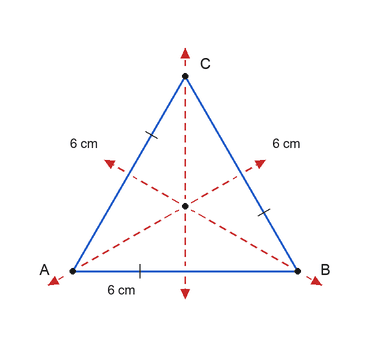
Watch out: Use the same radius (6 cm) for both arcs, so that all three sides are equal.
Therefore, the equilateral triangle has three lines of symmetry, and all three meet at one point inside the triangle.