
Question 303 marksMedium
Construct a triangle PQR such that PQ = QR = 5·5 cm and angle PQR = 90°. If possible, draw its lines of symmetry.
Confirming your payment
Sign up now and get 250 free tokens.
Symmetry · Question 30 of 79
Construct a triangle PQR such that PQ = QR = 5·5 cm and angle PQR = 90°. If possible, draw its lines of symmetry.
Solution:
Concept: A line of symmetry (axis of symmetry) divides a figure into two parts that fit exactly on each other when the figure is folded along that line, so each part is the mirror image of the other.
Step 1 — Draw QR.
We draw QR, 5.5 cm long.
Step 2 — Construct the right angle at Q.
With Q as centre we draw an arc cutting QR; from that point we step off two equal arcs of the same radius (giving 60° and 120°), and from these two points draw equal arcs meeting at a point. Joining it to Q gives ∠RQP = 90°.
Step 3 — Locate P.
With Q as centre and radius 5.5 cm we cut this perpendicular at P, and join PR.
Step 4 — Draw the line of symmetry.
Since PQ = QR and ∠Q = 90°, triangle PQR is an isosceles right-angled triangle. Its only line of symmetry is the bisector of ∠PQR, which is also the perpendicular bisector of PR; we draw it dotted.
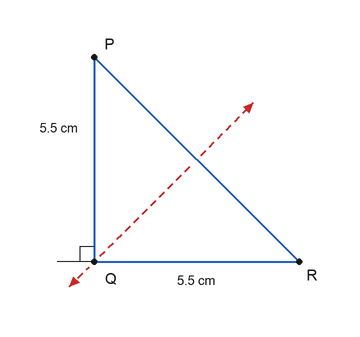
Watch out: The line of symmetry starts at Q, the vertex between the equal sides, not at P or R.
Therefore, triangle PQR has exactly one line of symmetry, the bisector of ∠PQR (also the perpendicular bisector of PR).