
Opening your dashboard
Class 7 Maths Chapter 19 Symmetry: Practice Questions
40 questions on Chapter 19, each worked through on its own page with the AI tutor. Class 7 Maths, ICSE 2026-27.
40 questions
1–5 marks · Mixed difficulty
- 11 mark
Question 1
Bloom's level: Remember
A line that divides a figure into two identical parts which coincide exactly when the figure is folded along it is called :
- 21 mark
Question 2
Bloom's level: Remember
The fixed point about which a figure is rotated is called the :
- 31 mark
Question 3
Bloom's level: Remember
The image of the point when it is reflected in the -axis is :
- 41 mark
Question 4
Bloom's level: Understand
How many lines of symmetry does an isosceles trapezium have?
- 51 mark
Question 5
Bloom's level: Understand
Which of the following has rotational symmetry of order 2 but no line of symmetry?
- 61 mark
Question 6
Bloom's level: Understand
An equilateral triangle is rotated clockwise about its centre. The smallest angle of rotation after which it first fits onto itself is :
- 71 mark
Question 7
Bloom's level: Apply
The image of the point when reflected in the origin is :
- 81 mark
Question 8
Bloom's level: Apply
A point is reflected in the -axis and its image is . The co-ordinates of are :
- 91 mark
Question 9
Bloom's level: Analyse
A square is drawn with at the bottom left, at the bottom right, at the top right and at the top left.
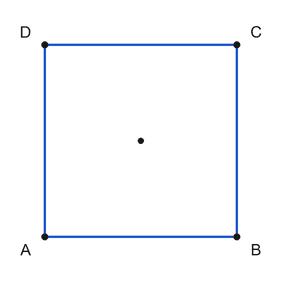
It is rotated clockwise through about its centre. Vertex now occupies the position that was earlier occupied by :
- 101 mark
Question 10
Bloom's level: Understand
Assertion (A) : The image of a point in a line (mirror) is as far behind the line as the point is in front of it.
Reason (R) : The line joining a point and its image is perpendicularly bisected by the mirror line.
- 111 mark
Question 11
Bloom's level: Analyse
Assertion (A) : A rectangle (which is not a square) has rotational symmetry of order 2.
Reason (R) : A rectangle has two lines of symmetry.
- 121 mark
Question 12
Bloom's level: Evaluate
Assertion (A) : A parallelogram which is neither a rectangle nor a rhombus has no line of symmetry.
Reason (R) : Such a parallelogram has no rotational symmetry either.
- 131 mark
Question 13
Bloom's level: Remember
What is meant by the order of rotational symmetry of a figure?
- 141 mark
Question 14
Bloom's level: Understand
Explain why a point on the -axis, such as , is its own image when reflected in the -axis.
- 152 marks
Question 15
Bloom's level: Understand
Explain why a square has rotational symmetry of order 4. Write the angles of rotation at which it fits onto itself.
- 162 marks
Question 16
Bloom's level: Apply
Write the images of the points , , and when they are reflected in the -axis.
- 172 marks
Question 17
Bloom's level: Apply
The line segment joins and . Find the end points of its image in the -axis. Using Pythagoras theorem, show that .

- 182 marks
Question 18
Bloom's level: Apply
A point is cm away from a line . Write the steps to find its image in the line , and find the length of .
- 192 marks
Question 19
Bloom's level: Analyse
The point is reflected and its image is . Was it reflected in the -axis, the -axis or the origin? Explain by comparing the signs of the co-ordinates.
- 202 marks
Question 20
Bloom's level: Apply
An equilateral triangle , with at the top, at the bottom left and at the bottom right, is rotated anticlockwise through about its centre.
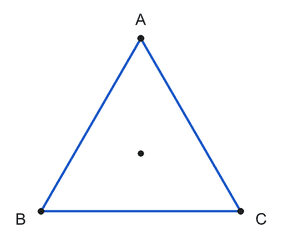
(i) Write the equal clockwise rotation.
(ii) Which vertex's earlier position does now occupy?
- 212 marks
Question 21
Bloom's level: Evaluate
Kiran says, "Reflecting a point in the -axis and then reflecting the image in the -axis gives the same point as reflecting it once in the origin." Check her statement with the point , and then say whether it is true for every point.
- 221 mark
Question 22
Bloom's level: Understand
Explain how folding a paper cut-out of a figure helps you decide whether a given line is a line of symmetry. Give one example from nature.
- 233 marks
Question 23
Bloom's level: Apply
Write the number of lines of symmetry of each figure :
(i) an equilateral triangle
(ii) a rectangle (not a square)
(iii) a square
(iv) a regular pentagon
(v) a regular hexagon
(vi) a kite
- 244 marks
Question 24
Bloom's level: Apply
The vertices of are , and .
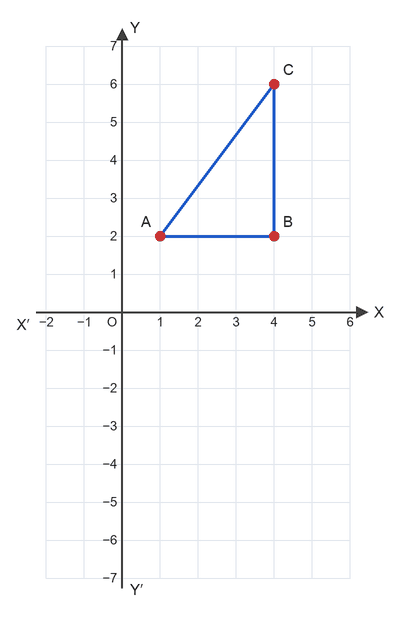
The triangle is reflected in the -axis to .
(i) Write the co-ordinates of , and .
(ii) Find the lengths , and , and , and .
(iii) What do you notice about the shape and size of the triangle after reflection?
- 254 marks
Question 25
Bloom's level: Analyse
Study the graph given below.
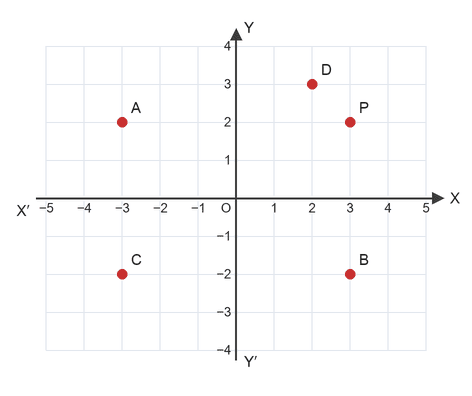
(i) Write the co-ordinates of the points , , , and .
(ii) Which point is the image of in (a) the -axis, (b) the -axis, (c) the origin?
(iii) Is the image of in any of these three? Give a reason.
(iv) Which point is the image of in the -axis?
- 265 marks
Question 26
Bloom's level: Analyse
Case study: A sign-board maker cuts large capital letters out of wood. He uses plain capital letters (no decorations): A, H, N, S, T and X.
(a) Which of these letters have a vertical line of symmetry?
(b) Which of these letters have rotational symmetry of order 2 (they look the same after a half turn)?
(c) Which letters have both a line of symmetry and rotational symmetry? Which letters have rotational symmetry but no line of symmetry at all? Explain why a letter that is the same after a half turn is useful for a hanging sign that may get turned upside down.
- 274 marks
Question 27
Bloom's level: Apply
Case study: A candle is placed 40 cm in front of a plane mirror fixed on a wall.
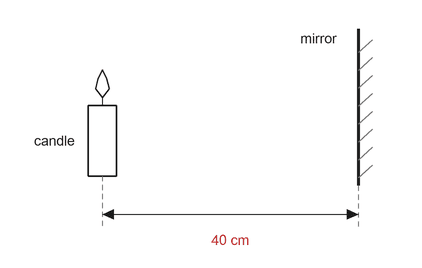
(a) How far behind the mirror is the image of the candle?
(b) What is the distance between the candle and its image?
(c) The candle is now moved 15 cm closer to the mirror. Find the new distance between the candle and its image. By how much has the image moved, and in which direction?
- 284 marks
Question 28
Bloom's level: Evaluate
Rohit makes three statements about rotation. Say whether each is true or false, and justify your answer.
(i) "When a figure is rotated, its shape stays the same but its size may change."
(ii) "Rotating a figure anticlockwise through gives the same result as rotating it clockwise through ."
(iii) "A figure that fits onto itself only once, after a full turn of , has rotational symmetry of order 1, so it has rotational symmetry."
- 294 marks
Question 29
Bloom's level: Create
A square tile is divided into a grid of 16 small squares. Shade exactly 4 small squares to make a design that has :
(a) exactly one line of symmetry
(b) exactly two lines of symmetry
(c) four lines of symmetry and rotational symmetry of order 4
Describe (or draw) each design, mark its lines of symmetry, and explain why it has no more lines than required.
- 305 marks
Question 30
Bloom's level: Create
Plan and carry out this activity on graph paper.
(i) Choose the point . Find its images in the -axis, in the -axis and in the origin.
(ii) Plot , , and and join them in this order. Name the figure formed and find its length and breadth.
(iii) Write the number of lines of symmetry and the order of rotational symmetry of this figure, and name the lines of symmetry.
(iv) Without drawing, predict the figure you would get by starting with instead. Give a reason.
- 311 mark
Question 31
A quadrilateral has exactly two lines of symmetry. It could be :
- 321 mark
Question 32
A lamp is placed 6·5 cm in front of a plane mirror.
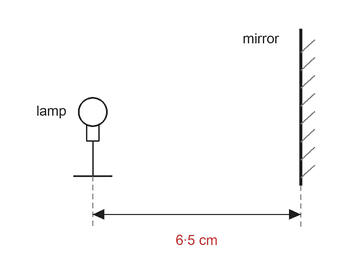
It is then moved 2 cm towards the mirror. The distance between the lamp and its image is now :
- 331 mark
Question 33
The smallest angle through which a regular pentagon must be turned about its centre so that it fits onto itself is :
- 342 marks
Question 34
The point is reflected in the -axis to the point , and is then reflected in the -axis to the point . Write the co-ordinates of and . Is also the image of in the origin ?
- 352 marks
Question 35
The image of the point in the -axis is . Find the values of and .
- 362 marks
Question 36
The image of a point in the origin is . Write the co-ordinates of and of the image of in the -axis.
- 372 marks
Question 37
An equilateral triangle has at the top, at the bottom left and at the bottom right.
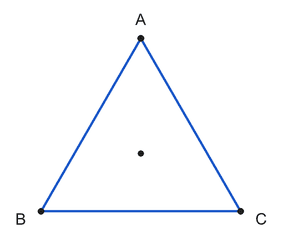
It is rotated about its centre through in the anticlockwise direction. Which vertex now occupies the original position of , of and of ? Through what angle clockwise would give the same final position ?
- 383 marks
Question 38
(a) Copy and complete the table :
Figure Number of lines of symmetry Order of rotational symmetry Equilateral triangle Regular hexagon Isosceles triangle (not equilateral) Parallelogram (not a rectangle or rhombus) (b) Which of these figures has rotational symmetry of order more than 1 but no line of symmetry ?
(c) Which of these figures has a line of symmetry but no rotational symmetry ?
- 394 marks
Question 39
Triangle is drawn on graph paper as shown.
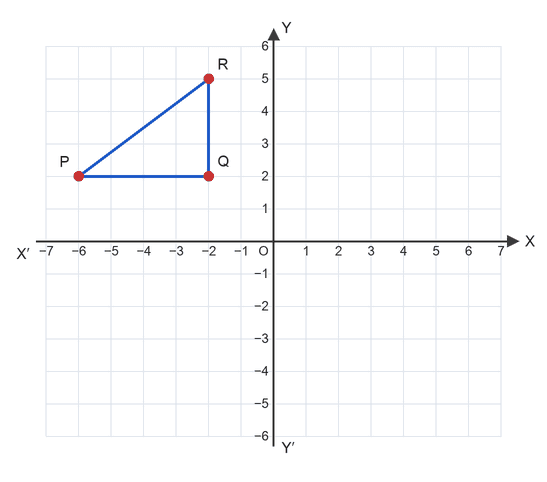
(a) Write the co-ordinates of , and .
(b) Write the co-ordinates of , , , the images of , , in the -axis.
(c) Write the co-ordinates of , , , the images of , , in the origin. In which quadrant does the triangle lie ?
- 404 marks
Question 40
is a regular hexagon with centre , and its vertices are named in the anticlockwise order.
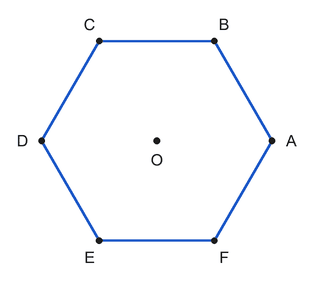
(a) Write the order of rotational symmetry of the hexagon and the smallest angle through which it can be turned about to fit onto itself.
(b) The hexagon is turned about through anticlockwise. Which vertex takes the place of ? Through anticlockwise, which vertex takes the place of ?
(c) How many lines of symmetry does the hexagon have ? Describe where they pass.