Answer: (A) (1)
Concept: In an Assertion–Reason item we judge the Assertion (A) and the Reason (R) separately, true or false, and then choose the code that matches both verdicts. A line of symmetry (axis of symmetry) divides a figure into two parts that fit exactly on each other when the figure is folded along that line, so each part is the mirror image of the other.
Step 1 — Judge the Assertion.
A square has 4 lines of symmetry and fits onto itself at 90°, 180°, 270° and 360°, so A is true.
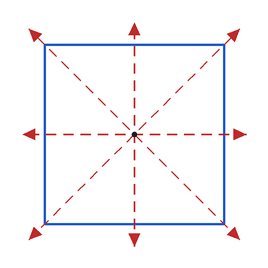
Step 2 — Judge the Reason.
A general parallelogram (not a rectangle or a rhombus) has no line of symmetry: folding along a diagonal or along a line through the mid-points of opposite sides does not make the halves fit. So R is false.
Why the other options are wrong:
- (B): code (2) calls A false, but a square has 4 lines and order 4.
- (C): code (3) calls R true, but a parallelogram has no line of symmetry.
- (D): code (4) calls A false, but A is true.
Therefore, A is true and R is false, code (1), option (A).
