
Opening your dashboard
Class 7 Maths Chapter 19 Symmetry: Competency-Based Questions (CBQ)
40 questions on Chapter 19, each worked through on its own page with the AI tutor. Class 7 Maths, ICSE 2026-27.
40 questions
1–5 marks · Mixed difficulty
- 11 mark
Question 1
Competency: Understanding
Lata cuts a rangoli stencil in the shape of a rhombus that is not a square. She wants to fold it so that the two halves cover each other exactly.
Along how many different lines can she fold it?
- 21 mark
Question 2
Competency: Understanding
Riya stands in front of a plane mirror fixed on a wall and raises her right hand.
Which statement about her image is not correct?
- 31 mark
Question 3
Competency: Application
An electrician fixes bulbs on a display board marked like graph paper. The design must be symmetric about the -axis. One bulb is at the point .
Its matching bulb must be fixed at
- 41 mark
Question 4
Competency: Application
A square floor tile has an arrow painted on it. The arrow points towards the North.

A worker rotates the tile about its centre through in the clockwise direction and fixes it.
The arrow now points towards the
- 51 mark
Question 5
Competency: Application
The minute hand of a wall clock moves from the number 2 to the number 6.
The rotation of the minute hand about the centre of the clock is
- 61 mark
Question 6
Competency: Understanding
Assertion (A): The image of the point in the -axis is the point itself.
Reason (R): Reflection in the -axis changes the sign of the -co-ordinate of a point and leaves its -co-ordinate unchanged.
- 72 marks
Question 7
Competency: Application
A town map is drawn on graph paper with the clock tower at the origin. A fountain stands at the point .
The council wants to build a second fountain so that the clock tower is exactly midway between the two fountains, on the straight line joining them. Find the co-ordinates of the second fountain. Which reflection gives this point?
- 82 marks
Question 8
Competency: Evaluation
Arun says, "A diagonal of a rectangle divides it into two identical triangles. So a diagonal of a rectangle is a line of symmetry."
Is Arun right? Give a reason. Write the correct number of lines of symmetry of a rectangle that is not a square, and say which lines they are.
- 92 marks
Question 9
Competency: Analysis
Sahil had to reflect a point P in the -axis. By mistake he reflected it in the origin and got the image .
Find the co-ordinates of P. Then find the image Sahil should have got.
- 102 marks
Question 10
Competency: Application
An artist draws a hill beside a still lake on graph paper. The -axis is the water line. The foot of the hill is at and , and its peak is at . She draws the reflection of the hill in the water.
Write the co-ordinates of the images of A, B and P. How many units apart are the peak and its image?
- 113 marks
Question 11
Competency: Analysis & Evaluation
A tile maker makes tiles in four shapes. He records two facts about each shape.
Tile shape Number of lines of symmetry Number of times it fits onto itself in one complete turn Isosceles trapezium Parallelogram (not a rectangle or a rhombus) Rhombus (not a square) Equilateral triangle (a) Copy and complete the table.
(b) Which of these tiles look exactly the same after being turned upside down, that is, rotated through ?
(c) Kavya says, "A shape that has no line of symmetry cannot have rotational symmetry." Use the table to decide whether she is right.
- 123 marks
Question 12
Competency: Creativity & Analysis
For Diwali you want to place exactly 6 diyas on a rangoli drawn on graph paper. Design your own arrangement that follows all these rules:
- Every diya is at a point with whole-number co-ordinates, and no diya is at the origin.
- The arrangement is symmetric about the -axis and about the -axis.
- At least one diya is not on either axis.
(a) Write the co-ordinates of your 6 diyas.
(b) Show that your arrangement is symmetric about both axes.
(c) Is your arrangement also unchanged when it is reflected in the origin? Explain why this happens.
- 133 marks
Question 13
Competency: Analysis & Evaluation
A square tile PQRS has P at the top left corner, Q at the top right, R at the bottom right and S at the bottom left. O is its centre.
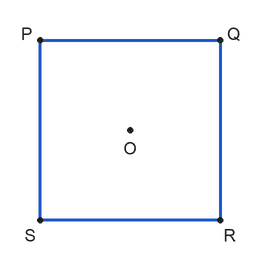
Mini rotates the tile about O through clockwise. Nikhil rotates an identical tile about O through anticlockwise. Mini says, "Our tiles must now look different, because my turn was three times as big."
(a) After Mini's rotation, which corner of the tile is at the top left, top right, bottom right and bottom left?
(b) Answer the same for Nikhil's rotation.
(c) Is Mini right? State the rule that connects a clockwise rotation with an anticlockwise rotation.
- 144 marks
Question 14
Competency: Application & Analysis
Case study — The giant wheel
A giant wheel at a fair has 12 identical cabins, equally spaced around the rim. They are numbered 1 to 12 in the clockwise direction. People get in and out only from the cabin that is at the bottom. The figure shows the wheel at rest, with cabin 1 at the bottom.
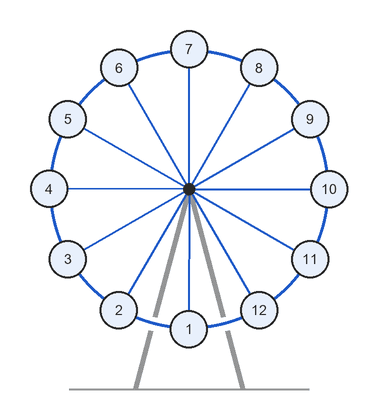
(a) Ignoring the numbers and the stand, what is the order of rotational symmetry of the wheel? What is the smallest angle of rotation after which it fits onto itself?
(b) From the position shown, the wheel turns clockwise through . Which cabin is now at the bottom?
(c) The wheel is back in the position shown. The operator wants to bring cabin 4 to the bottom with the smallest possible turn. In which direction, and through what angle, should he turn the wheel? What is the turn in the other direction?
- 155 marks
Question 15
Competency: Application & Analysis
Case study — Designing a kite
A kite maker draws the right half of a kite on graph paper, as shown. The -axis is the line of symmetry of the complete kite.
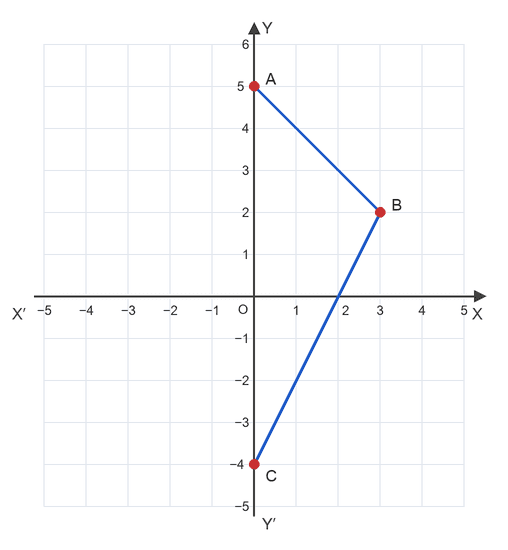
(a) Read the co-ordinates of A, B and C from the graph. Write the co-ordinates of B', the image of B in the -axis. Which of the points A, B and C are their own images in the -axis, and why?
(b) The complete kite is ABCB'. Is it also symmetric about the -axis? Justify your answer using the image of A. How many lines of symmetry does the kite have?
(c) The complete kite is reflected in the origin. Write the co-ordinates of the images of its four vertices. Does the image kite coincide with the original kite?
- 161 mark
Question 16
Competency: Analysis
Meera cuts a paper kite with and , where is longer than . She folds the kite along the diagonal and the two halves fit exactly on each other. She opens the kite and now folds it along the other diagonal .
What does she see?
- 171 mark
Question 17
Competency: Analysis
On a treasure map drawn on graph paper, a flag stands at a point . When the map is reflected in the -axis the flag stays where it is, and when the map is reflected in the -axis the flag again stays where it is.
The flag stands at
- 181 mark
Question 18
Competency: Application & Analysis
A triangular road sign is an equilateral triangle with its corners marked , and . It is turned about its centre through anticlockwise. From that position it is then turned through clockwise.
The marked corners are now in exactly the same places as they would be after one single turn from the start. That single turn is
- 191 mark
Question 19
Competency: Application & Analysis
The logo of a school science club is shown. It is made of four identical blades joined at the centre.
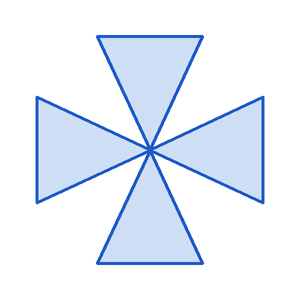
Which statement about the logo is correct?
- 201 mark
Question 20
Competency: Application
A shopkeeper stands in front of a large plane mirror in his shop. He finds that the distance between him and his image is m.
How far is he standing from the mirror?
- 211 mark
Question 21
Competency: Application
The beam of a model lighthouse at a science fair turns anticlockwise and completes one full turn in seconds. At the start the beam points East.
In which direction does the beam point after seconds?
- 221 mark
Question 22
Competency: Analysis & Evaluation
Assertion (A): A scalene triangle has no line of symmetry.
Reason (R): In a scalene triangle no two sides are equal.
- 231 mark
Question 23
Competency: Understanding & Application
A triangular signboard is an equilateral triangle of side cm. It is folded along a line through so that the two halves fit exactly on each other. The fold meets at the point .
The length of is
- 241 mark
Question 24
Competency: Application
A treasure is buried at a point in the fourth quadrant of a map drawn on graph paper. The image of in the -axis is marked as .
In which quadrant does lie?
- 251 mark
Question 25
Competency: Understanding
Assertion (A): The image of the point in the origin is the point .
Reason (R): The image of a point in the origin is found by changing the sign of the abscissa only.
- 262 marks
Question 26
Competency: Application
Anu has a square handkerchief of side cm. She wants to fold it once so that the two halves fit exactly on each other.
How many different folds can she make? Name the shape of the folded handkerchief in each kind of fold.
- 272 marks
Question 27
Competency: Analysis
A rangoli artist draws a pattern round a centre point . The pattern fits exactly onto itself when it is turned about through , and through no smaller angle. (Hypothetical data.)
(a) Find the order of rotational symmetry of the pattern.
(b) Write all the angles smaller than through which the pattern fits onto itself.
- 282 marks
Question 28
Competency: Application & Analysis
A square signboard on a post has a red dot at its top right corner. A motor turns the board about its centre through clockwise at the end of every hour. The motor has now turned the board 7 times.
(a) Through what single clockwise angle, smaller than , is this the same as?
(b) At which corner of the board is the red dot now?
- 292 marks
Question 29
Competency: Evaluation
Neha draws a trapezium in which but the sides and are of different lengths. She says, "The line joining the mid-points of and is a line of symmetry of my trapezium."
Is Neha right? Give a reason. What kind of trapezium has exactly one line of symmetry?
- 302 marks
Question 30
Competency: Understanding & Application
A weather vane has an arrow that points East. After the wind changes, the arrow points South.
Write one single rotation, clockwise, and one single rotation, anticlockwise, about the pivot that bring the arrow from East to South. Give the angle of each.
- 312 marks
Question 31
Competency: Understanding
A potter makes a circular clay plate. She cuts it along a diameter into two equal halves, and then cuts one half into two equal quarters.
Write the number of lines of symmetry of (i) the full plate, (ii) a half plate (a semicircle), (iii) a quarter plate (a quadrant). Give a reason for each.
- 323 marks
Question 32
Competency: Analysis & Application
A long plane mirror covers one wall of a dance room. Ria stands m from the mirror and her friend Sam stands m from it. They stand on the same line, which is at right angles to the mirror, and Ria is between Sam and the mirror.
(a) Find the distance between Ria and her own image.
(b) Find the distance between Sam and Ria's image.
(c) Find the distance between Ria's image and Sam's image. Compare it with the distance between Ria and Sam.
- 333 marks
Question 33
Competency: Analysis
A potter makes a plain regular hexagonal tile (all sides equal and all angles equal).
(a) The plain tile is turned about its centre through . Does it fit onto itself? Give a reason, and write the order of rotational symmetry of the plain tile.
(b) She paints a small red dot near one corner. Is there now any turn smaller than a complete turn after which the tile fits onto itself with the dot on the dot? What is the order of rotational symmetry now?
(c) Where must she paint a second dot, of the same size, so that the tile fits onto itself (dots on dots) after a half turn, but not after a turn of ?
- 343 marks
Question 34
Competency: Analysis & Evaluation
Asha, Bala and Chitra stand at the three corners of a rangoli in the shape of an equilateral triangle. Reading clockwise from the top corner, their order is Asha, Bala, Chitra.
(a) They all move together by turning about the centre of the triangle through , or clockwise. Write the order, reading clockwise from the top corner, after each of these turns.
(b) Their teacher wants the order Asha, Chitra, Bala (reading clockwise from the top corner). Can they get it by turning only? Give a reason.
(c) Which one move, using a line of symmetry of the triangle, gives this order?
- 353 marks
Question 35
Competency: Creativity & Analysis
The school art club wants a new logo. It will be made by taking one blade, a triangle with all three sides of different lengths, which has a corner at the centre of the logo, and then turning copies of this blade about . The logo must have rotational symmetry of order and no line of symmetry.
(a) How many blades does the logo need, and through what angles should the copies be turned about ?
(b) Design one blade by giving its three side lengths. Say how you place the other blades.
(c) Explain why your logo has no line of symmetry.
- 363 marks
Question 36
Competency: Analysis
A game robot has a button that reflects a point in a mirror. Pressing the same button again reflects the new point again in the same mirror.
(a) The point is reflected times, one after another, in the -axis. Where does it finish?
(b) The point is reflected times, one after another, in the origin. Where does it finish?
(c) The point is reflected again and again in the -axis. After how many reflections is it first at ? For which numbers of reflections is it back at ?
- 375 marks
Question 37
Competency: Application & Analysis
Case study — Tile designs
A tile maker prepares three designs on a grid of small squares by shading some of the squares, as shown. The columns are numbered to from the left and the rows to from the bottom.
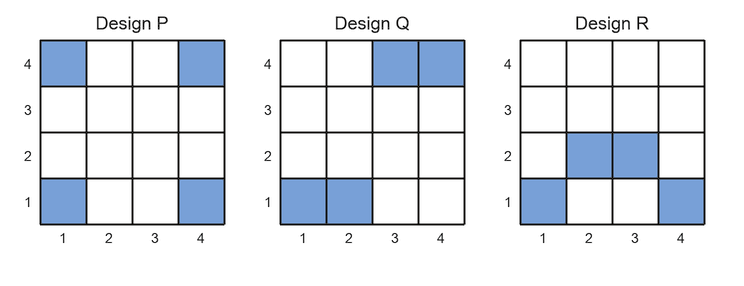
(a) Write the number of lines of symmetry of each design.
(b) Write the order of rotational symmetry of each design. Which designs look the same when the flat tile is turned upside down (a half turn of about its centre)?
(c) She shades four more squares in design R: the mirror images of its shaded squares in the horizontal line through the middle of the grid. Which squares are these? How many lines of symmetry and what order of rotational symmetry does the new design have?
- 384 marks
Question 38
Competency: Evaluation & Analysis
Case study — Rohan's project table
Rohan made a table for his project on symmetry. Two of the entries in it are wrong.
Figure Lines of symmetry Order of rotational symmetry Regular pentagon 5 5 Rhombus (not a square) 2 2 Equilateral triangle 3 6 Regular hexagon 3 6 Parallelogram (not a rectangle or a rhombus) 0 2 (a) Find the two wrong entries and write the correct values.
(b) For each wrong entry, explain how a student can check the correct value by turning or folding a paper model.
(c) Rohan says, "The number of lines of symmetry is always equal to the order of rotational symmetry." Use the corrected table to show that he is wrong.
- 394 marks
Question 39
Competency: Application & Analysis
Case study — Ceiling fans
A shop sells ceiling fans whose identical blades are placed at equal angles round the centre. Some details in the shop's list are missing. (Hypothetical data.)
Model Number of blades Smallest angle of turn after which the fan looks the same Breeze 3 Cool Zephyr 5 Gale (a) Complete the table.
(b) Which models look the same after a half turn ()?
(c) A customer says, "A fan with more blades always has a larger smallest angle." Use the table to decide whether she is right, and state the rule connecting the number of blades and the smallest angle.
- 405 marks
Question 40
Competency: Application & Analysis
Case study — Lamps and a mirror wall
The figure is the floor plan of a dance hall drawn on graph paper (1 unit = 1 m). A long mirror is fixed along the dashed line. Three lamps , and are shown. is fixed on the mirror itself.
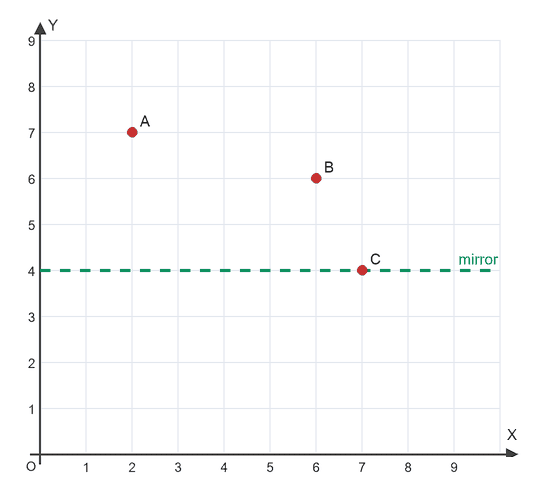
(a) Read the co-ordinates of , and from the figure.
(b) Each lamp has an image in the mirror. Write the co-ordinates of the images , and .
(c) Find, in metres, the distance between each lamp and its image. Which lamp is its own image, and why?