
Opening your dashboard
Class 12 Physics Chapter 23: Photoelectric Effect Solutions
104 textbook questions with step-by-step answers, free to read, for ISC 2026-27.
Get talked through Ch 23, not just shown the answer
Reading a finished solution is not the same as being able to do it. The AI tutor takes one question at a time and works it with you, in your own words, until you can.
- Ask it out loud, in your own words
- It gives you the next step, not the answer
- Stuck on part (ii)? Start there
104 questions with solutions
1–5 marks · Mixed difficulty
The first 49 solutions are on this page. This chapter is a long one, so the rest open on their own page to keep this one quick to load.
- 11 mark
Question 1
The energy of a photon of wavelength is given by
Solve with AIAnswer
(A)
(B)
(C)
- Correct
(D)
Answer: (D) , the photon energy written with its wavelength
Concept: A photon of frequency has energy , and frequency and wavelength are linked by .
Step 1 — Write the frequency in terms of the wavelength. We divide the wave relation by :
Step 2 — Put it into . Substituting gives the energy in terms of :
Step 3 — Check the other options. The other expressions are either written with or have the wrong dimensions:
- (A) This is also the photon's energy, but it is written with the frequency; the question gives the wavelength, so the expected form is .
- (B) This grows with wavelength, but longer waves carry less energy per photon; its unit is J m², not J.
- (C) This is the reciprocal of the correct expression and has unit J⁻¹, not J.
Note: option (A), , is also a correct expression for the photon's energy; the key (D) is the form written with the wavelength that the stem names.
Therefore, the answer is (D).
- 21 mark
Question 2
The momentum of a photon of energy will be,
Solve with AIAnswer
(A)
- Correct
(B)
(C)
(D)
Answer: (B) , the energy divided by the speed of light
Concept: A photon has energy , travels at speed and has zero rest mass. Relativity links the energy , momentum and rest mass of any particle by the energy–momentum relation.
Step 1 — Write the energy–momentum relation. For any particle:
Step 2 — Put in zero rest mass. A photon has , so the last term drops out:
Step 3 — Put in the photon's energy. We substitute :
Note: older textbooks reach the same result by multiplying the photon's "moving mass" , which is only the mass equivalent of its energy, by its speed .
Step 4 — Check the other options. Each other option has the wrong unit:
- (A) This is the energy itself (unit J), not a momentum (unit kg m s⁻¹).
- (C) This multiplies by instead of dividing; its unit is J m s⁻¹.
- (D) This has unit J s², which is not a momentum.
Therefore, the answer is (B).
- 31 mark
Question 3
The rest mass of photon is
Solve with AIAnswer
- Correct
(A) 0
(B)
(C) between 0 and
(D) equal to that of an electron
Answer: (A) 0
Concept: In relativity the energy , momentum and rest mass of any particle are linked by the energy–momentum relation . A body with any rest mass would need infinite energy to reach the speed of light .
Step 1 — Use the measured momentum of light. Experiments on radiation pressure show that light of energy carries momentum . Putting this into the energy–momentum relation gives:
Step 2 — Check with the speed of the photon. A body of rest mass moving at speed has energy . A photon always moves at , so the denominator is zero, and its energy can be finite only if .
Note: older textbooks give this argument with a "moving mass" set equal to ; that quantity is only the mass equivalent of the photon's energy, and physics today uses only the rest mass, which is zero for a photon.
Step 3 — Check the other options. Each other option contradicts this:
- (B) An infinite rest mass would need infinite energy to move at all.
- (C) Any non-zero rest mass would make the photon's energy infinite at speed .
- (D) An electron has rest mass kg and can never reach speed .
Therefore, the rest mass of a photon is zero, option (A).
- 41 mark
Question 4
A photon in motion has a mass
Solve with AIAnswer
(A)
(B)
(C)
- Correct
(D)
Answer: (D) , the energy divided by
Concept: Einstein's mass–energy relation gives the mass equivalent of any energy. A photon has zero rest mass, so "the mass of a photon in motion" can only mean the mass equivalent of its energy.
Step 1 — Use the photon's energy. A photon has energy .
Step 2 — Divide by . From , the mass equivalent of the moving photon's energy is:
Note: modern physics says a photon has zero mass and describes it by its energy and momentum ; "the mass of a moving photon" is an older name for , not a mass the photon has at rest.
Step 3 — Check the other options. Each other option has the wrong unit:
- (A) This is the reciprocal of (the momentum), so its unit is s kg⁻¹ m⁻¹, not kg.
- (B) This has unit J s², not kg.
- (C) This is the photon's energy (unit J), not a mass.
Therefore, the answer is (D): is the mass equivalent of the photon's energy (its rest mass is zero).
- 51 mark
Question 5
Choose the correct statement.
Solve with AIAnswer
(A) Photoelectric effect can take place from bound electron.
- Correct
(B) Photoelectric effect can take place from free electron.
(C) Photoelectric effect can take place from bounded or free electron.
(D) Nothing can be said.
Answer: (B) Photoelectric effect can take place from free electron.
Concept: In this chapter the photoelectrons of a metal are its free electrons: the conduction electrons that move freely inside the metal but are held at the surface, so that energy is needed to pull one out.
Step 1 — Which electrons absorb the light. A photon falling on a metal gives its energy to one of these free electrons. The electron uses to escape and keeps the rest as kinetic energy.
Step 2 — Why the metal matters. An electron that is completely free, alone in empty space, cannot absorb a whole photon, because energy and momentum cannot both be conserved. In the metal the electron is held by the metal, and the metal as a whole takes up the photon's momentum.
Step 3 — Check the other options. Each other option fits the chapter's picture less well:
- (A) This is true in the strict sense: an electron must be bound, to an atom or to the metal, for a photon to be absorbed, and tightly bound inner electrons are knocked out by X-rays. The key follows the chapter's usage instead, in which the electrons that light ejects from a metal surface are called its free (conduction) electrons.
- (C) This can also be defended, since inner bound electrons (by X-rays) and conduction electrons (by light) can both be emitted. The key picks the single case that the chapter's experiments, light falling on a metal surface, describe.
- (D) The experiments do say which electrons are emitted, so this is not the answer.
Note: in strict physics the photoelectric effect needs a bound electron, because an isolated free electron cannot absorb a whole photon, so (A) is the physically exact choice and (C) can also be argued. The key (B) uses "free electron" in the chapter's sense of a conduction electron held by the metal.
Therefore, the answer is (B).
- 61 mark
Question 6
If the distance of 100 W lamp is increased from a photocell, then saturation current in the photocell varies with distance as,
Solve with AIAnswer
(A)
(B)
(C)
- Correct
(D)
Answer: (D) , the inverse square of the distance
Concept: For light of a given frequency (here the same lamp at every distance), the saturation current is proportional to the number of photons falling on the cathode per second, that is, to the intensity of the light there.
Step 1 — How intensity changes with distance. A lamp small compared with sends its light out equally in all directions, spread over a sphere of area . The intensity at distance is:
Step 2 — Link to the current. Since and , we get .
Step 3 — Check the other options. Each other option has the wrong dependence:
- (A) This would make the current grow as the lamp moves away, but less light reaches the cell.
- (B) This also makes the current grow with distance.
- (C) This falls too slowly; the light spreads over an area that grows as , not .
Therefore, the answer is (D).
- 71 mark
Question 7
Photoelectric effect is an example of
Solve with AIAnswer
(A) elastic collision
- Correct
(B) inelastic collision
(C) two dimensioned collision
(D) oblique collision
Answer: (B) inelastic collision
Concept: In an elastic collision the total kinetic energy is unchanged; in an inelastic collision part of it is used up in another form, and the colliding bodies may even merge.
Step 1 — What happens to the photon. The photon is completely absorbed by the electron and stops existing.
Step 2 — What happens to the energy. Part of the photon's energy, the work function , is used to free the electron from the metal; only the rest appears as kinetic energy. Kinetic energy is not conserved, so the collision is inelastic.
Step 3 — Check the other options. None of the others describes the energy exchange:
- (A) In an elastic collision the photon would bounce off with its energy shared, but it is absorbed completely.
- (C) This only describes the geometry of a collision, not whether kinetic energy is kept.
- (D) This also describes only the direction of approach, not what happens to the energy.
Therefore, the answer is (B).
- 81 mark
Question 8
The energy of a photon of light of wavelength 450 nm is
Solve with AIAnswer
- Correct
(A)
(B)
(C)
(D)
Answer: (A)
Concept: The energy of a photon of wavelength is .
Step 1 — Write the data. We take , and .
Step 2 — Substitute. We put these values into the formula:
Step 3 — Check the other options. Each other value belongs to a very different wavelength:
- (B) A photon of J would have a wavelength of about 795 nm, in the near infrared.
- (C) A photon of J would have a wavelength of only about 16 nm, in the extreme ultraviolet.
- (D) This is about times the correct value; no single photon carries such an energy.
Therefore, the answer is (A).
- 91 mark
Question 9
The value of Planck energy is
Solve with AIAnswer
- Correct
(A)
(B)
(C)
(D)
Answer: (A) , quanta each of energy
Concept: By Planck's quantum theory, radiation is emitted or absorbed only in whole numbers of quanta, each of energy , so the energy of quanta is , where is a whole number.
Step 1 — Write the energy with the wavelength. We replace by in :
Step 2 — Check the other options. Each other expression has the wrong unit (it must be the joule):
- (B) has unit J s m, not J.
- (C) has unit J m², not J.
- (D) has unit J s², not J.
Therefore, the answer is (A).
- 101 mark
Question 10
Energy of a quanta of frequency Hz and J s will be
Solve with AIAnswer
- Correct
(A)
(B)
(C)
(D)
Answer: (A)
Concept: The energy of one quantum of radiation of frequency is .
Step 1 — Substitute the data. We multiply Planck's constant by the frequency:
This is about 4.1 eV, a typical ultraviolet photon.
Step 2 — Check the other options. Each other value is wrong by many powers of ten:
- (B) This is times the correct value.
- (C) This is only about eV, far too small for a photon of Hz.
- (D) This is ten times smaller still, about eV.
Note: option (A) is printed as J, a misprint; the book's own answer gives J, which is shown here.
Therefore, the answer is (A).
- 111 mark
Question 11
Which of the following is incorrect statement regarding photon?
Solve with AIAnswer
- Correct
(A) Photon exerts no pressure
(B) Photon energy is
(C) Photon rest mass is zero
(D) None of these
Answer: (A) Photon exerts no pressure
Concept: A photon carries momentum . When photons are absorbed or reflected by a surface, their momentum changes, so they push on the surface: this is radiation pressure.
Step 1 — Test the statement about pressure. Since each photon has momentum, a stream of photons striking a surface exerts a force on it. Radiation pressure has been measured in the laboratory, and sunlight's pressure pushes the dust tails of comets away from the Sun. So "photon exerts no pressure" is incorrect.
Step 2 — Check the other options. The other statements are correct or do not apply:
- (B) This is correct: the energy of a photon of frequency is .
- (C) This is correct: a photon always moves at speed and has zero rest mass.
- (D) This cannot be chosen, because statement (A) is incorrect.
Therefore, the incorrect statement is (A).
- 121 mark
Question 12
The photoelectric effect can be understood on the basis of
Solve with AIAnswer
(A) the principle of superposition
(B) the electromagnetic theory of light
(C) the special theory of relativity
- Correct
(D) line spectrum of the atom
Answer: (D) line spectrum of the atom
Concept: The photoelectric effect is explained by the quantum idea: light gives up its energy in packets , one packet to one electron.
Step 1 — Link with line spectra. The line spectrum of an atom shows the same idea: an atom emits or absorbs light only in packets , so only certain frequencies appear. Both effects rest on light energy being exchanged in quanta.
Step 2 — Check the other options. The others do not supply the quantum of energy:
- (A) Superposition explains interference, a wave effect; it cannot give a threshold frequency.
- (B) The electromagnetic wave theory predicts emission at any frequency if the light is intense enough, and a time lag for dim light, the opposite of what is observed.
- (C) Special relativity gives the photon's zero rest mass and its momentum , but Einstein's equation needs only the quantum of energy.
Note: none of the options names the photon directly; the key (D) groups the effect with line spectra as quantum effects, and (C) can also be argued because the photon's momentum and zero rest mass come from special relativity.
Therefore, the answer is (D).
- 131 mark
Question 13
Photoelectric effect can be explained by
Solve with AIAnswer
(A) Corpuscular theory of light
(B) Wave nature of light
(C) Bohr's theory
- Correct
(D) Quantum theory of light
Answer: (D) Quantum theory of light
Concept: By the quantum theory, light travels as photons of energy , and one photon is absorbed by one electron.
Step 1 — How the quantum theory explains the observations. An electron is emitted only if (threshold frequency); its maximum kinetic energy grows with frequency; brighter light means more photons and so more electrons; and a single photon acts at once, so there is no time lag.
Step 2 — Check the other options. Each other theory fails:
- (A) Newton's corpuscular theory treated light as particles but gave them no energy fixed by frequency, so it cannot give a threshold frequency.
- (B) The wave theory predicts emission at any frequency with enough intensity, and a time lag in dim light, which is not observed.
- (C) Bohr's theory explains the energy levels and spectrum of the hydrogen atom, not emission of electrons from a metal surface.
Therefore, the answer is (D).
- 141 mark
Question 14
The mass of photoelectron is
Solve with AIAnswer
(A)
(B)
- Correct
(C)
(D)
Answer: (C)
Concept: A photoelectron is an ordinary electron that has been ejected by light, so it has the electron's rest mass.
Step 1 — Recall the electron's mass. The rest mass of an electron is kg (more precisely kg).
Step 2 — Check the other options. Each other value is wrong by a power of ten:
- (A) This is about 5 times the mass of a proton ( kg), far heavier than any electron.
- (B) This is 100 times the electron's mass.
- (D) This is only one-thousandth of the electron's mass.
Therefore, the answer is (C).
- 151 mark
Question 15
Photoelectric effect supports quantum nature of light because
(i) There is minimum frequency of light below which no photoelectrons are emitted.
(ii) Electric charge of photoelectrons is quantised.
(iii) Maximum kinetic energy of photoelectrons depends only on the frequency of light and not on its intensity.
(iv) Even when metal surface is faintly illuminated, the photoelectrons leave the surface immediately.
Solve with AIAnswer
(A) (i), (ii), (iii)
(B) (i), (ii), (iv)
(C) (ii), (iii), (iv)
- Correct
(D) (i), (iii), (iv)
Answer: (D) Statements 1, 3 and 4
Concept: A fact supports the quantum (photon) nature of light if the wave theory cannot explain it while the photon picture, one photon of energy to one electron, can.
Step 1 — Statement 1, the threshold frequency. The wave theory predicts emission at any frequency if the light is intense enough. With photons, emission needs , which gives a minimum frequency. It supports the quantum nature.
Step 2 — Statement 2, quantised charge. The charge of an electron is always whether or not light is involved; this is a property of electrons, not of light. It does not support the quantum nature of light.
Step 3 — Statement 3, kinetic energy and frequency. In the wave theory a more intense wave should give faster electrons. With photons, depends on frequency only. It supports the quantum nature.
Step 4 — Statement 4, no time lag. In faint light a wave would take a long time to deliver enough energy to one electron. A single photon delivers it at once. It supports the quantum nature.
Step 5 — Check the other options. Each other option is wrong:
- (A) This includes statement 2, which is about electrons, and leaves out statement 4.
- (B) This includes statement 2 and leaves out statement 3.
- (C) This includes statement 2 and leaves out statement 1.
Therefore, the answer is (D).
- 161 mark
Question 16
Who discovered photoelectric effect?
Solve with AIWritten solution
Solution:
Concept: The photoelectric effect is the emission of electrons from a metal surface when light of suitable frequency falls on it.
Step 1 — The first observation. In 1887, while producing electromagnetic waves with a spark gap, Heinrich Hertz noticed that the spark jumped more easily when ultraviolet light fell on the gap electrodes.
Step 2 — Later work. In 1888 Hallwachs showed that ultraviolet light makes a negatively charged zinc plate lose its charge and an uncharged insulated plate become positively charged. In about 1899–1902 J. J. Thomson and Lenard showed that the particles given off are electrons.
Therefore, the photoelectric effect was discovered by Heinrich Hertz (1887).
- 171 mark
Question 17
Is photoelectric emission a spontaneous process or instantaneous process?
Solve with AIWritten solution
Solution:
Concept: In the photon picture one photon gives its whole energy to one electron at once.
Step 1 — What experiments show. Electrons are emitted as soon as the light falls on the surface, even when the light is very faint; the delay is less than about s.
Step 2 — Why. The electron does not have to collect energy slowly from a spread-out wave; a single photon supplies it immediately.
Therefore, photoelectric emission is an instantaneous process.
- 181 mark
Question 18
Which photon is more energetic, a red one or violet one?
Solve with AIWritten solution
Solution:
Concept: The energy of a photon is , so a photon of higher frequency carries more energy.
Step 1 — Compare the frequencies. Violet light (about 400 nm) has a frequency of about Hz, while red light (about 700 nm) has about Hz.
Step 2 — Compare the energies. Since , a violet photon has more energy (about 3.1 eV, against about 1.8 eV for red).
Therefore, a violet photon is more energetic than a red one.
- 191 mark
Question 19
“There are photographic plates which are immediately blackened by white light, but not affected by red light.” Why?
Solve with AIWritten solution
Solution:
Concept: A photon acts on its own: it can cause a change only if its single energy is large enough.
Step 1 — What blackens the plate. The silver bromide grains of such a plate change only when a photon of enough energy is absorbed; ordinary plates respond to blue, violet and shorter wavelengths.
Step 2 — Red light. Red photons have the lowest frequency of visible light, about 1.8 eV each, too little to start the change. Making the red light brighter only sends more of these weak photons.
Step 3 — White light. White light contains blue and violet photons with enough energy, so the plate is blackened at once.
Therefore, the plate is not affected by red light because red photons have too little energy each to start the change, while white light contains more energetic blue and violet photons.
- 201 mark
Question 20
Is it necessary that each incident photon eject a photoelectron?
Solve with AIWritten solution
Solution:
Concept: One photon can eject at most one electron, and only if its energy reaches the work function and the electron actually escapes.
Step 1 — Photons that eject nothing. Many photons are reflected by the surface. Others are absorbed by electrons that lose the energy in collisions inside the metal (it becomes heat) before they reach the surface.
Step 2 — Result. Only a small fraction of the photons, often much less than one in a hundred, produce photoelectrons.
Therefore, no: not every photon ejects a photoelectron, because some are reflected and some are absorbed without an electron escaping.
- 211 mark
Question 21
Mention a phenomenon illustrating particle nature of light.
Solve with AIWritten solution
Solution:
Concept: The particle nature of light means that light delivers its energy in packets (photons), each of energy , and each packet acts on one particle of matter at a time.
Step 1 — Choose the phenomenon. We choose the photoelectric effect, because its main facts cannot be explained if light is a continuous wave.
Step 2 — Show why it needs particles of light. In the photoelectric effect one photon frees one electron at once, there is a threshold frequency below which no electrons come out, and the electrons' maximum kinetic energy depends on the frequency, not on the intensity. These facts follow only if each photon hands its whole energy to one electron.
Note: the Compton effect, in which X-ray photons bounce off electrons like particles carrying momentum , is another example.
Therefore, the photoelectric effect illustrates the particle nature of light.
- 221 mark
Question 22
The photoelectric threshold wavelength for metal is 2500 Å. What does it mean?
Solve with AIWritten solution
Solution:
Concept: The threshold wavelength is the longest wavelength that can eject electrons from a metal; then .
Step 1 — Meaning. Light of wavelength up to 2500 Å can eject photoelectrons from this metal. Light of any longer wavelength cannot, however intense it is.
Step 2 — Work function it implies. The photon energy at 2500 Å is about 4.97 eV, so this is the work function of the metal.
Therefore, it means that no photoelectrons are emitted by light of wavelength greater than 2500 Å; only wavelengths of 2500 Å or less can eject electrons.
- 231 mark
Question 23
The work function of a metal is 4 eV. What does it mean?
Solve with AIWritten solution
Solution:
Concept: The work function is the minimum energy needed to free an electron from the surface of a metal.
Step 1 — Meaning. At least 4 eV of energy must be given to an electron to release it from this metal. In joules this minimum is J.
Step 2 — Light needed. Only photons of energy 4 eV or more can eject electrons, that is, light of wavelength about 310 nm or shorter (frequency about Hz or more).
Therefore, it means that electrons can be ejected from the metal only by photons having energy of 4 eV or more.
- 241 mark
Question 24
What is meant by kinetic mass of a photon?
Solve with AIWritten solution
Solution:
Concept: By Einstein's relation , any energy has a mass equivalent .
Step 1 — Recall what a photon has. A photon always travels at the speed of light and has zero rest mass, yet while it moves it carries energy .
Step 2 — Find the mass equivalent of this energy. Dividing the photon's energy by gives the mass linked with its motion, which is called its kinetic mass:
Note: modern physics usually says that a photon has zero mass and describes its motion by its energy and momentum ; "kinetic mass" (relativistic mass) is an older way of writing the same energy as .
Therefore, the kinetic mass of a photon is the mass it has because of its motion (energy), ; its rest mass is zero.
- 251 mark
Question 25
On what factor does the magnitude of photoelectric current, the velocity of ejected electrons depend during photoelectric emission from a metal?
Solve with AIWritten solution
Solution:
Concept: One photon frees one electron, and each photon brings energy .
Step 1 — Photoelectric current. The number of electrons emitted per second equals (a fraction of) the number of photons arriving per second, so, for light of a given frequency above the threshold, the current depends on the intensity of the light.
Step 2 — Velocity of the electrons. The maximum kinetic energy is , so the maximum velocity depends on the frequency of the light (and on the metal), not on its intensity.
Therefore, the photoelectric current depends on the intensity of the light, and the velocity of the ejected electrons depends on its frequency.
- 261 mark
Question 26
If the frequency of the incident light on the cathode of a photocell is doubled, how will the following change: (i) kinetic energy of the electrons, (ii) photoelectric current and (iii) stopping potential?
Solve with AIWritten solution
Solution:
Concept: Einstein's photoelectric equation states that one photon of energy gives all its energy to one electron. Part of it, the work function , frees the electron from the metal; the rest is the electron's maximum kinetic energy:
Step 1 — Part (i): kinetic energy. Before the change the maximum kinetic energy is:
After the frequency is doubled it becomes:
So the maximum kinetic energy becomes more than twice as large.
Step 2 — Part (ii): photoelectric current. The current depends on the number of photons arriving per second, not on their frequency. If the same number of photons arrives per second, the current does not change.
Step 3 — Part (iii): stopping potential. Since , the stopping potential changes in the same way as the kinetic energy and becomes more than twice as large.
Note: if instead the power of the light (energy per second) were kept the same, doubling the frequency would halve the number of photons per second, and the current would fall.
Therefore, (i) the kinetic energy becomes more than double, (ii) the photoelectric current does not change, and (iii) the stopping potential becomes more than double.
- 271 mark
Question 27
The light reaching our eye is discontinuous according to quantum theory. But we do not feel it. Why?
Solve with AIWritten solution
Solution:
Concept: The eye's response to light lasts a short time after the light arrives (persistence of vision, about s).
Step 1 — How many photons arrive. Even faint light carries enormous numbers of photons. For example, just 1 mW of orange light of 600 nm brings about photons every second.
Step 2 — Why the light seems continuous. So many photons reach the retina within each fraction of a second that the sensation from one has not faded before the next arrives. The separate arrivals merge into a steady sensation.
Note: the book quotes the duration of the effect on the retina as about s.
Therefore, we do not feel the discontinuity because a huge number of photons reach the eye every second and their effects merge through persistence of vision.
- 281 mark
Question 28
“When monochromatic radiation of 2000 Å falls upon a nickel plate, the latter acquires a positive charge. When the wavelength is increased to 3400 Å, the effect is found to cease, however intense the incident radiation may be”. Explain it.
Solve with AIWritten solution
Solution:
Concept: Electrons are emitted only if each photon's energy is at least the work function; the longest wavelength that works is the threshold wavelength.
Step 1 — Radiation of 2000 Å. Each photon carries about 6.2 eV. This is more than the nickel's work function, so electrons are ejected. The plate loses negative charge and becomes positively charged.
Step 2 — Radiation of 3400 Å. The effect stops at 3400 Å, so this is the threshold wavelength for the plate (work function about 3.7 eV here). Photons of 3400 Å or longer do not have enough energy each.
Step 3 — Why intensity does not help. Greater intensity only means more photons of the same small energy; an electron absorbs one photon, so none can escape.
Note: clean nickel surfaces have work functions of about 5 eV, which puts the threshold nearer 2400 Å; the explanation is the same with the question's 3400 Å.
Therefore, 2000 Å photons have more energy than the work function and eject electrons, leaving the plate positive, while photons of 3400 Å or longer are below the threshold and eject none, however intense the radiation.
- 291 mark
Question 29
Name one factor on which the energy of a quantum of light depends.
Solve with AIWritten solution
Solution:
Concept: Light is emitted and absorbed in quanta (photons), and Planck's relation fixes the energy of each quantum.
Step 1 — Write the energy of one quantum. Planck's relation gives the energy of a quantum of light of frequency , where is Planck's constant:
Step 2 — Identify the factor that can change. Since is a constant, the energy changes only with the frequency . Equivalently it depends on the wavelength, because , so a shorter wavelength means a more energetic quantum.
Therefore, the energy of a quantum of light depends on its frequency.
- 301 mark
Question 30
What is the effect of intensity of incident light on threshold frequency?
Solve with AIWritten solution
Solution:
Concept: The threshold frequency is given by , where is the work function of the metal.
Step 1 — What fixes . is a property of the metal surface, so depends only on the metal.
Step 2 — Role of intensity. Changing the intensity changes the number of photons, not the energy of each, so it cannot change .
Therefore, intensity has no effect on the threshold frequency.
- 311 mark
Question 31
If the intensity of incident radiation on a metal surface is doubled, what happens to the kinetic energy of the electrons emitted?
Solve with AIWritten solution
Solution:
Concept: The maximum kinetic energy of photoelectrons is .
Step 1 — Effect of doubling the intensity. Doubling the intensity doubles the number of photons per second, so twice as many electrons are emitted.
Step 2 — Effect on each electron. Each photon still has energy , so the maximum kinetic energy of each electron is unchanged.
Therefore, the kinetic energy of the emitted electrons does not change; only their number doubles.
- 321 mark
Question 32
Define photoelectric work function. How is it related to threshold frequency?
Solve with AIWritten solution
Solution:
Concept: Electrons inside a metal are held by the attraction of the positive ions, so energy must be supplied to pull one out through the surface.
Step 1 — Definition. The photoelectric work function of a metal is the minimum energy that must be given to an electron (by a photon) to free it from the surface of the metal.
Step 2 — Relation with threshold frequency. At the threshold frequency the photon has just this energy:
Therefore, the work function is the minimum energy needed to eject an electron from the metal surface, and .
- 331 mark
Question 33
Which photon is more energetic, a red one or a violet one?
Solve with AIWritten solution
Solution:
Concept: A photon of frequency has energy .
Step 1 — Compare the frequencies. Violet light has a higher frequency (about Hz) than red light (about Hz).
Step 2 — Compare the energies. Since is proportional to , the violet photon carries more energy.
Therefore, a violet photon is more energetic than a red one.
- 341 mark
Question 34
If the wavelength of an electromagnetic radiation is doubled, what will happen to the energy of photons?
Solve with AIWritten solution
Solution:
Concept: The energy of a photon is , so is inversely proportional to .
Step 1 — Write the energy before the change. For wavelength , each photon has:
Here and are constants, so only changes.
Step 2 — Double the wavelength. We replace by :
Therefore, the energy of each photon is halved.
- 351 mark
Question 35
Is photoelectric emission possible at all frequencies? Give reason for your answer.
Solve with AIWritten solution
Solution:
Concept: Emission needs each photon to bring at least the work function: .
Step 1 — Below the threshold frequency. If , each photon has less energy than , so no electron can escape, however intense the light.
Step 2 — At or above the threshold. If , emission takes place.
Therefore, no: photoelectric emission is possible only if the frequency of the light is greater than (or equal to) the threshold frequency of the metal.
- 361 mark
Question 36
Work function of aluminium is 4.2 eV. If two photons each of energy 2.5 eV are incident on its surface, will the emission of electrons take place? Justify your answer.
Solve with AIWritten solution
Solution:
Concept: An electron absorbs one whole photon; emission occurs only if that one photon's energy is at least the work function.
Step 1 — Compare one photon with the work function. Each photon has 2.5 eV, which is less than the 4.2 eV needed.
Step 2 — Why the two photons do not add. The energies of two photons are not combined in one electron at ordinary intensities: each photon acts on its own. Their total of 5 eV therefore does not help.
Therefore, no electron is emitted, because the energy of a single photon (2.5 eV) is less than the work function of aluminium (4.2 eV).
- 371 mark
Question 37
Out of microwaves, ultraviolet rays and infrared rays, which radiation will be most effective for emission of electrons from a metallic surface?
Solve with AIWritten solution
Solution:
Concept: A photon can eject an electron only if ; most metals have work functions of a few electronvolts.
Step 1 — Order the frequencies. Microwaves have the lowest frequency, infrared rays a higher one and ultraviolet rays the highest.
Step 2 — Compare the photon energies. Ultraviolet photons carry several electronvolts, enough to exceed the work functions of most metals; infrared and microwave photons carry far less.
Therefore, ultraviolet rays are the most effective for photoelectric emission.
- 381 mark
Question 38
Two metals and have work functions 4 eV and 10 eV respectively. Which metal has higher threshold wavelength?
Solve with AIWritten solution
Solution:
Concept: At the threshold wavelength a photon's energy equals the work function, so : is inversely proportional to .
Step 1 — Compare the work functions. Metal has the smaller work function, 4 eV.
Step 2 — Compare the threshold wavelengths. The smaller gives the longer . Using eV nm, the threshold wavelength of is:
In the same way, the threshold wavelength of is:
Therefore, metal , with the lower work function, has the higher threshold wavelength.
- 392 marks
Question 39
Draw a graph to show the effect of intensity of light on photoelectric current.
Solve with AIWritten solution
Solution:
Concept: For light of a fixed frequency above the threshold, each photon that is absorbed can free one electron, so the number of electrons emitted per second is proportional to the number of photons arriving per second, that is, to the intensity.
Step 1 — Set up the experiment. The frequency of the light and the collector potential are kept fixed (the collector positive enough to collect every emitted electron). Only the intensity is changed, and the current is read each time.
Step 2 — Draw the graph. The graph below plots photoelectric current against intensity:
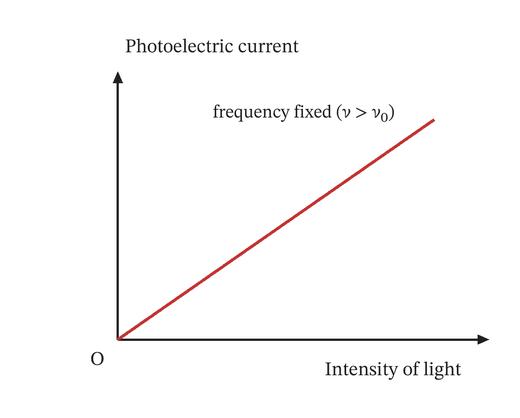
Step 3 — Read the graph. It is a straight line through the origin: doubling the intensity doubles the current, and with no light there is no current.
Therefore, the photoelectric current is directly proportional to the intensity of the incident light (a straight-line graph through the origin).
- 402 marks
Question 40
With a suitable graph explain the effect of retarding potential on photoelectric current.
Solve with AIWritten solution
Solution:
Concept: Photoelectrons leave the emitter with kinetic energies from zero up to a maximum . A negative (retarding) potential on the collector pushes them back, and only electrons with enough energy reach it.
Step 1 — Draw the graph. The graph shows the photoelectric current against the collector potential for light of one frequency at two intensities:
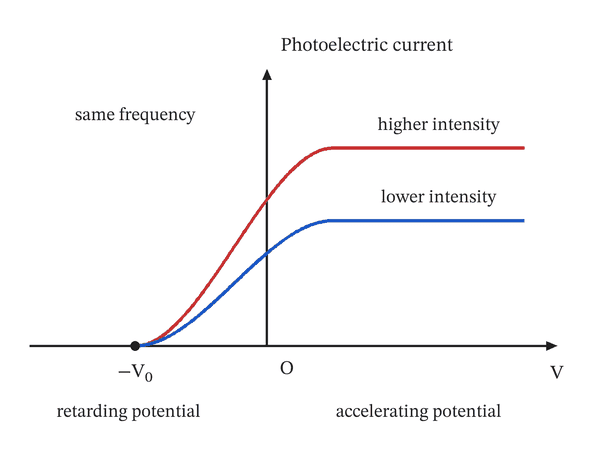
Step 2 — Positive (accelerating) potential. As increases, more of the emitted electrons are collected, until all of them are; the current then stays at its saturation value.
Step 3 — Negative (retarding) potential. When the collector is made negative, slow electrons are turned back, so the current falls steadily as the retarding potential grows.
Step 4 — Stopping potential. At even the fastest electrons are stopped and the current becomes zero. Then
Step 5 — Effect of intensity. Both curves reach zero at the same , because the stopping potential depends on the frequency, not the intensity; brighter light only gives a larger saturation current.
Therefore, the photoelectric current decreases as the retarding potential increases and becomes zero at the stopping potential , which is the same for all intensities of light of a given frequency.
- 412 marks
Question 41
State the laws of photoelectric current.
Solve with AIWritten solution
Solution:
Concept: The laws of photoelectric emission sum up what experiments with a photocell show.
Step 1 — Threshold frequency. For a given metal there is a minimum frequency, the threshold frequency, below which no photoelectrons are emitted, however intense the light. It depends only on the metal.
Step 2 — Photocurrent and intensity. Above the threshold, for light of a given frequency, the number of photoelectrons emitted per second, and so the photoelectric current, is directly proportional to the intensity of the incident light.
Step 3 — Kinetic energy and frequency. The maximum kinetic energy of the photoelectrons increases linearly with the frequency of the light and does not depend on its intensity.
Step 4 — No time lag. Emission starts as soon as light falls on the surface; there is no measurable time lag (less than about s).
Therefore, the four laws are: a threshold frequency exists; current is proportional to intensity (for light of a given frequency); maximum kinetic energy depends on frequency, not intensity; and emission is instantaneous.
- 422 marks
Question 42
Explain quantum theory of radiation.
Solve with AIWritten solution
Solution:
Concept: Planck (1900) proposed the quantum theory to explain the spectrum of black-body radiation; Einstein (1905) extended it to explain the photoelectric effect.
Step 1 — Radiation in packets. Radiation is emitted or absorbed not continuously but in separate packets of energy called quanta.
Step 2 — Energy of a quantum. Each quantum of radiation of frequency carries an amount of energy fixed by that frequency:
Here J s is Planck's constant. A body can emit or absorb only a whole number of quanta, so the energy it exchanges is .
Step 3 — Photons. Einstein added that the quanta also travel through space as packets, called photons, moving at the speed of light. For radiation of a given frequency, the intensity is proportional to the number of photons crossing unit area per second, because each photon carries the same energy .
Step 4 — One photon, one electron. When a photon is absorbed, it gives all its energy to one particle at once; a photon is never absorbed in part. (In scattering, such as the Compton effect, a photon can hand over part of its energy, but then a new photon of lower energy carries on.)
Therefore, the quantum theory states that radiation is emitted, absorbed and carried in discrete packets (photons), each of energy .
- 432 marks
Question 43
What is the relation connecting momentum and energy of a photon?
Solve with AIWritten solution
Solution:
Concept: By the theory of relativity, the energy , momentum and rest mass of any particle are linked by the energy–momentum relation. A photon has zero rest mass and always moves at the speed of light in vacuum.
Step 1 — Write the energy–momentum relation. We start from the general relation between the energy and the momentum of a particle:
Step 2 — Put in zero rest mass. For a photon the rest mass is zero, so the second term on the right drops out:
Step 3 — Write the momentum. Dividing both sides by gives the momentum of the photon in terms of its energy:
Step 4 — Write it with frequency and wavelength. We put and then use :
Note: Many older textbooks reach the same result by giving the photon a "moving mass" and multiplying it by . The answer is the same, but physics today uses only the rest mass, which is zero for a photon, together with the energy–momentum relation above.
Therefore, the momentum of a photon is its energy divided by the speed of light: , or .
- 442 marks
Question 44
Will a beam of photon get deflected while passing through (i) an electric field and (ii) a magnetic field?
Solve with AIWritten solution
Solution:
Concept: An electric field exerts a force , and a magnetic field a force , only on a body carrying charge .
Step 1 — Charge of a photon. Photons carry no electric charge, so .
Step 2 — Part (i): electric field. The electric force is zero, so the beam is not deflected.
Step 3 — Part (ii): magnetic field. The magnetic force is also zero, so the beam is not deflected.
Therefore, a photon beam is deflected (i) neither by an electric field (ii) nor by a magnetic field, because photons are uncharged.
- 452 marks
Question 45
Define work function. Give its unit.
Solve with AIWritten solution
Solution:
Concept: Free electrons inside a metal are held back at the surface by the attraction of the positive ions; energy is needed to pull one out.
Step 1 — Definition. The work function of a metal is the minimum energy that must be supplied to an electron to free it from the surface of the metal (so that it leaves with zero speed).
Step 2 — Unit. Being an energy, its SI unit is the joule (J). Because the values in joules are so small, it is usually given in electronvolts (eV); one electronvolt is the energy an electron gains when it is accelerated through a potential difference of 1 V:
The exact value is J, because the electronic charge has been fixed exactly in the SI since 2019.
Therefore, the work function is the minimum energy needed to free an electron from a metal surface; its unit is the joule, usually expressed in electronvolts.
- 462 marks
Question 46
Define threshold frequency. Is it the same for all metals? Why?
Solve with AIWritten solution
Solution:
Concept: A photon can eject an electron only if its energy is at least the work function of the metal.
Step 1 — Definition. The threshold frequency of a metal is the minimum frequency of incident radiation below which no photoelectric emission takes place.
Step 2 — Relation with the work function. At the threshold the photon energy just equals the work function:
Step 3 — Different metals. Different metals have different work functions (for example, about 2.3 eV for sodium and about 4.5 eV for copper), so their threshold frequencies are different.
Therefore, the threshold frequency is the minimum frequency that can cause photoemission; it is not the same for all metals, because it equals and the work function differs from metal to metal.
- 472 marks
Question 47
Define stopping potential. How is it related to the kinetic energy of the photoelectrons?
Solve with AIWritten solution
Solution:
Concept: A negative potential on the collector of a photocell repels the photoelectrons; only electrons with enough kinetic energy can reach it.
Step 1 — Definition. The stopping potential is the minimum negative (retarding) potential given to the collector with respect to the emitter that just stops the most energetic photoelectrons, so that the photocurrent becomes zero.
Step 2 — Relation with kinetic energy. The fastest electron loses its whole kinetic energy doing work against the field, so:
Therefore, the stopping potential is the retarding potential that just reduces the photocurrent to zero, and .
- 482 marks
Question 48
Write down the Einstein's photoelectric equation. Explain various terms.
Solve with AIWritten solution
Solution:
Concept: Einstein applied energy conservation to one photon absorbed by one electron at the surface of a metal.
Step 1 — Write the equation. Einstein's photoelectric equation is:
Step 2 — Explain the terms. The terms have these meanings:
- is the energy of one incident photon, where is Planck's constant and the frequency of the light.
- is the work function of the metal, the minimum energy needed to free an electron; , where is the threshold frequency.
- is the maximum kinetic energy of the emitted electrons, where is the electron's mass and its maximum speed.
Step 3 — Other form. We write the work function as , which gives:
Therefore, Einstein's equation says that the photon's energy is used to free the electron (work function) and the rest becomes its maximum kinetic energy.
- 492 marks
Question 49
Draw a graph to show the variation of stopping potential with frequency.
Solve with AIWritten solution
Solution:
Concept: Einstein's equation, with , gives the stopping potential in terms of the frequency:
This is the equation of a straight line of against .
Step 1 — Draw the graph. Stopping potential is plotted against frequency:
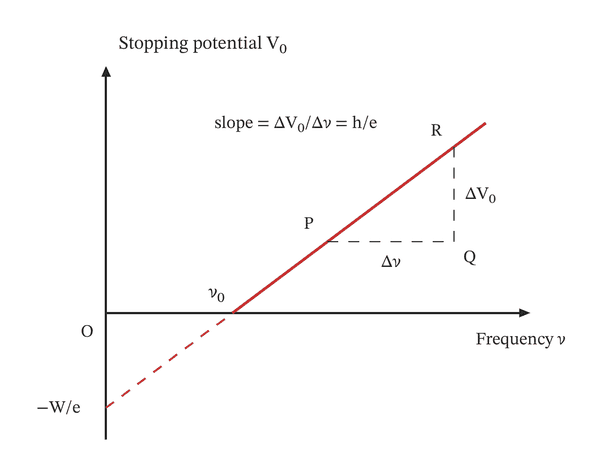
Step 2 — Read the intercept. The line cuts the frequency axis at the threshold frequency : below it there is no emission, so no stopping potential.
Step 3 — Read the slope. The slope equals , the same for every metal. Extended backwards (dashed) the line meets the axis at .
Therefore, the stopping potential increases linearly with frequency above the threshold frequency ; the graph is a straight line of slope cutting the frequency axis at .
- 502 marks
Question 50
Mention four applications of photoelectric effect.
- 512 marks
Question 51
When the frequency of the incident light is increased, the velocity of the ejected photons is also increased. Explain.
- 522 marks
Question 52
“When the intensity of incident light is increased, there is no increase in the kinetic energy of the photoelectrons.” Why?
- 532 marks
Question 53
Will the threshold frequency of a metal change with change in intensity of the incident light?
- 542 marks
Question 54
When light is incident on a plane mirror, only a certain percentage (about 75%) is reflected. What happens to the 25% of the photons? Are they not reflected or are they reflected with energy reduced by 25%?
- 552 marks
Question 55
Ultraviolet light is incident on two photosensitive materials having work functions and (). In which case will the kinetic energy of the emitted electrons be greater?
- 562 marks
Question 56
Does the ‘stopping potential’ in photoelectric emission depend upon
(i) the intensity of the incident radiation in a photocell?
(ii) the frequency of the incident radiation?
- 572 marks
Question 57
Two beams, one of red light and the other of blue light, of the same intensity are incident on a metallic surface to emit photoelectrons. Which one of the two beams emits electrons with greater kinetic energy?
- 582 marks
Question 58
Electrons are emitted from a photosensitive surface when it is illuminated by green light but electron emission does not take place by yellow light. Will the electrons be emitted when the surface is illuminated by (i) red light and (ii) blue light?
- 592 marks
Question 59
The frequency () of incident radiation is greater than threshold frequency () in a photocell. How will the stopping potential vary if frequency () is increased, keeping other factors constant?
- 602 marks
Question 60
For a photosensitive surface, threshold wavelength is . Does photoemission occur if the wavelength () of the incident radiation is (i) more than and (ii) less than ? Justify your answer.
- 612 marks
Question 61
Radiation of frequency Hz is incident on three photosensitive surfaces , and . Following observations are recorded.
Surface : No photoemission occurs.
Surface : Photoemission occurs but the photoelectrons have zero kinetic energy.
Surface : Photoemission occurs and photoelectrons have same K.E.
Based on Einstein's photoelectric equation, explain the three observations.
- 622 marks
Question 62
The graphs between the stopping potential ‘’ and frequency ‘’ of the incident radiation on two different metal plates and are shown in the given figure.

(i) Which metal, out of and , has the greater value of work function?
(ii) What does the slope of the line depict?
- 632 marks
Question 63
The graph below shows variation of photoelectric current with collector plate potential for different frequencies of incident radiations.

(i) Which physical parameter is kept constant for the three curves?
(ii) Which frequency (, or ) is the highest?
- 642 marks
Question 64
The given figure shows a plot of three curves, , and showing the variation of photocurrent vs. collector plate potential for three different intensities , and having frequencies , and respectively incident on a photosensitive surface. Point out the two curves for which the incident radiations have same frequency but different intensities.

- 653 marks
Question 65
(a) What is photoelectric effect?
(b) Describe an experiment to study photoelectric effect.
(c) Using graphs, explain the effect of (i) intensity of light, (ii) accelerating (retarding) potential and (iii) frequency on intensity of light.
- 663 marks
Question 66
Explain work function and threshold frequency in photoelectric emission. Give Einstein's equation for photoelectric emission. What do the symbols stand for?
- 673 marks
Question 67
Plot a labelled graph of , where is the stopping potential of photoelectrons versus frequency of the incident radiation. How will you use this graph to determine the value of the Planck's constant? Explain.
- 685 marks
Question 68
(a) Explain Planck's quantum theory of radiation.
(b) Explain the characteristics of photon.
(c) Give an argument to show that the rest mass of photon is zero.
- 695 marks
Question 69
(a) Explain the terms work function, threshold frequency and stopping potential.
(b) Obtain expression for energy, mass and momentum of a photon.
(c) Derive Einstein's photoelectric equation. Hence, explain the laws of photoelectric effect.
- 705 marks
Question 70
(a) Define stopping potential. How is it related to the kinetic energy of photoelectrons?
(b) Describe an experiment to determine the Planck's constant.
- 713 marks
Question 71
What is the mass, momentum and energy of a photon of wavelength 1 Å?
- 723 marks
Question 72
Calculate the number of photons emitted per second by a 1 kW X-ray tube emitting monochromatic X-ray of 1 Å.
- 733 marks
Question 73
Find the number of photons of red light of wavelength m whose energy is equal to the energy of one -ray photon of wavelength m.
- 743 marks
Question 74
Find the energy in eV of a photon whose frequency is (i) Hz and (ii) 50 MHz.
- 753 marks
Question 75
The power output of an FM radio transmitter is 150 kW and it operates at a frequency of 99.7 MHz. How many photons per second does the transmitter emit?
- 763 marks
Question 76
The energy required to remove an electron from sodium is 2.3 eV. Does sodium show a photoelectric effect for orange light with Å?
- 773 marks
Question 77
What is the energy associated with a photon of wavelength 4000 Å in joule?
- 783 marks
Question 78
Find the photon energy in eV for electromagnetic wave of wavelength 1 m.
- 793 marks
Question 79
Find the number of photons emitted per second by a 25 W source of monochromatic light of wavelength 6000 Å.
- 803 marks
Question 80
Find the number of photons emitted per second by a 25 W source of monochromatic light of wavelength 6600 Å. What is the photoelectric current assuming 3% efficiency for photoelectric effect?
- 813 marks
Question 81
The work function of sodium metal is 2.3 eV. What is the longest wavelength of light that can cause photoelectrons emission from sodium?
- 823 marks
Question 82
A metal has a threshold wavelength of 6000 Å. Calculate (i) threshold frequency and (ii) work function of metal in eV.
- 833 marks
Question 83
The photoelectric threshold wavelength of a metal is 5000 Å. Find (i) the value of work function in eV, (ii) the kinetic energy of the photoelectrons in eV ejected by the light of wavelength 4000 Å.
- 843 marks
Question 84
In photoelectric emission from a given target, the velocity of emitted electron is m/s when light of m is used. Calculate (i) the velocity of the emitted electrons with light of wavelength and (ii) the work function of the photocathode in eV.
- 854 marks
Question 85
A photon of wavelength 3010 Å falls on photocathode and ejects an electron of energy J. If the wavelength of the incident photon is changed to 5000 Å, the energy of the ejected electron is J. Calculate the value of Planck's constant, threshold wavelength and the work function for the photocathode.
- 863 marks
Question 86
Calculate the velocity of a photoelectron, if the work function of the photometal is 1.24 eV and the wavelength of the incident radiation is m. Calculate the speed of the ejected electrons. What retarding potential is necessary to stop the emission of these electrons?
- 873 marks
Question 87
The work function of molybdenum is 5 eV. When a light of unknown wavelength falls upon it, the maximum velocity of the ejected photoelectron is m/s. Find the incident wavelength.
- 883 marks
Question 88
In an experiment, tungsten cathode which has a threshold wavelength 2300 Å is irradiated by ultraviolet light of wavelength 1800 Å. Calculate (i) maximum energy of emitted photoelectrons and (ii) work function for tungsten (eV). Given J s, m/s.
- 893 marks
Question 89
A mercury arc is rated at 100 W. How many light quanta are emitted per second in radiation having wavelength 5000 Å if the intensity of the line is 5%? Assume that 40% of the power is spent for radiation.
- 903 marks
Question 90
Frequency of an electromagnetic radiation is Hz. Calculate the number of photons that will make up 6.625 joule of energy of this radiation.
- 913 marks
Question 91
How many photons of radiation of wavelength m must fall per second on a blackened metallic plate in order to produce a force of N?
- 923 marks
Question 92
Find the velocity with which an electron must travel in order that its momentum is equal to that of a photon with a wavelength of 5893 Å.
- 934 marks
Question 93
When violet light of 4000 Å strikes the cathode of a photocell, a retarding potential of 0.4 V is required to stop emission of electrons. Calculate (i) light frequency, (ii) photon energy, (iii) work function, (iv) threshold frequency and (v) net energy after the electron leaves the surface.
- 943 marks
Question 94
The stopping potential is 4.6 V for light of frequency Hz. When light of frequency Hz is used, the stopping potential is 12.9 V. Calculate the value of Planck's constant.
- 953 marks
Question 95
The work function of caesium is 1.0 eV. Calculate (i) the threshold wavelength, (ii) the maximum energy of the liberated electrons when the wavelength of the incident light is m and (iii) the stopping potential difference for the above incident light. ( J s, m s)
- 963 marks
Question 96
A photon is of energy 20 eV. Find (i) the wavelength and (ii) the momentum of the photon. ( J s, m/s, 1 eV J)
- 973 marks
Question 97
Threshold wavelength for silver is 3800 Å. Ultraviolet radiations of wavelength 2600 Å are made to incident on a silver plate. Calculate (i) the work function of silver in eV, (ii) the maximum kinetic energy of photoelectrons emitted from it and (iii) the stopping potential.
- 983 marks
Question 98
The work function of tungsten is 5.4 eV. What should be the wavelength of radiation which can eject photoelectrons of maximum energy 1.5 eV from tungsten?
- 993 marks
Question 99
When a radiation of frequency Hz falls on a metallic surface, photoelectrons of maximum K.E. J are emitted from the surface. Calculate the value of the threshold frequency ( J s).
- 1003 marks
Question 100
A monochromatic source emits light of frequency Hz. Calculate (i) the energy and (ii) the momentum of the photons emitted by the source ( J s, m/s).
- 1013 marks
Question 101
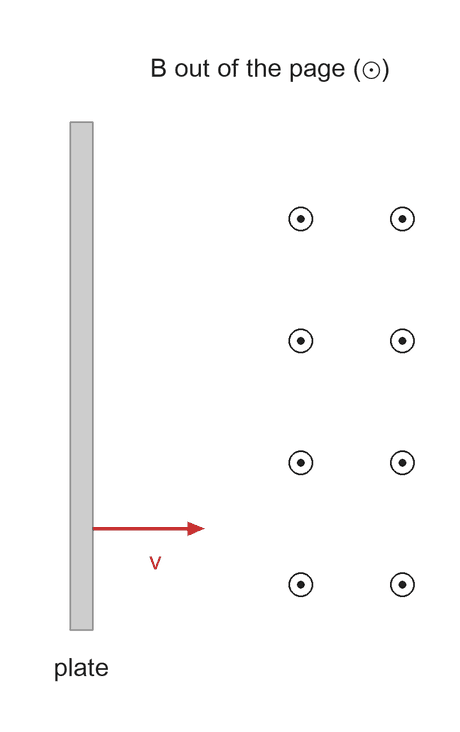
Light of wavelength 180 nm ejects photoelectrons from a plate of metal whose work function is 2 eV. If a uniform magnetic field of flux density Wb/m is applied parallel to the plate, what should be the radius of the path followed by electrons ejected normally from the plate with maximum energy?
- 1023 marks
Question 102
When a surface is irradiated with light of wavelength 4950 Å, a photocurrent appears which vanishes if a retarding potential greater than 0.6 V is applied across the phototube. When a different source of light is used it is found that the critical retarding potential is changed to 1.1 V. Find the work function of the emitting surface and the wavelength of the second source. If the photoelectrons (after emission from the surface) are subjected to a magnetic field of 10 tesla, what changes will be observed in the above two retarding potentials.
- 1034 marks
Question 103
A light source emitting three wavelengths 5000 Å, 6000 Å and 7000 Å has a total power of W and beam of diameter m. The power density is distributed equally amongst the three wavelengths. The beam shines normally on a metallic surface of area m and having a work function of 1.9 eV. Assuming that each photon liberates an electron, calculate the charge emitted per unit area in one second.
- 1044 marks
Question 104
A beam of light has three wavelengths 4144 Å, 4972 Å and 6216 Å with a total intensity of W m equally distributed amongst the three wavelengths. The beam falls normally on an area 1.0 cm of a clean metallic surface of work function 2.3 eV. Assume that there is no loss of light by reflection and that each energetically capable photon ejects one electron. Calculate the number of photoelectrons liberated in 2 seconds.
What Class 12 Physics Ch 23 covers
The sections of the chapter, in the order the book takes them. Every question above comes from one of these.
- 01Hertz and Lenard's Observations
- 02Laws of Photoelectric Emission
- 03Failure of Wave Theory and the Photon
- 04Work Function, Threshold Frequency and Stopping Potential
- 05Einstein's Photoelectric Equation
- 06Determination of Planck's Constant
More ways to study this chapter
The same chapter asked three other ways. Practise it, revise it, and see what the board has set on Ch 23 before.
- Competency-Based Questions (CBQ)Case study questions: a situation, and the part of the chapter that answers it.40questionsOpen
- Previous Year QuestionsQuestions that have actually appeared in board papers, each tagged with its year.16questionsOpen
- Practice QuestionsExtra questions per chapter, for when one attempt at a method is not enough.116questionsOpen
Ch 23 in past ISC papers
The same chapter as the board has actually asked it. These are worded differently from the textbook exercise, which is the point of reading them.
- 13 marks
Board paper question 1
In an experiment of photoelectric effect, the graph of maximum kinetic energy of the emitted photoelectrons versus the frequency of the incident light is a straight line AB as shown in Figure 6 below:

Find:
(i) Threshold frequency of the metal.
(ii) Work function of the metal.
(iii) Stopping potential for the photoelectrons emitted by the light of frequency .
Solve with AIWritten solution
Solution:
Key idea: Einstein's photoelectric equation says that a photon of frequency gives all its energy to one electron. Part of it, the work function , is used to free the electron from the metal, and the rest is the maximum kinetic energy of the photoelectron.
So a graph of against is a straight line of slope . It cuts the frequency axis () at the threshold frequency , and its extension cuts the axis () at .
Step 1 — Part (i): read the threshold frequency.
The threshold frequency is the frequency at which becomes zero. The line meets the frequency axis at A, which is at .
Step 2 — Part (ii): read the work function.
When we put in Einstein's equation, becomes . So the work function is the size of the intercept on the axis. The dashed extension of AB meets the axis at C, at .
In joules, we multiply by per eV.
Step 3 — Part (iii): read the kinetic energy at the given frequency.
At the graph is at point B, where the maximum kinetic energy is .
Step 4 — Part (iii): convert it to a stopping potential.
The stopping potential is the reverse potential that just stops the fastest electrons, so . An energy of is stopped by .
Note: The slope of the line is per , which corresponds to a Planck constant of .
If you work out with the paper's value of , , you get about ; the graph itself gives .
Therefore, (i) the threshold frequency is 1.0 × 10¹⁵ Hz; (ii) the work function is 4 eV (6.4 × 10⁻¹⁹ J); (iii) the stopping potential is 8 V.
- 21 mark
Board paper question 2
Two metals A and B have work functions and respectively. Which metal has lower threshold wavelength for photoelectric effect?
Solve with AIWritten solution
Solution:
Key idea: The threshold wavelength is the longest wavelength that can eject photoelectrons. A photon of this wavelength has energy just equal to the work function , so .
Step 1 — Compare the work functions.
Since is inversely proportional to , the metal with the larger work function has the smaller threshold wavelength. Metal B has the larger work function ( against ).
Step 2 — Check with numbers.
We take the standard values , and .
Therefore, metal B (work function 6 eV) has the lower threshold wavelength (about 206 nm against 309 nm for A).
- 33 marks
Board paper question 3
Monochromatic light of wavelength is incident on the surface of a metallic cathode whose work function is . How much potential difference must be applied between the cathode and the anode of a photocell to just stop the photo current from flowing?
Solve with AIWritten solution
Solution:
Key idea: Einstein's photoelectric equation says that a photon of frequency gives all its energy to one electron. Part of it, the work function , is used to free the electron from the metal, and the rest is the maximum kinetic energy of the photoelectron. The current just stops when the reverse potential (the stopping potential) satisfies .
Step 1 — Find the energy of one photon.
We take and , and convert the wavelength to metres.
Step 2 — Convert the photon energy to electron volts.
One electron volt is , so we divide by this.
Step 3 — Find the maximum kinetic energy of the photoelectrons.
We subtract the work function from the photon energy.
Step 4 — Find the stopping potential.
A kinetic energy of is just cancelled when the electron moves against a potential difference of , because .
The anode must be made negative with respect to the cathode.
Therefore, a reverse potential difference of 3.75 V (anode negative with respect to the cathode) just stops the photocurrent.
- 41 mark
Board paper question 4
Calculate the momentum of a photon of energy .
Solve with AIWritten solution
Solution:
Key idea: A photon has no rest mass, but it carries momentum , where is its energy and the speed of light.
Step 1 — Write the relation.
We use the paper's value .
Step 2 — Substitute the values.
We put the photon energy into the relation and divide by the speed of light.
Therefore, the momentum of the photon is 2 × 10⁻²⁷ kg m s⁻¹.
- 53 marks
Board paper question 5
(i) Plot a labelled graph of where is stopping potential versus frequency of the incident radiation.
(ii) State how will you use this graph to determine the value of Planck's constant.
Solve with AIWritten solution
Solution:
Key idea: Einstein's photoelectric equation, written for the stopping potential , is , where is the frequency of the radiation, is Planck's constant, the electronic charge and the work function.
This has the form , so against is a straight line of slope .
Step 1 — Part (i): plot the graph.
We plot on the vertical axis against on the horizontal axis.
The graph is a straight line that cuts the frequency axis at the threshold frequency ; below no electrons are emitted, so there is no stopping potential. Produced backwards (dashed), the line meets the potential axis at .

Step 2 — Part (ii): measure the slope.
We take two points P and R on the straight line and complete the right triangle PQR. The slope is the rise QR (a change in stopping potential) divided by the run PQ (the change in frequency).
Step 3 — Part (ii): find Planck's constant from the slope.
From the equation in the key idea, the slope equals . So we multiply the measured slope by the electronic charge .
Therefore, (i) the graph of |Vₛ| against f is a straight line starting at the threshold frequency f₀; (ii) its slope equals h/e, so Planck's constant is h = e × (slope).
- 61 mark
Board paper question 6
Einstein's photoelectric equation is:
Solve with AIAnswer
(A)
- Correct
(B)
(C)
(D)
Answer: (B)
Key idea: A photon of frequency (wavelength ) carries energy . In the photoelectric effect one photon gives all its energy to one electron; the work function is spent in freeing the electron, and the rest is its maximum kinetic energy.
Step 1 — Write the energy balance.
The photon energy equals the work function plus the maximum kinetic energy.
Step 2 — Rearrange and write it in terms of wavelength.
We subtract from both sides and use .
This matches option (B).
Why the others are wrong:
- (A) is not an energy: Planck's constant multiplies the frequency, not the wavelength (its unit would be J s m).
- (C) The plus sign would make the electron's kinetic energy larger than the photon's energy, which breaks the conservation of energy; the work function must be subtracted.
- (D) is not an energy (its unit is J m⁻¹), and the work function is again added instead of subtracted.
Therefore, Einstein's photoelectric equation is E_max = hc/λ − φ₀, option (B).
All 16 board paper questions for this chapter, solved the same way.
Class 12 Physics Ch 23 questions students ask
How many questions are there in Class 12 Physics Ch 23?
104 questions. Every one is solved step by step on this page.
Are these Class 12 Physics solutions free?
Yes. Every question and its full working is free to read, with no account needed.
Can I download the Class 12 Physics Ch 23 solutions as a PDF?
There is no PDF to download. Every solution is on this page instead, which means it is searchable, always the current syllabus, and readable on a phone. Use your browser's print option if you want it on paper.