
Question 402 marksMedium
With a suitable graph explain the effect of retarding potential on photoelectric current.
Confirming your payment
Sign up now and get 250 free tokens.
Photoelectric Effect · Question 40 of 104
With a suitable graph explain the effect of retarding potential on photoelectric current.
Solution:
Concept: Photoelectrons leave the emitter with kinetic energies from zero up to a maximum . A negative (retarding) potential on the collector pushes them back, and only electrons with enough energy reach it.
Step 1 — Draw the graph. The graph shows the photoelectric current against the collector potential for light of one frequency at two intensities:
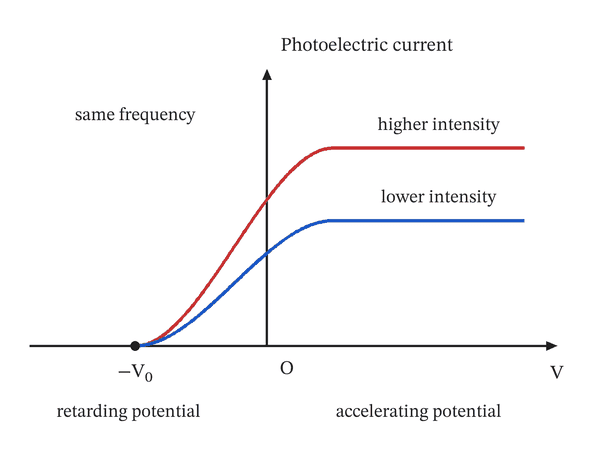
Step 2 — Positive (accelerating) potential. As increases, more of the emitted electrons are collected, until all of them are; the current then stays at its saturation value.
Step 3 — Negative (retarding) potential. When the collector is made negative, slow electrons are turned back, so the current falls steadily as the retarding potential grows.
Step 4 — Stopping potential. At even the fastest electrons are stopped and the current becomes zero. Then
Step 5 — Effect of intensity. Both curves reach zero at the same , because the stopping potential depends on the frequency, not the intensity; brighter light only gives a larger saturation current.
Therefore, the photoelectric current decreases as the retarding potential increases and becomes zero at the stopping potential , which is the same for all intensities of light of a given frequency.