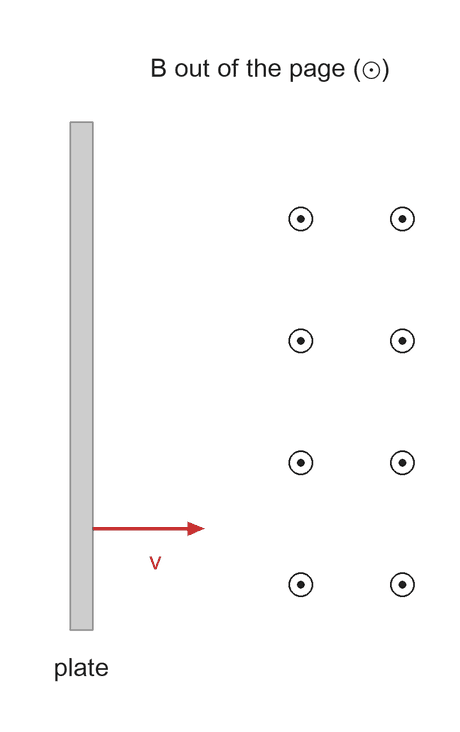
Light of wavelength 180 nm ejects photoelectrons from a plate of metal whose work function is 2 eV.
Question 1013 marksMedium
Light of wavelength 180 nm ejects photoelectrons from a plate of metal whose work function is 2 eV. If a uniform magnetic field of flux density 5.0×10⁻⁵ Wb/m2 is applied parallel to the plate, what should be the radius of the path followed by electrons ejected normally from the plate with maximum energy?
Solution:
Concept: Einstein's equation gives the maximum kinetic energy, Kmax=λhc−W, and hence the speed. An electron moving at right angles to a magnetic field feels a force evB at right angles to its velocity, so it moves in a circle of radius r=eBmv.
Given: Wavelength λ=180nm, work function W=2eV and B=5.0×10⁻⁵T; we take h=6.62×10⁻³⁴J s, c=3×10⁸m s−1, e=1.6×10⁻¹⁹C and m=9.1×10⁻³¹kg.
Step 1 — Find the photon energy. The energy of one photon is λhc:
E=180×10−96.62×10−34×3×108JE≈11.03×10⁻¹⁹J
Step 2 — Find the maximum kinetic energy. We subtract the work function, 2eV=3.2×10⁻¹⁹J:
Kmax=11.03×10⁻¹⁹J−3.2×10⁻¹⁹JKmax≈7.83×10⁻¹⁹J
Step 3 — Find the speed. From Kmax=21mv2:
v=9.1×10−312×7.83×10−19m s−1v≈1.31×10⁶m s−1
Step 4 — Find the radius of the path. The field is parallel to the plate and the electron leaves at right angles to the plate, so its velocity is perpendicular to B. The magnetic force supplies the centripetal force, evB=rmv2:
The figure shows the path: a semicircle of radius r whose centre C lies on the plate, with the force F always pointing towards C. The force does no work, so the speed stays the same all the way round.
Therefore, the electrons ejected normally with maximum energy move on a circular path of radius about 0.15m.