
Question 705 marksHard
(a) Define stopping potential. How is it related to the kinetic energy of photoelectrons?
(b) Describe an experiment to determine the Planck's constant.
Confirming your payment
Sign up now and get 250 free tokens.
Photoelectric Effect · Question 70 of 104
(a) Define stopping potential. How is it related to the kinetic energy of photoelectrons?
(b) Describe an experiment to determine the Planck's constant.
Solution:
Concept: Einstein's equation, with the kinetic energy measured by a stopping potential, gives , a straight line of against whose slope is .
Step 1 — Part (a): definition. The stopping potential is the minimum negative (retarding) potential applied to the collector with respect to the emitter that just stops the most energetic photoelectrons, so that the photocurrent becomes zero.
Step 2 — Part (a): relation with kinetic energy. The fastest electron does work against the retarding field and just comes to rest, so:
Step 3 — Part (b): apparatus. A photocell is used, as in the figure:
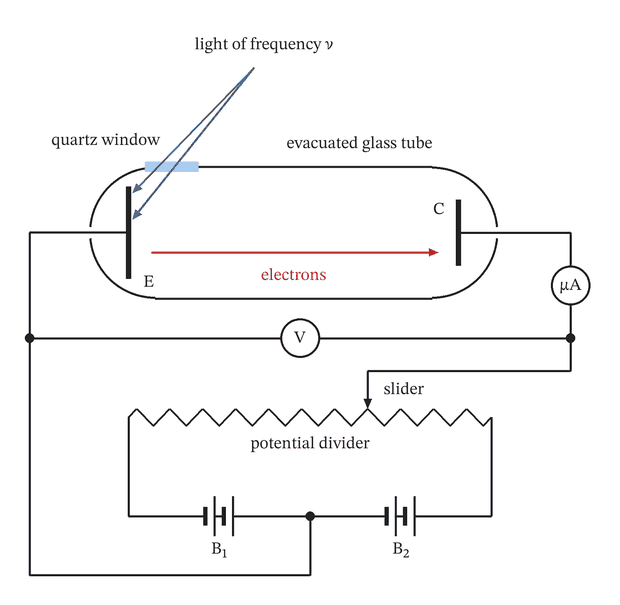
The photosensitive emitter E and the collector C are in an evacuated tube with a quartz window. A potential divider with batteries B₁ and B₂ makes the collector positive or negative with respect to E, the voltmeter V reads this potential and the microammeter μA reads the photocurrent. Light of known frequency is obtained from a source with filters or a monochromator. (Millikan used a similar arrangement, cutting fresh, clean surfaces of alkali metals inside the vacuum.)
Step 4 — Part (b): measure the stopping potential for one frequency. Light of frequency falls on E. The collector is made more and more negative until the microammeter just reads zero; the voltmeter reading is the stopping potential .
Step 5 — Part (b): repeat for other frequencies. The measurement is repeated with light of several frequencies (all above the threshold), giving the stopping potentials
Step 6 — Part (b): plot the graph. is plotted against :
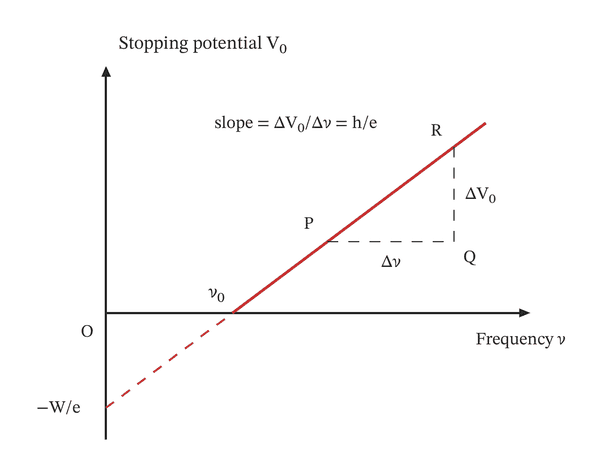
The points lie on a straight line, as Einstein's equation predicts:
Step 7 — Part (b): calculate . The slope of the line equals , so:
With C this gives J s. The intercept on the frequency axis gives the threshold frequency , and .
Therefore, (a) the stopping potential is the retarding potential that just stops the fastest photoelectrons, with ; (b) measuring for several frequencies and plotting against gives a straight line of slope , so slope.