
Opening your dashboard
Class 12 Physics Chapter 23 Photoelectric Effect: Previous Year Questions
16 questions on Chapter 23, each solved step by step. Class 12 Physics, ICSE 2026-27.
16 questions with solutions
1–3 marks · Mixed difficulty
- 13 marks
Question 1
In an experiment of photoelectric effect, the graph of maximum kinetic energy of the emitted photoelectrons versus the frequency of the incident light is a straight line AB as shown in Figure 6 below:

Find:
(i) Threshold frequency of the metal.
(ii) Work function of the metal.
(iii) Stopping potential for the photoelectrons emitted by the light of frequency .
Solve with AIWritten solution
Solution:
Key idea: Einstein's photoelectric equation says that a photon of frequency gives all its energy to one electron. Part of it, the work function , is used to free the electron from the metal, and the rest is the maximum kinetic energy of the photoelectron.
So a graph of against is a straight line of slope . It cuts the frequency axis () at the threshold frequency , and its extension cuts the axis () at .
Step 1 — Part (i): read the threshold frequency.
The threshold frequency is the frequency at which becomes zero. The line meets the frequency axis at A, which is at .
Step 2 — Part (ii): read the work function.
When we put in Einstein's equation, becomes . So the work function is the size of the intercept on the axis. The dashed extension of AB meets the axis at C, at .
In joules, we multiply by per eV.
Step 3 — Part (iii): read the kinetic energy at the given frequency.
At the graph is at point B, where the maximum kinetic energy is .
Step 4 — Part (iii): convert it to a stopping potential.
The stopping potential is the reverse potential that just stops the fastest electrons, so . An energy of is stopped by .
Note: The slope of the line is per , which corresponds to a Planck constant of .
If you work out with the paper's value of , , you get about ; the graph itself gives .
Therefore, (i) the threshold frequency is 1.0 × 10¹⁵ Hz; (ii) the work function is 4 eV (6.4 × 10⁻¹⁹ J); (iii) the stopping potential is 8 V.
- 21 mark
Question 2
Two metals A and B have work functions and respectively. Which metal has lower threshold wavelength for photoelectric effect?
Solve with AIWritten solution
Solution:
Key idea: The threshold wavelength is the longest wavelength that can eject photoelectrons. A photon of this wavelength has energy just equal to the work function , so .
Step 1 — Compare the work functions.
Since is inversely proportional to , the metal with the larger work function has the smaller threshold wavelength. Metal B has the larger work function ( against ).
Step 2 — Check with numbers.
We take the standard values , and .
Therefore, metal B (work function 6 eV) has the lower threshold wavelength (about 206 nm against 309 nm for A).
- 33 marks
Question 3
Monochromatic light of wavelength is incident on the surface of a metallic cathode whose work function is . How much potential difference must be applied between the cathode and the anode of a photocell to just stop the photo current from flowing?
Solve with AIWritten solution
Solution:
Key idea: Einstein's photoelectric equation says that a photon of frequency gives all its energy to one electron. Part of it, the work function , is used to free the electron from the metal, and the rest is the maximum kinetic energy of the photoelectron. The current just stops when the reverse potential (the stopping potential) satisfies .
Step 1 — Find the energy of one photon.
We take and , and convert the wavelength to metres.
Step 2 — Convert the photon energy to electron volts.
One electron volt is , so we divide by this.
Step 3 — Find the maximum kinetic energy of the photoelectrons.
We subtract the work function from the photon energy.
Step 4 — Find the stopping potential.
A kinetic energy of is just cancelled when the electron moves against a potential difference of , because .
The anode must be made negative with respect to the cathode.
Therefore, a reverse potential difference of 3.75 V (anode negative with respect to the cathode) just stops the photocurrent.
- 41 mark
Question 4
Calculate the momentum of a photon of energy .
Solve with AIWritten solution
Solution:
Key idea: A photon has no rest mass, but it carries momentum , where is its energy and the speed of light.
Step 1 — Write the relation.
We use the paper's value .
Step 2 — Substitute the values.
We put the photon energy into the relation and divide by the speed of light.
Therefore, the momentum of the photon is 2 × 10⁻²⁷ kg m s⁻¹.
- 53 marks
Question 5
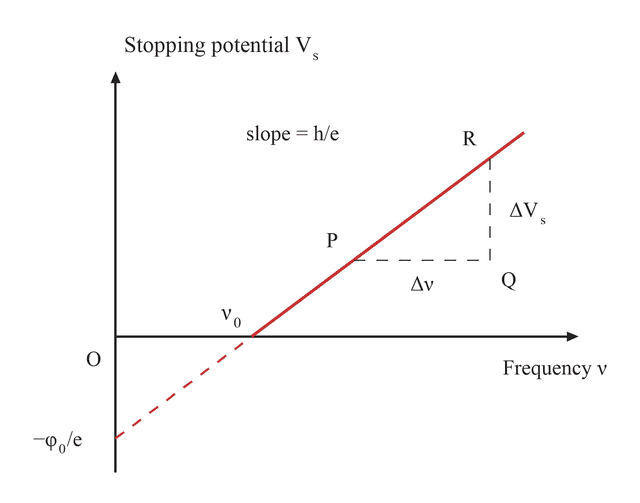
(i) Plot a labelled graph of where is stopping potential versus frequency of the incident radiation.
(ii) State how will you use this graph to determine the value of Planck's constant.
Solve with AIWritten solution
Solution:
Key idea: Einstein's photoelectric equation, written for the stopping potential , is , where is the frequency of the radiation, is Planck's constant, the electronic charge and the work function.
This has the form , so against is a straight line of slope .
Step 1 — Part (i): plot the graph.
We plot on the vertical axis against on the horizontal axis.
The graph is a straight line that cuts the frequency axis at the threshold frequency ; below no electrons are emitted, so there is no stopping potential. Produced backwards (dashed), the line meets the potential axis at .

Step 2 — Part (ii): measure the slope.
We take two points P and R on the straight line and complete the right triangle PQR. The slope is the rise QR (a change in stopping potential) divided by the run PQ (the change in frequency).
Step 3 — Part (ii): find Planck's constant from the slope.
From the equation in the key idea, the slope equals . So we multiply the measured slope by the electronic charge .
Therefore, (i) the graph of |Vₛ| against f is a straight line starting at the threshold frequency f₀; (ii) its slope equals h/e, so Planck's constant is h = e × (slope).
- 61 mark
Question 6
Einstein's photoelectric equation is:
Solve with AIAnswer
(A)
- Correct
(B)
(C)
(D)
Answer: (B)
Key idea: A photon of frequency (wavelength ) carries energy . In the photoelectric effect one photon gives all its energy to one electron; the work function is spent in freeing the electron, and the rest is its maximum kinetic energy.
Step 1 — Write the energy balance.
The photon energy equals the work function plus the maximum kinetic energy.
Step 2 — Rearrange and write it in terms of wavelength.
We subtract from both sides and use .
This matches option (B).
Why the others are wrong:
- (A) is not an energy: Planck's constant multiplies the frequency, not the wavelength (its unit would be J s m).
- (C) The plus sign would make the electron's kinetic energy larger than the photon's energy, which breaks the conservation of energy; the work function must be subtracted.
- (D) is not an energy (its unit is J m⁻¹), and the work function is again added instead of subtracted.
Therefore, Einstein's photoelectric equation is E_max = hc/λ − φ₀, option (B).
- 71 mark
Question 7
The energy associated with light of which of the following colors in minimum?
Solve with AIAnswer
(A) Violet
- Correct
(B) Red
(C) Green
(D) Yellow
Answer: (B) Red
Key idea: Light is a stream of photons. Each photon of wavelength has energy , where is Planck's constant and the speed of light.
The energy is inversely proportional to the wavelength, so the colour with the longest wavelength has the least energy per photon.
Step 1 — Recall the order of wavelengths.
In the visible spectrum the wavelength increases in the order violet (about ), green (about ), yellow (about ), red (about ).
Step 2 — Compare the photon energies.
Red has the longest wavelength, so its photons have the smallest energy. With , a photon carries about .
Why the others are wrong:
- (A) Violet has the shortest visible wavelength, so its photons have the maximum energy (about at ), not the minimum.
- (C) Green light (about ) has a shorter wavelength than red, so each photon carries more energy (about ).
- (D) Yellow light (about ) also has a shorter wavelength than red, so its photons carry more energy (about ).
Therefore, red light has the minimum energy per photon, option (B).
- 82 marks
Question 8
Define the following with reference to photoelectric effect.
(i) Threshold frequency
(ii) Stopping potential
Solve with AIWritten solution
Solution:
Key idea: Photoelectrons are emitted only if each photon has at least the energy needed to free an electron, and the fastest of them can be stopped by a reverse potential. These two facts lead to the threshold frequency and the stopping potential.
Step 1 — Part (i): define threshold frequency.
The threshold frequency of a metal is the minimum frequency of the incident radiation that can just eject photoelectrons from its surface (with zero kinetic energy). Below no photoelectrons are emitted, however intense the light. It is related to the work function by .
Step 2 — Part (ii): define stopping potential.
The stopping potential is the minimum negative (retarding) potential given to the anode with respect to the cathode that just stops the most energetic photoelectrons, so that the photocurrent becomes zero. It measures the maximum kinetic energy of the photoelectrons.
Therefore, (i) threshold frequency is the minimum frequency of light that can just emit photoelectrons from a metal; (ii) stopping potential is the least retarding potential on the anode that reduces the photocurrent to zero (eVₛ = K_max).
- 91 mark
Question 9
In photoelectric effect experiment the slope of the graph of the slopping potential versus frequency give the value of.
Solve with AIAnswer
- Correct
(A)
(B) e
(C)
(D)
Answer: (A)
Key idea: Einstein's equation written for the stopping potential is , where is the frequency, Planck's constant, the electronic charge and the work function.
Step 1 — Read the question.
The paper prints "slopping potential"; it means the stopping potential.
Step 2 — Write in straight-line form.
We divide Einstein's equation by .
Step 3 — Read off the slope.
This is the equation of a straight line with plotted against , and the coefficient of is its slope, .
Why the others are wrong:
- (B) The electronic charge alone has the unit coulomb, but the slope has the unit volt per hertz (V s); it is divided by .
- (C) is the reciprocal of the slope; it would be the slope of a graph of frequency against stopping potential.
- (D) is the slope of a graph of stopping potential against , not against frequency.
Therefore, the slope of the stopping potential against frequency graph gives h/e, option (A).
- 103 marks
Question 10
Monochromatic light of wavelength is incident on the surface of a metal whose work function is . Calculate: (i) the energy of an incident photon in eV. (ii) the maximum kinetic energy of photoelectrons in eV.
Solve with AIWritten solution
Solution:
Key idea: The energy of a photon is . By Einstein's photoelectric equation, the maximum kinetic energy of the photoelectrons is , where is the work function.
Step 1 — Part (i): find the photon energy in joules.
We take and , and convert the wavelength to metres.
Step 2 — Part (i): convert to electron volts.
One electron volt is .
Step 3 — Part (ii): find the maximum kinetic energy.
We subtract the work function from the photon energy.
Note: With the more precise values , and , the answers are about and .
Therefore, (i) the energy of an incident photon is about 3.1 eV (3.125 eV); (ii) the maximum kinetic energy of the photoelectrons is 2.0 eV.
- 113 marks
Question 11
(a) In an experiment on photo electric effect, how does stopping potential change, if at all, when intensity of incident monochromatic UV radiation is increased?
(b) Ultraviolet light is incident on metals P, Q and R, having work functions , and respectively,
a. Which metal has lowest threshold frequency for photoelectric effect?
b. For which metal is the value of minimum?
(Note: is maximum kinetic energy of the emitted photoelectrons.)
Solve with AIWritten solution
Solution:
Key idea: By Einstein's equation, the maximum kinetic energy is , where is the frequency of the radiation and the work function. The stopping potential obeys .
The threshold frequency is . Intensity decides how many photons arrive per second, not how much energy each photon has.
Step 1 — Part (a): decide what intensity changes.
A more intense beam of the same frequency delivers more photons per second, so more electrons are emitted and the photocurrent increases. Each photon still has the same energy , so the maximum kinetic energy of the electrons does not change.
Step 2 — Part (a): state the effect on the stopping potential.
The stopping potential depends only on (through ), so it stays the same.
Step 3 — Part (b) a.: find the lowest threshold frequency.
Since , the threshold frequency is proportional to the work function. The smallest work function is that of Q (), so Q has the lowest threshold frequency.
Step 4 — Part (b) b.: find the smallest maximum kinetic energy.
For the same ultraviolet light (same ), is smallest for the largest work function. Metal P has the largest work function (), so its is the minimum.
Watch out: P emits electrons at all only if each ultraviolet photon has more than , that is, a wavelength shorter than about ; otherwise P emits no photoelectrons.
Therefore, (a) the stopping potential does not change when the intensity is increased (only the photocurrent increases); (b) a. metal Q has the lowest threshold frequency; b. E_max is minimum for metal P.
- 122 marks
Question 12
With reference to photoelectric effect, define the terms:
(i) Threshold frequency.
(ii) Work function.
Solve with AIWritten solution
Solution:
Key idea: An electron is held inside a metal, so a definite minimum energy is needed to pull it out. In the photoelectric effect this energy comes from one photon, which leads to a minimum (threshold) frequency.
Step 1 — Part (i): define threshold frequency.
The threshold frequency of a metal is the minimum frequency of the incident radiation that can just eject photoelectrons from its surface. Radiation of lower frequency emits no photoelectrons, however intense it is.
Step 2 — Part (ii): define work function.
The work function of a metal is the minimum energy that must be given to an electron to just remove it from the surface of the metal. It is related to the threshold frequency by Planck's constant .
Therefore, (i) threshold frequency is the minimum frequency of incident radiation that can just cause photoelectric emission from a metal; (ii) work function is the minimum energy needed to just remove an electron from the metal surface (φ₀ = hν₀).
- 133 marks
Question 13
(i) Plot a labelled graph of stopping potential () versus frequency () of incident UV radiation.
(ii) State how the value of Planck's constant can be determined from this graph.
Solve with AIWritten solution
Solution:
Key idea: Einstein's photoelectric equation in terms of the stopping potential is , where is the frequency, Planck's constant, the electronic charge and the work function.
So against is a straight line of slope .
Step 1 — Part (i): plot the labelled graph.
We plot the stopping potential on the vertical axis against the frequency of the ultraviolet radiation on the horizontal axis.
The graph is a straight line that cuts the frequency axis at the threshold frequency ; below no electrons are emitted, so there is no stopping potential. Produced backwards (dashed), the line meets the potential axis at .

Step 2 — Part (ii): measure the slope.
We choose two points P and R on the line and draw the right triangle PQR. The slope is the rise QR, a change in stopping potential, divided by the run PQ, the change in frequency.
Step 3 — Part (ii): obtain Planck's constant.
The slope equals , so multiplying it by the electronic charge gives .
Therefore, (i) Vₛ against f is a straight line beginning at the threshold frequency f₀; (ii) Planck's constant is found as h = e × slope of this line.
- 141 mark
Question 14
Calculate the momentum of a photon having an energy of .
Solve with AIWritten solution
Solution:
Key idea: A photon of energy carries momentum , where is the speed of light.
Step 1 — Write the relation.
We use the paper's value .
Step 2 — Substitute the values.
We put the photon energy into the relation and divide by the speed of light.
Therefore, the momentum of the photon is 1.6 × 10⁻²⁷ kg m s⁻¹.
- 152 marks
Question 15
The work functions for metals and are and respectively. Perform necessary calculations to find out which metal emits photoelectrons, when monochromatic light of wavelength is incident on them.
Solve with AIWritten solution
Solution:
Key idea: A metal emits photoelectrons only if the energy of each photon, , is greater than its work function.
Step 1 — Find the photon energy in joules.
We use the paper's values and , with the wavelength in metres.
Step 2 — Convert the photon energy to electron volts.
We divide by per eV.
Step 3 — Compare with each work function.
For the photon energy is greater than the work function , so electrons are emitted (with maximum kinetic energy about ). For the photon energy is less than the work function , so no electron can be freed, however intense the light.
Therefore, only metal M₁ emits photoelectrons (photon energy ≈ 3.02 eV exceeds 1.9 eV but not 5.0 eV).
- 163 marks
Question 16
(i) The graphs below show variation of stopping potential versus frequency of incident radiation for metals A and B.
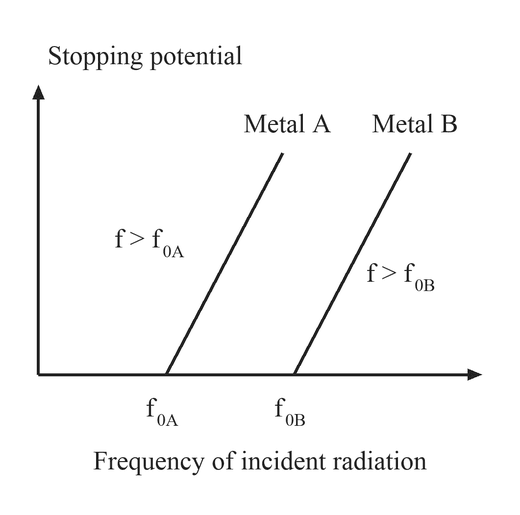
UV radiation of appropriate wavelength is allowed to fall on both the metals. Which metal will emit photoelectrons with higher maximum kinetic energy ()? Give a reason.
(ii) State the conclusion that was drawn from Davisson-Germer's experiment.
Solve with AIWritten solution
Solution:
Key idea: Einstein's equation gives , where is the frequency and the work function. The stopping potential obeys , and the work function is , where is the threshold frequency. Davisson and Germer's experiment tested whether electrons behave as waves.
Step 1 — Part (i): compare the work functions from the graph.
Each line meets the frequency axis at that metal's threshold frequency. Metal A's line starts at , which is lower than . Since , metal A has the smaller work function.
Step 2 — Part (i): compare the maximum kinetic energies.
Both metals receive the same UV radiation, so each photon has the same energy . Then is larger for the metal with the smaller work function. The graph shows the same thing: the two lines are parallel (both have slope ), and at any frequency the line for A is higher, so A has the larger stopping potential and hence the larger .
Step 3 — Part (ii): state the conclusion of Davisson and Germer.
A beam of electrons scattered from a nickel crystal showed a strong diffraction maximum at a particular angle, just as X-rays do. This showed that moving electrons behave as waves, and the wavelength found from the diffraction agreed with the de Broglie wavelength (for electrons the theory gives about and the experiment measured about ).
Therefore, (i) metal A emits photoelectrons with the higher maximum kinetic energy, because its threshold frequency, and so its work function, is lower; (ii) the Davisson–Germer experiment showed that electrons have a wave nature (electron diffraction), confirming de Broglie's relation λ = h/p.