Solution:
Key idea: Einstein's equation gives Emax=hf−ϕ0, where f is the frequency and ϕ0 the work function. The stopping potential Vs obeys eVs=Emax, and the work function is hf0, where f0 is the threshold frequency. Davisson and Germer's experiment tested whether electrons behave as waves.
Step 1 — Part (i): compare the work functions from the graph.
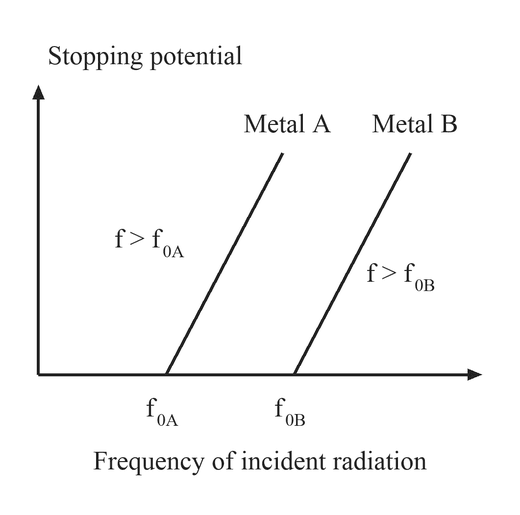
Each line meets the frequency axis at that metal's threshold frequency. Metal A's line starts at f0A, which is lower than f0B. Since ϕ0=hf0, metal A has the smaller work function.
Step 2 — Part (i): compare the maximum kinetic energies.
Both metals receive the same UV radiation, so each photon has the same energy hf. Then Emax=hf−ϕ0 is larger for the metal with the smaller work function. The graph shows the same thing: the two lines are parallel (both have slope eh), and at any frequency the line for A is higher, so A has the larger stopping potential and hence the larger Emax=eVs.
Step 3 — Part (ii): state the conclusion of Davisson and Germer.
A beam of electrons scattered from a nickel crystal showed a strong diffraction maximum at a particular angle, just as X-rays do. This showed that moving electrons behave as waves, and the wavelength found from the diffraction agreed with the de Broglie wavelength λ=ph (for 54 V electrons the theory gives about 1.67 A˚ and the experiment measured about 1.65 A˚).
Therefore, (i) metal A emits photoelectrons with the higher maximum kinetic energy, because its threshold frequency, and so its work function, is lower; (ii) the Davisson–Germer experiment showed that electrons have a wave nature (electron diffraction), confirming de Broglie's relation λ = h/p.