
Opening your dashboard
Class 12 Physics Chapter 23 Photoelectric Effect: Practice Questions
116 questions on Chapter 23, each worked through on its own page with the AI tutor. Class 12 Physics, ICSE 2026-27.
116 questions
1–4 marks · Mixed difficulty
- 11 mark
Question 1
A clean zinc plate is fixed to the cap of a gold-leaf electroscope, which is given a negative charge so that its leaves stand apart. Ultraviolet light from a mercury lamp falls on the plate, and the leaves slowly collapse. A sheet of ordinary window glass is then placed between the lamp and the plate, as shown, and the leaves stop collapsing.
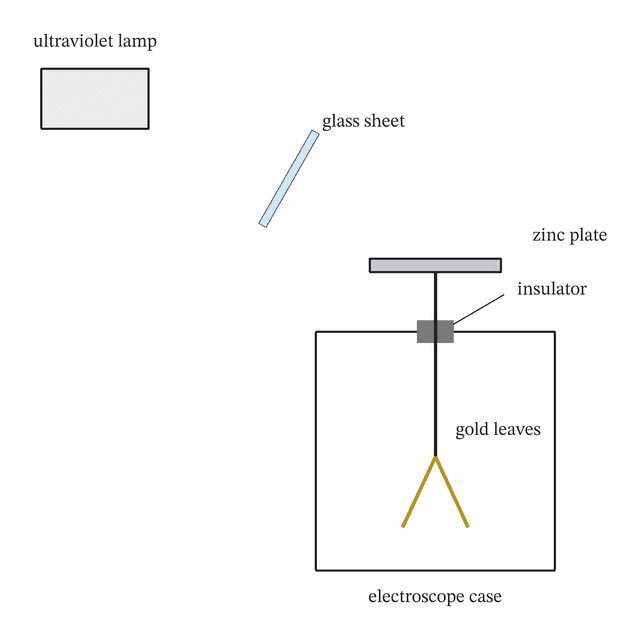
The best explanation is that the glass
- 22 marks
Question 2
The zinc plate in the figure is fixed to the cap of a gold-leaf electroscope and is lit by light from the source shown.
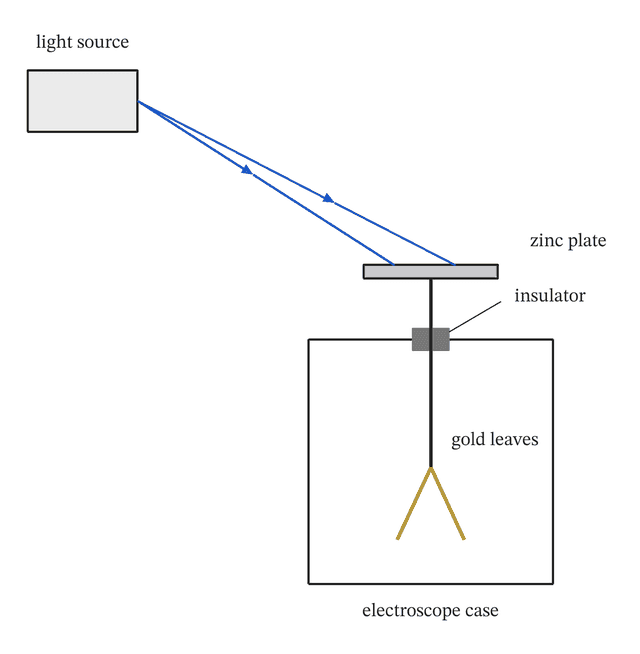
(a) The electroscope is charged positively, so its leaves stand apart, and ultraviolet light falls on the plate. What happens to the leaves? Explain.
(b) The electroscope is charged negatively, and the plate is lit for several minutes by a bright red laser beam of wavelength instead. What happens to the leaves? Explain. Take , and . Take the energy needed to free an electron from zinc as about .
- 33 marks
Question 3
(Hypothetical data.) A small lamp acts as a point source of light. A photocell is placed from it, with its collector at a large positive potential, and the saturation current is . The cathode of the cell is small and faces the lamp, so the light it receives is inversely proportional to the square of its distance from the lamp. Take .
(a) Find the saturation current when the cell is moved to from the lamp.
(b) How many photoelectrons reach the collector each second at ?
(c) At what distance from the lamp would the saturation current be ?
- 41 mark
Question 4
In a Hertz–Lenard type experiment, curve X shows how the photoelectric current varies with the collector potential for light falling on the emitter. One change is then made to the light, and curve Y is obtained with the same emitter.

Which change can explain curve Y?
- 53 marks
Question 5
(Hypothetical data.) In a Hertz–Lenard type photocell lit by light of fixed frequency and intensity, the current is when the collector is at with respect to the emitter, and it is still at . Take .
(a) Why does raising the collector potential from to not increase the current?
(b) How many photoelectrons leave the emitter each second?
(c) What total charge reaches the collector in minutes?
- 62 marks
Question 6
In Hertz and Lenard's experiment, the light falling on the emitter is kept fixed.
(a) Even when the collector is at the same potential as the emitter (), the microammeter shows a current. Explain why.
(b) As is raised from zero to a few volts positive, the current rises and then levels off. Explain both parts of this behaviour.
- 73 marks
Question 7
(Hypothetical data.) In a photocell, the fastest photoelectrons leave the emitter with a kinetic energy of , and some leave with almost zero kinetic energy. The collector is at with respect to the emitter. Take and the mass of an electron .
(a) Find the greatest and the least kinetic energies, in electronvolts, with which electrons reach the collector.
(b) Express the greatest kinetic energy in joules.
(c) Find the speed of the fastest electrons as they reach the collector.
- 81 mark
Question 8
When zinc is lit with ultraviolet light it loses negative charge. Which measurement shows that this negative charge is carried away by electrons?
- 91 mark
Question 9
A student tests one photocell with monochromatic light and writes four entries in a notebook. (Hypothetical data.) Which entry must be a mistake?
- 103 marks
Question 10
(Hypothetical data.) A photocell lit by extremely faint light gives, on average, photoelectrons per second. Take .
(a) Find the average photocurrent.
(b) Find the average time between one photoelectron and the next.
(c) The light is switched on at . A student argues from (b) that the first photoelectron cannot appear until about has passed. In fact, photoelectrons are sometimes recorded within of switching on. Which law of photoelectric emission does this show, and what is wrong with the student's argument?
- 111 mark
Question 11
Light of one fixed frequency, above the threshold frequency, passes through identical grey filters before it reaches a photocell. Each filter lets through of the light that falls on it. With three filters in the beam the saturation current is . (Hypothetical data.) With only one filter in the beam, the saturation current will be
- 124 marks
Question 12
(Hypothetical data.) A student shines monochromatic light on the same photocathode in three runs and records the saturation current and the stopping potential:
Run Wavelength Light power on cathode Saturation current Stopping potential 1 2 3 not recorded Take , and . The maximum kinetic energy of the photoelectrons is times the stopping potential.
(a) Which two laws of photoelectric emission do runs 1 and 2 illustrate? Explain.
(b) Find the maximum kinetic energy of the photoelectrons, in eV and in joules, in runs 1 and 3. Which law do these two runs illustrate?
(c) Find the energy of one photon, in eV, in runs 1 and 3. Compare the increase in photon energy with the increase in maximum kinetic energy from run 1 to run 3.
- 131 mark
Question 13
A burglar alarm uses an invisible infrared beam of wavelength falling on a photocell. Four possible cathode materials have these approximate threshold wavelengths: potassium , caesium antimonide , silver–oxygen–caesium and zinc . (Hypothetical data.) Which choice will make the alarm work?
- 142 marks
Question 14
Light of frequency , and then light of a higher frequency , falls on the same emitting surface; both frequencies are above the threshold frequency. For each frequency the intensity of the light is varied, and the maximum kinetic energy of the photoelectrons is measured. Sketch, on one set of axes, the maximum kinetic energy against the intensity for both frequencies, and explain the shape of your graph.
- 153 marks
Question 15
(Hypothetical data.) Two lasers, each giving a beam of power , are used in turn on the same photocell. One is blue () and the other red (); both wavelengths are shorter than the threshold wavelength of the cathode. Assume that, for both beams, of the photons striking the cathode each free one electron, and that the whole beam falls on the cathode. Take , and .
(a) Find the number of photons per second in each beam.
(b) Find the saturation current for each beam.
(c) The two beams have the same power. Explain why the beam of higher frequency gives the smaller saturation current.
- 161 mark
Question 16
A photocell is connected to a very fast recorder, and its collector is at a large positive potential. Light of a frequency above the threshold frequency is switched on at and then kept steady. Which description of the photocurrent is correct, even when the light is very faint?
- 174 marks
Question 17
(Hypothetical data.) Light of intensity falls on a sodium surface, from which an electron needs at least to escape. In the classical wave picture, suppose that one electron can collect all the energy falling on a circle of radius (about the size of an atom). Take .
(a) Find the energy that this electron collects each second.
(b) Find how long it would take, in this model, before the electron could escape. Give your answer in seconds and in hours.
(c) Experiments show that emission starts within . What does this comparison show about the nature of light?
- 181 mark
Question 18
Light of a frequency above the threshold frequency falls on a metal, and its intensity is then increased many times. Which pair gives correctly what the classical wave theory of light predicts for the maximum kinetic energy of the photoelectrons, and what is actually observed?
- 193 marks
Question 19
(Hypothetical data.) A space probe carries a perfectly reflecting solar sail of area . At the Earth's distance from the Sun, sunlight of intensity falls normally on the sail. The mass of the probe, including the sail, is . Take .
(a) Find the momentum carried by the sunlight per second through each square metre.
(b) Find the force of the sunlight on the sail.
(c) Find the acceleration this gives the probe.
- 201 mark
Question 20
A photon has a momentum of . (Hypothetical data.) Take . The photon belongs to the
- 213 marks
Question 21
(Hypothetical data.) Violet light of wavelength and power falls on the cathode of a photocell. The saturation current is , and the fastest photoelectrons have a kinetic energy of . Take , and .
(a) Find the number of photons striking the cathode per second.
(b) Find the number of photoelectrons emitted per second, and the fraction of the photons that free an electron.
(c) Find the greatest possible rate at which the photoelectrons carry away kinetic energy, and express it as a percentage of the power of the light. Comment on your answer.
- 222 marks
Question 22
(Hypothetical data.) A fully dark-adapted human eye can just see a very short flash of light in which about photons of wavelength reach the eye. Take , and .
(a) Find the energy of one such photon in joules and in electronvolts, and the total energy of the flash.
(b) If the flash lasts , find the average power reaching the eye during the flash.
- 233 marks
Question 23
(Hypothetical data.) In an experiment on the particle nature of light, monochromatic light of wavelength is made so faint that its power is only . It passes through an apparatus long. Take and .
(a) Find the average number of photons entering the apparatus per second.
(b) Find the average time between successive photons, and the average distance between them along the beam.
(c) On average, how many photons are inside the apparatus at any moment? What does this tell us about any pattern built up on a screen at the end of the apparatus?
- 241 mark
Question 24
Planck explained the radiation from hot bodies by assuming that energy is emitted and absorbed in quanta. To explain the photoelectric effect, Einstein went a step further. What did Einstein add?
- 253 marks
Question 25
(Hypothetical data.) A metal surface has a threshold wavelength of . Beam A, of wavelength and intensity , and beam B, of wavelength and intensity , are shone on the surface in turn. Take , and .
(a) Beam A is times more intense than beam B. According to the classical wave theory, which beam should be better at freeing electrons? Why?
(b) Find the minimum energy needed to free an electron, and the energy of one photon in each beam, in electronvolts.
(c) Hence state which beam actually frees electrons, and explain why the wave theory fails here.
- 261 mark
Question 26
With a certain monochromatic light, the current in a photocell falls to zero when the collector is below the emitter. The light is then changed to light whose photons each carry more energy, with the same emitter. (Hypothetical data.) The current now falls to zero when the collector is below the emitter by
- 273 marks
Question 27
The free (conduction) electrons in a metal at room temperature, , have thermal energies of the order of . A clean metal surface has a work function of . (Hypothetical data.) Take , , and .
(a) Find at in electron-volts, and how many times larger the work function is.
(b) Use your answer to explain why this metal gives out no electrons in the dark at room temperature, yet does so at once when suitable light falls on it.
(c) Find the threshold frequency of the surface, and say in which part of the spectrum it lies.
- 281 mark
Question 28
Emitters made of two different metals, P and Q, are lit in turn by the same monochromatic light. The graph shows how the photocurrent changes with the potential of the collector for each emitter.
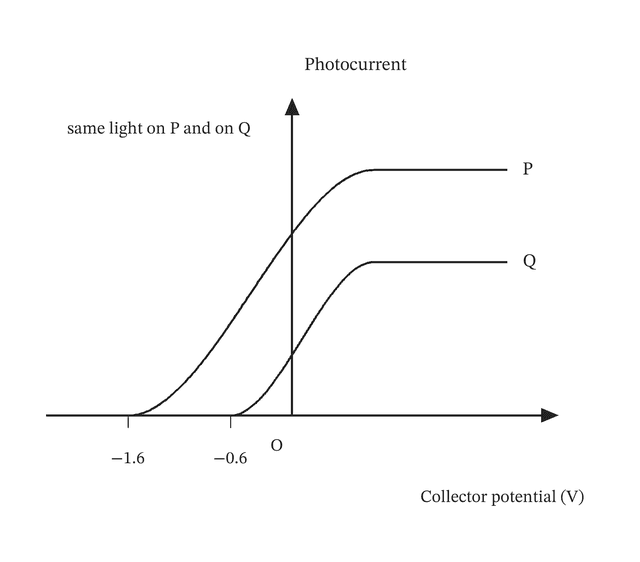
The work function of P is . (Hypothetical data.) What is the work function of Q?
- 293 marks
Question 29
In an evacuated photocell, the emitter E and the collector C are parallel plates apart. For the light used, the stopping potential is . The collector is now held below the emitter, as shown, so that the field between the plates is uniform.

(Hypothetical data.) Take .
(a) Find the maximum kinetic energy of the photoelectrons, in eV and in joules.
(b) Find the strength of the electric field between the plates.
(c) One of the fastest electrons leaves E moving straight towards C. How far from E does it come to rest before turning back?
- 301 mark
Question 30
Removing the outer electron from a single caesium atom in a gas needs about , but the work function of caesium metal is only about . Which statement best explains the difference?
- 313 marks
Question 31
Flame detectors in factories use a photocell that must respond to the ultraviolet light from a flame but not to sunlight. Sunlight reaching the ground contains almost no ultraviolet of wavelength shorter than about , because the ozone layer absorbs it. The photocathode chosen has a work function of . (Hypothetical data.) Take , and .
(a) Find the threshold wavelength and the threshold frequency of this photocathode.
(b) Explain why the photocell does not respond to sunlight.
(c) Find the stopping potential when ultraviolet light of wavelength from a flame falls on the photocathode.
- 321 mark
Question 32
A metal emitter has a work function of . Ultraviolet light whose photons each carry falls on it. The surface is then coated with a very thin layer of caesium, which lowers its work function to about , and the same light is used. (Hypothetical data.) Compared with the bare metal, for the coated surface
- 333 marks
Question 33
A photocell's emitter is known to be one of the four metals in the table, whose work functions are given. Light of wavelength gives a stopping potential of . (Hypothetical data.)
Metal caesium potassium calcium magnesium Work function (eV) 2.14 2.29 2.87 3.66 Take , and .
(a) Find the work function of the emitter, and identify the metal.
(b) Find the threshold frequency and the threshold wavelength of the emitter.
- 341 mark
Question 34
The threshold wavelength of a metal is . A lamp shines light of two wavelengths, and , onto it at the same time. (Hypothetical data.) Take , and . What is the stopping potential?
- 353 marks
Question 35
The graph shows the maximum kinetic energy of the photoelectrons from metal A against the frequency of the light falling on it. The line meets the frequency axis at .
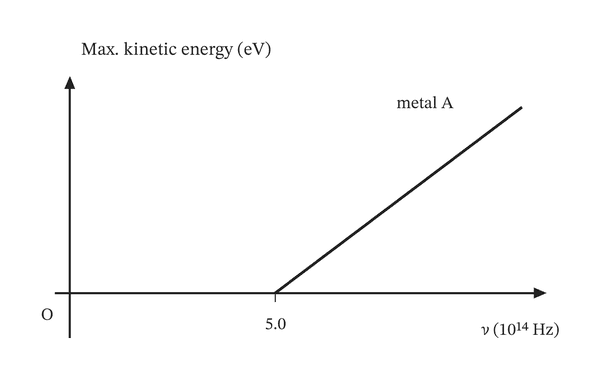
(Hypothetical data.) Take , , and (mass of an electron).
(a) Write Einstein's photoelectric equation in the form of this straight line, and find the work function of A in eV.
(b) Find the maximum kinetic energy, and the maximum speed, of the photoelectrons when light of wavelength falls on A.
(c) If the line is extended backwards past the frequency axis, where does it meet the energy axis? Why is that part of the line never observed?
- 361 mark
Question 36
For the photoelectrons from one metal, a student draws four graphs from the same set of readings. According to Einstein's photoelectric equation, which graph is not a straight line?
- 373 marks
Question 37
In a time-of-flight experiment, light of wavelength falls on an emitter. Photoelectrons pass through a small hole into a field-free tube long, and the fastest of them take to travel its length. The emitter, the plate and the tube are all at the same potential, so the electrons keep their starting speed.
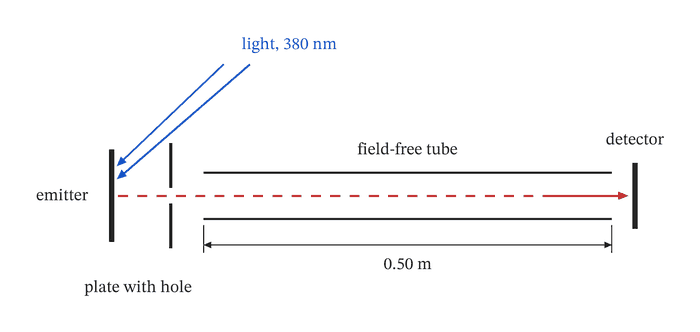
(Hypothetical data.) Take , , and (mass of an electron).
(a) Find the maximum speed and the maximum kinetic energy of the photoelectrons, in eV.
(b) Use Einstein's photoelectric equation to find the work function of the emitter.
(c) Find the threshold wavelength of the emitter.
- 381 mark
Question 38
When photons of energy fall on a metal, the fastest photoelectrons have a kinetic energy of . The same metal is then lit by photons of energy . (Hypothetical data.) What happens now?
- 393 marks
Question 39
A vacuum photocell is joined only to a voltmeter of very high resistance; there is no battery in the circuit. Light of wavelength falls on the emitter E, whose work function is .

(Hypothetical data.) Take , and .
(a) Explain why the collector C becomes negatively charged, and why its potential stops changing after a short time.
(b) Find the steady reading of the voltmeter.
(c) The light is made twice as intense. What happens to the steady reading? Explain.
- 401 mark
Question 40
Two metals A and B have work functions and . Light of one frequency, high enough to eject electrons from both, falls on each in turn, and the frequency is then raised step by step. (Hypothetical data.) How does the difference between the maximum kinetic energies of the photoelectrons, , change as the frequency rises?
- 413 marks
Question 41
Above the atmosphere, sunlight contains far-ultraviolet radiation, including a bright line of wavelength given out by hydrogen atoms in the Sun. The outer surface of a spacecraft has a work function of . (Hypothetical data.) Take , , and (mass of an electron).
(a) Find the energy of a photon in eV.
(b) Find the maximum kinetic energy and the maximum speed of the photoelectrons that this light ejects from the surface.
(c) Find the longest wavelength that can eject electrons from this surface, and explain why visible sunlight cannot do so.
- 423 marks
Question 42
The same photocell is lit first by light of wavelength and then by light of an unknown wavelength. The graph shows the photocurrent against the collector potential in each case.

(Hypothetical data.) Take , and .
(a) Find the work function of the emitter.
(b) Find the unknown wavelength.
(c) Which light gives more photoelectrons per second? Give a reason.
- 434 marks
Question 43
In an experiment to find Planck's constant, a student lights a photocell through five colour filters in turn and measures the stopping potential each time. (Hypothetical data.)
Wavelength (nm) 380 420 460 500 540 (V) 1.32 1.01 0.75 0.54 0.35 Take and .
(a) Use Einstein's photoelectric equation to show that a graph of against should be a straight line, and say what its slope equals.
(b) Plot this graph and use it to find Planck's constant.
(c) From the graph, find the threshold wavelength and the work function of the emitter.
- 441 mark
Question 44
In Millikan's experiment the metal surfaces were shaved clean inside the vacuum, by a knife worked from outside, before readings were taken. Suppose instead that a surface carries a thin film of contamination that raises its work function by . (Hypothetical data.) Compared with the stopping potential–frequency line for the clean surface, the line for the surface with the film
- 452 marks
Question 45
In a stopping-potential experiment, light reaches the photocell through a filter that passes all wavelengths from to and no others. The student records the wavelength of this light as , the middle of the band. (Hypothetical data.) Take , and .
(a) Which wavelength in the band decides the measured stopping potential? Explain.
(b) By how much is the measured stopping potential higher than it would be for light of exactly ?
- 461 mark
Question 46
A student plots the maximum kinetic energy of the photoelectrons, in electron-volts, against the frequency of the light. Taking and , the slope of the line is
- 473 marks
Question 47
The graph shows the stopping potential against the frequency of the light for an emitter made of metal X.
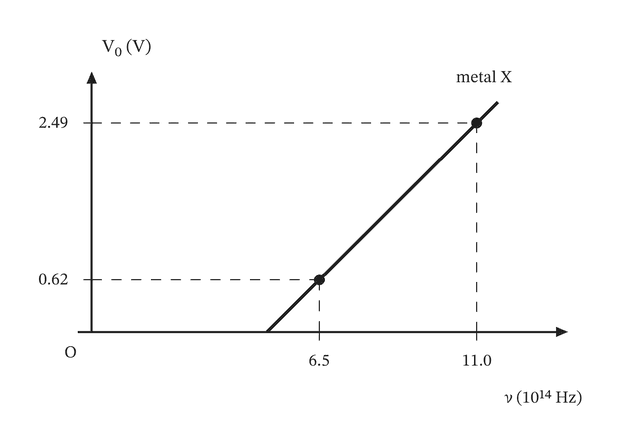
With an emitter of another metal, Y, a single reading is taken: at . (Hypothetical data.) Take .
(a) Use the two marked points to find Planck's constant.
(b) Find the work function of X, in eV, and its threshold frequency.
(c) Explain why one reading is enough to draw the line for Y, and find the work function and the threshold frequency of Y.
- 481 mark
Question 48
Millikan's careful photoelectric measurements, published in 1916, are remembered mainly because they
- 494 marks
Question 49
A student measures the stopping potential for five frequencies of light. One of the readings was written down wrongly. (Hypothetical data.)
() 5.0 6.0 7.0 8.0 9.0 (V) 0.20 0.61 1.23 1.44 1.86 Take .
(a) Find the rise in for each step of . Use these rises to find the wrong reading, and suggest what it should have been.
(b) Using the four good readings, find Planck's constant.
(c) Find the threshold frequency and the work function of the emitter, in eV.
- 503 marks
Question 50
A student tries to find Planck's constant from a single reading. The student's photocell has a caesium emitter, whose work function is taken from a data book as . With light of wavelength , the student measures a stopping potential of . (Hypothetical data.) Take and .
(a) Find the value of the student obtains.
(b) The work function of a real surface can differ from the data-book value. Suppose the surface's work function were really lower, so that the student measured instead. Using with this reading, find the student's value of and its percentage error, taking the accepted value as .
(c) Millikan instead found from the slope of a straight-line plot of against . Explain why his method avoids this problem.
- 512 marks
Question 51
‘Alkali metals are most suitable for photoelectric emission.’ Why?
- 522 marks
Question 52
Is photoemission possible at all frequencies? Give reasons for your answer.
- 532 marks
Question 53
Every metal has a definite work function. Why do not photoelectrons come out, all with the same energy if incident radiation is monochromatic? Why is there an energy distribution of photoelectrons?
- 542 marks
Question 54
Two metals and have work functions 2 eV, 4 eV respectively. Which metal has a lower threshold wavelength for photoelectric effect?
- 552 marks
Question 55
“The frequency of light incident in a photosensitive metal is doubled”. Will the kinetic energy be doubled?
- 561 mark
Question 56
“When light from a lamp falls on a wooden table, no photoelectrons are emitted from it.” Why?
- 572 marks
Question 57
“No photoelectric emission takes place if the frequency is less than the threshold frequency.” Why?
- 581 mark
Question 58
The distance between a photocell and a source of light is . What is the effect on the stopping potential if the distance is doubled?
- 591 mark
Question 59
“It is difficult to eject a free electron from copper than from sodium.” Why?
- 603 marks
Question 60
Light of wavelength 2000 Å falls on a metallic surface whose work function is 4.21 eV. Calculate the stopping potential.
- 613 marks
Question 61
Calculate the longest wavelength of the incident radiation which will eject photoelectrons from a metal surface whose work function is 3 eV.
- 623 marks
Question 62
Light of wavelength 5000 Å falls on a metal surface of work function 2.01 eV. Find the kinetic energy of photoelectrons.
- 633 marks
Question 63
Light of wavelength 5500 Å falls on a sensitive plate with a work function 1.7 eV. Find (i) energy of photon, (ii) energy of photoelectron and (iii) stopping potential.
- 643 marks
Question 64
Calculate the maximum kinetic energy of the electrons emitted from a photosensitive surface of work function 3.2 eV, for the incident radiation of wavelength 300 nm.
- 652 marks
Question 65
For a photosensitive surface, work function is J. Taking Planck's constant to be J s, find the threshold frequency.
- 662 marks
Question 66
A radio transmitter operates on a wavelength of 1500 m at a power of 400 kW. Find the energy of the radio photons in joules.
- 671 mark
Question 67
How can the work function of tungsten be increased?
- 682 marks
Question 68
Define stopping potential. How is it related to the kinetic energy of photoelectrons?
- 693 marks
Question 69
The work function of sodium is 2.28 eV.
(i) What is the minimum energy for a quantum of radiation to cause photoelectric emission from a sodium surface?
(ii) Calculate the wavelength of this radiation.
- 702 marks
Question 70
Find the momentum of the photon of energy 3.0 eV.
- 712 marks
Question 71
Threshold wavelength of certain metal is 792 nm. What is the maximum kinetic energy of photoelectrons emitted by this metal, if it is exposed to ultraviolet light of wavelength 396 nm?
- 722 marks
Question 72
Monochromatic light of wavelength 198 nm is incident on the surface of a metallic cathode, whose work function is 2.5 eV. How much potential difference must be applied between the cathode and the anode of a photocell to just stop the photocurrent from flowing?
- 732 marks
Question 73
Two metals A and B have work functions 4 eV and 6 eV respectively. Which metal has lower threshold wavelength for photoelectric effect?
- 742 marks
Question 74
What is meant by threshold frequency in photoelectric effect? Does it depend upon the intensity of the incident light?
- 751 mark
Question 75
Which one of the following is true in photoelectric emission?
- 761 mark
Question 76
As the intensity of incident light increases,
- 771 mark
Question 77
When yellow light is incident on a surface, no electrons are emitted while green light can emit. If red light is incident on the surface, then
- 781 mark
Question 78
Light of frequency is incident on a certain photoelectric substance with threshold frequency . The work function for the substance is
- 791 mark
Question 79
According to photon theory of light, which of the following physical quantities associated with the photon do not/does not change as it collides with an electron in vacuum.
- 801 mark
Question 80
Sodium and copper have work functions 2.3 eV and 4.5 eV respectively. Then ratio of their threshold wavelengths is nearest to
- 811 mark
Question 81
Which of the following shows particle nature of light?
- 821 mark
Question 82
By photoelectric effect, Einstein proved,
- 831 mark
Question 83
When ultraviolet rays are incident on metal plate, then photoelectric effect does not occur. It occurs by the incidence of
- 841 mark
Question 84
The magnitude of saturation photoelectric current depends upon
- 851 mark
Question 85
For photoelectric emission, tungsten required light of 2300 Å. If light of 1800 Å wavelength is incident then, emission
- 861 mark
Question 86
The incident photon involved in the photoelectric effect experiment
- 871 mark
Question 87
The stopping potential (),
(A) depends upon the angle of incident light
(B) depends upon the intensity of incident light
(C) depends upon the surface nature of the substance
(D) is independent of the intensity of the incident light
- 881 mark
Question 88
4 eV is the energy of the incident photon and the work function is 2 eV. What is the stopping potential?
- 891 mark
Question 89
Two identical metal plates show photoelectric effect by a light of wavelength falling on plate A and on plate B (). The maximum kinetic energy is,
- 901 mark
Question 90
A photocell is illuminated by a small bright source placed 1 m away. When the same source of light is placed 1/2 m away, the number of electrons emitted by photocathode would
- 911 mark
Question 91
Light of frequency is incident on the metal of threshold frequency . The maximum kinetic energy of the emitted photoelectrons is,
- 921 mark
Question 92
The number of photons of wavelength 540 nm emitted per second by an electric bulb of power 100 W is ( J s)
- 931 mark
Question 93
In photoelectric effect, the electrons are ejected from metals if incident light has certain minimum
- 941 mark
Question 94
If the threshold wavelength for sodium is 5420 Å, then the work function of sodium is
- 951 mark
Question 95
When wavelength of the incident photon is decreased, then
- 961 mark
Question 96
The light rays having photons of energy 1.8 eV are falling on a metal surface having a work function 1.2 eV. What is the stopping potential to be applied to stop the emitting electrons?
- 971 mark
Question 97
When a metallic surface is illuminated with radiation of wavelength , the stopping potential is . If the same surface is illuminated with radiation of wavelength , the stopping potential is . The threshold wavelength for the metallic surface is
- 981 mark
Question 98
Light of two different frequencies whose photons have energies 1 eV and 2.5 eV respectively, successively illuminates a metal of work function 0.5 eV. The ratio of maximum kinetic energy of the emitted electron will be
- 991 mark
Question 99
The photoelectric threshold wavelength of silver is m. The velocity of the electron ejected from a silver surface by ultraviolet light of wavelength m is
(A) m/s
(B) m/s
(C)
(D)
- 1001 mark
Question 100
If a source of 4 kW produces photons/second, the radiation belong to a part of the spectrum called
- 1011 mark
Question 101
The work function for metals , and are respectively 1.92 eV, 2.0 eV and 5 eV. According to Einstein's equation, the metals which will emit photoelectrons for a radiation of wavelength 4100 Å is/are
- 1021 mark
Question 102
In an experiment of photoelectric effect, the stopping potential was measured to be and volts with incident light of wavelength and respectively. The relation between and may be
- 1031 mark
Question 103
The work function of a substance is 4.0 eV. The longest wavelength of light that can cause photoelectric emission from this substance is approximately
- 1041 mark
Question 104
In a photoelectric experiment, if both the intensity and frequency of the incident light are doubled, then the saturation photoelectric current
- 1051 mark
Question 105
If 5% of the energy supplied to a bulb is irradiated as visible light, how many quanta are emitted per second by a 100 W lamp (assume wavelength of visible light as cm)?
- 1061 mark
Question 106
When the energy of the incident radiation is increased by 20%, the kinetic energy of the photoelectrons emitted from a metal surface increased from 0.5 eV to 0.8 eV. The work function of the metal is
- 1071 mark
Question 107
When a certain photosensitive surface is illuminated with monochromatic light of frequency , the stopping potential for the photocurrent is . When the surface is illuminated by light of frequency , the stopping potential is . The threshold frequency for photoelectric emission is
- 1081 mark
Question 108
In a photoelectric experiment, the threshold wavelength is 380 nm. If the wavelength of the incident light is 260 nm, the maximum kinetic energy of the emitted electrons will be [given ]
- 1091 mark
Question 109
When a photon of energy 4.0 eV strikes the surface of a metal , the ejected photoelectrons have maximum kinetic energy eV and de Broglie wavelength . The maximum kinetic energy of photoelectrons liberated from another metal by photon of energy 4.50 eV is eV. If the de Broglie wavelength of these photoelectrons is , then the work function of the metal is
- 1101 mark
Question 110
In a photoelectric effect experiment, the graph of stopping potential versus reciprocal of wavelength is shown in the given figure. As the intensity of the incident radiation is increased

- 1111 mark
Question 111
Light of frequency 1.5 times the threshold frequency is incident on a photosensitive material, what will be the photoelectric current if the frequency is halved and intensity is doubled?
- 1121 mark
Question 112
The stopping potential for electrons emitted from a photosensitive surface illuminated by light of wavelength 491 nm is 0.710 V. When the incident wavelength is changed to a new value, the stopping potential is 1.43 V. The new wavelength is
- 1131 mark
Question 113
The stopping potential in the context of photoelectric effect depends on the following property of the incident electromagnetic radiation
- 1141 mark
Question 114
In a photoelectric experiment, increasing the intensity of incident light
- 1151 mark
Question 115
An electromagnetic wave of wavelength is incident on a photosensitive surface of negligible work function. If 'm' mass is of photoelectron emitted from the surface has de Broglie wavelength , then
- 1161 mark
Question 116
The number of photons per second on an average emitted by the source of monochromatic light of wavelength 600 nm, when it delivers the power of watt will be ( J s)