Solution:
Concept: A photocell lets us vary the intensity and frequency of the light and the potential of the collector, and measure the resulting photocurrent.
Step 1 — Part (a): the photoelectric effect. The photoelectric effect is the emission of electrons from a metal surface when light (or other electromagnetic radiation) of suitable frequency falls on it. The emitted electrons are called photoelectrons, and the current they carry is the photoelectric current.
Step 2 — Part (b): the apparatus. The apparatus is shown below:
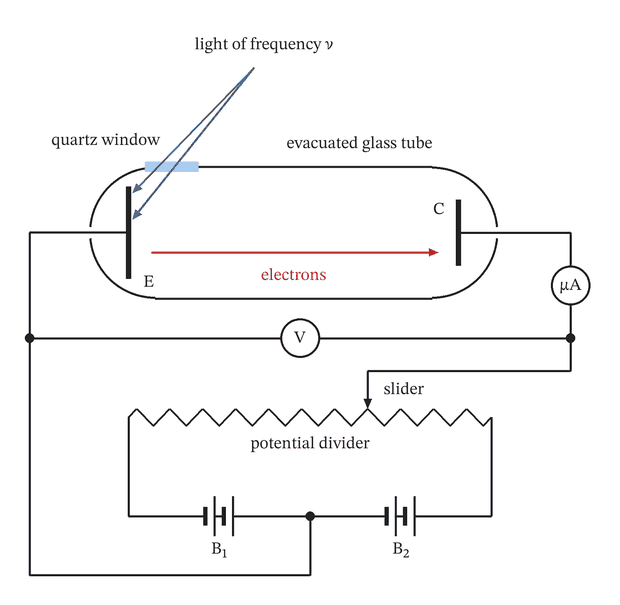
An evacuated glass tube contains a photosensitive plate, the emitter E, and a collector plate C. Light enters through a quartz window, which lets ultraviolet through. A potential divider connected across the batteries B₁ and B₂ applies a potential to C that can be made positive or negative with respect to E; the voltmeter V reads it, and the microammeter μA measures the photocurrent.
Step 3 — Part (b): the method. Light of known frequency and intensity falls on E. The potential of C is varied step by step from positive to negative, and the current is read at each step. The experiment is then repeated with different intensities and different frequencies.
Step 4 — Part (c)(i): effect of intensity. With the frequency and the collector potential fixed, the current is directly proportional to the intensity:
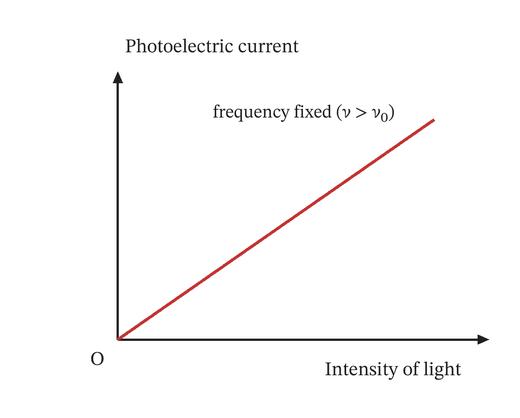
More intense light brings more photons per second and so frees more electrons per second.
Step 5 — Part (c)(ii): effect of accelerating and retarding potential. As the accelerating potential increases, the current rises to a saturation value, when every emitted electron is collected. With a retarding potential the current falls, and it becomes zero at the stopping potential −V0, where eV0=Kmax:
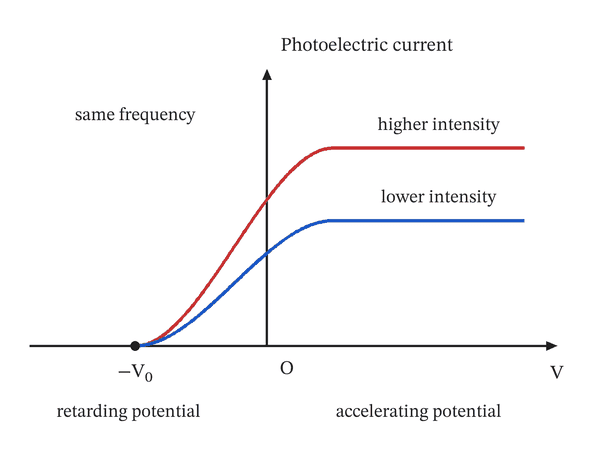
For two intensities of the same frequency the saturation currents differ, but the stopping potential is the same.
Step 6 — Part (c)(iii): effect of frequency. For the same intensity (the same number of photons per second) but different frequencies ν1>ν2>ν3, the saturation current is the same, but the stopping potential is larger for the higher frequency:

Higher frequency gives each photon more energy, so the fastest electrons have more kinetic energy and need a larger retarding potential to stop them.
Note: Part (iii) is read as the effect of frequency on the photocurrent and the stopping potential.
Note: The equal saturation currents in the frequency graph assume equal numbers of photons per second (the textbook's "same intensity"). At equal energy per second, higher-frequency light carries fewer photons, so real saturation currents are not in general equal; the graph is idealised.
Therefore, (a) photoelectric emission is the emission of electrons by a metal under light of suitable frequency; (b) it is studied with a photocell whose collector potential is varied while the current is measured; (c) the current is proportional to intensity, falls to zero at the stopping potential under a retarding potential, and a higher frequency gives a larger stopping potential with the same saturation current.
