Solution:
Concept: For light of one frequency, the saturation current is proportional to the intensity (the number of photons arriving per second), and the stopping potential (where the current falls to zero) depends on the frequency: eV0=hν−W.
Step 1 — Part (i): compare the saturation currents. All three curves level off at the same saturation current, so the same number of electrons is emitted per second in each case. The intensity of the light is the same for the three curves.
Step 2 — Part (ii): compare the stopping potentials. The answer figure marks where each curve meets the potential axis:
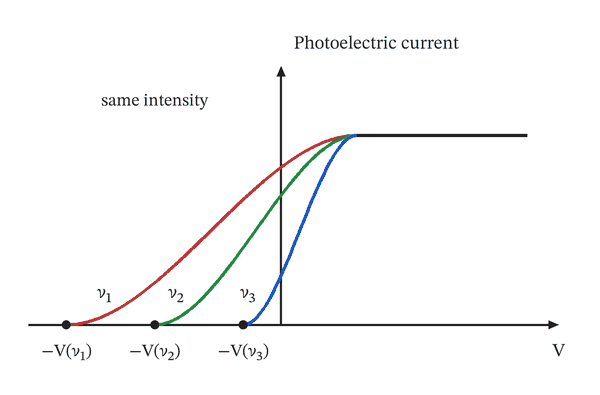
The curve for ν1 reaches zero at the most negative potential, so it has the largest stopping potential. Since V0 increases with frequency, ν1 is the highest.
Note: Strictly, equal saturation currents mean equal numbers of photons arriving per second (taking each photon to be equally likely to free an electron); the textbook calls this "the same intensity". At equal energy per second, higher-frequency light carries fewer photons, so a real photocell would not in general give equal saturation currents. The graph is idealised.
Therefore, (i) the intensity of the incident radiation is kept constant, and (ii) ν1 is the highest frequency.

