
Opening your dashboard
Class 12 Physics Chapter 19: Wave Optics - Huygens' Principle Solutions
45 textbook questions with step-by-step answers, free to read, for ISC 2026-27.
Get talked through Ch 19, not just shown the answer
Reading a finished solution is not the same as being able to do it. The AI tutor takes one question at a time and works it with you, in your own words, until you can.
- Ask it out loud, in your own words
- It gives you the next step, not the answer
- Stuck on part (ii)? Start there
45 questions with solutions
1–4 marks · Mixed difficulty
The first 39 solutions are on this page. This chapter is a long one, so the rest open on their own page to keep this one quick to load.
- 11 mark
Question 1
The wave theory of light was given by
Solve with AIAnswer
(A) Maxwell
(B) Planck
- Correct
(C) Huygens
(D) Young
Answer: (C) Huygens
Concept: Christiaan Huygens put forward the wave theory of light in 1678, treating light as a wave spreading out from the source.
Step 1 — Recall the history. Newton had proposed the corpuscular (particle) theory. Huygens proposed that light travels as a wave and gave the idea of wavefronts and secondary wavelets.
Step 2 — Check the other options. Each of the other options names a later scientist:
- (A) This scientist gave the electromagnetic theory (1864), which showed that light waves are electromagnetic waves; the wave theory itself came almost two hundred years earlier.
- (B) This scientist began the quantum theory (1900), which is not a wave theory.
- (D) This scientist supported the wave theory with his double-slit interference experiment (1801), but did not first propose it.
Therefore, the wave theory of light was given by Huygens, option (C).
- 21 mark
Question 2
Which of the following phenomena can explain quantum nature of light?
Solve with AIAnswer
- Correct
(A) Photoelectric effect
(B) Interference
(C) Diffraction
(D) Polarisation
Answer: (A) Photoelectric effect
Concept: The quantum (photon) nature of light means light energy comes in packets of . Effects that need these packets show the quantum nature; effects that need superposition of waves show the wave nature.
Step 1 — Look at the photoelectric effect. In the photoelectric effect electrons are emitted only if the frequency is above a threshold, and their maximum energy depends on frequency, not intensity. Only the photon idea () explains this.
Step 2 — Check the other options. Each of the other options is explained by the wave theory:
- (B) Interference is the superposition of waves, which shows the wave nature.
- (C) Diffraction is the bending of waves round obstacles, which also shows the wave nature.
- (D) Polarisation shows that light waves are transverse, again a wave property.
Therefore, the photoelectric effect, option (A), explains the quantum nature of light.
- 31 mark
Question 3
Newton postulated his corpuscular theory on the basis of
Solve with AIAnswer
(A) Newton's rings
(B) Colours of thin films
- Correct
(C) Rectilinear propagation of light
(D) Dispersion of white light
Answer: (C) Rectilinear propagation of light
Concept: In the corpuscular theory, light is a stream of tiny particles (corpuscles) shot out from the source in straight lines.
Step 1 — Link the theory to the observation. Fast particles moving freely travel in straight lines, so the theory was built to explain why light travels in straight lines and casts sharp shadows (rectilinear propagation), along with reflection and refraction.
Step 2 — Check the other options. None of the other options was the basis of the theory:
- (A) This pattern is an interference effect of a thin air film; it is explained by the wave theory, not by corpuscles.
- (B) These colours are also an interference effect, explained by the wave theory.
- (D) Newton studied this with prisms and gave colours to corpuscles of different sizes, but the theory itself was founded on straight-line travel.
Therefore, the corpuscular theory was based on the rectilinear propagation of light, option (C).
- 41 mark
Question 4
Wave nature of light is verified by
Solve with AIAnswer
- Correct
(A) Interference
(B) Photoelectric effect
(C) Reflection
(D) Refraction
Answer: (A) Interference
Concept: Interference is the superposition of two waves giving bright and dark fringes. Particles cannot cancel each other to give darkness, so interference is a proof of wave nature.
Step 1 — Why interference proves waves. In Young's double-slit experiment, light added to light gives dark fringes at some points. Only waves meeting out of phase can do this.
Step 2 — Check the other options. Each of the other options fails to verify the wave nature:
- (B) This effect shows the particle (photon) nature of light.
- (C) Reflection is explained by both the corpuscular and the wave theory, so it cannot decide between them.
- (D) Refraction is also explained by both theories (they differ only on the speed in the denser medium).
Therefore, the wave nature of light is verified by interference, option (A).
- 51 mark
Question 5
The frequency of light ray having the wavelength 3000 Å is
Solve with AIAnswer
(A) cycles/s
- Correct
(B) cycles/s
(C) 90 cycles/s
(D) 3000 cycles/s
Answer: (B) cycles/s
Concept: For light in vacuum (or air), speed = frequency × wavelength, so the frequency is the speed of light divided by the wavelength. Use ; one ångström is m.
Step 1 — Convert the wavelength to metres. The wavelength in metres is
Step 2 — Find the frequency. Divide the speed of light by the wavelength:
Step 3 — Check the other options. Each of the other options comes from a slip:
- (A) is what you get by multiplying in cm/s () by the bare number 3000 from the wavelength in Å, a product instead of a quotient with mixed units; the frequency is divided by in metres.
- (C) 90 cycles/s is in metres (), a product instead of a quotient.
- (D) 3000 cycles/s just repeats the number in the wavelength.
Therefore, the frequency is cycles/s, option (B).
- 61 mark
Question 6
The rectilinear propagation of light in a medium is due to its
Solve with AIAnswer
(A) High velocity
(B) Large wavelength
- Correct
(C) High frequency
(D) Source
Answer: (C) High frequency
Concept: Waves bend round an obstacle (diffract) noticeably only when the obstacle is comparable to the wavelength. Light seems to go straight because its wavelength () is very small compared with everyday obstacles.
Step 1 — Relate wavelength and frequency. For a given speed, . A very small wavelength means a very high frequency (about – Hz for light).
Step 2 — Choose the option. The small wavelength of light, that is, its high frequency, is why light hardly bends round obstacles and appears to travel in straight lines.
Step 3 — Check the other options. Each of the other options gives a wrong cause:
- (A) Speed does not decide bending; sound and light would both bend if their wavelengths matched the obstacles.
- (B) A large wavelength would make light bend round obstacles more, the opposite of rectilinear propagation.
- (D) The source does not decide whether light travels straight.
Note: the basic reason is the very small wavelength of light; "high frequency" is the same fact stated through .
Therefore, the answer is option (C), high frequency (that is, very small wavelength).
- 71 mark
Question 7
By Huygens' wave theory of light, we cannot explain the phenomenon of
Solve with AIAnswer
(A) Interference
(B) Diffraction
- Correct
(C) Photoelectric effect
(D) Polarisation
Answer: (C) Photoelectric effect
Concept: A wave spreads its energy continuously over the wavefront. The photoelectric effect needs energy to arrive in packets of (photons), which a wave theory cannot supply.
Step 1 — Why the wave theory fails. In the wave theory, light of any frequency should eject electrons if it is intense enough, and faint light should need a time delay while the electrons collect energy. In practice no electrons come out below a threshold frequency, however intense the light, and emission starts with no measurable delay (within about s); only the photon picture explains this.
Step 2 — Check the other options. Each of the other options is explained by a wave theory:
- (A) Interference is the superposition of waves and is explained by the wave theory.
- (B) Diffraction, the bending of waves round obstacles, is explained by secondary wavelets.
- (D) Polarisation is explained once light waves are taken as transverse waves.
Note: Huygens himself pictured light as longitudinal waves, so his original theory could not explain polarisation; this was put right later by taking the waves as transverse. The photoelectric effect cannot be explained by any wave theory.
Therefore, the wave theory cannot explain the photoelectric effect, option (C).
- 81 mark
Question 8
Light appears to travel in straight lines since
Solve with AIAnswer
(A) It is not absorbed by the atmosphere
(B) It is reflected by the atmosphere
- Correct
(C) Its wavelength is very small
(D) Its velocity is very large
Answer: (C) Its wavelength is very small
Concept: Bending of waves round obstacles (diffraction) is noticeable only when the size of the obstacle or opening is comparable to the wavelength.
Step 1 — Compare sizes. The wavelength of visible light is about to , far smaller than everyday objects. So the bending is too small to notice and light appears to travel in straight lines.
Step 2 — Check the other options. None of the other options explains straight-line travel:
- (A) Absorption only reduces the intensity; it has nothing to do with the direction of travel.
- (B) Reflection by the atmosphere would scatter light in many directions, not keep it straight.
- (D) The speed of light is indeed very large, but speed does not decide whether a wave bends round an obstacle.
Therefore, light appears to travel in straight lines because its wavelength is very small, option (C).
- 91 mark
Question 9
The idea of secondary wavelets for the propagation of a wave was first given by
Solve with AIAnswer
(A) Newton
- Correct
(B) Huygens
(C) Maxwell
(D) Fresnel
Answer: (B) Huygens
Concept: Huygens' principle says that every point of a wavefront acts as a source of secondary wavelets, and the envelope of these wavelets gives the new wavefront.
Step 1 — Name the scientist. This construction was first given by Christiaan Huygens (1678), and it is named after him.
Step 2 — Check the other options. Each of the other options names a different contribution:
- (A) Newton gave the corpuscular theory, which has no wavelets.
- (C) Maxwell gave the electromagnetic theory of light.
- (D) Fresnel later added the idea that the secondary wavelets interfere with each other (the Huygens–Fresnel principle), but the wavelets themselves came from Huygens.
Therefore, the idea of secondary wavelets was first given by Huygens, option (B).
- 101 mark
Question 10
Rays diverging from a point source form a wavefront that is
Solve with AIAnswer
(A) Cylindrical
- Correct
(B) Spherical
(C) Plane
(D) Cubical
Answer: (B) Spherical
Concept: A wavefront joins points that vibrate in the same phase, and it is always perpendicular to the rays.
Step 1 — Find the shape. From a point source light travels equally in all directions, so after time the disturbance has reached every point at distance from the source. These points lie on a sphere centred on the source.
Step 2 — Check the other options. Each of the other options needs a different source:
- (A) A cylindrical wavefront comes from a line source or a narrow slit.
- (C) A plane wavefront comes from a very distant source or from a source at the focus of a convex lens.
- (D) No source gives a cubical wavefront in a uniform medium, because light spreads at the same speed in every direction.
Therefore, rays from a point source form a spherical wavefront, option (B).
- 111 mark
Question 11
What is a wavefront?
Solve with AIWritten solution
Solution:
Concept: As a wave travels, the particles of the medium (or the field) vibrate; points reached by the wave at the same time vibrate in step.
Step 1 — Define it. A wavefront is the continuous locus (surface) of all the vibrating points that are in the same state of vibration, that is, in the same phase, at a given instant.
Therefore, a wavefront is the locus of all points vibrating in the same phase.
- 121 mark
Question 12
What is the shape of wavefront emitted by a light source in the form of (i) a point source, (ii) a narrow slit and (iii) a line source?
Solve with AIWritten solution
Solution:
Concept: The points in the same phase lie at the same distance from the source, so the wavefront has the shape of the surface at equal distance from the source.
Step 1 — Point source. Points at equal distance from a point lie on a sphere.
(i) Spherical wavefront.
Step 2 — Narrow slit. A narrow slit behaves like a line source, and points at equal distance from a line lie on a cylinder.
(ii) Cylindrical wavefront.
Step 3 — Line source. For the same reason, a line source gives a cylinder.
(iii) Cylindrical wavefront.
Therefore, the wavefronts are (i) spherical, (ii) cylindrical and (iii) cylindrical.
- 131 mark
Question 13
What is the phase difference between any two points on a wavefront?
Solve with AIWritten solution
Solution:
Concept: By definition, all points on a wavefront vibrate in the same phase.
Step 1 — Apply the definition. Since every point on a wavefront has the same phase, the difference between the phases of any two of them is nil.
Therefore, the phase difference between any two points on a wavefront is zero.
- 141 mark
Question 14
What is the relation of a wavefront with a ray of light?
Solve with AIWritten solution
Solution:
Concept: A ray shows the direction in which the light energy travels, and the wave always moves forward at right angles to its wavefront.
Step 1 — State the relation. The ray at any point is drawn along the normal to the wavefront at that point.
Therefore, the rays of light are always perpendicular to the wavefront.
- 151 mark
Question 15
Define refractive index in terms of speed of light.
Solve with AIWritten solution
Solution:
Concept: Light travels fastest in vacuum and more slowly in a material medium.
Step 1 — Define it. The (absolute) refractive index of a medium is the ratio of the speed of light in vacuum, , to the speed of light in the medium, :
Therefore, refractive index , the speed of light in vacuum divided by the speed of light in the medium.
- 161 mark
Question 16
What is optical path?
Solve with AIWritten solution
Solution:
Concept: Light is slower in a medium, so a length of a medium of refractive index takes the same time to cross as a length of vacuum.
Step 1 — Define it. The optical path of light in a medium is the product of the refractive index of the medium and the geometrical distance travelled in it:
Therefore, optical path = refractive index × geometrical path; it equals the distance light would cover in vacuum in the same time.
- 171 mark
Question 17
When light propagates in a medium, what happens to its (i) velocity, (ii) wavelength and (iii) frequency?
Solve with AIWritten solution
Solution:
Concept: The frequency of light is fixed by the source; the speed depends on the medium (), and the wavelength follows from .
Step 1 — Velocity. In a denser medium () light slows down.
(i) The velocity changes; it decreases to in a medium of refractive index .
Step 2 — Wavelength. With fixed and smaller, the wavelength also becomes smaller.
(ii) The wavelength changes; it becomes .
Step 3 — Frequency. The frequency is set by the source and does not depend on the medium.
(iii) There is no change in frequency.
Therefore, the velocity and the wavelength decrease, while the frequency stays the same.
- 181 mark
Question 18
What is the geometrical shape of the wavefront when a plane wave passes through a convex lens?
Solve with AIWritten solution
Solution:
Concept: A convex lens brings rays parallel to its axis together at its focus , and wavefronts are always perpendicular to the rays.
Step 1 — Follow the rays. The rays of a plane wave are parallel. After the convex lens they converge to the focus .
Step 2 — Find the wavefront. Wavefronts perpendicular to rays that all meet at are parts of spheres centred on , shrinking towards it.
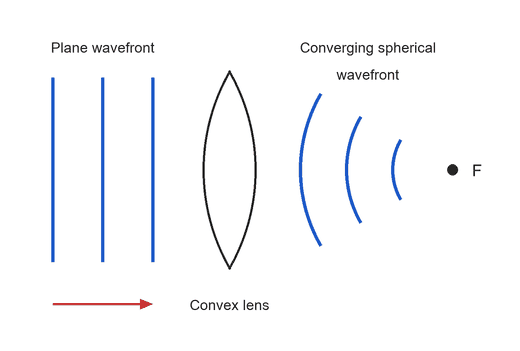
Therefore, after a convex lens the plane wavefront becomes a converging spherical wavefront.
- 191 mark
Question 19
Out of speed, frequency and wavelength, name the parameter(s) which remain the same on reflection.
Solve with AIWritten solution
Solution:
Concept: On reflection the light goes back into the same medium; the frequency is fixed by the source.
Step 1 — Speed. The medium is the same, so the speed is the same.
Step 2 — Frequency and wavelength. The frequency does not change, and with the same speed the wavelength is also the same.
Therefore, all three (speed, frequency and wavelength) remain the same on reflection.
- 201 mark
Question 20
Out of speed, frequency and wavelength, name the parameter(s) which remain the same on refraction.
Solve with AIWritten solution
Solution:
Concept: On refraction the light enters a new medium, so its speed changes, while its frequency is still fixed by the source.
Step 1 — Speed and wavelength. The speed changes to in the new medium, so the wavelength changes in the same ratio.
Step 2 — Frequency. The atoms at the boundary re-radiate at the frequency of the incident light, so the frequency stays the same.
Therefore, only the frequency remains the same on refraction.
- 211 mark
Question 21
What type of wavefront will emerge from (i) a point source and (ii) distant light source?
Solve with AIWritten solution
Solution:
Concept: Wavefronts from a source are surfaces at equal distance from it; very far from the source a small part of a large sphere is practically flat.
Step 1 — Point source. The points in the same phase lie on spheres centred on the source, which grow as the light spreads out.
(i) A diverging spherical wavefront.
Step 2 — Distant source. Far away the radius of the sphere is huge, so the part reaching us is practically flat.
(ii) A plane wavefront.
Therefore, (i) a point source gives a diverging spherical wavefront and (ii) a distant source gives a plane wavefront.
- 221 mark
Question 22
The refractive index of glass is 1.5 for light waves of Å in vacuum. Calculate the wavelength in glass.
Solve with AIWritten solution
Solution:
Concept: The frequency does not change when light enters glass, but the speed falls to , so the wavelength also falls to .
Step 1 — Write the relation. The frequency is the same in vacuum and in glass, so the ratio of the speeds, , is also the ratio of the wavelengths. The wavelength in glass is therefore
Step 2 — Substitute the values. Put Å and :
Therefore, the wavelength in glass is 4000 Å.
- 231 mark
Question 23
Differentiate between a ray and a wavefront.
Solve with AIWritten solution
Solution:
Concept: A wavefront tells us where the wave has reached; a ray tells us which way it is going.
Step 1 — Wavefront. A wavefront is the locus of points of the medium which are in the same phase of vibration; it is a surface (sphere, cylinder or plane).
Step 2 — Ray. A ray is a straight line drawn perpendicular to the wavefront, showing the direction in which the wave (its energy) travels.
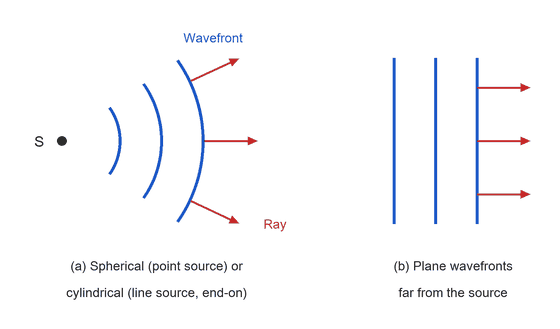
Therefore, a wavefront is a surface of points in the same phase, while a ray is the line perpendicular to it that shows the direction of propagation.
- 242 marks
Question 24
Who proposed (i) corpuscular theory and (ii) wave theory of light?
Solve with AIWritten solution
Solution:
Concept: Two rival theories of light were put forward in the seventeenth century: one treating light as particles, the other as waves.
Step 1 — Corpuscular theory. The theory that light is a stream of tiny particles was proposed by Newton.
(i) Isaac Newton.
Step 2 — Wave theory. The theory that light travels as a wave, with wavefronts and secondary wavelets, was proposed by Huygens.
(ii) Christiaan Huygens.
Therefore, (i) the corpuscular theory was proposed by Isaac Newton and (ii) the wave theory by Christiaan Huygens.
- 252 marks
Question 25
Who proposed (i) electromagnetic theory and (ii) quantum theory?
Solve with AIWritten solution
Solution:
Concept: Later theories of light showed that light is an electromagnetic wave and that its energy is exchanged in packets (quanta).
Step 1 — Electromagnetic theory. Maxwell showed (1864) that light is an electromagnetic wave travelling at speed .
(i) James Clerk Maxwell.
Step 2 — Quantum theory. Planck (1900) proposed that radiation is emitted and absorbed in quanta of energy ; Einstein (1905) extended this to light itself (photons).
(ii) Max Planck.
Therefore, (i) the electromagnetic theory was proposed by Maxwell and (ii) the quantum theory by Planck.
- 262 marks
Question 26
What is a wavefront? Mention the different types.
Solve with AIWritten solution
Solution:
Concept: As a wave spreads, points that it reaches at the same moment vibrate in the same phase; the surface through them is the wavefront.
Step 1 — Definition. A wavefront is the locus of all points of the medium that are vibrating in the same phase at a given instant. Rays are perpendicular to it.
Step 2 — Types. The shape depends on the source:
- Spherical wavefront: from a point source; the wavefronts are concentric spheres centred on the source.
- Cylindrical wavefront: from a line source (or a narrow slit); the wavefronts are coaxial cylinders round the source.
- Plane wavefront: very far from a source (or from a point source at the focus of a convex lens); a small part of a very large sphere or cylinder is practically flat.
Therefore, a wavefront is the locus of points vibrating in the same phase, and it may be spherical, cylindrical or plane.
- 272 marks
Question 27
Mention the sources of (i) spherical wavefront, (ii) cylindrical wavefront and (iii) plane wavefront.
Solve with AIWritten solution
Solution:
Concept: A wavefront is a surface of equal distance (equal phase) from the source, so its shape follows the shape of the source.
Step 1 — Spherical. Points at equal distance from a point lie on a sphere.
(i) A point source.
Step 2 — Cylindrical. Points at equal distance from a line lie on a cylinder.
(ii) A linear source (a line source or a narrow slit).
Step 3 — Plane. Far from the source the curvature becomes negligible.
(iii) A source at a large distance: a small part of a spherical or cylindrical wavefront far from its source is practically plane.
Therefore, a point source gives spherical, a linear source cylindrical, and a very distant source plane wavefronts.
- 282 marks
Question 28
Explain Huygens' principle. What are secondary wavelets?
Solve with AIWritten solution
Solution:
Concept: Huygens' principle is a geometrical method for finding the position of a wavefront at a later time when its present position is known.
Step 1 — State the principle. Huygens' principle has two parts:
- Every point on a given wavefront (the primary wavefront) acts as a fresh source of new disturbances, called secondary wavelets. These travel out in all directions with the speed of the wave in that medium.
- The new wavefront at any later time is the forward envelope (common tangent surface) of the secondary wavelets at that time.
Step 2 — Explain with a plane wavefront. Let be a plane wavefront at in a medium where the wave speed is . In time each secondary wavelet from a point of becomes a sphere of radius . The tangent surface touching all these wavelets in the forward direction is the new wavefront, a distance ahead of .
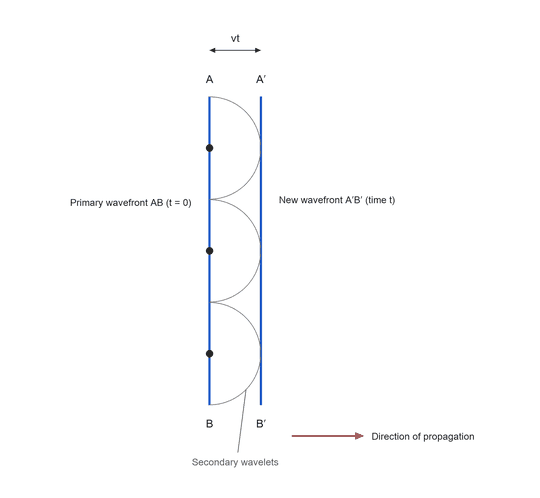
Step 3 — Secondary wavelets. The secondary wavelets are the small spherical waves sent out by each point of the primary wavefront; only their forward envelope is taken, so there is no backward wave.
Therefore, by Huygens' principle each point of a wavefront sends out secondary wavelets (spherical wavelets of speed ), and the forward envelope of these wavelets is the new wavefront.
- 292 marks
Question 29
Define refractive index in terms of velocity of light.
Solve with AIWritten solution
Solution:
Concept: Light travels fastest in vacuum; in a medium it is slower. The refractive index compares the two speeds.
Step 1 — Define it. The refractive index of a medium is the ratio of the speed of light in vacuum to the speed of light in the medium.
Step 2 — Write it as a formula. With the speed in vacuum and the speed in the medium,
Watch out: The ratio is over , so for every material medium.
Note: the book's printed answer is ; the correct ratio is , because its own words, speed in vacuum ÷ speed in the medium, give (and would make ).
Therefore, refractive index , the speed of light in vacuum divided by the speed of light in the medium.
- 302 marks
Question 30
What is optical path? How is it related to refractive index?
Solve with AIWritten solution
Solution:
Concept: Light travels more slowly in a medium, so a path in a medium is "optically longer" than the same length in vacuum.
Step 1 — Definition. The optical path is the distance light would travel in vacuum in the same time that it takes to travel a given distance in the medium.
Step 2 — Relation with refractive index. Light covers a distance in the medium in time . In this time, in vacuum, it would cover
Step 3 — State the relation. So the optical path is the refractive index of the medium times the distance travelled in that medium.
Therefore, optical path , refractive index of the medium × distance travelled by light in it.
- 312 marks
Question 31
Draw diagrams to show the change in shape of a wavefront on passing through a concave lens and a convex lens.
Solve with AIWritten solution
Solution:
Concept: Rays are perpendicular to wavefronts. A convex lens makes parallel rays converge to its focus; a concave lens makes them diverge as if from its focus.
Step 1 — Convex lens. A plane wavefront falling on a convex lens comes out as a converging spherical wavefront centred on the focus ; it shrinks towards .
Step 2 — Concave lens. A plane wavefront falling on a concave lens comes out as a diverging spherical wavefront centred on the virtual focus on the incident side; it grows as it moves away.
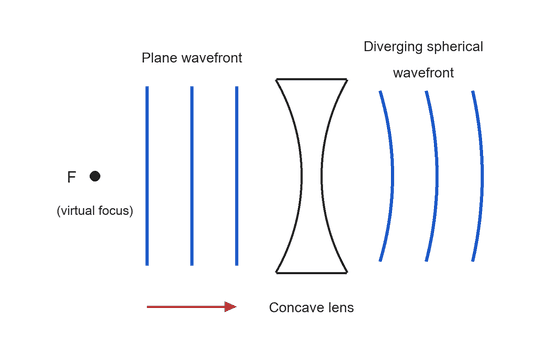
Step 3 — Why the shapes are curved. The middle of a convex lens is thickest, so the central part of the wavefront is delayed most and the wavefront curves round towards the focus. A concave lens is thinnest at the middle, so the edges are delayed most and the wavefront bulges forward.
Therefore, a convex lens turns a plane wavefront into a converging spherical wavefront, and a concave lens turns it into a diverging spherical wavefront.
- 322 marks
Question 32
Explain the change in (i) wavelength and (ii) frequency of light when it propagates from one medium into another.
Solve with AIWritten solution
Solution:
Concept: The frequency of light is fixed by the source; the speed in each medium is , and .
Step 1 — Frequency. At the boundary the atoms of the second medium are set into forced oscillation by the incident light and re-radiate at the same frequency, so the frequency does not change.
Step 2 — Wavelength. With the same in both media, the wavelengths are in the ratio of the speeds:
(i) The wavelength changes: it decreases when light goes into a denser medium (larger ) and increases when it goes into a rarer medium.
(ii) The frequency remains the same.
Therefore, on passing into another medium the wavelength changes (in the ratio ) but the frequency stays the same.
- 333 marks
Question 33
If is the distance travelled by a light wave in air in seconds and is the distance travelled in a medium of refractive index in the same time, prove that .
Solve with AIWritten solution
Solution:
Concept: Refractive index , where is the speed of light in air (vacuum) and the speed in the medium; distance = speed × time.
Step 1 — Distance in air. In air light travels at speed , so in time it covers
Step 2 — Distance in the medium. In the medium light travels at , so in the same time it covers
Step 3 — Combine the two. Multiply both sides of the last result by :
Comparing with Step 1, , so
Step 4 — Meaning. The distance is the optical path of the light in the medium; the result says it equals the distance light covers in air in the same time.
Therefore, .
- 343 marks
Question 34
State Huygens' principle. Use it to derive Snell's law of refraction for a parallel beam incident on the plane surface of a refracting medium. Give proper diagram.
Solve with AIWritten solution
Solution:
Concept: Huygens' principle lets us find a new wavefront from the old one using secondary wavelets; when the wavelets travel more slowly in the second medium, the wavefront turns, and this turning is refraction.
Step 1 — State Huygens' principle. Every point on a wavefront acts as a source of secondary wavelets, which spread out with the speed of the wave in that medium. The new wavefront at any later instant is the forward envelope (common tangent) of these secondary wavelets.
Step 2 — Set up the construction. Let be the plane surface separating medium 1 (speed ) and medium 2 (speed ), with medium 2 denser so . A parallel beam falls obliquely on . is the incident plane wavefront at the moment its end touches the surface; the rays are perpendicular to .
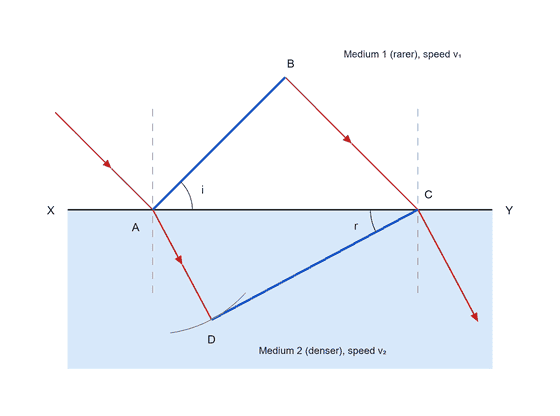
Step 3 — Use the secondary wavelets. Let the disturbance at take time to reach on the surface, so
In the same time the secondary wavelet from spreads into medium 2 as a sphere of radius
The tangent drawn from to this wavelet is the refracted wavefront, and is the refracted ray (perpendicular to ).
Step 4 — Identify the angles. The incident ray is perpendicular to and the normal is perpendicular to , so the angle of incidence equals the angle between and , that is, . In the same way the angle of refraction equals the angle between and , that is, .
Step 5 — Write the sines. In right triangle (right angle at ),
In right triangle (right angle at ),
Step 6 — Divide. Dividing the two results, and cancel:
Step 7 — Bring in the refractive index. Since and , the ratio is a constant for the pair of media, equal to the refractive index of medium 2 with respect to medium 1:
This is Snell's law. Also, the incident ray, the refracted ray and the normal all lie in the plane of the diagram, which is the first law of refraction.
Therefore, is a constant equal to , the refractive index , which is Snell's law of refraction.
- 353 marks
Question 35
On the basis of Huygens' wave theory, show that when light is incident on a plane mirror obliquely, angle of reflection is equal to angle of incidence.
Solve with AIWritten solution
Solution:
Concept: By Huygens' principle, each point of a wavefront sends out secondary wavelets with the speed of light in the medium, and the new wavefront is their common tangent. On reflection the wavelets travel back into the same medium with the same speed.
Step 1 — Recall Huygens' principle. Every point of the incident wavefront that reaches the mirror becomes a source of secondary wavelets travelling back into the same medium, and the reflected wavefront is the tangent to these wavelets.
Step 2 — Set up the construction. Let be a plane mirror and let a parallel beam fall on it obliquely. is the incident plane wavefront at the moment its end touches the mirror; the incident rays are perpendicular to . Let be the speed of light in the medium.
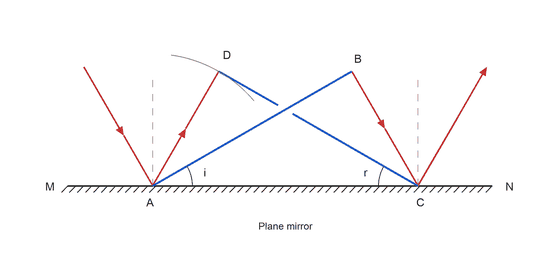
Step 3 — Use the secondary wavelets. Let the disturbance at take time to reach the point on the mirror, so
In the same time the secondary wavelet from spreads back into the same medium as a sphere of radius
The tangent drawn from to this wavelet is the reflected wavefront, and is the reflected ray (perpendicular to ).
Step 4 — Identify the angles. The incident ray is perpendicular to and the normal is perpendicular to the mirror, so the angle of incidence equals the angle between and the mirror: . In the same way the angle of reflection equals the angle between and the mirror: .
Step 5 — Compare the two triangles. Look at triangles and :
- and are both (a wavefront is perpendicular to its rays);
- , since both equal ;
- is common (the hypotenuse of both).
So the triangles are congruent (RHS).
Step 6 — Conclude the angles are equal. Corresponding angles of congruent triangles are equal, so
Also, the incident ray, the reflected ray and the normal at all lie in the plane of the diagram (the plane of incidence).
Therefore, the angle of reflection is equal to the angle of incidence ().
- 363 marks
Question 36
Derive Snell's law of refraction using Huygens' wave theory.
Solve with AIWritten solution
Solution:
Concept: By Huygens' principle each point of a wavefront sends out secondary wavelets with the speed of the wave in that medium; when they travel more slowly in the second medium, the wavefront turns, and this turning is refraction.
Step 1 — Recall Huygens' principle. Every point of a wavefront is a source of secondary wavelets, and the new wavefront is the forward envelope of these wavelets.
Step 2 — Set up the construction. Let be the plane surface separating medium 1 (speed ) and medium 2 (speed ), with medium 2 denser so . A parallel beam falls obliquely on . is the incident plane wavefront at the moment its end touches the surface; the rays are perpendicular to .
Step 3 — Use the secondary wavelets. Let the disturbance at take time to reach on the surface, so
In the same time the secondary wavelet from spreads into medium 2 as a sphere of radius
The tangent drawn from to this wavelet is the refracted wavefront, and is the refracted ray (perpendicular to ).
Step 4 — Identify the angles. The incident ray is perpendicular to and the normal is perpendicular to , so the angle of incidence equals the angle between and , that is, . In the same way the angle of refraction equals the angle between and , that is, .
Step 5 — Write the sines. In right triangle (right angle at ),
In right triangle (right angle at ),
Step 6 — Divide. Dividing the two results, and cancel:
Step 7 — Bring in the refractive index. Since and , the ratio is a constant for the pair of media, equal to the refractive index of medium 2 with respect to medium 1:
This is Snell's law. Also, the incident ray, the refracted ray and the normal all lie in the plane of the diagram, which is the first law of refraction.
Therefore, is a constant for the two media, equal to , the refractive index ; this is Snell's law.
- 373 marks
Question 37
Derive the laws of reflection using Huygens' wave theory.
Solve with AIWritten solution
Solution:
Concept: The laws of reflection are: (1) the incident ray, the reflected ray and the normal at the point of incidence lie in one plane; (2) the angle of reflection equals the angle of incidence. Huygens' secondary wavelets give both.
Step 1 — Recall Huygens' principle. Every point of the incident wavefront that reaches the mirror becomes a source of secondary wavelets travelling back into the same medium at the same speed, and the reflected wavefront is the common tangent to these wavelets.
Step 2 — Set up the construction. Let be a plane mirror and let a parallel beam fall on it obliquely. is the incident plane wavefront at the moment its end touches the mirror; the incident rays are perpendicular to . Let be the speed of light in the medium.
Step 3 — Use the secondary wavelets. Let the disturbance at take time to reach the point on the mirror, so
In the same time the secondary wavelet from spreads back into the same medium as a sphere of radius
The tangent drawn from to this wavelet is the reflected wavefront, and is the reflected ray (perpendicular to ).
Step 4 — Identify the angles. The incident ray is perpendicular to and the normal is perpendicular to the mirror, so the angle of incidence equals the angle between and the mirror: . In the same way the angle of reflection equals the angle between and the mirror: .
Step 5 — Compare the two triangles. Look at triangles and :
- and are both (a wavefront is perpendicular to its rays);
- , since both equal ;
- is common (the hypotenuse of both).
So the triangles are congruent (RHS).
Step 6 — Conclude the angles are equal. Corresponding angles of congruent triangles are equal, so
Also, the incident ray, the reflected ray and the normal at all lie in the plane of the diagram (the plane of incidence).
Step 7 — State the two laws. Both laws of reflection follow from the construction: the rays and the normal are coplanar, and .
Therefore, the incident ray, the reflected ray and the normal lie in one plane, and the angle of reflection equals the angle of incidence.
- 383 marks
Question 38
The refractive index of glycerine for light of wavelength 589 nm is 1.473. Find the velocity of light in glycerine.
Solve with AIWritten solution
Solution:
Concept: The refractive index of a medium is , so the speed of light in the medium is . The wavelength is given only to say which light is used; it is not needed in the calculation.
Step 1 — Write the formula. Make the subject of :
Step 2 — Substitute the values. Take and :
Therefore, the velocity of light in glycerine is m/s.
- 393 marks
Question 39
Light of wavelength 589 nm in vacuum enters silica of refractive index 1.458. What is the wavelength of the light in silica?
Solve with AIWritten solution
Solution:
Concept: The frequency of light stays the same when it enters a medium, but its speed becomes . Since , the wavelength becomes .
Step 1 — Write the relation. Let be the wavelength in silica:
Step 2 — Substitute the values. We substitute nm and :
In metres this is m.
Therefore, the wavelength of the light in silica is m.
- 403 marks
Question 40
Light of wavelength 550 nm in vacuum passes through a piece of crown glass of refractive index 1.52. Find the velocity and frequency of light in crown glass.
- 413 marks
Question 41
During a certain interval of time, light travels a distance of 2 km in a medium of refractive index 1.49. Find the optical path of light.
- 423 marks
Question 42
White light ( = 400 nm to 700 nm in vacuum) is passed through water of refractive index 1.33. Find the wavelength limits in water.
- 433 marks
Question 43
What is the range of frequency of light that is visible to an average human being (400 nm < < 700 nm)?
- 443 marks
Question 44
The speed of yellow light in a certain solid is m/s. What is the refractive index of the material?
- 454 marks
Question 45
The wavelength of a certain light is 546 nm in vacuum.
(i) What is its frequency in vacuum?
(ii) Find its wavelength, frequency and speed in benzene liquid, if its refractive index is 1.501.
What Class 12 Physics Ch 19 covers
The sections of the chapter, in the order the book takes them. Every question above comes from one of these.
- 01Wave Theory of Light
- 02Wavefront and Ray
- 03Huygens' Principle
- 04Laws of Reflection from Huygens' Principle
- 05Laws of Refraction from Huygens' Principle
- 06Refractive Index, Optical Path and Change of Wavelength
More ways to study this chapter
The same chapter asked three other ways. Practise it, revise it, and see what the board has set on Ch 19 before.
- Competency-Based Questions (CBQ)Case study questions: a situation, and the part of the chapter that answers it.40questionsOpen
- Previous Year QuestionsQuestions that have actually appeared in board papers, each tagged with its year.13questionsOpen
- Practice QuestionsExtra questions per chapter, for when one attempt at a method is not enough.78questionsOpen
Ch 19 in past ISC papers
The same chapter as the board has actually asked it. These are worded differently from the textbook exercise, which is the point of reading them.
- 14 marks
Board paper question 1
On the basis of Huygen's Wave theory of light, show that angle of reflection is equal to angle of incidence. You must draw a labelled diagram for this derivation.
Solve with AIWritten solution
Solution:
Key idea: By Huygens' principle, every point on a wavefront acts as a source of secondary wavelets, which spread out in all directions with the speed of the wave in that medium. The forward envelope (common tangent) of these wavelets after a time is the new wavefront. A ray is the direction of travel of the wave and is always perpendicular to the wavefront.
We find the reflected wavefront by Huygens' construction, then compare the angles it makes with the mirror. The labelled diagram is in Step 2.
Step 1 — Set up the incident wavefront.
A plane wavefront AB falls obliquely on a plane mirror MN. Its end A has just touched the mirror at time , while the end B still has to travel a distance BC to reach the mirror at C. Let be the speed of light and the time taken by the disturbance at B to reach C.
Step 2 — Draw the secondary wavelet from A.
From , point A sends out a secondary wavelet. The reflected light travels back in the same medium, so in time this wavelet becomes a hemisphere of radius about A.
Points of the mirror between A and C are reached one after another and send out smaller wavelets. The tangent CD, drawn from C to the wavelet about A, touches all of them, so CD is the reflected wavefront.
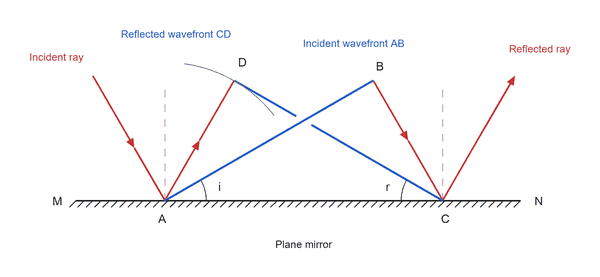
Step 3 — Identify the angles i and r.
The incident ray is perpendicular to AB and the normal is perpendicular to MN, so the angle between AB and the mirror equals the angle of incidence: . In the same way, the reflected ray is perpendicular to CD, so the angle between CD and the mirror equals the angle of reflection: .
Step 4 — Compare the two right triangles.
In triangle ABC the angle at B is , because the ray BC is perpendicular to the wavefront AB. In triangle CDA the angle at D is , because a tangent is perpendicular to the radius AD. So we can write the sines of and .
Step 5 — Use BC = AD.
Both distances equal , and AC is common to the two triangles, so the two sines are equal.
(The triangles ABC and CDA are congruent by the RHS rule, which gives the same result.) The incident ray, the reflected ray and the normal all lie in the plane of the figure, which is the other law of reflection.
Therefore, Huygens' construction gives sin i = sin r for every point of the wavefront, so the angle of reflection is equal to the angle of incidence, r = i.
- 23 marks
Board paper question 2
Derive Snell's law of refraction using Huygen's wave theory.
Solve with AIWritten solution
Solution:
Key idea: By Huygens' principle, every point on a wavefront acts as a source of secondary wavelets, which spread out in all directions with the speed of the wave in that medium. The forward envelope (common tangent) of these wavelets after a time is the new wavefront. A ray is the direction of travel of the wave and is always perpendicular to the wavefront.
We find the refracted wavefront by Huygens' construction and compare the angles the two wavefronts make with the surface. The diagram is in Step 2.
Step 1 — Set up the incident wavefront.
A plane wavefront AB travels in medium 1 (speed ) and falls obliquely on the surface XY of medium 2 (speed , with for a denser medium). Its end A touches the surface at . Let be the time the disturbance at B takes to reach the surface at C.
Step 2 — Draw the secondary wavelet from A.
From , point A sends a secondary wavelet into medium 2, where light travels with speed . In time this wavelet becomes a hemisphere of radius about A.
The tangent CD, drawn from C to this wavelet, touches the wavelets from all points between A and C, so CD is the refracted wavefront.
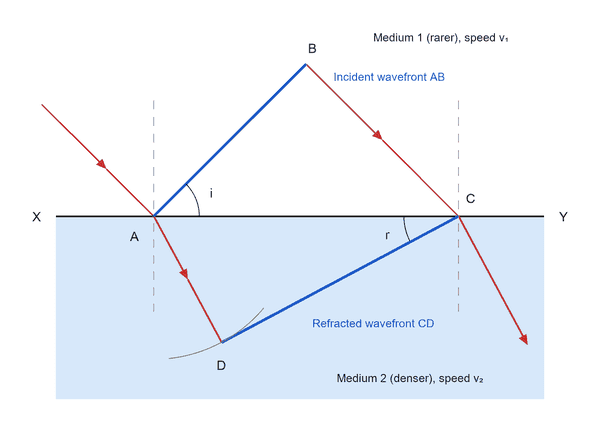
Step 3 — Identify the angles i and r.
The incident ray is perpendicular to AB and the normal is perpendicular to XY, so the angle between AB and the surface is the angle of incidence: . The refracted ray is perpendicular to CD, so the angle between CD and the surface is the angle of refraction: .
Step 4 — Write sin i and sin r from the right triangles.
Triangle ABC has a right angle at B (ray BC is perpendicular to wavefront AB), and triangle CDA has a right angle at D (tangent CD is perpendicular to radius AD). AC is the hypotenuse of both.
Step 5 — Divide the two sines.
The common side AC cancels, and so does the time .
Step 6 — Conclude that the ratio is a constant.
For a given pair of media and a given colour of light, and are fixed, so the ratio is a constant. This constant is the refractive index of medium 2 with respect to medium 1.
The incident ray, the refracted ray and the normal all lie in the plane of the figure. This is Snell's law. Since , , so the ray bends towards the normal in the denser medium.
Therefore, Huygens' construction gives sin i / sin r = v₁/v₂, a constant for the two media (the refractive index ₁n₂), which is Snell's law of refraction.
- 31 mark
Board paper question 3
When a light wave travels from air to glass :
Solve with AIAnswer
- Correct
(A) its wavelength decreases
(B) its wavelength increases
(C) there is no change in wavelength
(D) its frequency decreases.
Answer: (A) its wavelength decreases
Key idea: The frequency of light is fixed by its source and does not change when the light crosses into another medium. Speed, wavelength and frequency are linked by , so the wavelength changes in the same ratio as the speed.
Step 1 — Compare the speeds.
Light travels more slowly in glass than in air. If the refractive index of glass is , the speed in glass is .
Step 2 — Find the new wavelength.
The frequency stays the same, so the wavelength falls in proportion to the speed.
For example, light of wavelength in air has a wavelength of in glass of refractive index .
Why the others are wrong:
- (B) The wavelength would increase only if the light went into a medium where it travels faster, such as from glass into air.
- (C) Only the frequency stays the same; since the speed changes, the wavelength must change too.
- (D) The frequency is set by the source, and refraction does not change it.
Therefore, when light goes from air to glass its wavelength decreases, option (A).
- 41 mark
Board paper question 4
With what type of source of light are cylindrical wave fronts associated ?
Solve with AIWritten solution
Solution:
Key idea: A wavefront is the surface through all points that vibrate in the same phase. Its shape depends on the shape of the source: light spreading out from a line travels equally in all directions perpendicular to that line.
Step 1 — Think about the spreading of light from a line.
After a time , light from every point of a long line source has gone the same distance outwards, perpendicular to the line. All points at this distance from the line lie on a cylinder whose axis is the line.
Step 2 — Name the source.
So cylindrical wavefronts come from a linear source, such as a narrow illuminated slit or a long straight filament.
Therefore, cylindrical wavefronts are associated with a line (linear) source of light, such as an illuminated slit.
- 55 marks
Board paper question 5
(i) Using Huygen's wave theory, derive Snell's law of refraction.
(ii) With the help of an experiment, state how will you identify whether a given beam of light is polarised or unpolarised.
Solve with AIWritten solution
Solution:
Key idea: By Huygens' principle, every point on a wavefront acts as a source of secondary wavelets, which spread out in all directions with the speed of the wave in that medium. The forward envelope (common tangent) of these wavelets after a time is the new wavefront. A ray is the direction of travel of the wave and is always perpendicular to the wavefront.
Part (i): derivation of Snell's law. We find the refracted wavefront by Huygens' construction and compare the angles the wavefronts make with the surface.
Step 1 — Set up the incident wavefront.
A plane wavefront AB travels in medium 1 (speed ) and falls obliquely on the surface XY of medium 2 (speed , with for a denser medium). Its end A touches the surface at . Let be the time the disturbance at B takes to reach the surface at C.
Step 2 — Draw the secondary wavelet from A.
From , point A sends a secondary wavelet into medium 2, where light travels with speed . In time this wavelet becomes a hemisphere of radius about A.
The tangent CD, drawn from C to this wavelet, touches the wavelets from all points between A and C, so CD is the refracted wavefront.
Step 3 — Identify the angles i and r.
The incident ray is perpendicular to AB and the normal is perpendicular to XY, so the angle between AB and the surface is the angle of incidence: . The refracted ray is perpendicular to CD, so the angle between CD and the surface is the angle of refraction: .
Step 4 — Write sin i and sin r from the right triangles.
Triangle ABC has a right angle at B (ray BC is perpendicular to wavefront AB), and triangle CDA has a right angle at D (tangent CD is perpendicular to radius AD). AC is the hypotenuse of both.
Step 5 — Divide the two sines.
The common side AC cancels, and so does the time .
Step 6 — Conclude that the ratio is a constant.
For a given pair of media and a given colour of light, and are fixed, so the ratio is a constant. This constant is the refractive index of medium 2 with respect to medium 1.
The incident ray, the refracted ray and the normal all lie in the plane of the figure. This is Snell's law. Since , , so the ray bends towards the normal in the denser medium.
Step 7 — Part (ii): test the beam with a polaroid.
We place a polaroid (used as an analyser) in the path of the beam and look at the light that comes through it, while slowly rotating the polaroid through a full turn about the direction of the beam.
Step 8 — Read the result.
If the brightness of the transmitted light stays the same at every position of the polaroid, the beam is unpolarised, because its vibrations are equally strong in all directions perpendicular to the beam. If the brightness changes, becoming a maximum and then falling to zero twice in one full rotation, the beam is plane-polarised: its vibrations are in one plane only, and the polaroid blocks them completely when its transmission axis is perpendicular to that plane. (If the brightness changes but never falls to zero, the beam is partially polarised.)
Therefore, (i) Huygens' construction gives sin i / sin r = v₁/v₂, a constant (Snell's law); (ii) on rotating a polaroid in the beam, unchanged brightness means unpolarised light, while brightness that falls to zero twice per rotation means plane-polarised light.
- 63 marks
Board paper question 6
Derive the law of reflection using Huygens's wave theory.
Solve with AIWritten solution
Solution:
Key idea: By Huygens' principle, every point on a wavefront acts as a source of secondary wavelets, which spread out in all directions with the speed of the wave in that medium. The forward envelope (common tangent) of these wavelets after a time is the new wavefront. A ray is the direction of travel of the wave and is always perpendicular to the wavefront.
We find the reflected wavefront by Huygens' construction and compare the angles the incident and reflected wavefronts make with the mirror. The diagram is in Step 2.
Step 1 — Set up the incident wavefront.
A plane wavefront AB falls obliquely on a plane mirror MN. Its end A has just touched the mirror at time , while the end B still has to travel a distance BC to reach the mirror at C. Let be the speed of light and the time taken by the disturbance at B to reach C.
Step 2 — Draw the secondary wavelet from A.
From , point A sends out a secondary wavelet. The reflected light travels back in the same medium, so in time this wavelet becomes a hemisphere of radius about A.
Points of the mirror between A and C are reached one after another and send out smaller wavelets. The tangent CD, drawn from C to the wavelet about A, touches all of them, so CD is the reflected wavefront.
Step 3 — Identify the angles i and r.
The incident ray is perpendicular to AB and the normal is perpendicular to MN, so the angle between AB and the mirror equals the angle of incidence: . In the same way, the reflected ray is perpendicular to CD, so the angle between CD and the mirror equals the angle of reflection: .
Step 4 — Compare the two right triangles.
In triangle ABC the angle at B is , because the ray BC is perpendicular to the wavefront AB. In triangle CDA the angle at D is , because a tangent is perpendicular to the radius AD. So we can write the sines of and .
Step 5 — Use BC = AD.
Both distances equal , and AC is common to the two triangles, so the two sines are equal.
(The triangles ABC and CDA are congruent by the RHS rule, which gives the same result.) The incident ray, the reflected ray and the normal all lie in the plane of the figure, which is the other law of reflection.
Therefore, Huygens' construction gives sin i = sin r for every point of the wavefront, so the angle of reflection is equal to the angle of incidence, r = i.
All 13 board paper questions for this chapter, solved the same way.
Class 12 Physics Ch 19 questions students ask
How many questions are there in Class 12 Physics Ch 19?
45 questions. Every one is solved step by step on this page.
Are these Class 12 Physics solutions free?
Yes. Every question and its full working is free to read, with no account needed.
Can I download the Class 12 Physics Ch 19 solutions as a PDF?
There is no PDF to download. Every solution is on this page instead, which means it is searchable, always the current syllabus, and readable on a phone. Use your browser's print option if you want it on paper.