
Opening your dashboard
Class 12 Physics Chapter 19 Wave Optics - Huygens' Principle: Competency-Based Questions (CBQ)
40 questions on Chapter 19, each worked through on its own page with the AI tutor. Class 12 Physics, ICSE 2026-27.
40 questions
1–5 marks · Mixed difficulty
- 13 marks
Question 1
Competency: Application
A student measures the speed of microwaves with a kitchen microwave oven. The label on the oven gives the frequency of its microwaves as . She removes the turntable, so that the food cannot rotate, covers a flat plate with a thin layer of grated cheese and heats it for about . A standing wave forms inside the oven, and the cheese melts first at its antinodes, which are half a wavelength apart. Along one straight row of melted spots, the distance between the centres of the first and the fifth spot is . Each spot centre can be located only to about . (Hypothetical data.)
(a) Find the wavelength of the microwaves.
(b) Find the speed of the microwaves.
(c) The measured could be wrong by up to either way. Find the range of speeds her data allow. Does her result agree with the speed of light, , and what does this suggest about light?
- 21 mark
Question 2
Competency: Analysis & Evaluation
A space probe far from the Earth sends out a short pulse of radio waves and a short pulse of visible laser light at the same instant. Both pulses travel to the Earth through empty space.
Assertion (A): The two pulses reach the Earth at the same instant.
Reason (R): In a vacuum, an electromagnetic wave of higher frequency travels faster than one of lower frequency.
- 31 mark
Question 3
Competency: Application
A satellite navigation (GPS) receiver works out its distance from each satellite by multiplying the travel time of the satellite's radio signal by the speed of light, . The signal travels only one way, from the satellite to the receiver. If the receiver's value of the travel time is wrong by , its distance from that satellite is wrong by about
- 44 marks
Question 4
Competency: Application
A laser beam can be steered through a small angle with a thin glass wedge. In the wedge shown, the front face is flat and vertical, the wedge is high, and its thickness grows steadily from at the top to at the bottom. The glass has refractive index . A plane wavefront of laser light falls normally on the front face. (Hypothetical data.)
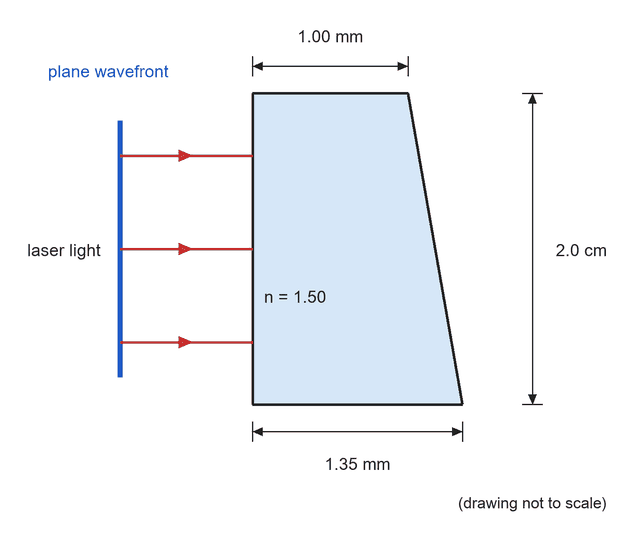
(a) Using the idea of a wavefront, explain why the beam leaves the wedge in a slightly different direction.
(b) When the wavefront has completely left the wedge, by what distance (measured in air) does the part that crossed the thick bottom edge lag behind the part that crossed the thin top edge?
(c) Find the angle through which the beam is turned, and say which way it turns. How far does the laser spot move on a screen away?
- 51 mark
Question 5
Competency: Analysis & Evaluation
A builder's laser level sends its narrow, parallel laser beam through a short glass rod whose axis is horizontal and at right angles to the beam. The rod spreads the light out into a thin vertical fan, which draws a straight vertical line on a wall, as shown in the side view.

Assertion (A): Beyond the rod, the wavefronts of this light are approximately cylindrical, not spherical.
Reason (R): The refractive index of the glass of the rod is greater than that of air.
- 61 mark
Question 6
Competency: Application
A laser pointer sends a narrow parallel beam (plane wavefronts) along the principal axis of a thin concave lens of focal length . A small light sensor P is placed on the axis beyond the lens, as shown.
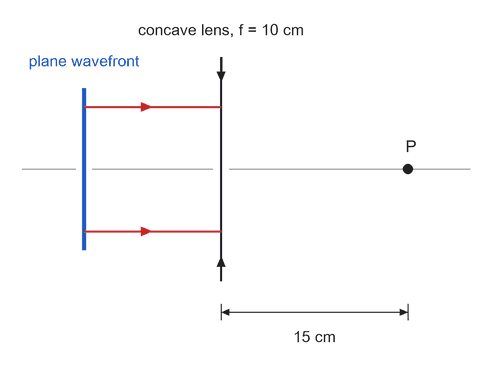
Treating the lens as ideal, the wavefronts of the light as they reach P are
- 71 mark
Question 7
Competency: Analysis & Evaluation
Light from a distant star arrives at the top of the Earth's atmosphere as a plane wavefront. Lower down, moving pockets of warmer and cooler air, with slightly different refractive indices, drift across its path. Through a telescope the star's image jumps about and keeps changing in brightness ("twinkles"). Which statement explains this best in terms of wavefronts and rays?
- 84 marks
Question 8
Competency: Application
On a hot, sunny afternoon the air just above a dark road is much hotter than the air higher up. A driver sees what looks like a pool of water on the road far ahead; it is really light from the sky. In a simple model, the refractive index of the air increases steadily from at the road surface (air at about ) to at a height of (air at about ). Take . (Hypothetical data.)
(a) Using Huygens' principle, explain why light travelling almost horizontally just above the road curves upwards.
(b) A short vertical section of a wavefront stretches from the road surface to a height of . Find how much faster light travels at its bottom end than at its top end. While the top end moves forward , how much farther does the bottom end move? Hence find the angle (in radians) through which this section of the wavefront, and so the light, turns.
(c) In this model the light turns through the same angle for every it travels, so it follows a circular arc. Find the radius of this arc. A ray that is horizontal just at the road surface then curves up to the driver's eyes, above the road. Using height for a distance along a circular arc of radius , estimate how far ahead of the driver this ray skims the road.
- 93 marks
Question 9
Competency: Application
In some nuclear research reactors the core sits under deep water, and the water around it glows blue. Very fast electrons move through the water faster than light does in water, and give out light called Cherenkov radiation. Treat each point of an electron's path as a source of light wavelets, sent out at the instant the electron passes that point. Consider an electron moving in a straight line through water at . Take for water and . (Hypothetical data.)
(a) Find the speed of light in water and show that the electron is faster.
(b) The electron passes a point P and reaches a point Q later. Find the distance PQ, and the radius of the wavelet sent out from P at the instant the electron reaches Q.
(c) Using Huygens' principle, explain why the wavelets add up to a cone-shaped wavefront with its tip at the electron. Find the angle between the electron's path and the direction in which the light travels.
- 101 mark
Question 10
Competency: Analysis & Evaluation
A wide parallel beam passes obliquely from air into glass (). In a Huygens construction, end A of a plane wavefront AB touches the glass first, end B reaches it at D, and DC is the refracted wavefront touching the wavelet from A at C.
Assertion (A): The refracted wavefront DC is shorter than AB, so the beam is narrower in the glass.
Reason (R): Light travels more slowly in glass than in air.
- 111 mark
Question 11
Competency: Analysis & Evaluation
Far out at sea, ocean waves often travel towards a straight beach at an angle, yet close to the shore their crests are almost parallel to the beach. Water waves travel more slowly in shallower water, and the water gets shallower towards the beach. Which explanation, based on Huygens' principle, is correct?
- 123 marks
Question 12
Competency: Application
Two plane mirrors and are joined along an edge O, at right angles to each other, like two faces of the corner-cube reflectors that astronauts left on the Moon. A ray of light, travelling in the plane at right angles to both mirrors, strikes at P with an angle of incidence of , as shown.

(a) Using the laws of reflection, find the angle of incidence of the ray on .
(b) Show that the ray finally leaving is parallel to the incident ray but travels in the opposite direction, whatever the angle of incidence on (as long as the ray strikes both mirrors).
(c) A short laser pulse sent from an observatory returns from a corner-cube reflector on the Moon after it was sent. Taking , find the distance of the reflector. Why is a corner reflector used rather than a single flat mirror? (Hypothetical data.)
- 131 mark
Question 13
Competency: Analysis & Evaluation
A smooth mirror shows a clear image of a lamp, but a wall painted with matt paint does not, even when the lamp lights it brightly.
Assertion (A): A matt painted wall reflects light without forming a clear image, although each tiny part of its surface obeys the laws of reflection.
Reason (R): The surface is rough on the scale of the wavelength of light, so the secondary wavelets from its different points are delayed by different amounts and do not combine into one plane reflected wavefront.
- 141 mark
Question 14
Competency: Analysis & Evaluation
The figure shows a Huygens construction for the reflection of a plane wavefront AB at a plane mirror. End A touches the mirror first. While end B travels to the mirror at D, a secondary wavelet from A spreads to a radius AC, and DC is the reflected wavefront, touching this wavelet at C.
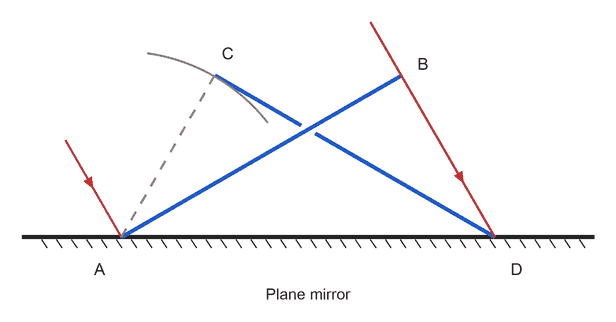
Assertion (A): The reflected wavefront DC has the same length as the incident wavefront AB.
Reason (R): The frequency of the light does not change on reflection.
- 151 mark
Question 15
Competency: Application
A solar furnace uses flat mirrors (heliostats) to send sunlight horizontally onto a large concave mirror. At one moment the Sun is above the horizon, in the same vertical plane as a heliostat M and the concave mirror, with the Sun on the side of M away from the concave mirror, as shown.

The angle of incidence of the sunlight on the heliostat must be
- 163 marks
Question 16
Competency: Application
In a ripple tank, a thick glass plate makes the water shallow over one part of the tank; the edge of the plate is a straight line. Straight waves of frequency travel at in the deep water and at over the plate. In the deep water the crests meet the edge of the plate at , as shown in the top view. (Hypothetical data.)
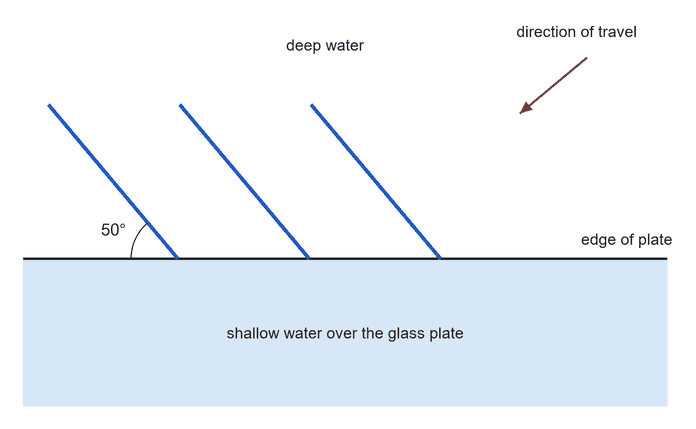
(a) Find the wavelength in the deep water and over the plate.
(b) Using a Huygens construction, find the angle between the crests and the edge of the plate in the shallow water.
(c) A student says the frequency over the plate must be lower than because the waves are slower there. Explain why she is wrong.
- 173 marks
Question 17
Competency: Application
A swimming pool has a small lamp L fixed on its floor, below the still surface of the water, as shown. At night, seen from above, light comes out of the water only through a bright circle on the surface directly above the lamp. Take for water and . (Hypothetical data.)
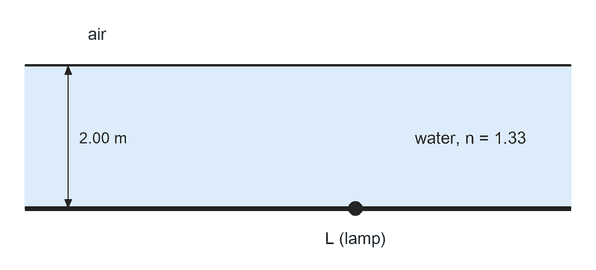
(a) Find the speed of light in the water. Using the Huygens result , find the largest angle of incidence at the surface for which light from L can still leave the water.
(b) Find the radius of the bright circle.
(c) A diver whose eye is at L looks straight up. Within what half-angle about the vertical does the diver see the whole sky above the water? Explain.
- 181 mark
Question 18
Competency: Analysis & Evaluation
A cut diamond () sparkles brilliantly in air, mainly because much of the light entering its top is totally internally reflected inside it and comes back out through the top. When the same diamond is dropped into a glass of water (), it sparkles much less.
Assertion (A): Under water, much less of the light inside the diamond is totally internally reflected than in air.
Reason (R): For light inside diamond, the critical angle at a diamond–water surface (about ) is larger than at a diamond–air surface (about ).
- 191 mark
Question 19
Competency: Analysis & Evaluation
A narrow beam of light passes obliquely out of a glass block () into the water () in which the block is standing.
Assertion (A): The beam bends away from the normal as it passes from the glass into the water.
Reason (R): Light travels faster in glass than in water.
- 201 mark
Question 20
Competency: Analysis & Evaluation
A lamp and a loudspeaker hang above a calm pond. Light travels at in air and in water; sound travels at in air and in water. Both the light and the sound strike the water surface at an angle of incidence of . Huygens' construction applies to both kinds of wave. Which statement is correct?
- 214 marks
Question 21
Competency: Application
A step-index optical fibre has a glass core of refractive index surrounded by a cladding of refractive index . A very short pulse of light is sent into a length of the fibre. Part of the light travels straight along the axis; part follows zig-zag paths, and the steepest of these meets the core–cladding boundary at exactly the critical angle , as shown. Take . (Hypothetical data.)
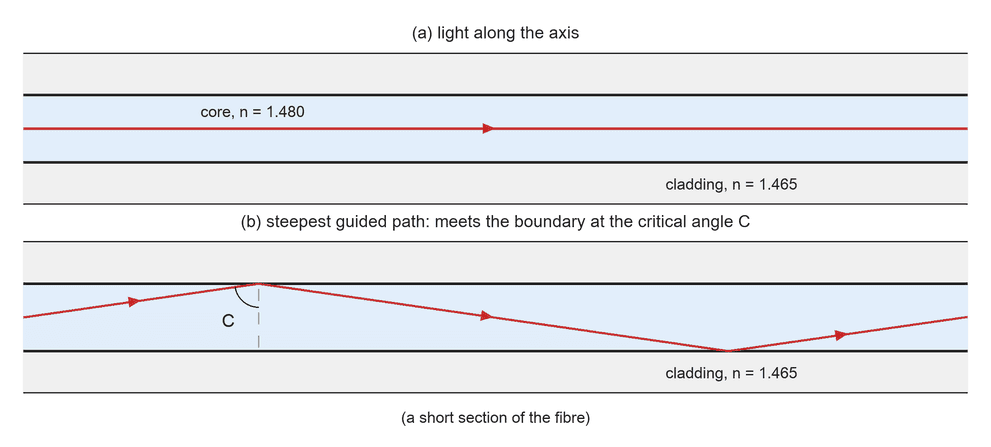
(a) Find the speed of light in the core and the time the axial light takes to travel .
(b) Find the critical angle at the core–cladding boundary.
(c) Show that, along a length of fibre, the steepest guided path has a length . Hence find how much later this light arrives than the axial light, and explain why this limits how many separate pulses can be sent each second.
- 223 marks
Question 22
Competency: Application
An airport radar sends out microwaves of frequency . Its rotating aerial is protected by a dome (a radome) with a solid plastic wall, whose refractive index for these microwaves is . The wall lets the waves through with the least reflection when its thickness is exactly half a wavelength of the waves inside the plastic. Take , and take the waves to cross the wall at right angles. (Hypothetical data.)
(a) Find the wavelength of the microwaves in air and in the plastic.
(b) Find the thickness of a half-wave wall, and the optical path of the waves through it.
(c) The radar is changed to work at . Is the old wall still half a wavelength thick? Find the wall thickness needed now.
- 231 mark
Question 23
Competency: Analysis & Evaluation
A diver under water looks at a red lamp on a buoy. In air the lamp's light has a wavelength of . In the water () its wavelength is about , which in air would be the wavelength of blue-green light.
Assertion (A): The diver sees the lamp as blue-green.
Reason (R): The wavelength of light in water is shorter than in air.
- 241 mark
Question 24
Competency: Application
Scientists measure the thickness of an ice sheet with ice-penetrating radar. A short radio pulse is sent straight down from the ice surface; it reflects from the rock beneath the ice and is picked up back at the surface after it was sent. The refractive index of the ice for these radio waves is . Take . (Hypothetical data.) The thickness of the ice is about
- 251 mark
Question 25
Competency: Analysis & Evaluation
In a classroom demonstration, a clear Pyrex glass rod is lowered into a beaker of vegetable oil, and the part of the rod under the oil almost disappears from view. The glass and the oil both have a refractive index of about . Which statement explains this best?
- 263 marks
Question 26
In a Huygens construction, and are two points apart on a plane wavefront. Secondary wavelets of radius are drawn from them. The two wavelets cross at , and the line is their common tangent ahead of the wavefront, as shown.

(i) Find how far lies behind the line .
(ii) Find this distance again if the two points were only apart.
(iii) Use your answers to explain why the new wavefront is taken as the envelope , and state why, according to Fresnel, light is found on the envelope and not elsewhere.
- 273 marks
Question 27
Light of wavelength in air falls on a plane mirror at an angle of incidence of . Think of the crests of the incident plane wave as a set of parallel wavefronts one wavelength apart. The figure shows three crests meeting the mirror at , and .
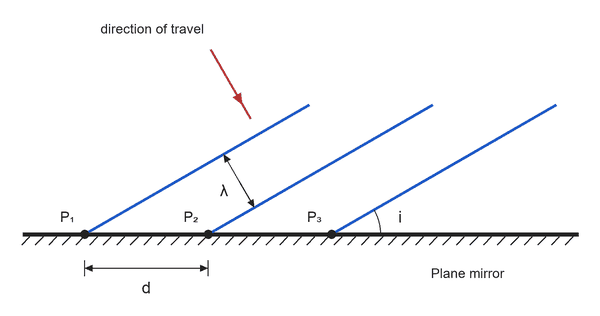
(a) Show that successive crests meet the mirror along lines a distance apart, and find .
(b) Find the speed with which the line where one crest meets the mirror moves along the mirror. Does this speed break any physical law?
(c) In Huygens' construction each point of the mirror starts its reflected wavelet when the incident crest arrives there. So the reflected crests meet the mirror along the same lines, moving at the same speed . Use this to show that the angle of reflection equals the angle of incidence.
- 283 marks
Question 28
(Hypothetical data.) A point source S, in front of a large plane mirror, gives out a very short flash of light at . Take .
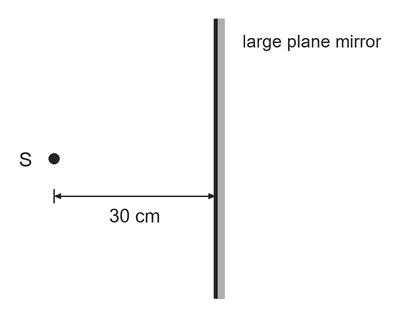
(a) At what time does the wavefront first reach the mirror?
(b) At part of the wavefront has been reflected. Using Huygens' principle, find the centre and the radius of the reflected wavefront, and where it crosses the perpendicular line from S to the mirror.
(c) At , how far from the foot O of that perpendicular do the incident and reflected wavefronts meet the mirror?
- 294 marks
Question 29
A plane wavefront travelling inside a glass block () reaches the flat glass–air surface. End A of the wavefront touches the surface first, and the other end B reaches the surface at D. The distance AD is . The figure shows the case .

(a) For an angle of incidence of , use Huygens' construction to find BD, the radius AC of the secondary wavelet from A in the air, and the angle of refraction.
(b) Repeat the construction for an angle of incidence of . What does it show?
(c) Find the largest angle of incidence for which a refracted wavefront can be drawn.
- 303 marks
Question 30
Light of wavelength 550 nm in vacuum passes through a piece of crown glass of refractive index 1.52. Find the velocity and frequency of light in crown glass.
- 315 marks
Question 31
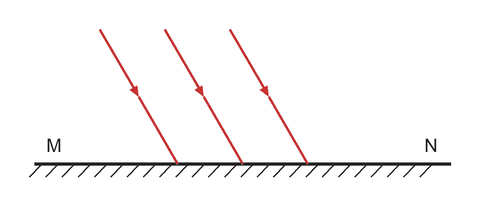
State Huygens' principle. Using this principle illustrate how a parallel beam of light is reflected from a plane mirror. Prove the laws of reflection.
- 325 marks
Question 32
State Huygens' principle. Use it to derive Snell's law of refraction for a parallel beam incident on the plane surface of a refractive medium. The proper diagram must also be drawn.

- 331 mark
Question 33
Competency: Analysis
A survey ship S measures the depth of the sea with an echo sounder. The sounder sends a short pulse of sound downwards in a wide cone, reaching up to on every side of the vertical, and it times the first echo that comes back. It then shows the depth as , where is the time of the first echo and is the speed of sound in sea water. Here the seabed is a flat slope rising at to the horizontal, and the point V of the seabed vertically below the ship is deep, as shown. Huygens' construction, and so the law of reflection, applies to sound waves just as it does to light. (Hypothetical data.)
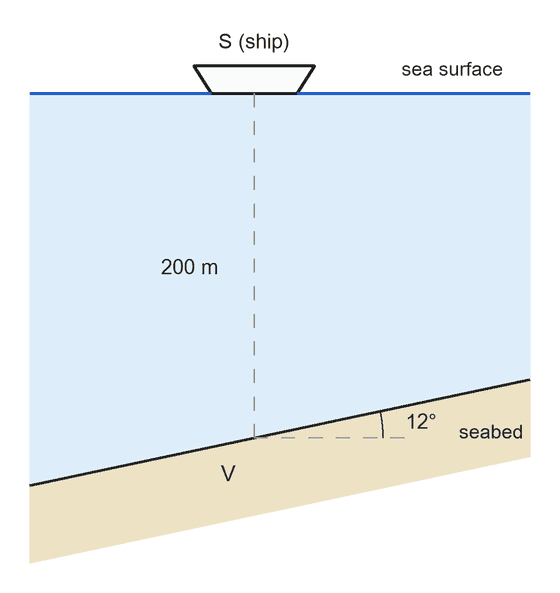
Which statement about the first echo is correct?
- 341 mark
Question 34
Competency: Analysis & Evaluation
Large astronomical telescopes collect and focus starlight with a concave mirror rather than a lens. When starlight is focused by a single glass lens instead, the image of a star has faint coloured edges.
Assertion (A): A concave mirror brings all the colours of starlight to the same focus, but a single glass lens does not.
Reason (R): In Huygens' construction for reflection, the incident and the reflected wavelets travel in the same medium at the same speed, so the angle of reflection equals the angle of incidence for every colour.
- 351 mark
Question 35
Competency: Application
A service robot turns its head towards a person who calls it. Two microphones, on the left and on the right, are fixed apart on a horizontal line across the robot's face. The person stands in front of the robot, at the height of the microphones, and far away compared with . A sharp clap from the person reaches first and reaches later. "Straight ahead" means at right angles to the line . Take the speed of sound in the air as . (Hypothetical data.)
In which direction is the person?
- 362 marks
Question 36
Competency: Evaluation
Two stock exchanges are apart in a straight line. Orders can be sent between them along an optical fibre that follows roads and railway lines, long, whose glass core has a refractive index of . They can also be sent by a chain of microwave towers, whose signal travels through air of refractive index . Take , and take each signal to travel at in its medium. (Hypothetical data.)
(a) Using optical paths, find the one-way travel time by each route. Which route is faster, and by how much?
(b) An engineer claims that a new, perfectly straight fibre between the exchanges would make the fibre route faster than the microwave route. Is the engineer right? Justify your answer with a calculation.
- 373 marks
Question 37
Competency: Analysis
During a festival, a firework bursts with a loud bang at a point P just above flat, open ground. A steady wind blows from west to east at , and it is the same at all heights near the ground. Sound travels at relative to the air. In Huygens' principle, each point of a sound wavefront sends out secondary wavelets that spread at relative to the air, while the moving air carries the wavelets along with it. Three listeners stand on the ground from P: A to the east of P, B to the west and C to the north. (Hypothetical data.)
(a) Use Huygens' principle to show that, seconds after the bang, the wavefront is a sphere of radius metres whose centre is metres east of P. Give the radius and the position of the centre at .
(b) Find when the bang reaches A and when it reaches B.
(c) Find when the bang reaches C, and compare this with the time the bang would take to travel in still air.
- 383 marks
Question 38
Competency: Creativity
A medical endoscope needs a tiny lens that is flat on both faces. One design is a thin glass disc, thick, whose refractive index is largest on its axis and becomes smaller towards its rim, but does not change along the axis. In one disc the refractive index is on the axis and at a distance from the axis, which is the edge of the part that is used. A plane wavefront falls normally on the disc. Treat the disc as thin, so that the light crosses it parallel to the axis. For a spherical wavefront of radius , the middle and the points at a distance from the axis are about apart along the axis, when this is much smaller than . (Hypothetical data.)
(a) Using the idea of a wavefront, explain why the light leaving the disc converges to a focus, even though both faces of the disc are flat.
(b) Find the optical path through the disc along the axis and at from the axis, and hence find the focal length of the disc.
(c) Design a disc of the same thickness, with a refractive index of on its axis, that focuses at . What refractive index is needed at from the axis? How must the refractive index fall with the distance from the axis, so that light passing at every distance up to meets at the same focus?
- 392 marks
Question 39
Competency: Application
During an ultrasound scan, a narrow beam of ultrasound passes from a layer of fat into muscle, meeting the flat boundary between them at an angle of incidence of . Ultrasound travels at about in fat and about in muscle. Huygens' construction applies to ultrasound just as it does to light, so . (Hypothetical data.)
(a) Find the angle of refraction in the muscle. Does the beam bend towards or away from the normal? Explain using the secondary wavelets.
(b) The scanner draws its picture as if the beam had gone straight on without bending. A small cyst lies on the real beam, beyond the boundary, measured at right angles to the boundary. Taking the scanner to show the cyst on the straight-on line at the same distance from the boundary, how far sideways from its true position does it show the cyst?
- 404 marks
Question 40
Competency: Analysis & Evaluation
A fruit-juice factory checks the sugar content of its syrup by measuring the syrup's refractive index. The table gives the refractive index of solutions of sugar (sucrose) in water at , for yellow sodium light of wavelength in vacuum. In one check, a narrow beam of this light strikes the flat, still surface of a syrup sample from the air at an angle of incidence of , and the refracted beam in the syrup is measured to make with the normal. The angles can be read only to within . Take the refractive index of air as , and assume that the refractive index changes linearly between neighbouring values in the table. (Hypothetical data for the sample.)
Sugar in the solution, by mass (%) 0 10 20 30 40 Refractive index 1.333 1.348 1.364 1.381 1.400 (a) Using Huygens' principle, explain why, for the same angle of incidence, the beam bends more towards the normal in a syrup that contains more sugar.
(b) Find the refractive index of the sample, the speed of light in it, and its sugar content.
(c) The angle of refraction could be wrong by up to either way. Find the range of sugar content that this allows. A manager claims that this check can tell apart two syrups whose sugar contents differ by . Is the claim justified?