
Question 23 marksAsked 2016Medium
Derive Snell's law of refraction using Huygen's wave theory.
Confirming your payment
Sign up now and get 250 free tokens.
Previous Year Questions · Question 2 of 13
Derive Snell's law of refraction using Huygen's wave theory.
Solution:
Key idea: By Huygens' principle, every point on a wavefront acts as a source of secondary wavelets, which spread out in all directions with the speed of the wave in that medium. The forward envelope (common tangent) of these wavelets after a time is the new wavefront. A ray is the direction of travel of the wave and is always perpendicular to the wavefront.
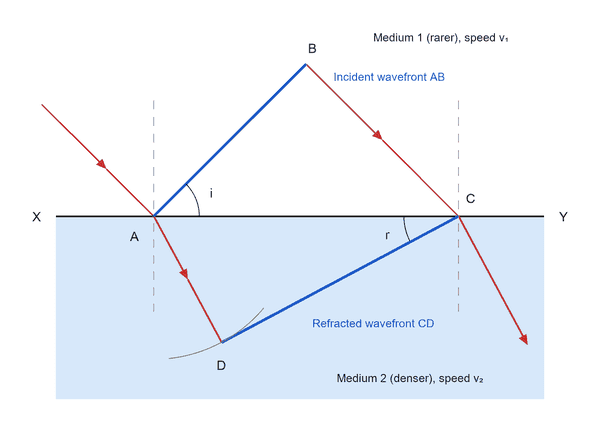
We find the refracted wavefront by Huygens' construction and compare the angles the two wavefronts make with the surface. The diagram is in Step 2.
Step 1 — Set up the incident wavefront.
A plane wavefront AB travels in medium 1 (speed ) and falls obliquely on the surface XY of medium 2 (speed , with for a denser medium). Its end A touches the surface at . Let be the time the disturbance at B takes to reach the surface at C.
Step 2 — Draw the secondary wavelet from A.
From , point A sends a secondary wavelet into medium 2, where light travels with speed . In time this wavelet becomes a hemisphere of radius about A.
The tangent CD, drawn from C to this wavelet, touches the wavelets from all points between A and C, so CD is the refracted wavefront.
Step 3 — Identify the angles i and r.
The incident ray is perpendicular to AB and the normal is perpendicular to XY, so the angle between AB and the surface is the angle of incidence: . The refracted ray is perpendicular to CD, so the angle between CD and the surface is the angle of refraction: .
Step 4 — Write sin i and sin r from the right triangles.
Triangle ABC has a right angle at B (ray BC is perpendicular to wavefront AB), and triangle CDA has a right angle at D (tangent CD is perpendicular to radius AD). AC is the hypotenuse of both.
Step 5 — Divide the two sines.
The common side AC cancels, and so does the time .
Step 6 — Conclude that the ratio is a constant.
For a given pair of media and a given colour of light, and are fixed, so the ratio is a constant. This constant is the refractive index of medium 2 with respect to medium 1.
The incident ray, the refracted ray and the normal all lie in the plane of the figure. This is Snell's law. Since , , so the ray bends towards the normal in the denser medium.
Therefore, Huygens' construction gives sin i / sin r = v₁/v₂, a constant for the two media (the refractive index ₁n₂), which is Snell's law of refraction.