
Opening your dashboard
Class 12 Physics Chapter 19 Wave Optics - Huygens' Principle: Previous Year Questions
13 questions on Chapter 19, each solved step by step. Class 12 Physics, ICSE 2026-27.
13 questions with solutions
1–5 marks · Mixed difficulty
- 14 marks
Question 1
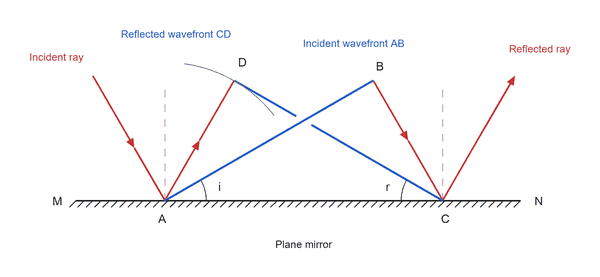
On the basis of Huygen's Wave theory of light, show that angle of reflection is equal to angle of incidence. You must draw a labelled diagram for this derivation.
Solve with AIWritten solution
Solution:
Key idea: By Huygens' principle, every point on a wavefront acts as a source of secondary wavelets, which spread out in all directions with the speed of the wave in that medium. The forward envelope (common tangent) of these wavelets after a time is the new wavefront. A ray is the direction of travel of the wave and is always perpendicular to the wavefront.
We find the reflected wavefront by Huygens' construction, then compare the angles it makes with the mirror. The labelled diagram is in Step 2.
Step 1 — Set up the incident wavefront.
A plane wavefront AB falls obliquely on a plane mirror MN. Its end A has just touched the mirror at time , while the end B still has to travel a distance BC to reach the mirror at C. Let be the speed of light and the time taken by the disturbance at B to reach C.
Step 2 — Draw the secondary wavelet from A.
From , point A sends out a secondary wavelet. The reflected light travels back in the same medium, so in time this wavelet becomes a hemisphere of radius about A.
Points of the mirror between A and C are reached one after another and send out smaller wavelets. The tangent CD, drawn from C to the wavelet about A, touches all of them, so CD is the reflected wavefront.
Step 3 — Identify the angles i and r.
The incident ray is perpendicular to AB and the normal is perpendicular to MN, so the angle between AB and the mirror equals the angle of incidence: . In the same way, the reflected ray is perpendicular to CD, so the angle between CD and the mirror equals the angle of reflection: .
Step 4 — Compare the two right triangles.
In triangle ABC the angle at B is , because the ray BC is perpendicular to the wavefront AB. In triangle CDA the angle at D is , because a tangent is perpendicular to the radius AD. So we can write the sines of and .
Step 5 — Use BC = AD.
Both distances equal , and AC is common to the two triangles, so the two sines are equal.
(The triangles ABC and CDA are congruent by the RHS rule, which gives the same result.) The incident ray, the reflected ray and the normal all lie in the plane of the figure, which is the other law of reflection.
Therefore, Huygens' construction gives sin i = sin r for every point of the wavefront, so the angle of reflection is equal to the angle of incidence, r = i.
- 23 marks
Question 2
Derive Snell's law of refraction using Huygen's wave theory.
Solve with AIWritten solution
Solution:
Key idea: By Huygens' principle, every point on a wavefront acts as a source of secondary wavelets, which spread out in all directions with the speed of the wave in that medium. The forward envelope (common tangent) of these wavelets after a time is the new wavefront. A ray is the direction of travel of the wave and is always perpendicular to the wavefront.
We find the refracted wavefront by Huygens' construction and compare the angles the two wavefronts make with the surface. The diagram is in Step 2.
Step 1 — Set up the incident wavefront.
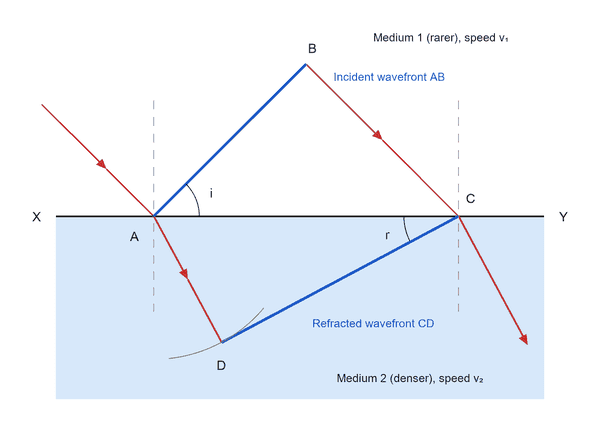
A plane wavefront AB travels in medium 1 (speed ) and falls obliquely on the surface XY of medium 2 (speed , with for a denser medium). Its end A touches the surface at . Let be the time the disturbance at B takes to reach the surface at C.
Step 2 — Draw the secondary wavelet from A.
From , point A sends a secondary wavelet into medium 2, where light travels with speed . In time this wavelet becomes a hemisphere of radius about A.
The tangent CD, drawn from C to this wavelet, touches the wavelets from all points between A and C, so CD is the refracted wavefront.
Step 3 — Identify the angles i and r.
The incident ray is perpendicular to AB and the normal is perpendicular to XY, so the angle between AB and the surface is the angle of incidence: . The refracted ray is perpendicular to CD, so the angle between CD and the surface is the angle of refraction: .
Step 4 — Write sin i and sin r from the right triangles.
Triangle ABC has a right angle at B (ray BC is perpendicular to wavefront AB), and triangle CDA has a right angle at D (tangent CD is perpendicular to radius AD). AC is the hypotenuse of both.
Step 5 — Divide the two sines.
The common side AC cancels, and so does the time .
Step 6 — Conclude that the ratio is a constant.
For a given pair of media and a given colour of light, and are fixed, so the ratio is a constant. This constant is the refractive index of medium 2 with respect to medium 1.
The incident ray, the refracted ray and the normal all lie in the plane of the figure. This is Snell's law. Since , , so the ray bends towards the normal in the denser medium.
Therefore, Huygens' construction gives sin i / sin r = v₁/v₂, a constant for the two media (the refractive index ₁n₂), which is Snell's law of refraction.
- 31 mark
Question 3
When a light wave travels from air to glass :
Solve with AIAnswer
- Correct
(A) its wavelength decreases
(B) its wavelength increases
(C) there is no change in wavelength
(D) its frequency decreases.
Answer: (A) its wavelength decreases
Key idea: The frequency of light is fixed by its source and does not change when the light crosses into another medium. Speed, wavelength and frequency are linked by , so the wavelength changes in the same ratio as the speed.
Step 1 — Compare the speeds.
Light travels more slowly in glass than in air. If the refractive index of glass is , the speed in glass is .
Step 2 — Find the new wavelength.
The frequency stays the same, so the wavelength falls in proportion to the speed.
For example, light of wavelength in air has a wavelength of in glass of refractive index .
Why the others are wrong:
- (B) The wavelength would increase only if the light went into a medium where it travels faster, such as from glass into air.
- (C) Only the frequency stays the same; since the speed changes, the wavelength must change too.
- (D) The frequency is set by the source, and refraction does not change it.
Therefore, when light goes from air to glass its wavelength decreases, option (A).
- 41 mark
Question 4
With what type of source of light are cylindrical wave fronts associated ?
Solve with AIWritten solution
Solution:
Key idea: A wavefront is the surface through all points that vibrate in the same phase. Its shape depends on the shape of the source: light spreading out from a line travels equally in all directions perpendicular to that line.
Step 1 — Think about the spreading of light from a line.
After a time , light from every point of a long line source has gone the same distance outwards, perpendicular to the line. All points at this distance from the line lie on a cylinder whose axis is the line.
Step 2 — Name the source.
So cylindrical wavefronts come from a linear source, such as a narrow illuminated slit or a long straight filament.
Therefore, cylindrical wavefronts are associated with a line (linear) source of light, such as an illuminated slit.
- 55 marks
Question 5
(i) Using Huygen's wave theory, derive Snell's law of refraction.
(ii) With the help of an experiment, state how will you identify whether a given beam of light is polarised or unpolarised.
Solve with AIWritten solution
Solution:
Key idea: By Huygens' principle, every point on a wavefront acts as a source of secondary wavelets, which spread out in all directions with the speed of the wave in that medium. The forward envelope (common tangent) of these wavelets after a time is the new wavefront. A ray is the direction of travel of the wave and is always perpendicular to the wavefront.
Part (i): derivation of Snell's law. We find the refracted wavefront by Huygens' construction and compare the angles the wavefronts make with the surface.
Step 1 — Set up the incident wavefront.
A plane wavefront AB travels in medium 1 (speed ) and falls obliquely on the surface XY of medium 2 (speed , with for a denser medium). Its end A touches the surface at . Let be the time the disturbance at B takes to reach the surface at C.
Step 2 — Draw the secondary wavelet from A.
From , point A sends a secondary wavelet into medium 2, where light travels with speed . In time this wavelet becomes a hemisphere of radius about A.
The tangent CD, drawn from C to this wavelet, touches the wavelets from all points between A and C, so CD is the refracted wavefront.
Step 3 — Identify the angles i and r.
The incident ray is perpendicular to AB and the normal is perpendicular to XY, so the angle between AB and the surface is the angle of incidence: . The refracted ray is perpendicular to CD, so the angle between CD and the surface is the angle of refraction: .
Step 4 — Write sin i and sin r from the right triangles.
Triangle ABC has a right angle at B (ray BC is perpendicular to wavefront AB), and triangle CDA has a right angle at D (tangent CD is perpendicular to radius AD). AC is the hypotenuse of both.
Step 5 — Divide the two sines.
The common side AC cancels, and so does the time .
Step 6 — Conclude that the ratio is a constant.
For a given pair of media and a given colour of light, and are fixed, so the ratio is a constant. This constant is the refractive index of medium 2 with respect to medium 1.
The incident ray, the refracted ray and the normal all lie in the plane of the figure. This is Snell's law. Since , , so the ray bends towards the normal in the denser medium.
Step 7 — Part (ii): test the beam with a polaroid.
We place a polaroid (used as an analyser) in the path of the beam and look at the light that comes through it, while slowly rotating the polaroid through a full turn about the direction of the beam.
Step 8 — Read the result.
If the brightness of the transmitted light stays the same at every position of the polaroid, the beam is unpolarised, because its vibrations are equally strong in all directions perpendicular to the beam. If the brightness changes, becoming a maximum and then falling to zero twice in one full rotation, the beam is plane-polarised: its vibrations are in one plane only, and the polaroid blocks them completely when its transmission axis is perpendicular to that plane. (If the brightness changes but never falls to zero, the beam is partially polarised.)
Therefore, (i) Huygens' construction gives sin i / sin r = v₁/v₂, a constant (Snell's law); (ii) on rotating a polaroid in the beam, unchanged brightness means unpolarised light, while brightness that falls to zero twice per rotation means plane-polarised light.
- 63 marks
Question 6
Derive the law of reflection using Huygens's wave theory.
Solve with AIWritten solution
Solution:
Key idea: By Huygens' principle, every point on a wavefront acts as a source of secondary wavelets, which spread out in all directions with the speed of the wave in that medium. The forward envelope (common tangent) of these wavelets after a time is the new wavefront. A ray is the direction of travel of the wave and is always perpendicular to the wavefront.
We find the reflected wavefront by Huygens' construction and compare the angles the incident and reflected wavefronts make with the mirror. The diagram is in Step 2.
Step 1 — Set up the incident wavefront.
A plane wavefront AB falls obliquely on a plane mirror MN. Its end A has just touched the mirror at time , while the end B still has to travel a distance BC to reach the mirror at C. Let be the speed of light and the time taken by the disturbance at B to reach C.
Step 2 — Draw the secondary wavelet from A.
From , point A sends out a secondary wavelet. The reflected light travels back in the same medium, so in time this wavelet becomes a hemisphere of radius about A.
Points of the mirror between A and C are reached one after another and send out smaller wavelets. The tangent CD, drawn from C to the wavelet about A, touches all of them, so CD is the reflected wavefront.
Step 3 — Identify the angles i and r.
The incident ray is perpendicular to AB and the normal is perpendicular to MN, so the angle between AB and the mirror equals the angle of incidence: . In the same way, the reflected ray is perpendicular to CD, so the angle between CD and the mirror equals the angle of reflection: .
Step 4 — Compare the two right triangles.
In triangle ABC the angle at B is , because the ray BC is perpendicular to the wavefront AB. In triangle CDA the angle at D is , because a tangent is perpendicular to the radius AD. So we can write the sines of and .
Step 5 — Use BC = AD.
Both distances equal , and AC is common to the two triangles, so the two sines are equal.
(The triangles ABC and CDA are congruent by the RHS rule, which gives the same result.) The incident ray, the reflected ray and the normal all lie in the plane of the figure, which is the other law of reflection.
Therefore, Huygens' construction gives sin i = sin r for every point of the wavefront, so the angle of reflection is equal to the angle of incidence, r = i.
- 71 mark
Question 7
what is the phase difference between any two points lying on the same wave front?
Solve with AIWritten solution
Solution:
Key idea: A wavefront is defined as the locus (surface) of all points of the medium that are vibrating in the same phase at a given instant.
Step 1 — Apply the definition.
Any two points on the same wavefront are, by definition, in the same phase of vibration.
Step 2 — State the phase difference.
Points in the same phase have no phase difference between them.
Therefore, the phase difference between any two points on the same wavefront is zero.
- 81 mark
Question 8
What type of wavefronts are associated with a source at infinity?
Solve with AIAnswer
(A) Cylindrical wavefronts
- Correct
(B) Plane wavefronts
(C) Spherical wavefronts
(D) All types of wavefronts
Answer: (B) Plane wavefronts
Key idea: Wavefronts from a point source are spheres, and from a line source they are cylinders, centred on the source. As the distance from the source grows, the radius grows and any small part of the wavefront becomes flatter.
Step 1 — Let the source go very far away.
For a source at infinity the radius of the wavefront is infinitely large, so the part of the wavefront that reaches us is flat.
Step 2 — Name the wavefront.
A flat wavefront is a plane wavefront, and its rays are parallel. Light from the Sun or a distant star is treated this way.
Why the others are wrong:
- (A) Cylindrical wavefronts come from a line source, such as a slit, at a finite distance.
- (C) Spherical wavefronts come from a point source at a finite distance.
- (D) A source at infinity gives only one type: whatever its shape, any small part of its very large wavefront is effectively plane.
Therefore, a source at infinity gives plane wavefronts, option (B).
- 93 marks
Question 9
Using Huygen's wave theory of light, show that the angle of incidence is equal to the angle of reflection. Draw a neat and labelled diagram.
Solve with AIWritten solution
Solution:
Key idea: By Huygens' principle, every point on a wavefront acts as a source of secondary wavelets, which spread out in all directions with the speed of the wave in that medium. The forward envelope (common tangent) of these wavelets after a time is the new wavefront. A ray is the direction of travel of the wave and is always perpendicular to the wavefront.
We use Huygens' construction to find the reflected wavefront, then compare the angles. The neat labelled diagram is in Step 2.
Step 1 — Set up the incident wavefront.
A plane wavefront AB falls obliquely on a plane mirror MN. Its end A has just touched the mirror at time , while the end B still has to travel a distance BC to reach the mirror at C. Let be the speed of light and the time taken by the disturbance at B to reach C.
Step 2 — Draw the secondary wavelet from A.
From , point A sends out a secondary wavelet. The reflected light travels back in the same medium, so in time this wavelet becomes a hemisphere of radius about A.
Points of the mirror between A and C are reached one after another and send out smaller wavelets. The tangent CD, drawn from C to the wavelet about A, touches all of them, so CD is the reflected wavefront.
Step 3 — Identify the angles i and r.
The incident ray is perpendicular to AB and the normal is perpendicular to MN, so the angle between AB and the mirror equals the angle of incidence: . In the same way, the reflected ray is perpendicular to CD, so the angle between CD and the mirror equals the angle of reflection: .
Step 4 — Compare the two right triangles.
In triangle ABC the angle at B is , because the ray BC is perpendicular to the wavefront AB. In triangle CDA the angle at D is , because a tangent is perpendicular to the radius AD. So we can write the sines of and .
Step 5 — Use BC = AD.
Both distances equal , and AC is common to the two triangles, so the two sines are equal.
(The triangles ABC and CDA are congruent by the RHS rule, which gives the same result.) The incident ray, the reflected ray and the normal all lie in the plane of the figure, which is the other law of reflection.
Therefore, Huygens' construction gives sin i = sin r for every point of the wavefront, so the angle of reflection is equal to the angle of incidence, r = i.
- 101 mark
Question 10
What type of wavefronts are associated with a point source of light?
Solve with AIWritten solution
Solution:
Key idea: A wavefront is the surface through all points vibrating in the same phase. Light from a source spreads out at the same speed in every direction it can travel.
Step 1 — Think about the spreading of light from a point.
After a time , light from a point source has travelled the same distance in every direction. All the points it has reached lie on a sphere of radius centred on the source.
Step 2 — Name the wavefront.
So the wavefronts are spheres centred on the source, and the rays spread out along the radii.
Therefore, a point source of light gives spherical wavefronts.
- 113 marks
Question 11
Using Huygen's wave theory, show that (for refraction of light):
where terms have their usual meaning. You must draw a neat and labelled diagram.
Solve with AIWritten solution
Solution:
Key idea: By Huygens' principle, every point on a wavefront acts as a source of secondary wavelets, which spread out in all directions with the speed of the wave in that medium. The forward envelope (common tangent) of these wavelets after a time is the new wavefront. A ray is the direction of travel of the wave and is always perpendicular to the wavefront.
We find the refracted wavefront by Huygens' construction and show that the ratio of the sines is fixed by the two speeds. The neat labelled diagram is in Step 2.
Step 1 — Set up the incident wavefront.
A plane wavefront AB travels in medium 1 (speed ) and falls obliquely on the surface XY of medium 2 (speed , with for a denser medium). Its end A touches the surface at . Let be the time the disturbance at B takes to reach the surface at C.
Step 2 — Draw the secondary wavelet from A.
From , point A sends a secondary wavelet into medium 2, where light travels with speed . In time this wavelet becomes a hemisphere of radius about A.
The tangent CD, drawn from C to this wavelet, touches the wavelets from all points between A and C, so CD is the refracted wavefront.
Step 3 — Identify the angles i and r.
The incident ray is perpendicular to AB and the normal is perpendicular to XY, so the angle between AB and the surface is the angle of incidence: . The refracted ray is perpendicular to CD, so the angle between CD and the surface is the angle of refraction: .
Step 4 — Write sin i and sin r from the right triangles.
Triangle ABC has a right angle at B (ray BC is perpendicular to wavefront AB), and triangle CDA has a right angle at D (tangent CD is perpendicular to radius AD). AC is the hypotenuse of both.
Step 5 — Divide the two sines.
The common side AC cancels, and so does the time .
Step 6 — Conclude that the ratio is a constant.
For a given pair of media and a given colour of light, and are fixed, so the ratio is a constant. This constant is the refractive index of medium 2 with respect to medium 1.
The incident ray, the refracted ray and the normal all lie in the plane of the figure. This is Snell's law. Since , , so the ray bends towards the normal in the denser medium.
Therefore, Huygens' construction gives sin i / sin r = v₁/v₂, which is a constant for the two media (the refractive index ₁n₂).
- 123 marks
Question 12
A parallel beam of light is travelling obliquely from an optically rarer medium to an optically denser medium.
(i) Draw a labelled diagram showing incident and refracted wavefronts. Mark angle of incidence as '' and angle of refraction as ''.
(ii) Use Huygen's wave theory to prove Snell's law.
Solve with AIWritten solution
Solution:
Key idea: By Huygens' principle, every point on a wavefront acts as a source of secondary wavelets, which spread out in all directions with the speed of the wave in that medium. The forward envelope (common tangent) of these wavelets after a time is the new wavefront. A ray is the direction of travel of the wave and is always perpendicular to the wavefront.
Part (i) asks for the diagram, which is drawn in Step 2 below: AB is the incident wavefront, CD the refracted wavefront, is marked at A and at C. Part (ii) is the proof that follows from it.
Step 1 — Set up the incident wavefront.
A plane wavefront AB travels in medium 1 (speed ) and falls obliquely on the surface XY of medium 2 (speed , with for a denser medium). Its end A touches the surface at . Let be the time the disturbance at B takes to reach the surface at C.
Step 2 — Draw the secondary wavelet from A.
From , point A sends a secondary wavelet into medium 2, where light travels with speed . In time this wavelet becomes a hemisphere of radius about A.
The tangent CD, drawn from C to this wavelet, touches the wavelets from all points between A and C, so CD is the refracted wavefront.
Step 3 — Identify the angles i and r.
The incident ray is perpendicular to AB and the normal is perpendicular to XY, so the angle between AB and the surface is the angle of incidence: . The refracted ray is perpendicular to CD, so the angle between CD and the surface is the angle of refraction: .
Step 4 — Write sin i and sin r from the right triangles.
Triangle ABC has a right angle at B (ray BC is perpendicular to wavefront AB), and triangle CDA has a right angle at D (tangent CD is perpendicular to radius AD). AC is the hypotenuse of both.
Step 5 — Divide the two sines.
The common side AC cancels, and so does the time .
Step 6 — Conclude that the ratio is a constant.
For a given pair of media and a given colour of light, and are fixed, so the ratio is a constant. This constant is the refractive index of medium 2 with respect to medium 1.
The incident ray, the refracted ray and the normal all lie in the plane of the figure. This is Snell's law. Since , , so the ray bends towards the normal in the denser medium.
Therefore, (i) the labelled diagram shows the incident wavefront AB, the refracted wavefront CD and the angles i and r; (ii) Huygens' construction gives sin i / sin r = v₁/v₂, a constant, which proves Snell's law.
- 133 marks
Question 13
Using Huygen's wave theory and a labelled diagram, show that angle of reflection (r) is equal to angle of incidence (i).
Solve with AIWritten solution
Solution:
Key idea: By Huygens' principle, every point on a wavefront acts as a source of secondary wavelets, which spread out in all directions with the speed of the wave in that medium. The forward envelope (common tangent) of these wavelets after a time is the new wavefront. A ray is the direction of travel of the wave and is always perpendicular to the wavefront.
We find the reflected wavefront by Huygens' construction and compare the angles the two wavefronts make with the mirror. The labelled diagram is in Step 2.
Step 1 — Set up the incident wavefront.
A plane wavefront AB falls obliquely on a plane mirror MN. Its end A has just touched the mirror at time , while the end B still has to travel a distance BC to reach the mirror at C. Let be the speed of light and the time taken by the disturbance at B to reach C.
Step 2 — Draw the secondary wavelet from A.
From , point A sends out a secondary wavelet. The reflected light travels back in the same medium, so in time this wavelet becomes a hemisphere of radius about A.
Points of the mirror between A and C are reached one after another and send out smaller wavelets. The tangent CD, drawn from C to the wavelet about A, touches all of them, so CD is the reflected wavefront.
Step 3 — Identify the angles i and r.
The incident ray is perpendicular to AB and the normal is perpendicular to MN, so the angle between AB and the mirror equals the angle of incidence: . In the same way, the reflected ray is perpendicular to CD, so the angle between CD and the mirror equals the angle of reflection: .
Step 4 — Compare the two right triangles.
In triangle ABC the angle at B is , because the ray BC is perpendicular to the wavefront AB. In triangle CDA the angle at D is , because a tangent is perpendicular to the radius AD. So we can write the sines of and .
Step 5 — Use BC = AD.
Both distances equal , and AC is common to the two triangles, so the two sines are equal.
(The triangles ABC and CDA are congruent by the RHS rule, which gives the same result.) The incident ray, the reflected ray and the normal all lie in the plane of the figure, which is the other law of reflection.
Therefore, Huygens' construction gives sin i = sin r for every point of the wavefront, so the angle of reflection is equal to the angle of incidence, r = i.