Solution:
Key idea: By Huygens' principle, every point on a wavefront acts as a source of secondary wavelets, which spread out in all directions with the speed of the wave in that medium. The forward envelope (common tangent) of these wavelets after a time t is the new wavefront. A ray is the direction of travel of the wave and is always perpendicular to the wavefront.
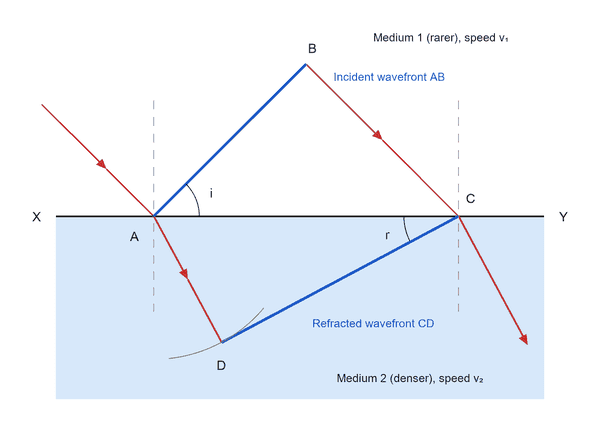
Part (i) asks for the diagram, which is drawn in Step 2 below: AB is the incident wavefront, CD the refracted wavefront, i is marked at A and r at C. Part (ii) is the proof that follows from it.
Step 1 — Set up the incident wavefront.
A plane wavefront AB travels in medium 1 (speed v1) and falls obliquely on the surface XY of medium 2 (speed v2, with v2<v1 for a denser medium). Its end A touches the surface at t=0. Let t be the time the disturbance at B takes to reach the surface at C.
BC=v1t
Step 2 — Draw the secondary wavelet from A.
From t=0, point A sends a secondary wavelet into medium 2, where light travels with speed v2. In time t this wavelet becomes a hemisphere of radius v2t about A.
AD=v2t
The tangent CD, drawn from C to this wavelet, touches the wavelets from all points between A and C, so CD is the refracted wavefront.
Step 3 — Identify the angles i and r.
The incident ray is perpendicular to AB and the normal is perpendicular to XY, so the angle between AB and the surface is the angle of incidence: ∠BAC=i. The refracted ray is perpendicular to CD, so the angle between CD and the surface is the angle of refraction: ∠DCA=r.
Step 4 — Write sin i and sin r from the right triangles.
Triangle ABC has a right angle at B (ray BC is perpendicular to wavefront AB), and triangle CDA has a right angle at D (tangent CD is perpendicular to radius AD). AC is the hypotenuse of both.
sini=ACBC
sinr=ACAD
Step 5 — Divide the two sines.
The common side AC cancels, and so does the time t.
sinrsini=ADBC
sinrsini=v2tv1t
sinrsini=v2v1
Step 6 — Conclude that the ratio is a constant.
For a given pair of media and a given colour of light, v1 and v2 are fixed, so the ratio is a constant. This constant is the refractive index of medium 2 with respect to medium 1.
sinrsini=1n2
The incident ray, the refracted ray and the normal all lie in the plane of the figure. This is Snell's law. Since v1>v2, sinr<sini, so the ray bends towards the normal in the denser medium.
Therefore, (i) the labelled diagram shows the incident wavefront AB, the refracted wavefront CD and the angles i and r; (ii) Huygens' construction gives sin i / sin r = v₁/v₂, a constant, which proves Snell's law.
