
Question 55 marksAsked 2018Medium
(i) Using Huygen's wave theory, derive Snell's law of refraction.
(ii) With the help of an experiment, state how will you identify whether a given beam of light is polarised or unpolarised.
Confirming your payment
Sign up now and get 250 free tokens.
Previous Year Questions · Question 5 of 13
(i) Using Huygen's wave theory, derive Snell's law of refraction.
(ii) With the help of an experiment, state how will you identify whether a given beam of light is polarised or unpolarised.
Solution:
Key idea: By Huygens' principle, every point on a wavefront acts as a source of secondary wavelets, which spread out in all directions with the speed of the wave in that medium. The forward envelope (common tangent) of these wavelets after a time is the new wavefront. A ray is the direction of travel of the wave and is always perpendicular to the wavefront.
Part (i): derivation of Snell's law. We find the refracted wavefront by Huygens' construction and compare the angles the wavefronts make with the surface.
Step 1 — Set up the incident wavefront.
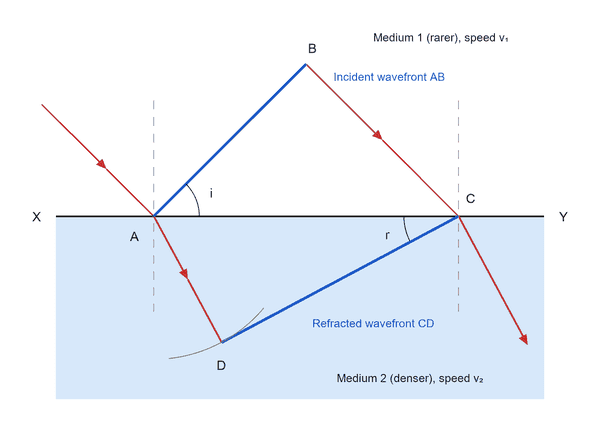
A plane wavefront AB travels in medium 1 (speed ) and falls obliquely on the surface XY of medium 2 (speed , with for a denser medium). Its end A touches the surface at . Let be the time the disturbance at B takes to reach the surface at C.
Step 2 — Draw the secondary wavelet from A.
From , point A sends a secondary wavelet into medium 2, where light travels with speed . In time this wavelet becomes a hemisphere of radius about A.
The tangent CD, drawn from C to this wavelet, touches the wavelets from all points between A and C, so CD is the refracted wavefront.
Step 3 — Identify the angles i and r.
The incident ray is perpendicular to AB and the normal is perpendicular to XY, so the angle between AB and the surface is the angle of incidence: . The refracted ray is perpendicular to CD, so the angle between CD and the surface is the angle of refraction: .
Step 4 — Write sin i and sin r from the right triangles.
Triangle ABC has a right angle at B (ray BC is perpendicular to wavefront AB), and triangle CDA has a right angle at D (tangent CD is perpendicular to radius AD). AC is the hypotenuse of both.
Step 5 — Divide the two sines.
The common side AC cancels, and so does the time .
Step 6 — Conclude that the ratio is a constant.
For a given pair of media and a given colour of light, and are fixed, so the ratio is a constant. This constant is the refractive index of medium 2 with respect to medium 1.
The incident ray, the refracted ray and the normal all lie in the plane of the figure. This is Snell's law. Since , , so the ray bends towards the normal in the denser medium.
Step 7 — Part (ii): test the beam with a polaroid.
We place a polaroid (used as an analyser) in the path of the beam and look at the light that comes through it, while slowly rotating the polaroid through a full turn about the direction of the beam.
Step 8 — Read the result.
If the brightness of the transmitted light stays the same at every position of the polaroid, the beam is unpolarised, because its vibrations are equally strong in all directions perpendicular to the beam. If the brightness changes, becoming a maximum and then falling to zero twice in one full rotation, the beam is plane-polarised: its vibrations are in one plane only, and the polaroid blocks them completely when its transmission axis is perpendicular to that plane. (If the brightness changes but never falls to zero, the beam is partially polarised.)
Therefore, (i) Huygens' construction gives sin i / sin r = v₁/v₂, a constant (Snell's law); (ii) on rotating a polaroid in the beam, unchanged brightness means unpolarised light, while brightness that falls to zero twice per rotation means plane-polarised light.