
Question 353 marksMedium
On the basis of Huygens' wave theory, show that when light is incident on a plane mirror obliquely, angle of reflection is equal to angle of incidence.
Confirming your payment
Sign up now and get 250 free tokens.
Wave Optics - Huygens' Principle · Question 35 of 45
On the basis of Huygens' wave theory, show that when light is incident on a plane mirror obliquely, angle of reflection is equal to angle of incidence.
Solution:
Concept: By Huygens' principle, each point of a wavefront sends out secondary wavelets with the speed of light in the medium, and the new wavefront is their common tangent. On reflection the wavelets travel back into the same medium with the same speed.
Step 1 — Recall Huygens' principle. Every point of the incident wavefront that reaches the mirror becomes a source of secondary wavelets travelling back into the same medium, and the reflected wavefront is the tangent to these wavelets.
Step 2 — Set up the construction. Let be a plane mirror and let a parallel beam fall on it obliquely. is the incident plane wavefront at the moment its end touches the mirror; the incident rays are perpendicular to . Let be the speed of light in the medium.
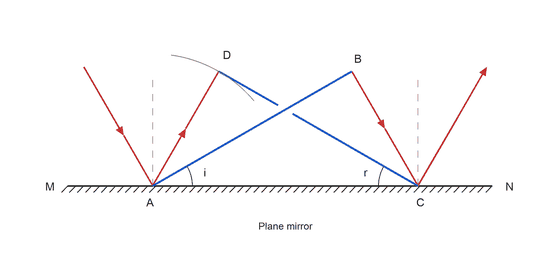
Step 3 — Use the secondary wavelets. Let the disturbance at take time to reach the point on the mirror, so
In the same time the secondary wavelet from spreads back into the same medium as a sphere of radius
The tangent drawn from to this wavelet is the reflected wavefront, and is the reflected ray (perpendicular to ).
Step 4 — Identify the angles. The incident ray is perpendicular to and the normal is perpendicular to the mirror, so the angle of incidence equals the angle between and the mirror: . In the same way the angle of reflection equals the angle between and the mirror: .
Step 5 — Compare the two triangles. Look at triangles and :
So the triangles are congruent (RHS).
Step 6 — Conclude the angles are equal. Corresponding angles of congruent triangles are equal, so
Also, the incident ray, the reflected ray and the normal at all lie in the plane of the diagram (the plane of incidence).
Therefore, the angle of reflection is equal to the angle of incidence ().