
Question 363 marksMedium
Derive Snell's law of refraction using Huygens' wave theory.
Confirming your payment
Sign up now and get 250 free tokens.
Wave Optics - Huygens' Principle · Question 36 of 45
Derive Snell's law of refraction using Huygens' wave theory.
Solution:
Concept: By Huygens' principle each point of a wavefront sends out secondary wavelets with the speed of the wave in that medium; when they travel more slowly in the second medium, the wavefront turns, and this turning is refraction.
Step 1 — Recall Huygens' principle. Every point of a wavefront is a source of secondary wavelets, and the new wavefront is the forward envelope of these wavelets.
Step 2 — Set up the construction. Let be the plane surface separating medium 1 (speed ) and medium 2 (speed ), with medium 2 denser so . A parallel beam falls obliquely on . is the incident plane wavefront at the moment its end touches the surface; the rays are perpendicular to .
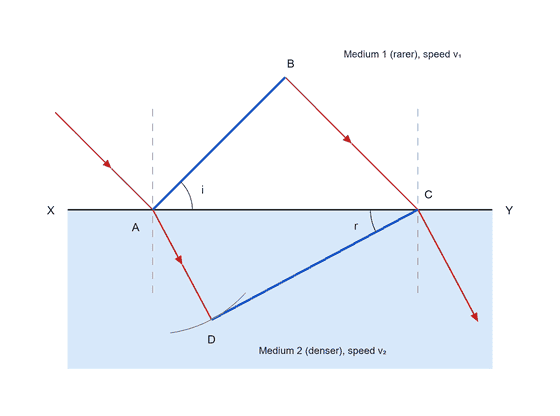
Step 3 — Use the secondary wavelets. Let the disturbance at take time to reach on the surface, so
In the same time the secondary wavelet from spreads into medium 2 as a sphere of radius
The tangent drawn from to this wavelet is the refracted wavefront, and is the refracted ray (perpendicular to ).
Step 4 — Identify the angles. The incident ray is perpendicular to and the normal is perpendicular to , so the angle of incidence equals the angle between and , that is, . In the same way the angle of refraction equals the angle between and , that is, .
Step 5 — Write the sines. In right triangle (right angle at ),
In right triangle (right angle at ),
Step 6 — Divide. Dividing the two results, and cancel:
Step 7 — Bring in the refractive index. Since and , the ratio is a constant for the pair of media, equal to the refractive index of medium 2 with respect to medium 1:
This is Snell's law. Also, the incident ray, the refracted ray and the normal all lie in the plane of the diagram, which is the first law of refraction.
Therefore, is a constant for the two media, equal to , the refractive index ; this is Snell's law.